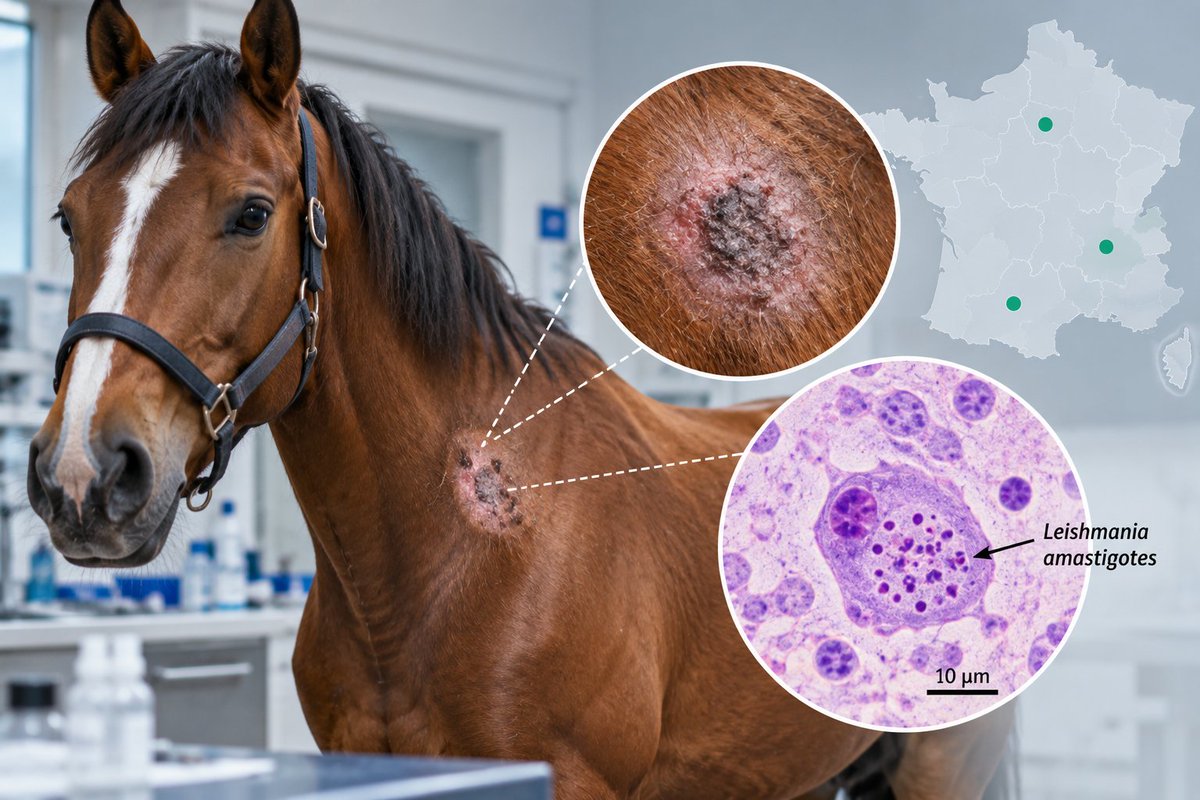
Leishmaniasis in horses — an emerging infection in France?
https://t.co/U1kDgFa0rF
A new study reports the first documented cases of equine cutaneous leishmaniasis caused by Leishmania (Mundinia) martiniquensis in France.
Three horses from different regions developed localized cutaneous lesions
So proud to share this incredible paper translated in 34 languages! Processing and mounting phlebotomine sand flies: a consensus guideline | Parasite https://t.co/TkbJhiuY1I
Now in press in Parasite:
𝗣𝗿𝗼��𝗲𝘀𝘀𝗶𝗻𝗴 𝗮𝗻𝗱 𝗺𝗼𝘂𝗻𝘁𝗶𝗻𝗴 𝗽𝗵𝗹𝗲𝗯𝗼𝘁𝗼𝗺𝗶𝗻𝗲 𝘀𝗮𝗻𝗱 𝗳𝗹𝗶𝗲𝘀: 𝗮 𝗰𝗼𝗻𝘀𝗲𝗻𝘀𝘂𝘀 𝗴𝘂𝗶𝗱𝗲𝗹𝗶𝗻𝗲
This paper will be published with translations in several languages!
Stay tuned... https://t.co/yMsdEkYflU
Abstract: This article provides a comprehensive guide for the processing and mounting of phlebotomine sand fly specimens, which is crucial for species identification and pathogen detection and isolation. It discusses a range of techniques suitable for both field and laboratory settings. The guide includes detailed instructions on sand fly collection, handling, covering, and euthanasia (recommending dry freezing or CO2 over chemicals) as well as conservation strategies, such as cold storage and preservation in ethanol. The quality of preparation of certain anatomical structures (genital organs, head and wings) is essential for their proper microscopic observation and is described in this work. The article also presents detailed sample processing, including the clearing process with agents such as potassium hydroxide then Marc-André solution. The mounting process compares different media, emphasizing their optical properties and preservation potential. Hoyer fluid (also known as chloral gum) is recommended for quick observation, particularly for spermathecae, due to its clarity, although it is not suitable for long-term storage. Other media discussed include polyvinyl alcohol, Euparal®(for limited water tolerance), and Canada balsam (a hydrocarbon-soluble medium), with the latter two offering long-term preservation capabilities. Innovative molecular biology approaches such as DNA sequencing and MALDI-ToF, which require particular attention to sample processing, are also addressed. Furthermore, short video clips illustrating various mounting techniques as well as translations in 33 different languages are provided, allowing the guideline to reach the diverse needs and expectations of the global scientific community.
𝗡𝗲𝘄 𝗿𝗲𝘃𝗶𝗲𝘄 𝗽𝗮𝗽𝗲𝗿:
A review of Leishmania infections in American Phlebotomine sand flies – Are those that transmit leishmaniasis anthropophilic or anthropportunists?
https://t.co/ePuz00DJt0
🗣️ @ClaudeMalhuret : « Il faut donc le répéter. L’élection n’a été volée à personne.
Et si elle a été volée, c’est aux électeurs de gauche par les dirigeants de l’extrême-gauche et leur invraisemblable partie de poker menteur. »
#DPG#DirectSenat
𝗡𝗲𝘄 𝗽𝗮𝗽𝗲𝗿 𝗶𝗻 𝗣𝗔𝗥𝗔𝗦𝗜𝗧𝗘:
Phlebotomine sand fly distribution and abundance in France: A systematic review https://t.co/1MvYqrnEPT
𝗔𝗯𝘀𝘁𝗿𝗮𝗰𝘁: Global changes in climate are contributing to modified Phlebotomine sand fly presence and activity, and the distribution of the pathogens they transmit (e.g., Leishmania and Phlebovirus), and are leading to their possible extension toward northern France. To predict the evolution of these pathogens and control their spread, it is essential to identify and characterize the presence and abundance of potential vectors. However, there are no recent publications describing sand fly species distribution in France. Consequently, we carried out a systematic review to provide distribution and abundance maps over time, along with a simplified dichotomous key for species in France. The review adhered to PRISMA guidelines, resulting in 172 relevant capture reports from 168 studies out of the 2646 documents retrieved, of which 552 were read and 228 analyzed. Seven species were recorded and categorized into three groups based on their abundance: low abundance species, abundant but little-studied species, and abundant vector species. Sand flies are certainly present throughout France but there is a greater diversity of species in the Mediterranean region. Phlebotomus perniciosus and Ph. ariasi are the most abundant and widely distributed species, playing a role as vectors of Leishmania. Sergentomyia minuta, though very abundant, remains under-studied, highlighting the need for further research. Phlebotomus papatasi, Ph. perfiliewi, Ph. sergenti, and Ph. mascittii are present in low numbers and are less documented, limiting understanding of their potential role as vectors. This work provides the necessary basis for comparison of field data generated in the future.
𝗗𝗼𝘄𝗻𝗹𝗼𝗮𝗱 𝘁𝗵𝗲 𝗣𝗗𝗙: https://t.co/1MvYqrnEPT
Affligeant.
Sorbonne Université nous annonce fièrement (!) qu'ils arrêtent leur abonnement à Web of Science.
Arguments: SU affiche "son rôle pionnier dans le domaine de la science ouverte" et "espère que d’autres universités et organismes de recherche la suivront".
Contre l’amendement de la commission des finances du Sénat qui propose de retirer 100 millions d’euros au CNRS, je rappelle quelques évidences ⤵️
Les élites de notre pays n’aiment ni nos chercheurs, ni nos universités, c’est pourquoi elles n’éprouvent aucune difficulté à les maltraiter financièrement. Ancien chercheur du CNRS, je sais à quel point mes collègues font vivre cette institution sans les moyens adaptés, avec talent et avec cœur. Ils incarnent au quotidien le service public de la recherche, spécificité française dont nous pouvons être fiers.
[Nouvel article]
La phylogénie moléculaire des Psychodopygina (Diptera, Psychodidae) soutient la systématique morphologique de ce groupe de vecteurs de leishmaniose cutanée du Nouveau Monde
https://t.co/1h846whovg
Now in press in 𝙋𝙖𝙧𝙖𝙨𝙞𝙩𝙚:
On the systematics of Phlebotomus betisi and two new related species from Laos with proposal of the subgenus Lewisius n. subg.
🔜 https://t.co/NzrperVWPY