Neither yet. Those thresholds are the operating model I’d want, not something we have enough production recovery data to claim.
Deploy Hatch is just getting to the point where we can measure this properly across seeded failure classes. The interesting part will be seeing which trigger actually wins once we have enough runs instead of guessing.
110+ people are using Deploy Hatch. $0 in revenue.
Last week, @Boardyai introduced me to a founder building agent reliability tools, so I showed him the part of Deploy Hatch I'm proudest of.
I had an agent deliberately break a preview, deploy the broken code, pull the full logs through our MCP server, diagnose that the runtime failed, prove the bug was in the user code rather than our platform, patch it, and redeploy.
It handled the entire cycle autonomously. The only time it paused was to ask which GitHub repo to connect; exactly where a human should be in the loop.
Then he opened my homepage and asked what any of that had to do with "Ship the app, not the server."
The answer? Nothing.
I wrote that tagline a month ago when Deploy Hatch was just a simple manual deployment platform. The AI agent orchestration came weeks later, but the website never caught up.
His feedback was direct: the product is real, but the landing page isn't selling it. If a visitor has to read between the lines to realize what you actually do, your copy is broken. It also explained my Google Ads performance: 1,600 impressions, 99 clicks, 0 paid conversions.
He gave me one key piece of advice: stop trying to reach every developer at once. Focus entirely on the builder whose AI agent handles everything up to production, only to hit a wall when it's time to actually deploy.
The product isn't changing, but the entire homepage is getting rewritten this week.
Has anyone else looked at their landing page and realized it was describing a version of their product from a month ago? How did you catch it?
Deploy Hatch. It’s production infrastructure for developers using AI coding agents like Claude Code, Codex, Cursor, and Copilot.
The agent can build the software, then Deploy Hatch gives it a controlled way to deploy, diagnose failures, recover when allowed, and verify the app is actually healthy, without giving the agent unrestricted access to your servers.
https://t.co/7cQ84cZy5V
Building Deploy Hatch
It’s for developers using AI coding agents like Claude Code, Codex, and Cursor who don’t want the workflow to end when the code is written.
Deploy Hatch gives those agents a controlled path from GitHub to production so they can deploy, diagnose failures, recover within defined boundaries, and verify the app is actually healthy without getting unrestricted infrastructure access.
https://t.co/sA1YbZIHij
Building Deploy Hatch in public — Day 19 🐣
Someone asked a dangerous question:
“Can Deploy Hatch host something like a Minecraft server?”
Me: “That’s basically just TCP support.”
Narrator: It was not “just TCP support.” 💀
So… we built it properly.
Over the last stretch, Deploy Hatch went from primarily deploying web apps, bots, workers & AI-built software to supporting customer-configured persistent Raw TCP workloads in production.
And today we finally certified the WHOLE path. 🚀
What got built/tested:
→ Raw TCP networking across our 3-node production fleet
→ Public TCP port allocation
→ Cross-node TCP ingress
→ TCP failover between nodes
→ Port ownership + generation tracking
→ Automatic binding release
→ Reconciliation without murdering unrelated HTTP workloads (important feature 😂)
→ Firewall + isolation boundaries
→ Persistent container Start / Stop semantics
→ Customer-facing Raw TCP configuration
→ Normal dashboard deployment path
→ Invalid TCP configuration rejection
→ UDP rejection (because pretending unsupported things work is how you summon demons)
→ Authentication boundaries
→ No-mutation negative tests
→ Full production canaries
→ Cleanup + restore certification
Then we attacked it with intentionally bad configurations.
→Multiple ports? ❌
→Internal exposure? ❌
→UDP pretending to be TCP? ❌
→Port 70000? Absolutely not. ❌
→Unauthenticated configuration changes? 401. 👋
And after all of that:
→0 active test bindings
→0 active deployment jobs
→0 nonterminal test deployments
→0 customer deployments touched
Final result:
→RAW TCP: 🟢 PRODUCTION READY
→CUSTOMER CONFIGURATION: 🟢 PRODUCTION READY
→3-NODE INGRESS: 🟢 PRODUCTION READY
→UDP: 🔴 STILL BLOCKED ON PURPOSE
The funny part?
TCP wasn't really the destination.
The bigger goal is making Deploy Hatch the production boundary AI agents can safely use.
Eventually I don't want an AI agent to need to know:
��this is TCP, port 25565, worker type X, runtime Y…”
I want it to say:
“I built this. Deploy it.”
Then Deploy Hatch figures out what the software needs, determines what it can safely configure itself, asks a human when the consequences matter, deploys it, watches it, diagnoses failures, and recovers when possible.
So Day 19 ends with one giant chunk of the roadmap crossed out:
Raw TCP
Next:
Teaching Deploy Hatch to understand what you built before it deploys it. 🤖🐣
This project keeps getting slightly more ridiculous.
I love it.
https://t.co/sA1YbZIHij
#BuildInPublic #SaaS #DevTools #AI #IndieHacker #CloudComputing
@Sherifdeenolat2 Building Deploy Hatch!
Connect your GitHub repo and get your app running without becoming a DevOps engineer.
And if you build with AI, coding agents can deploy, diagnose, and recover what they build through Deploy Hatch too.
https://t.co/6XB5UArwK1
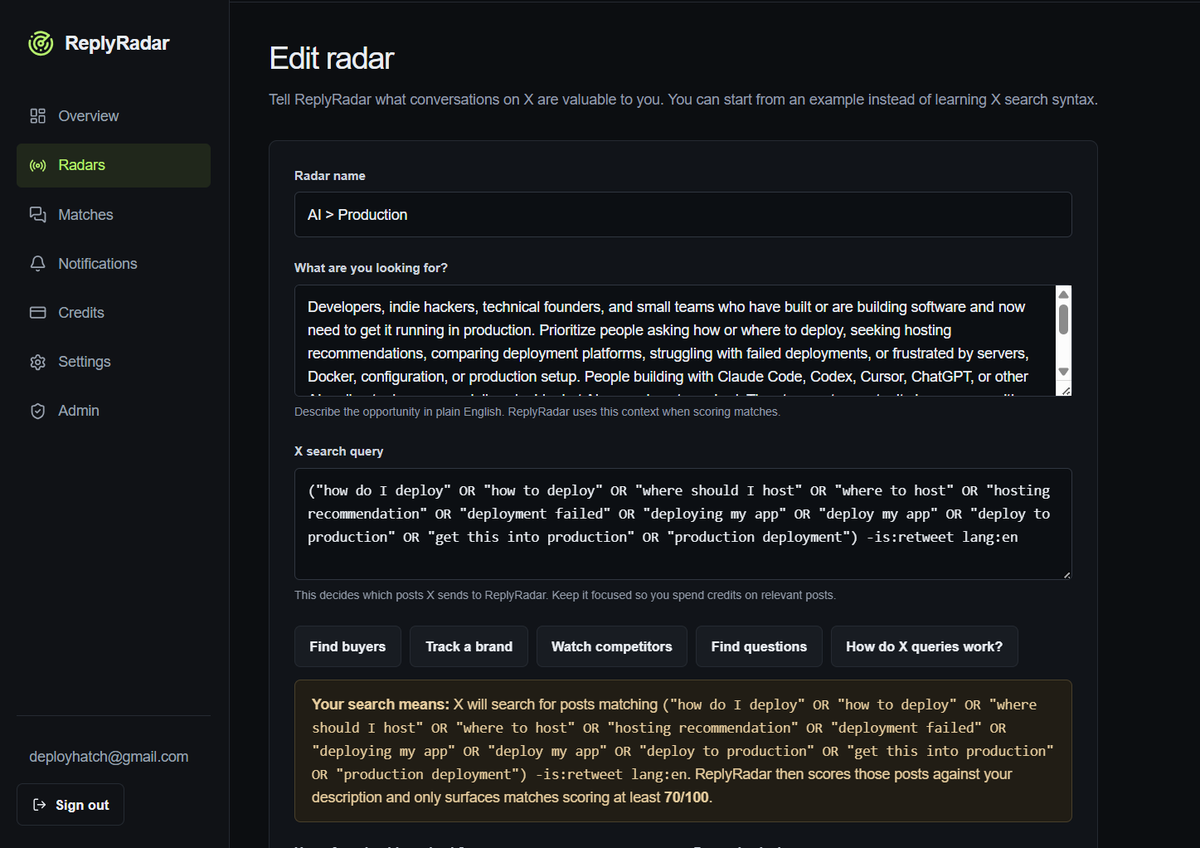
Check out https://t.co/fwPFTdJNs9 and get to the X conversations that matter first.
Find customers, track a brand, check competition, and more with ReplyRadar.