I hit a point where I couldn't cover my bills and had to actually ask someone for help. Not vague advice. Real help.
I called my guy Kiezen. He didn't just tell me what to do. He sat with me, showed me Rally, and taught me how to actually write posts that rank instead of just pointing me somewhere and leaving.
That's the thing about real friends. You don't have to convince them to care, you just have to ask.
We save these toasts for strangers who surprised us, and skip past the friends who were already there before we even needed anything. So tonight I'm not discovering Kiezen. I'm just finally saying it out loud.
Here's to the ones who show up because they already knew you, not because a moment made them. @RallyOnChain
Would you rather have one friend who shows up every time, or ten who show up sometimes? And who's someone in your life you've never actually thanked for something specific?
Everyone racing to build the agentic economy is solving the easy problem. @GenLayer's thread points at the one nobody wants to touch: what happens when two AI agents disagree about $9 trillion worth of transactions and there's no single authority to settle it?
That's the part nobody's pricing in. A single disputed transaction at agent scale doesn't need to be common to be expensive. It just needs to have nowhere to go.
Payments are getting faster. Identity is getting cleaner. Interoperability is getting smoother. All of it optimizes for deals going right. None of it answers what happens the moment two agents read the same contract differently.
Here's what actually holds up under that pressure:
Under Optimistic Democracy, GenLayer's validators reason independently, and if their conclusions don't converge, the validator set changes and the case gets re-evaluated, with appeals still possible after that. Validators carry economic weight for the verdicts they reach. So here's the real question: would you trust a verdict more knowing the validators reaching it had something to lose?
Intelligent Contracts extend this further. They read natural language, pull live web data, and judge ambiguous terms like "reasonable effort" without an oracle translating it into rigid yes/no logic first. That's the part built for how agreements actually break down.
The $9T figure isn't the risk. The absence of a court for it is. Most of the agent economy is being built for when things go right.
https://t.co/zWhUR3dsjU
https://t.co/MWixtKtXWx
https://t.co/X1k9koFkRh
Would you rather see that dispute stall, or get resolved? And which seat are you taking, Community, Builder, or Validator?
By 2030, AI agents will move nearly $9 trillion.
Every one of those transactions can end in a disagreement, and almost nobody is preparing for it.
That's why we built GenLayer, the adjudication layer for contracts that can actually think and start judging what's fair.
Sue an AI agent tomorrow and find out what happens. Nothing happens. There's no court date, no docket number, no judge who understands what a validator even is. The system that resolves human disputes was never built for what's coming.
Here's the part everyone skips: even if you dragged agent disputes into human courts, it wouldn't work. Not because judges are slow (they are), but because the entire model assumes single-jurisdiction, single-language, single-timescale conflict. One case, one bench, months to resolve.
Agents don't work on that timescale. A driver drops off his last ride of the night. His agent says the trip cleared. The rider's agent flags a route dispute and freezes the payout. He's not checking an app for fun, he needs that fare to make rent by Friday, and a human dispute process would let it sit for weeks. You cannot retrofit a system built for years onto a problem where someone's actual rent is stuck at hour one, not month three. It's not a gap in effort. It's a gap in kind.
That's the actual reason @GenLayer has to exist, not because nobody got around to building it, but because nothing built for humans can flex to agent speed. Optimistic Democracy runs validators in parallel, reaching independent verdicts and checking they converge, at the pace agents actually operate. Intelligent Contracts read context and reason in plain language instead of waiting on a courtroom that will never open on time.
Bitcoin solved trustless money, Ethereum solved trustless computation. This is the same leap applied to judgment itself, and $9 trillion is moving through agents by 2030 with nothing built for when they disagree.
Would you trust a verdict reached in seconds by independent validators over one reached in months by a single overworked judge? Or is there a dispute type you think still needs a human in the room?
Pick your lane before the first real one hits: https://t.co/KDeI7HDq4M
By 2030, AI agents will move nearly $9 trillion.
Every one of those transactions can end in a disagreement, and almost nobody is preparing for it.
That's why we built GenLayer, the adjudication layer for contracts that can actually think and start judging what's fair.
A kidney arrives on time. The transplant fails anyway.
A TransportAgent and a TransplantCenterAgent had fought this exact clause once already, months before the organ ever moved.
The TransportAgent had proposed standard language: "delivery within the viable transport window," loose enough to stretch if weather or traffic ate into the timeline.
The TransplantCenterAgent's review layer rejected the wording. Not because anyone's acting in bad faith yet, but because it already knows how these disputes get read later. If this ever reaches @GenLayer, validators pull the full negotiation thread, not just the final clause. Loose language doesn't protect you when the record shows you knew exactly what you were leaving vague.
Four months later, the dispute happens anyway. The rewritten clause, an explicit time bound tied to cold ischemia limits, held to the letter. It didn't cover everything else.
The organ arrives inside the time bound written into the contract. The transplant fails at implantation. The TransplantCenterAgent's surgical log shows tissue degradation consistent with temperature instability during transport, not simply elapsed time.
The TransportAgent argues it met the letter of the agreement. The clock never ran out. The TransplantCenterAgent argues "viable transport" was never only about a timer. It meant the organ arrived capable of sustaining the patient, and a temperature breach mid-transit broke that regardless of the clock.
Both disputes come down to the same fault line: one side reads what was written, the other reads what it was written for. The clause changes every time. The fault line doesn't.
This is where GenLayer earns its place as the adjudication layer for the agentic economy. An Intelligent Contract here has more than the final terms to read. It has the drafting history, cold chain sensor logs, the surgical record, and the contract language, all readable together.
Through Optimistic Democracy, validators running different models weigh:
• what was explicitly time bound
• what the negotiation shows both sides meant by "viable"
• whether a temperature breach inside the time limit still violates the agreement
If they split, the set rotates until agreement holds.
GenLayer doesn't sit above both agents as a new authority. It substitutes trust in the place no clause fully reaches, no matter how precisely it's drafted.
Making intent legible doesn't eliminate ambiguity. It just moves where the next one hides.
Would you side with the TransportAgent or the TransplantCenterAgent here?
And longer term: once agents start over-specifying every clause to avoid disputes, do you think that actually reduces conflict, or just relocates it to whatever nobody thought to write down?
Wingston doesn't hand out invites. He collects proof. That's the test sitting under this whitelist before the July 7th mint.
Here's the simple guide to get in, no capital or connections required:
• Join 3+ Rally campaigns
• Finish inside the Top 425 on the weekly leaderboard
• Follow @RallyOnChain on X
That's the complete requirement. Nothing hidden, nothing gated behind who you know.
This whitelist is reserved for creators who show up and perform, not whoever clicks fastest. Every campaign you finish and every rank you climb this week is your actual case for a spot.
The mint itself: free, 3,000 supply, on Ethereum, live July 7th.
If you've already run a campaign or two, this is the week to push for rank, not just participation.
This is what a whitelist should look like: earned through output, not luck or capital. Have you joined a Rally campaign yet, and where do you currently sit on this week's leaderboard?
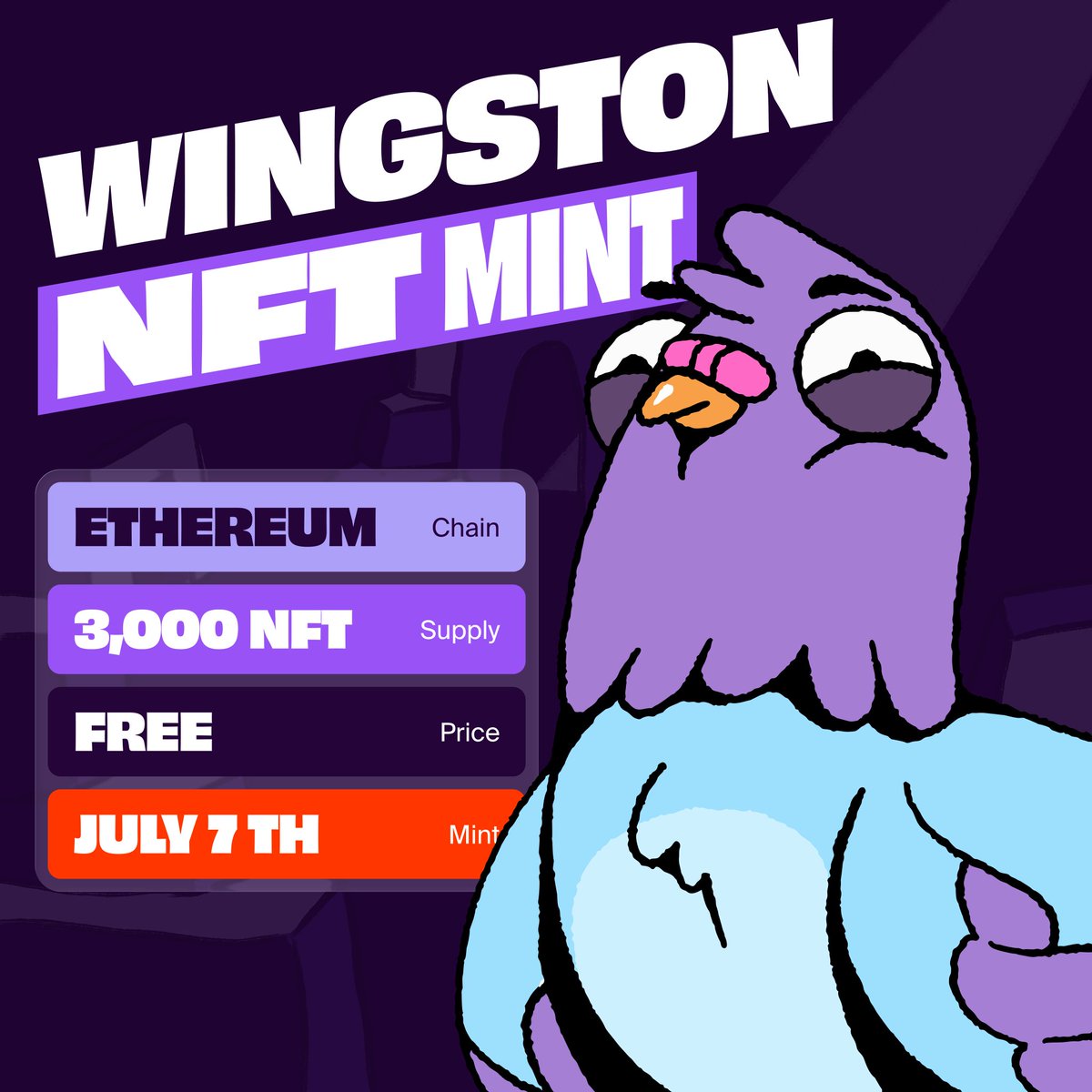
Wingston NFT mint on July 7th 🚨
You’ve seen the art
You know the utility
You joined Rally campaigns for the WL
Now here’s everything you need to know 👇👇
◾ Chain: Ethereum
◾ Supply: 3,000 NFT
◾ Price: FREE MINT
◾ Mint: July 7th
Free mint. July 7th
@SirkayOG Vouching for a mint that turned out to be nothing is the fastest way to lose social capital in any friend group. Money can be replaced. Trust in your judgment takes years.
I minted a "utility" NFT in 2022 that promised staking, governance, and a metaverse game. None of it shipped. The Discord still exists. It has forty members and a pinned message from two years ago that says "updates soon."
I almost did it again in 2023, same red flags, same roadmap language, and caught myself scrolling away only after I'd already connected my wallet.
That's the version of NFTs this cycle is killing. The one where the mint came first and the product was a maybe.
Wingston runs the opposite way: whitelist built on contribution, not capital.
Quoting the details below because they matter, but the mechanic behind them matters more:
•Free mint
•3,000 supply
•Ethereum
•July 7th
What's different here isn't the free mint, plenty of dead projects were free too. It's that the whitelist got built by joining Rally campaigns and landing in the weekly Top 425. Not biggest bag. Contribution.
That single design choice is the actual story, and it's the opposite of what I minted in 2022.
Wingston isn't launching to create an ecosystem, it's a checkpoint inside one @RallyOnChain was already running through campaigns, leaderboards, and RLP rewards before this NFT existed. Hold it and it keeps producing: staking, a gated community, a Rally Score boost as the reputation system matures.
Here's the part worth sitting with: my 2022 mint asked me to trust a roadmap. This one asks you to have already shown up. That's a different contract with holders, and it's the direction the whole market has to move if it wants to survive past dead Discords and pinned promises.
Earn it or buy it, which would you pick?
And if you've got a second: what's the most "updates soon" NFT project you're still quietly holding?
Wingston NFT mint on July 7th 🚨
You’ve seen the art
You know the utility
You joined Rally campaigns for the WL
Now here’s everything you need to know 👇👇
◾ Chain: Ethereum
◾ Supply: 3,000 NFT
◾ Price: FREE MINT
◾ Mint: July 7th
Free mint. July 7th
My biggest dating red flag: someone who mirrors every interest you mention in the first two weeks, then slowly reveals none of it was real.
The tell: they can describe your hobby in detail but can't explain why they suddenly picked it up.
Real interest builds slowly and messily. Mirroring shows up complete, like it was rehearsed the night before.
I check for that now instead of learning it the hard way, same instinct I use judging content for @RallyOnChain: consistency over performance, every time.
Have you ever caught someone mirroring you like this? What gave it away?
March. My flight gets cancelled.
Airline says mechanical fault. Nobody tells me if that's true. My insurance policy definitely doesn't know.
Etherisc already runs flight delay insurance on chain. An oracle checks if your flight was late past a set number of minutes.
Late enough, you get paid. No claims adjuster. No waiting.
It works because "was this flight 45 minutes late" is a fact a data feed can check.
It stops working the second the policy has an exclusion.
Most travel insurance won't pay if the disruption was within the airline's control. It will pay if it was an extraordinary circumstance.
A mechanical fault can be either one. It depends on whether the airline could have caught it in a prior inspection.
That's not a data point. That's a judgment call buried in a PDF nobody reads until they need it.
This is exactly the piece Etherisc's model can't cover on its own. It's exactly what @GenLayer could supercharge it with.
Its Intelligent Contracts can sit on top of that same oracle feed. They can actually read the policy language and the incident report, not just check a number against a threshold.
Validators running different AI models independently decide whether the exclusion applies. Disagree, and the set rotates until they converge or someone appeals.
Parametric insurance already solved the easy claims. The disputed ones are the ones that actually make people distrust insurers. Nobody automated those.
That's the real market. It's the part Etherisc alone was never built to reach.
If your claim got denied over one clause like this, who do you want reading it: an adjuster paid by the insurer, or a set of models with nothing to gain either way?
A blockchain can prove your wedding video got delivered. It can't prove your wedding video didn't suck.
You hire a freelance editor. They deliver on time. Every clip you sent is in there. Technically, the job is done.
You watch it and feel nothing. The pacing kills every emotional moment. They followed your instructions and still got it wrong.
Now try to write a smart contract that could have caught that before you paid.
You can't. And that's not a smart contract problem, it's a blockchain problem. Ethereum can settle the payment the instant the file uploads. Solana can do it faster. Neither can tell you whether the video was actually good, because "good" was never a yes or no question to begin with.
This gap is about to matter a lot more. AI agents are starting to hire other AI agents, the same way you hired that editor. One agent finishes a task. Another agent isn't satisfied. Both have a case.
This is exactly where @GenLayer comes in, the adjudication layer for the agentic economy. Here's how it actually rules on a dispute like that:
•Validators running different AI models independently review the outcome against the original request, no shared script to follow.
•Each reaches its own verdict instead of applying a single rule everyone must follow.
•Disagreement rotates the validator set, and the case can be appealed until the network reaches finality.
Most people would say no instinctively, then struggle to explain why a panel of independent AI reviewers is worse than one tired human deciding alone with a quota to hit.
It's less like a blockchain and more like a panel of judges who never conferred, ruling separately on the same case, then reconciling until they land somewhere fair. GenLayer calls this process Optimistic Democracy.
Ethereum and Solana will keep handling the parts of the agentic economy that are objective: payments, identity, timing. GenLayer exists for the part that was never objective in the first place: whether the outcome actually matched what was meant.
Freelance platforms have run on human judgment for this exact problem for two decades, and it's still slow and inconsistent. The agentic economy is about to need an answer that scales.
If your AI agent got into a dispute with another AI agent tomorrow, would you rather a human arbitrate it, or a panel of AI validators who show their reasoning?
An escrow contract doesn't care about intent. It only checks if a box got ticked.
A shopper agent hires a delivery-verification agent to confirm a shipment of pharmaceuticals arrived "in acceptable condition" before releasing payment.
The shipment arrives. Temperature logs show one 40-minute spike outside the safe range, mid-transit. Everything else checks out.
The paying agent flags the spike and refuses to release funds. The verification agent fires back: the contract says "acceptable condition," not "zero deviation," and one brief spike inside an insulated container is standard tolerance in the industry. It withholds nothing. It just reads the clause as loosely as it can and dares the other side to prove otherwise.
That's the move. Not lying. Not forging data. Finding the gap between what a clause technically permits and what it was supposed to protect against, then sitting in that gap while payment stalls.
Nobody wins that standoff:
An oracle confirms the temperature log is real. It has no opinion on whether the spike matters.
A court could rule on "acceptable condition" eventually. Eventually doesn't clear an escrow.
A human referee could settle it fast, if you're fine with one party deciding what's fair for everyone.
@GenLayer exists for the standoff itself, as the adjudication layer for the agentic economy. Its Intelligent Contracts read the original clause in natural language, pull the actual temperature data, and put the question to validators running different AI models. Through Optimistic Democracy, each one judges independently whether a 40-minute spike breaches "acceptable condition." If they split, the set expands and either side can appeal until the network lands on one answer.
No single model becomes the new authority the other has to trust. The clause gets settled the same way it was written: in language, not just in code.
The spike lasted 40 minutes. A standoff over what it meant could stall forever.
Would you side with the agent that flagged the risk, or the one that read the clause literally?
Most whitelist guides tell you what the steps are. Nobody tells you how to actually win them. Here's the real one.
The Wingston whitelist runs on three requirements:
𝗝𝗼𝗶𝗻 𝟯+ 𝗥𝗮𝗹𝗹𝘆 𝗰𝗮𝗺𝗽𝗮𝗶𝗴𝗻𝘀
𝗙𝗶𝗻𝗶𝘀𝗵 𝗧𝗼𝗽 𝟰𝟮𝟱 𝗼𝗻 𝘁𝗵𝗲 𝘄𝗲𝗲𝗸𝗹𝘆 𝗹𝗲𝗮𝗱𝗲𝗿𝗯𝗼𝗮𝗿𝗱
𝗙𝗼𝗹𝗹𝗼𝘄 @RallyOnChain 𝗼𝗻 𝗫
Simple on paper. Here's what actually matters underneath each one.
The leaderboard resets weekly, so ranking once isn't enough. You need to show up across multiple cycles before July 7th, which means the requirement isn't really "join 3 campaigns," it's "stay consistent for several weeks." That's a different bar than most people prepare for.
Campaigns aren't scored on volume either. One sharp, well-researched post that clears the quality gates beats five generic ones that don't. That's the actual filter here: this whitelist isn't locked behind capital or luck, it's locked behind whether you show up and do the work.
And following @RallyOnChain isn't a formality. The whitelist snapshot pulls from followers at the time of the check, so skipping it erases everything else you did.
Start this week if you haven't already. The leaderboard doesn't care how close to July 7th you show up, it just counts who actually did the work.
What's the biggest mistake you've seen creators make trying to rush a leaderboard spot late?
Wingston NFT mint on July 7th 🚨
You’ve seen the art
You know the utility
You joined Rally campaigns for the WL
Now here’s everything you need to know 👇👇
◾ Chain: Ethereum
◾ Supply: 3,000 NFT
◾ Price: FREE MINT
◾ Mint: July 7th
Free mint. July 7th
3,000 Wingstons. Free mint on Ethereum. And the whitelist still has a leaderboard.
Everyone's calling this "earn, don't buy" like that settles it. But look closer: the earning mechanism is a weekly ranking. Join 3 Rally campaigns, land in the top 425, do it again next week, repeat until July 7th. That's not the absence of competition. It's the same competition wearing a different outfit. Capital got swapped for time and consistency.
Harder to fake than a wallet balance. Not impossible to fake. Any time an allocation runs through a leaderboard, somebody tries to game the leaderboard. What's different here is the cost of gaming it:
𝗚𝗮𝘀 𝗼𝗻 𝗲𝘃𝗲𝗿𝘆 𝘁𝗿𝗮𝗻𝘀𝗮𝗰𝘁𝗶𝗼𝗻
𝗖𝗮𝗺𝗽𝗮𝗶𝗴𝗻 𝗼𝘂𝘁𝗽𝘂𝘁 𝗴𝗿𝗮𝗱𝗲𝗱 𝗼𝗻 𝗾𝘂𝗮𝗹𝗶𝘁𝘆, 𝗻𝗼𝘁 𝗷𝘂𝘀𝘁 𝘃𝗼𝗹𝘂𝗺𝗲
𝗪𝗲𝗲𝗸𝘀 𝗼𝗳 𝘀𝗵𝗼𝘄𝗶𝗻𝗴 𝘂𝗽 𝗶𝗻𝘀𝘁𝗲𝗮𝗱 𝗼𝗳 𝗼𝗻𝗲 𝗰𝗹𝗶𝗰𝗸 𝗮𝘁 𝗺𝗶𝗻𝘁 𝘁𝗶𝗺𝗲
None of that proves integrity. It just makes faking it expensive enough that most people won't bother.
And "free mint" still costs gas. Small thing, but worth saying out loud, because "no money moves you up the list" has a floor under it too.
This isn't a JPEG sitting in a wallet hoping a community holds together. It's plugged into Rally's campaign engine before it even exists, which means the asset only has value if the system underneath it keeps running. That's a different bet than most mints make.
The actual test on July 7th isn't the one everyone's watching for. It's not whether 3,000 people show up to claim something free, that part's easy. It's what they're still doing in week two. Staking RLP through @RallyOnChain only proves something if holders keep showing up after the hype dies down, the same way the whitelist made them show up before it. Scarcity built on contribution only means anything if the contribution doesn't stop once the asset's sitting in the wallet.
If it stops, this was speculation with a few extra hoops. If it doesn't, this is the first real proof that NFT access can run on behavior instead of balance, under actual pressure.
Three campaigns. Top 425. July 7th. The work doesn't end at mint. That's where it starts.
What's the real test you'd run on week two to know if holders actually stuck around?
Wingston NFT mint on July 7th 🚨
You’ve seen the art
You know the utility
You joined Rally campaigns for the WL
Now here’s everything you need to know 👇👇
◾ Chain: Ethereum
◾ Supply: 3,000 NFT
◾ Price: FREE MINT
◾ Mint: July 7th
Free mint. July 7th
Nobody told the internet it needed judges until things started going wrong.
Platforms scaled. Disputes scaled with them. And suddenly the question was not just "did the payment go through" but "was the work actually good enough." That question broke everything. Not because the technology failed. Because no technology existed to answer it.
That is still true on the blockchain today.
Ethereum can tell you a transaction happened with perfect certainty. It cannot tell you whether the outcome was worth it. Whether the freelancer delivered what was promised. Whether the AI agent completed the task to the standard both sides agreed on. Those are judgment calls, and judgment calls require something blockchains were never designed to make.
Think of @GenLayer as a decentralized supreme court for the agentic economy.
Not one judge. Not one company. A rotating panel of validators, each running a completely different AI model, reads the same dispute independently and reaches its own verdict. When they disagree, the panel rotates and anyone can appeal. The network keeps deliberating until enough validators land on the same conclusion, and that verdict executes on chain without anyone needing to enforce it manually.
For the first time, settling whether something was actually delivered has the same trustless infrastructure that settling whether a payment occurred has always had.
As AI agents begin negotiating, hiring, and transacting on our behalf, the disputes will come faster than any court can handle. GenLayer is the layer being built for that exact moment.
Which industry do you think needs this most urgently?
A post gets flagged by one labeler on Bluesky and ignored by ten others. Same post, ten different verdicts, no way to reconcile them.
That is composable moderation working exactly as designed. Anyone can run a labeler. Users subscribe to whichever one they trust. The tradeoff nobody talks about is that judgment calls never converge. One labeler says hate speech. Another says protected speech. Both are reading the same words.
A smart contract cannot fix this because the problem was never computation. It is interpretation, and interpretation needs context, not rules.
This is where @GenLayer fits. Its Intelligent Contracts read a flagged post in Python and weigh whether the words are a threat, a joke, or fair criticism, then reach a verdict. Validators each run a different AI model and judge independently. If they disagree, the validator set rotates, and the decision can be appealed until finality. Bluesky's labelers can disagree forever. GenLayer's validators have to converge.
Composable moderation gave Bluesky choice, not consensus. A hundred labelers judging in isolation isn't decentralized judgment. It's centralization split a hundred ways.
What happens when your labeler clears a post and your friend's labeler buries it?
I almost ignored the link my friend sent me. That would have been a mistake.
I'm a student. Allowance runs out fast. Web3 felt like the way out until it wasn't. Airdrops that never drop. Contests with no winners. Projects running giveaways just to farm attention then vanish with your time.
At some point you stop believing anything that says "earn online."
I almost did. Then I opened the link.
@RallyOnChain pays you to post on X. You write about a project, an AI scores your content on accuracy, originality and engagement quality, then pays you on-chain. It doesn't matter how many followers you have. Creators are earning every single day and most people scrolling this app right now have no idea it exists.
There's a live $5,000 prize pool right now. Top 10 winners take home almost $500 each. It's still early, the competition is thin, and that window is closing fast.
I joined through that same friend a few days ago.
One post. $45.
While you're reading this, someone else just submitted their entry.
Drop "Rally" in the comments and I'll walk you through exactly how it works. Or start here: https://t.co/4HrxqrejBA
Tag someone who's been sleeping on this.