$RH ... This CEO is a "piece of work" ... RH trimmed its outlook for the full year as it contends with higher tariff-related costs and uncertainty, making for what it called a riskier business environment.
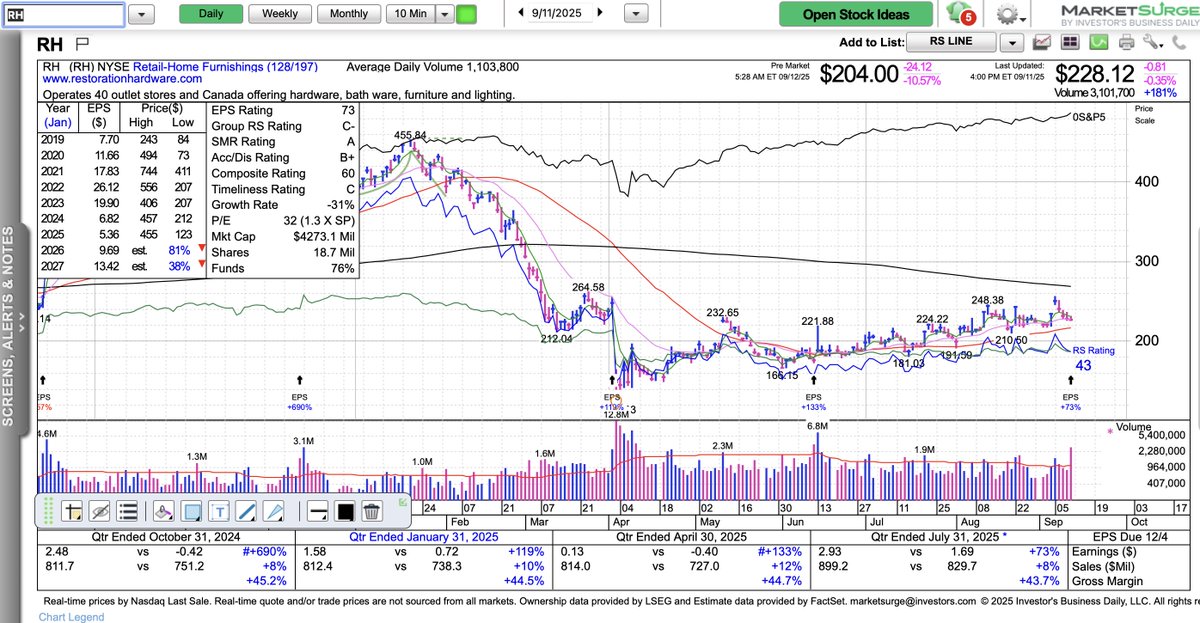
The furniture retailer said Thursday it now expects revenue growth of 9% to 11% for the full year, down from its prior guidance of 10% to 13%.
The revised view came as the company grew profit and revenue by less than Wall Street expected in its latest quarter.
The stock fell 4.7% to $217.45 in after-hours trading. Shares have fallen 42% this year through the market close.
In its latest quarter, RH posted a profit of $51.7 million, or $2.62 a share, up from $29 million, or $1.45 a share, a year earlier.
Adjusted earnings per share were $2.93, below estimates of $3.21 a share according to analysts polled by FactSet.
Revenue rose 8.4% to $899.2 million, missing the $905.4 million modeled by analysts.
Chief Executive Gary Friedman said the company expects a higher risk business environment going forward due to tariff uncertainty, market volatility and inflation risk, but continues to perform well in what he calls the worst housing market in almost 50 years.
"We are performing at a level most would expect in a robust housing market," he said in a letter to shareholders.
The company also expects some revenue to be delayed until next year after it pushed out the launch of its fall sourcebook by eight weeks as it waited for clarity on tariff rates in order to finalize pricing. It now expects about $40 million in revenue to shift out of the current quarter and into the next two quarters as a result, it said.
RH also forecast $30 million in added costs from incremental tariffs, net of mitigation strategies, during the second half of the year.
It plans to offset some of those costs by continuing to shift its sourcing away from China, with expectations for receipts to decline to 2% in the fourth quarter from 16% in the first quarter of the year. It is also looking to identify alternative countries to source hand-knotted rugs due to a higher tariff rate on imports from India, and is shifting more manufacturing of its upholstered furniture to its factory in North Carolina.