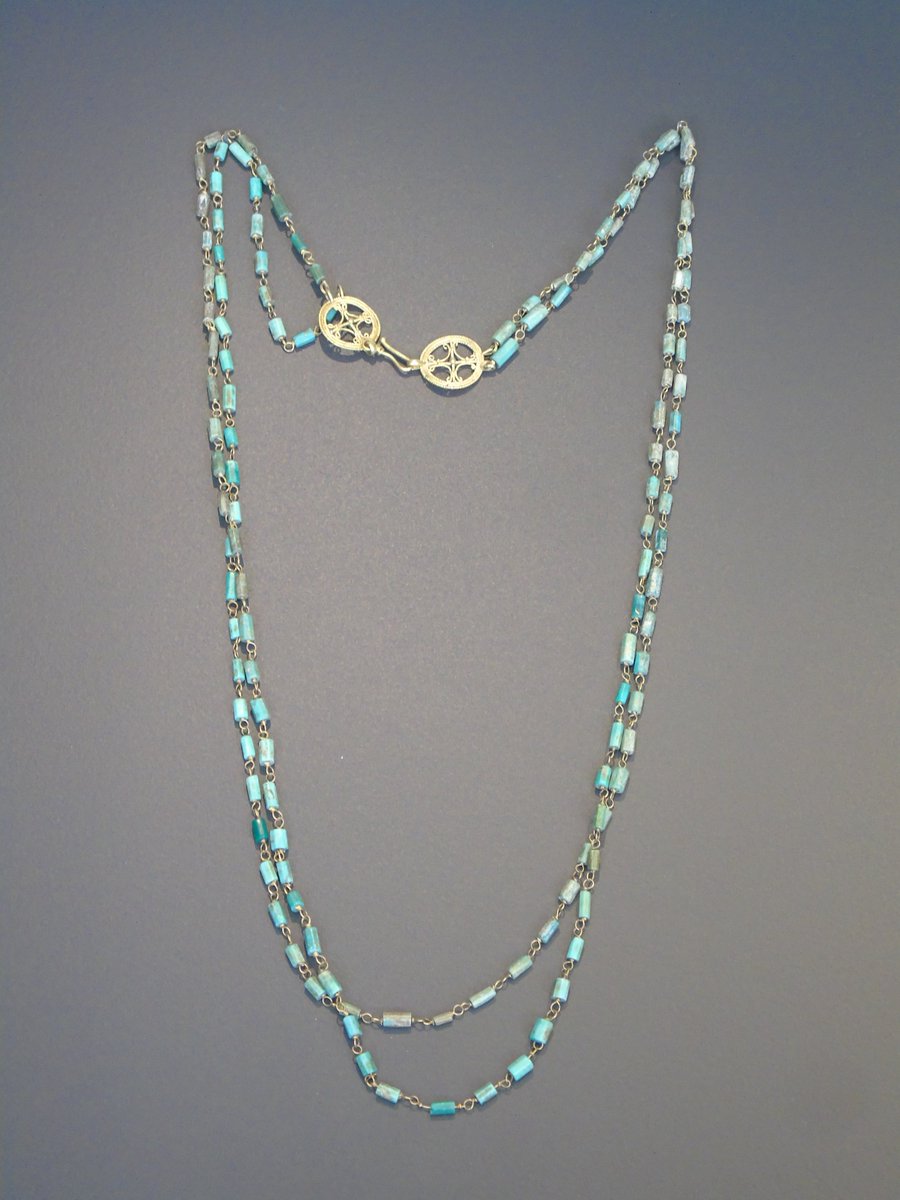
Two beautiful #Roman necklaces, made from gold with pearls & emeralds for decoration; these were originally worn by women in Roman Spain some 1700-2100 years ago #Archaeology#RomanArchaeology
#ReliefWednesday - Side A of the two-sided relief in red sandstone depicting Mithras the hunter on horseback, galloping and shooting arrows. From a Mithraeum found at Dieburg (Germany).
This side is divided into eleven panels by horizontal and vertical rims. In its centre, a representation of Mithras, a horseman in a short tunic and a flying cloak. The god, whose head is damaged, shoots an arrow from his bow. Before the horse stands a tree. On either side, a torchbearer in Oriental dress stands cross-legged upon a krater. The left one lifts a torch with both hands; the right one holds a torch upwards with his left hand and points it downwards with his right hand. Next to the right torchbearer, an animal with long ears (probably a hare) is represented. Mithras, as a horseman, is accompanied by three large dogs. Around this main scene are various other representations depicting the life of Mithras.
Read more 👉 https://t.co/jQIUOer23b
Museum Schloss Fechenbach, Dieburg, Germany.
From above- well preserved Temple of Jupiter (converted into a baptistery) nearby the peristyle of the retirement villa of Diocletian in Split. @AncientRomeLive
#AmphitheatreSaturday - The semi-amphitheatre of Andesina (Grand, France) is a massive, 149-metre-long Gallic-style arena. Built around AD 80 and carved into a natural hillside, this unique half-oval structure could seat roughly 17,000 spectators. Sections of the massive outer walls, axial corridors, animal cages, and sacella (small chapels) remain visible.
The structure was an integral part of a massive pilgrimage site dedicated to Apollo Grannus, a Celtic-Roman healing god. Pilgrims visited to seek healing and perform rituals at a nearby magical water source.
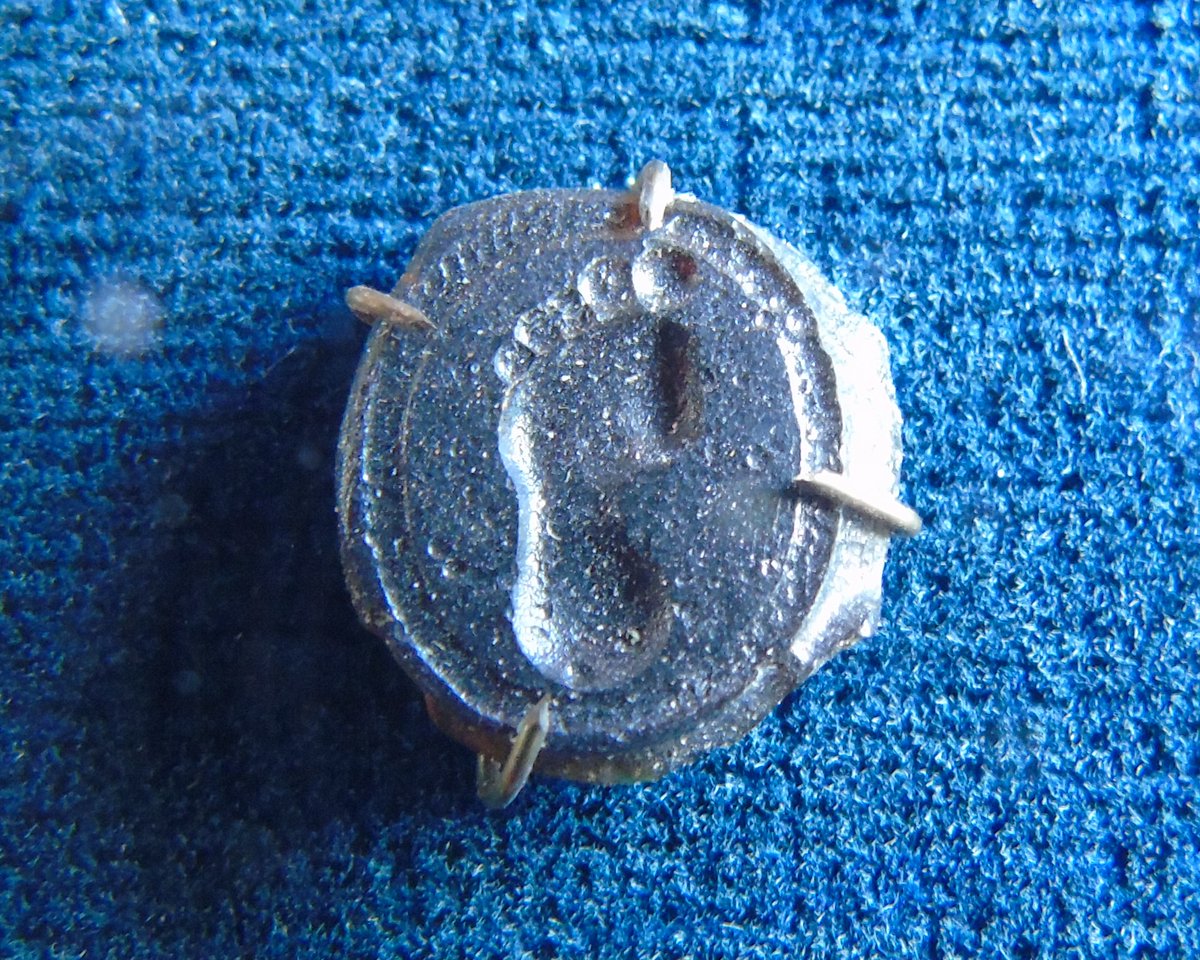
A #Roman gem, once set into a ring, which is carved with the image of a left foot - not the most common design for this type of gem, but a lovely piece of work nonetheless! #Archaeology
Rome raised a Germanic boy, trained him, made him an officer. They trusted him.
In 9 AD he led three legions into Germania — and turned on them. None came back.
Watch free on MovieAtlas @MovieAtlasApp
"Teutoburg Forest" by historyreforged
#EpigraphyTuesday - Monumental inscription from a triumphal arch dedicated to Hadrian, discovered near the camp of the Sixth Legion at Tel Shalem in Judea.
The inscription, in three lines, had belonged to a large triumphal arch erected, presumably in AD 136, by order of the Roman Senate to commemorate the suppression of the Bar Kokhba revolt. A proposed reconstruction of the inscription was prepared in 1999 by Professor Werner Eck of the University of Cologne, a renowned scholar of ancient Roman history. According to W. Eck, the inscription reads (with the expansion of abbreviations):
Imp(eratori) Cae[s(ari) divi T]ra[iani Par]/th[i]ci f(ilio) d[ivi Nervae nep(oti) Tr]aiano [Hadriano Aug(usto)] / pon[t]if(ici) m[ax(imo) trib(unicia) pot(estate) XX? imp(eratori) I]I co(n)s(uli) [III p(atri) p(atriae) s(enatus) p(opulus)q(ue) R(omanus)?]
“To the Emperor Caesar, son of the deified Trajan Parthicus, grandson of the deified Nerva, Trajan Hadrian Augustus, chief priest, holder of tribunician power for the twentieth time (?) , acclaimed imperator for the second time, consul for the third time, father of the fatherland, [the Senate and People of Rome (?)]”
The impressive dimensions of the inscription – about 11 m wide – and the size of the letters – 41cm high in the first line – show that the inscription belonged to a monumental arch similar to the Arch of Titus in Rome, erected after his death to commemorate his conquest of Jerusalem.
Israel Museum, Jerusalem, Israel.
Today 421AD The Eastern Roman/Byzantine Emperor, Theodosius II married Aelia Eudocia. Also known as Saint Eudocia, she is important for her literary work which entwines her pagan upbringing with her conversion to Christianity
In 212 AD, Caracalla did what no emperor had dared: he made every free man in the empire a Roman citizen — millions, in one decree.
Watch free on MovieAtlas @MovieAtlasApp
"CAESARS | CARACALLA" by Neural_Fiction
There’s been a lot of talk in this race about what makes a "real man."
A man does what’s right when no one is watching. He upholds his commitments to his family and neighbors. He doesn’t lie, cheat, & steal his way through life.
Real men serve others. Weak men serve themselves.
From the archive: Known as the Mazarrón II, the ship was located just six feet beneath the surface of the Mediterranean, roughly 200 feet away from a beach called Playa de la Isla. https://t.co/xH1ldSAp5T


![carolemadge's tweet photo. #EpigraphyTuesday - Monumental inscription from a triumphal arch dedicated to Hadrian, discovered near the camp of the Sixth Legion at Tel Shalem in Judea.
The inscription, in three lines, had belonged to a large triumphal arch erected, presumably in AD 136, by order of the Roman Senate to commemorate the suppression of the Bar Kokhba revolt. A proposed reconstruction of the inscription was prepared in 1999 by Professor Werner Eck of the University of Cologne, a renowned scholar of ancient Roman history. According to W. Eck, the inscription reads (with the expansion of abbreviations):
Imp(eratori) Cae[s(ari) divi T]ra[iani Par]/th[i]ci f(ilio) d[ivi Nervae nep(oti) Tr]aiano [Hadriano Aug(usto)] / pon[t]if(ici) m[ax(imo) trib(unicia) pot(estate) XX? imp(eratori) I]I co(n)s(uli) [III p(atri) p(atriae) s(enatus) p(opulus)q(ue) R(omanus)?]
“To the Emperor Caesar, son of the deified Trajan Parthicus, grandson of the deified Nerva, Trajan Hadrian Augustus, chief priest, holder of tribunician power for the twentieth time (?) , acclaimed imperator for the second time, consul for the third time, father of the fatherland, [the Senate and People of Rome (?)]”
The impressive dimensions of the inscription – about 11 m wide – and the size of the letters – 41cm high in the first line – show that the inscription belonged to a monumental arch similar to the Arch of Titus in Rome, erected after his death to commemorate his conquest of Jerusalem.
Israel Museum, Jerusalem, Israel.](https://pbs.twimg.com/media/HKY28TaXAAEh0cO.jpg)








![carolemadge's tweet photo. #EpigraphyTuesday - Monumental inscription from a triumphal arch dedicated to Hadrian, discovered near the camp of the Sixth Legion at Tel Shalem in Judea.
The inscription, in three lines, had belonged to a large triumphal arch erected, presumably in AD 136, by order of the Roman Senate to commemorate the suppression of the Bar Kokhba revolt. A proposed reconstruction of the inscription was prepared in 1999 by Professor Werner Eck of the University of Cologne, a renowned scholar of ancient Roman history. According to W. Eck, the inscription reads (with the expansion of abbreviations):
Imp(eratori) Cae[s(ari) divi T]ra[iani Par]/th[i]ci f(ilio) d[ivi Nervae nep(oti) Tr]aiano [Hadriano Aug(usto)] / pon[t]if(ici) m[ax(imo) trib(unicia) pot(estate) XX? imp(eratori) I]I co(n)s(uli) [III p(atri) p(atriae) s(enatus) p(opulus)q(ue) R(omanus)?]
“To the Emperor Caesar, son of the deified Trajan Parthicus, grandson of the deified Nerva, Trajan Hadrian Augustus, chief priest, holder of tribunician power for the twentieth time (?) , acclaimed imperator for the second time, consul for the third time, father of the fatherland, [the Senate and People of Rome (?)]”
The impressive dimensions of the inscription – about 11 m wide – and the size of the letters – 41cm high in the first line – show that the inscription belonged to a monumental arch similar to the Arch of Titus in Rome, erected after his death to commemorate his conquest of Jerusalem.
Israel Museum, Jerusalem, Israel.](https://pbs.twimg.com/media/HKY3Q7JWQAAKQ_V.jpg)