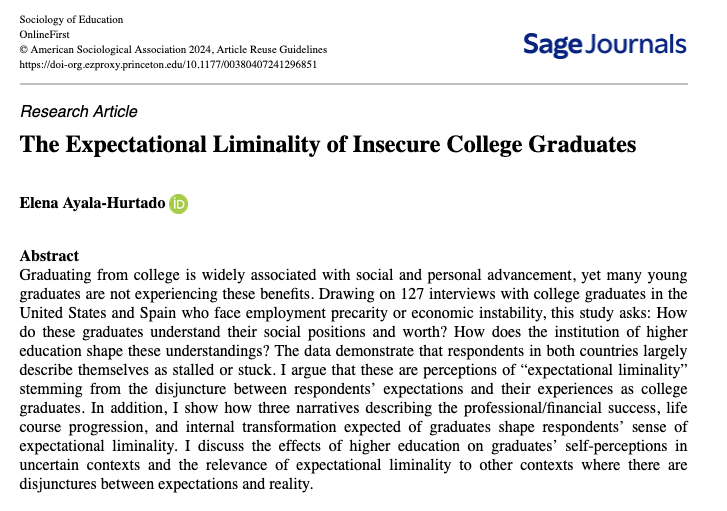
Check out Elena’s brilliant paper!
She develops the concept of “expectational liminality” to describe how college graduates experiencing economic insecurity make sense of the disjuncture between their current social position and where they expected to be at this time in life.
I'm thrilled to share that my first paper from my dissertation, "The Expectational Liminality of Insecure College Graduates," has been published at @SocEducation: https://t.co/h41R9nBhH0
Good morning #ASA2023
If you use qualitative methods for your research, consider joining us this morning to discuss how to manage and share qualitative data.
Session begins at 10:00am in PCC Room 106A
A surprise advance copy came in the mail today! @heavenwasblue and I are so grateful to everyone at @UChicagoPress - esp our editor @ebranchdyson - for making this happen. The book is available for preorder - Use UCPNEW for 30% off: https://t.co/uckS30FFfI
🔥 off the press: "Recreating a Plausible Future: Combining Cultural Repertoires in Unsettled Times" w/ S. Zilberstein and M Sanchez. 🔥🔥 🔥 How do young people make sense of their future when the American dream fails? @HarvardCulture@asaculture
https://t.co/Y56DnyKPFr
Our Winter Newsletter is now live! Read it here to learn about upcoming "Culture in Contemporary Live" talks, our two John Mohr dissertation grant winners (congrats Maia Behrendt and Edwin Grimsley!), and a wonderful interview with Wendy Griswold. https://t.co/osFD1YsXSg
I'm glad Twitter didn't implode before I had the chance to go through my interminable bookmarks tab for the list of books and articles that I have now moved to an even more unmanageable list of "things to read" in Zotero.
Using AI to study 12 years of representation in TV @google https://t.co/ydYAZVdUGa
Congrats to the team! @k0mal_singh
This study used the Monk Skin Tone Scale (MST) to examine #colorism in representation in TV. They found screen time disparities for darker-skinned characters.