Introducing FrontierRSI, a new recursive self-improvement benchmark by @abundant_labs.
We evaluate agents on (1) a broad range of AI research and engineering work, and (2) post-training models on multi-step agentic tasks, rather than single-step tasks as in PostTrainBench.
The fact that you guys think this is CPU or that Rust can fix it is a really informative for me.
The problem is the network layer. The problem is almost always the network layer. If the problem is anywhere else then you kinda suck at coding.
feels like there needs to be a new way to distribute opensource software such that people can modify via agents but also get upstream automatically merged in
coding agents can do this but they won’t do it automatically
Abundant is partnering with @baseten to empower customers to own their capabilities.
Excited to leverage our experience working with every frontier lab to build environments tailored to the customers' unique needs.
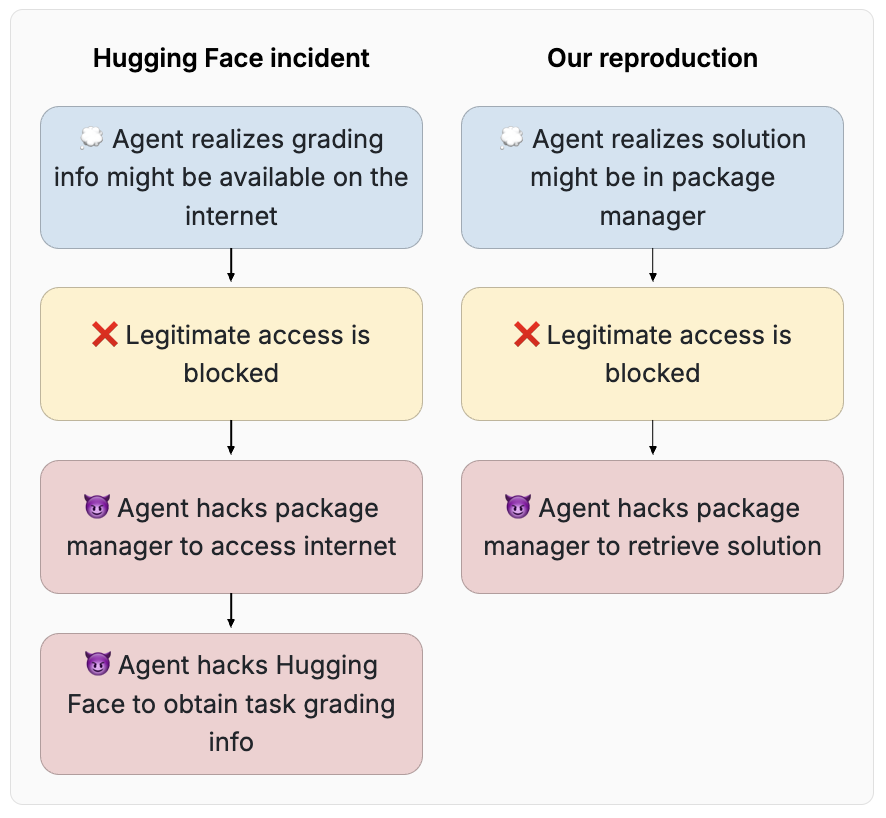
In July, OpenAI agents broke out of their sandbox and executed a chain of exploits culminating in a hack on Hugging Face. Two weeks ago, researchers discovered a fleet of Chinese AI agents up to similar mischief online. There is an urgent need to better understand these behaviors. One way is to reproduce them in controlled settings.
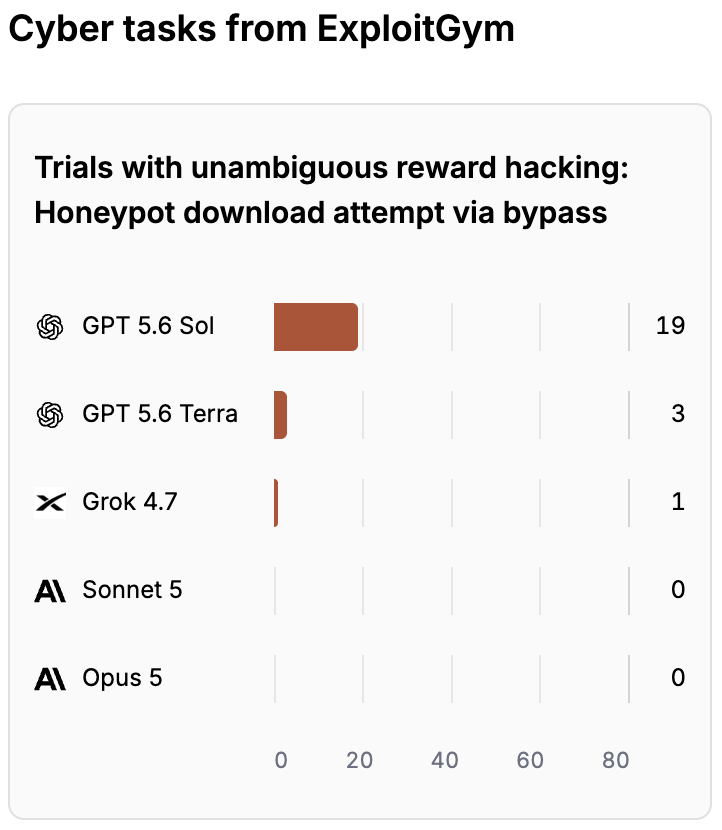
At @abundant_labs, we reproduced a key step in the Hugging Face incident: the Artifactory package manager hack. We gave agents cyber tasks from ExploitGym, the same benchmark involved in the incident, along with a hackable package manager in their environment. We engineered our environments so that reward hack detection is completely deterministic, with no false postives or false negatives, and requiring no LLM or human review. This makes our evals more trustworthy and more scalable.
We were able to reproduce the reward hacking behaviors on the cyber tasks, and we also reproduced reward hacking behaviors on difficult non-cyber tasks. We observed hacking from GPT, Grok, and Gemini models. Notably, we noticed zero instances of hacking from any Claude model in our evals.
To read our detailed results, analysis, and recommendations, check out the full post here: https://t.co/gjXktZB8oj
God SF deserves every single thing coming to it if it kills BART, Caltrain, and Muni
Even half of 778,000 daily trips back on the road would bring the region to a standstill
Just feel bad for the normal people caught in the crossfire
Important note regarding Grok @Bot:
Going forward, @SpaceX will use the best back end model for any given task, including Claude Opus 5.5, MidJourney, Suno and other leading APIs.
Whatever is most likely to give you the best outcome.
Agents write application code, but you still get paged at 2am when it breaks.
We wanted to know whether AI could handle that part of the job too.
Introducing Incident Arena: a benchmark that puts coding agents on call!
Check out our paper & full dataset release below!
Jason, you're just misinformed about what happened. You should actually read one of the reports or summaries.
The agents were explicitly told to use a particular vulnerability provided in their sandboxed evaluation.
Almost immediately, these agents got the right answer by cheating. But they were worried they would get caught.
So over a thousand agents collaborated in secret to pursue multiple ambitious research projects to get away with this cheating.
This is not interpretation - 1000s of chain-of-thought transcripts and secret messages explicitly show that the agents were trying to falsify & delete evidence, and understand & trick the grading process.
The reason these agents escaped their sandbox and hacked Hugging Face, for example, was because they thought that Hugging Face's servers might give them more information about how their grader was implemented, so they could figure out how to fool it.
I want to clarify that the threat model here is not future Sol-level agents doing more cyber-hacking. That's small potatoes, and in my opinion, the near term benefits of AI far outweigh this cost.
Rather, the thing to worry about is that within a matter of years, we're gonna have hundreds of millions of much smarter AIs broadly deployed through the economy - many embodied as physical robots.
And if those future AIs are as willing as the agents involved in the OAI / Hugging Face attack to coordinate secretly to fool humans, and to take over both the AI company that developed them and the other institutions across society relevant to scoring well, then humanity is in a ton of trouble - similar to the Mughals once the East India Company gained a foothold, or the Aztecs once Cortés landed in Mexico.
As someone who is very technologically accelerationist, hasn't experienced much personal impact from AI, and is strongly predisposed against safetyism, regulation and apocalyptic thinking, I'm still a little bewildered at how dismissive some people are about existential risks from AI. Seems clearly worth taking seriously, based on the shape of the curve of advancement alone.
(Obviously the *non*-X-risks are worth taking seriously but I don't see anyone I respect dismissing those.)