When @NVIDIA says the home is the new datacenter, they're validating the thesis Akash has been building on.
Their path requires new construction, new hardware, and a cabinet bolted to your house.
Akash Homenode takes a different approach. The Windows app handles everything, downloading and installing the OS in dual boot alongside your existing setup. No dedicated space or fixed location required.
Your GPU earns whether you're at home, in a dorm, or an apartment.
↓ Here's how they actually compare ↓
https://t.co/adKAoSOg1S
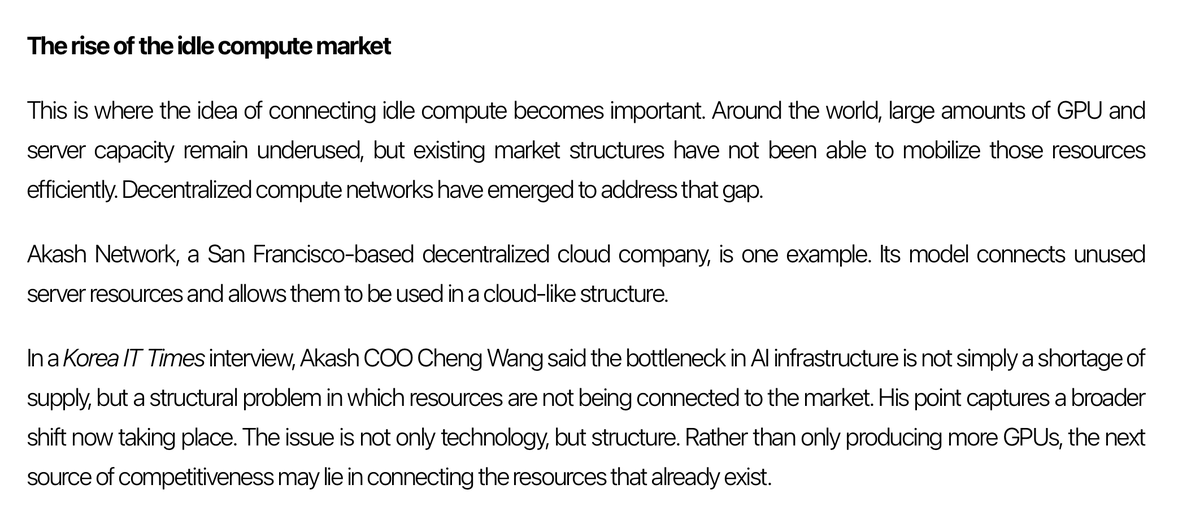
Is there really a GPU shortage or just a lack of proper distribution? Millions of GPUs currently sit idle while demand keeps climbing.
COO Cheng Wang explains why Akash Homenode is the next step in closing that gap by letting anyone contribute idle hardware and earn for capacity that would otherwise go unused.
→ Read the full discussion: https://t.co/sMqzyaH3Cs
It’s super rewarding to watch Akash Homenode providers generating income by utilizing their gaming rigs to host AI workloads on Akash during periods of idle time.
Future of AI is at home.
👉 Signup at https://t.co/kNStXwiTV9 for early access.
Homenode is one of the reasons I joined Akash. I was a firm believer that smaller models would be become increasingly important once agents got good enough, then OpenClaw and Hermes Agent happened and here we are.
Razer and @akashnet just scaled a free AI experience to thousands of users globally at the cost of $0.01 per image.
The secret? Two technologies built for completely different problems, working as one.
Here's how 🧵
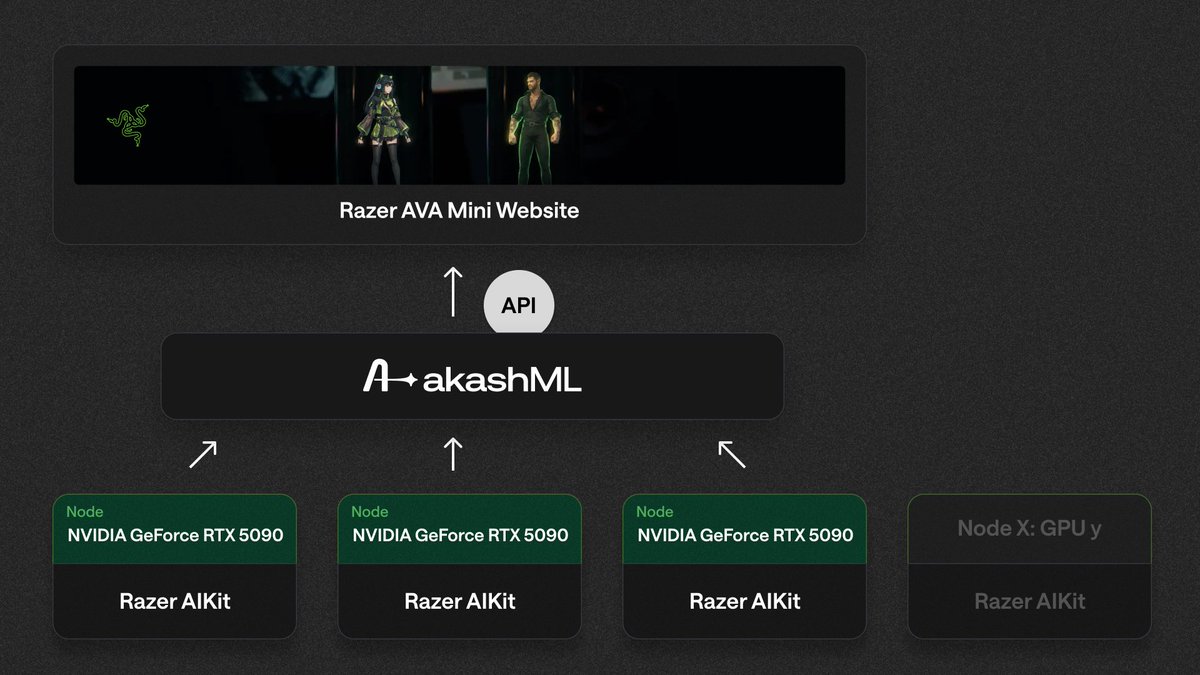
Today we're pleased to share how AVA Mini, @Razer’s personalized AI companion experience, was brought to life at global scale using Razer's AIKit and Akash.
By leveraging Razer AIKit’s inference capabilities on Akash’s decentralized compute network, managed by AkashML (@akashnetai), the team achieved:
• $0.01 per generated image
• 3.24 second average response time
• Seamless scaling during peak campaign demand
• Zero manual intervention across the campaign lifecycle
Read the complete whitepaper:
https://t.co/DTGl9JBuwg
The agentic era is here — and it's running on Akash.
Kimi K2.6 is now available on AkashML. Open source, 1T params, built for sustained autonomous execution with 256K context and agent swarms scaling to 300 sub-agents.
No walled gardens. Just raw, open compute. ⚡
https://t.co/ykvtbmXzsu
Now Available on AkashML: Kimi K2.6!
This open source agentic MoE model activates only 32B of its 1T parameters per token, delivering frontier-level performance built for sustained autonomous execution:
→ Long-horizon coding across Rust, Go, and Python
→ 256K context window with native multimodal support
→ Agent swarms scaling to 300 sub-agents and 4,000 coordinated steps
→ Autonomous execution that runs for hours without human oversight
Access Kimi K2.6 on AkashML: https://t.co/yGVdr2mbKj
BME going live is a fundamental shift for the network.
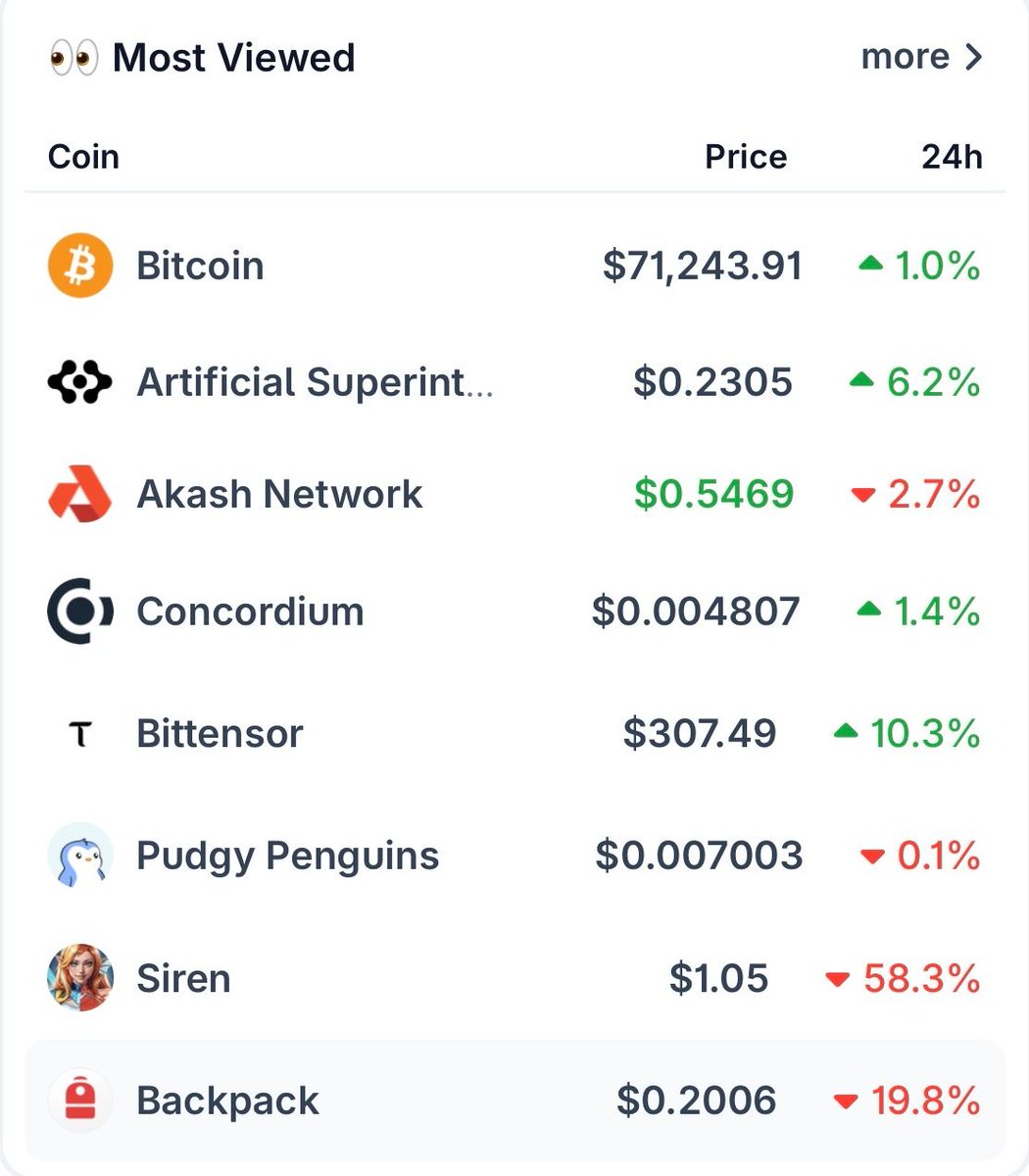
Every deployment now directly ties into $AKT utility—linking real compute demand with token dynamics.
This is how decentralized infrastructure scales: usage → value → sustainability.
👏👏👏
Burn-Mint Equilibrium is officially live as the core team completed the Mainnet 17 upgrade just moments ago.
Every workload on Akash now directly ties to the utility of $AKT.
Here's what's happening on-chain right now:
→ $AKT price data and oracle are live
→ The price oracle is healthy and BME is active
→ All deployment are fully functional
$300B in Gulf AI investment is at risk because the world's most critical AI services run inside a handful of large, stationary, well-known buildings.
That's the cost of centralizing the world's AI into data centers that can easily be found on a map.
Akash Homenode puts compute where it can't be targeted: inside millions of homes worldwide, with no central address to strike.
Source ↓
https://t.co/y4K9m6HFUg
AI is starving for power. Data centers are maxed out, and the energy grid is buckling.
The builders pushing AI forward are running out of runway, but the solution is sitting idle in millions of homes around the world.
Akash Homenode connects your GPU directly to the builders who need to power their AI workloads.
Early access is open now for NVIDIA RTX 4090 and 5090 owners.
The future of the AI economy will run your infrastructure.
Join the Early Access list and calculate potential earnings: https://t.co/R5ocDfDGDb
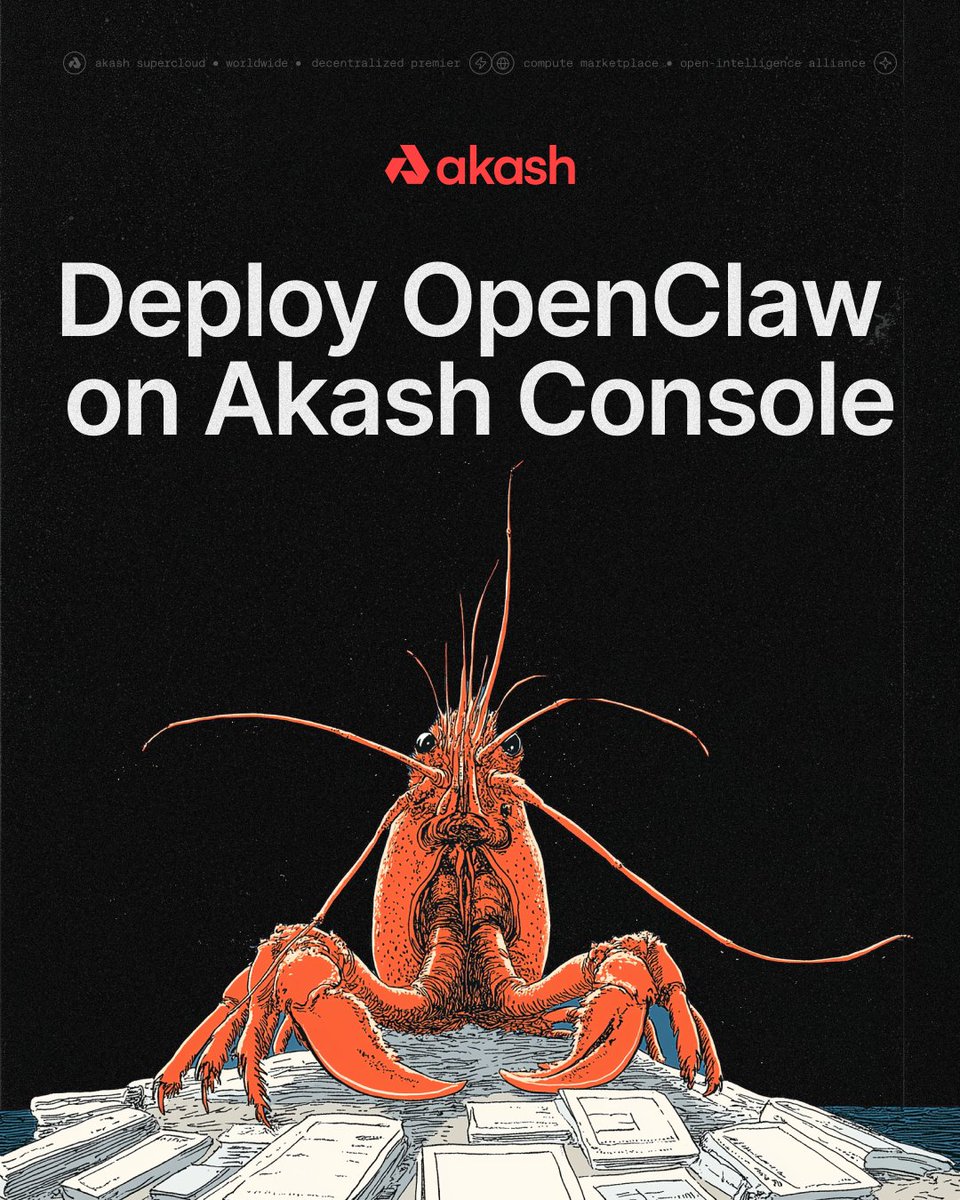
Why spend $600 on a Mac mini to run @openclaw (previously Clawdbot) when you can run it for less than $1 on Akash?
Permissionless. Private. Permanent.🦞
Start Deploying ↓
https://t.co/5Bcse5hpcX
There is tons happening on Akash but here are things to keep track of and why you should be excited for 2025.
1. Increase revenue: Akash maintains a healthy 50% utilization rate despite growing supply. Continue investing in better user experience and new capabilities (virtual machines, bare metal scheduling) to expand use cases and maintain utilization as supply grows. Heavy investments in growth and sales.
2. Sustainable incentives: Akash lacks on-chain supply incentives because we avoid wasteful models. We're developing incentives that align usage with emissions to reduce pressure on AKT and ensure sustainable network growth rather than enriching incentives farmers.
3. Continuous, non-disruptive verification: Permissionless incentives require cryptographic verification to reach mass adoption. After five years of research, Akash has developed a workable model for continuous verification, a breakthrough for decentralized compute that will transform how we attract network supply.
4. Increase structural $AKT demand: Align AKT demand with on-chain revenue with continuous market buy and reduction of circulating supply. More revenue means less AKT circulating. This strongly aligns token holders with Akash users.
LFG 🚀
With pressure to solve stable payments for Akash users for leasing GPUs, we introduced multi-currency settlement with one major unintended flaw: it reduced demand for $AKT.
We now have found a way to have stable payments along with every dollar spent on Akash driving demand for AKT, which is then burned to pay for compute.
If this proposal is approved, we’ll have BME in testnet by end of October.
In the coming weeks, we'll introduce a revamp of the incentive program that aligns emissions directly with usage.
It's time $AKT gets a transformation.
My conviction in #DePIN & protocols like @akashnet grows daily.
AEP-60 intruduces the #UX for at home DEPIN scalability 🔗👇
#AEP60 outlines the upcoming EoY "#AkashAtHome" MVP, empowering users to run as #AkashNetwork providers on edge devices like laptops via straightforward client installs, regional clusters, managed control nodes, and NAT traversal for easier onboarding.
https://t.co/FpgALULpQu