@nsitharaman
PROPOSAL FOR SIMPLIFIED TAXATION IN INDIA
Banking Transaction Tax (BTT) +Cash Transaction Tax(CTT)
Objective
To replace India’s complex web of direct and indirect taxes with a simple, technology-driven, low-evasion tax system that ensures stable revenue, minimal compliance cost, and faster economic formalisation.
The Proposal (At a Glance)
1. Banking Transaction Tax (BTT)
Rate: 1% (to be phased in; pilot at 0.1%–0.25%)
Levy: On eligible digital/banking transactions
Collection: Auto-deducted by banks/payment systems
No input credit (simple, transparent, final tax)
2. Cash Transaction Tax (CTT)
Rate: 10%
Levy: On large cash withdrawals and deposits
Exemptions: Small rural and low-value personal cash use
Taxes Proposed to be Replaced (Phase-wise)
Personal Income Tax (majority of individuals)
Corporate Income Tax (excluding select sectors initially)
GST (gradual slab reduction → replacement)
TDS/TCS
Cesses and surcharges
Most excise and compliance-heavy indirect taxes
Why This Works
1. Radical Simplicity
No returns, no filings, no audits
No classification disputes (HSN, slabs, exemptions)
Near-zero compliance cost for citizens and businesses
2. Broader & Automatic Tax Base
Every digital transaction contributes
Captures economic activity currently outside tax net
Eliminates evasion through understatement of income
3. Strong Behavioural Incentives
Digital payments encouraged
Cash becomes costly at scale
Informal economy naturally shrinks
4. Lower Cost of Tax Administration
Automated collection via banking rails
Reduced litigation, raids, and enforcement overhead
Revenue Potential (Indicative)
Even after behavioural adjustments, combined BTT + CTT can approach or exceed current Centre + State tax revenues
Revenue becomes transaction-linked, not declaration-dependent
Stable, predictable cash flow for governments
Safeguards & Exclusions (Critical Design)
Zero-rated: Exports, capital market settlements, inter-bank flows
Netting windows: To avoid multiple taxation within a single commercial settlement
De minimis thresholds: For small retail/UPI transactions
MSME relief: Annual rebate or turnover-linked cap
Federal Structure & States
Weekly or real-time revenue sharing via RBI systems
Formula-based devolution (no disputes, no compensation cess)
Predictable cash flow improves state fiscal planning
Phased Implementation Roadmap
Phase 0 – Pilot (6–12 months)
BTT @ 0.1% on limited B2B/merchant receipts
Existing taxes remain unchanged
Measure revenue, inflation impact, behaviour
Phase 1 – Partial Swap (Year 1)
Expand BTT coverage
Introduce CTT on large cash movements
Remove nuisance cesses, reduce TDS/TCS
Phase 2 – Structural Shift (Years 2–3)
Reduce GST slabs
Raise personal income tax exemptions
Replace select direct taxes
Phase 3 – Consolidation (Years 4–5)
Evaluate full replacement for most taxpayers
Stabilise lowest effective BTT rate needed for neutrality
Strategic Outcome
India moves to the simplest large-economy tax system globally
Higher compliance through design, not enforcement
Faster growth, higher transparency, lower friction
Bottom Line:
This reform is not about higher taxation.
It is about simpler taxation, wider participation, and trust-based governance — enabled by India’s digital financial infrastructure.
From Sardar Patel's Integration of Princely States to Modi's Challenge to Regional Political Kingdoms
How India's Political Map and Political Power Structure Were Unified
When India became independent, the country was fragmented into more than 560 princely states. Sardar Vallabhbhai Patel united these kingdoms into one nation, creating the territorial India we know today.
Supporters of Prime Minister Narendra Modi argue that a similar transformation has taken place in Indian politics over the last decade. While Patel integrated princely states, Modi has challenged the dominance of regional political kingdoms that once controlled large parts of India.
For nearly fifty years after Independence, Congress dominated India. As Congress weakened, regional parties emerged across almost every state. Many became powerful enough to dictate terms to governments in New Delhi. Several eventually became family-run political organizations centered on caste, language, or regional identity.
Today, many of these parties have either disappeared, fragmented, merged into larger formations, or lost their once-dominant position.
Uttar Pradesh: End of SP-BSP Dominance
For three decades, politics revolved around the Samajwadi Party and Bahujan Samaj Party.
Mulayam Singh Yadav, Akhilesh Yadav and Mayawati shaped the state's political narrative. Today, BSP has been reduced to a shadow of its former self, while SP faces a BJP that has become the state's principal political force.
Bihar: Regional Giants Lose Monopoly
Bihar was once the undisputed arena of Lalu Prasad Yadav's RJD and Nitish Kumar's JD(U).
The BJP's rise transformed Bihar from a regional-party stronghold into a state where national politics increasingly drives electoral outcomes.
Maharashtra: Collapse of Traditional Power Centres
For decades Maharashtra politics was controlled by Shiv Sena and NCP.
Both parties later split, weakening their organizational dominance. The BJP emerged as the largest political force, ending the era when regional parties could determine the state's future without national players.
Haryana: The Fall of Chautala Politics
The Indian National Lok Dal once dominated rural Haryana.
Today, INLD has largely faded, and Haryana politics is centered around the BJP and national-level issues.
Punjab: Akali Era Fades
The Shiromani Akali Dal was once among India's strongest regional parties.
After decades of influence, its electoral footprint has dramatically shrunk, ending its position as Punjab's unquestioned regional powerhouse.
Odisha: End of the Naveen Patnaik Era
For nearly a quarter-century, the Biju Janata Dal appeared unbeatable.
The BJP's victory in Odisha ended one of India's longest-running regional-party governments and demonstrated that even the strongest regional fortresses could be breached.
West Bengal: The Fall of Two Regional Empires
West Bengal first witnessed the decline of the Left Front after 34 years in power.
The Trinamool Congress then ruled the state for 15 years under Mamata Banerjee. In 2026, the BJP won a decisive mandate, ending TMC rule and forming its first government in Bengal. The result marked the first time the BJP captured power in the state and reduced TMC from a dominant ruling party to the opposition. (mint)
Assam and Northeast: Regional Parties Absorbed into a Larger Coalition
The Northeast was historically dominated by regional forces such as AGP in Assam, Arunachal Congress in Arunachal Pradesh, and numerous local parties.
Today, many of these parties either operate within BJP-led alliances or have seen their influence substantially reduced.
Andhra Pradesh: From National Kingmaker to State Player
The Telugu Desam Party once played a decisive role in forming governments in New Delhi.
Under N.T. Rama Rao and Chandrababu Naidu, TDP was among India's most influential regional parties. While it remains relevant, its national influence is far below its peak.
Telangana: Regional Dominance Challenged
The Telangana movement produced TRS (later BRS), which dominated the state for a decade.
The party's decline after losing power demonstrated that even newly created regional parties face challenges from national parties.
Jammu & Kashmir: End of Traditional Dynasties
For decades politics revolved around the National Conference and PDP.
The abrogation of Article 370 fundamentally altered the state's political structure and reduced the monopoly of traditional regional players.
Tamil Nadu: The Last Great Regional Fortress
Tamil Nadu remains one of the few major states where regional parties continue to dominate through DMK and AIADMK.
However, BJP's growing organizational presence has ended the belief that the state is permanently closed to national parties.
Karnataka: Regional Parties Marginalized
The Janata Dal (Secular) once held the balance of power in Karnataka.
Today, politics is largely a direct contest between the BJP and Congress, with JD(S) playing a much smaller role.
Former Congress Splinters That Disappeared
Many Congress breakaway parties that once dominated regional politics have virtually disappeared:
• Bangla Congress (West Bengal)
• Utkal Congress (Odisha)
• Arunachal Congress (Arunachal Pradesh)
• Telangana Praja Samithi (Andhra region)
• Tamil Maanila Congress (Tamil Nadu)
• Haryana Vikas Party (Haryana)
• Tiwari Congress (Uttar Pradesh)
• Madhya Pradesh Vikas Congress (Madhya Pradesh)
• Indian Congress (Socialist)
• Rashtriya Samajwadi Congress
• Multiple Kerala Congress factions that fragmented over decades
Most eventually merged back into Congress, joined the BJP, or became politically irrelevant.
The Modi Era and the Nationalization of Politics
Supporters of Narendra Modi argue that India has moved from an era dominated by state satraps and regional power brokers to one increasingly shaped by national leadership, national welfare schemes, and national political narratives.
They compare this transformation to Sardar Patel's integration of princely states. Patel united India's territory; Modi, they argue, has weakened many of the political fiefdoms that emerged after Independence.
Critics disagree and maintain that regional parties remain essential for protecting India's federal structure and linguistic diversity.
Yet the political map of India in 2026 is undeniably different from that of 2004. Many regional parties that once controlled states, influenced coalition governments, and acted as kingmakers in Delhi have either vanished, weakened, split, or become junior partners. In their place has emerged the most geographically expansive national political organization India has seen in decades.
Congress: The Party That Once Ruled India but Could Not Stay United
Opinion
For much of India's post-Independence history, the Congress Party dominated the country's political landscape. From Jawaharlal Nehru to Indira Gandhi and later the Gandhi family, Congress enjoyed unparalleled power. Yet, behind the image of a national movement and freedom-fighting legacy lies another story: a party repeatedly weakened by internal power struggles, personality clashes, dynastic politics, and the inability to accommodate strong regional leaders.
The result is visible today. Some of the most influential regional parties in India were not created by ideological opponents of Congress—they were created by Congress leaders themselves after becoming disillusioned with the party.
From National Movement to Family-Controlled Organization
Founded in 1885, the Indian National Congress played a significant role in India's freedom struggle. However, after Independence, Congress gradually transformed from a broad-based national movement into a centralized political organization increasingly dominated by a single family.
The first signs of trouble appeared in 1969 when Prime Minister Indira Gandhi split the party. The Congress (Organisation) faction led by senior leaders such as Morarji Desai and K. Kamaraj was sidelined, while Indira Gandhi consolidated control over the party.
Many political observers consider this moment the beginning of the decline of Congress's internal democracy.
A History of Leaders Walking Away
Over the decades, numerous influential Congress leaders left the party after disputes with the central leadership.
Kerala Congress: The First Major Breakaway
In 1964, K. M. George formed Kerala Congress after disagreements within the state Congress unit.
Unlike many Congress offshoots, Kerala Congress survived and evolved into multiple factions that remain relevant in Kerala politics. Its continued existence demonstrates how regional leaders often found greater success outside the Congress framework.
Bangla Congress Ends Congress Dominance in Bengal
Ajoy Mukherjee formed Bangla Congress in 1966 after growing dissatisfaction with Congress rule in West Bengal.
The party played a key role in ending Congress's dominance in the state, opening the door first for coalition governments and eventually decades of Left rule.
Telangana Praja Samithi
Marri Chenna Reddy launched Telangana Praja Samithi in 1969 to champion Telangana's regional aspirations.
Although the party later merged back into Congress, it highlighted a recurring pattern: regional aspirations often found stronger expression outside the Congress structure.
Utkal Congress and the Rise of Odisha Regionalism
Biju Patnaik founded Utkal Congress in 1969 after breaking with Congress leadership.
Though the party itself disappeared, its political legacy eventually led to the creation of the Biju Janata Dal (BJD), which went on to dominate Odisha politics for decades while Congress steadily declined in the state.
Arunachal Congress
In 1996, Gegong Apang formed Arunachal Congress after disagreements with the Congress high command.
For a period, the party virtually replaced Congress in Arunachal Pradesh, demonstrating how fragile Congress's state-level support could become once influential leaders walked away.
The Sonia Gandhi Era and New Splits
The late 1990s saw another wave of departures.
Tamil Maanila Congress
G. K. Moopanar formed Tamil Maanila Congress in 1996 after opposing Congress's alliance decisions in Tamil Nadu.
The new party immediately achieved remarkable electoral success, raising questions about whether Congress's decline in the state was caused more by leadership decisions than by public sentiment.
Trinamool Congress
Perhaps the most successful Congress breakaway was Mamata Banerjee's Trinamool Congress, founded in 1998.
Frustrated with Congress leadership and organizational weakness in West Bengal, Banerjee built her own party and eventually defeated both the Left Front and Congress itself.
Today, Trinamool Congress is the dominant force in West Bengal, while Congress remains a marginal player.
Nationalist Congress Party
In 1999, Sharad Pawar, P. A. Sangma and Tariq Anwar left Congress over Sonia Gandhi's foreign origin issue and founded the Nationalist Congress Party (NCP).
The split exposed growing unease among senior Congress leaders regarding the concentration of authority around the Gandhi family.
Although NCP later allied with Congress, it became one of Maharashtra's most influential political forces.
People's Democratic Party
Former Union Home Minister Mufti Mohammad Sayeed founded the People's Democratic Party (PDP) in Jammu and Kashmir in 1999.
The party emerged as a major regional force, further illustrating Congress's inability to retain strong state-level leadership.
YSR Congress Party
One of the most damaging exits for Congress came in Andhra Pradesh.
After the death of Y. S. Rajasekhara Reddy, his son Y. S. Jagan Mohan Reddy left Congress and formed the YSR Congress Party in 2011.
The consequences were severe. Congress, once dominant in Andhra Pradesh, was virtually wiped out in the state, while YSRCP became a major political force.
The Rise of BJP and the Decline of Congress
While Congress continued to fragment, the Bharatiya Janata Party expanded across the country by building a cadre-based organization, promoting leadership beyond a single family, and focusing on organizational discipline.
Under Prime Minister Narendra Modi and Home Minister Amit Shah, BJP transformed itself from a party once limited to a few states into India's dominant political force.
Many states where Congress once held overwhelming influence—including Uttar Pradesh, Gujarat, Assam, Haryana, and large parts of central India—have witnessed a dramatic shift toward BJP.
At the same time, several former Congress strongholds are now controlled by parties that were originally created by Congress rebels.
A Political Legacy of Fragmentation
Ironically, Congress's greatest contribution to modern Indian politics may not be the party itself but the numerous political organizations that emerged from its repeated internal conflicts.
Trinamool Congress in West Bengal, NCP in Maharashtra, YSR Congress in Andhra Pradesh, Kerala Congress factions in Kerala, PDP in Jammu and Kashmir, and the political tradition that eventually produced BJD in Odisha all have roots in Congress.
The story of Congress over the past six decades is therefore not merely a story of electoral decline. It is also the story of a party that repeatedly failed to retain ambitious regional leaders, many of whom went on to build successful alternatives.
As India moves further into the Modi era, Congress faces a difficult challenge: rebuilding itself while competing not only with BJP, but also with many of its own political descendants.
@NalinisKitchen Non only many professionals loosing revenue, government is also loosing plenty of tax revenue which it can charge to people.
Who is gaining? Don't know.
UAE Drops a Bomb on America
Emirati officials just delivered a direct warning to the US:
"If you keep dragging us into this war with Iran and we run out of dollars… we will stop using the US dollar for oil sales."
They made it crystal clear — they’re ready to switch to Chinese yuan or any other currency.
This is not just talk. This is a direct threat to the petrodollar system that has kept the dollar as the world’s reserve currency for decades.
The UAE is fed up.
@grok can you check if its true?
@BricsIndia2026@FinMinIndia Newly added member "Iran" is bombed by a traitor. And member nations don't have the power to collectively condemn it.
One can judge the power of this union by this.
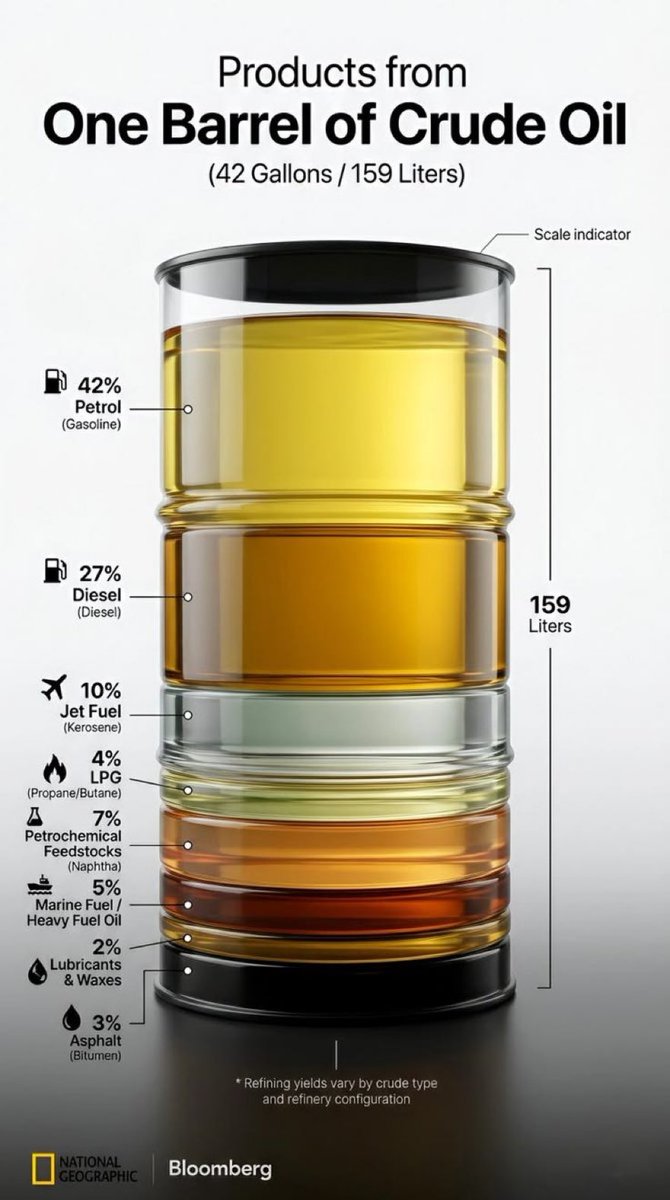
Since this comes up many times, those who don't know what Crude Oil barrel price have to do with price of Petrol or LPG, here is breakdown of each barrel (159 Liters) of Crude oil becomes after refining.
It’s only week five this is the global picture as of today.
🇧🇩 Bangladesh - Fuel rationing active. Universities closed. Military deployed in oil depots.
🇱🇰 Sri Lanka - Fuel rationing active. 15 litre per week cap for private motorists. Four day school week. Scaled back public sector operations.
🇸🇮 Slovenia - 50 litre per day cap on fuel for private drivers. 200 litres for businesses and farmers. Indefinite.
🇵🇭 Philippines - National energy emergency declared. Four day working week in place.
🇵🇰 Pakistan - Four day work weeks and school closures still in effect.
🇲🇲 Myanmar - Alternating driving days imposed.
🇹🇭 Thailand - Diesel price cap imposed. Government officials told to work from home and limit travel. Fuel exports banned except to Cambodia and Laos.
🇻�� Vietnam - Tapping fuel price stabilisation fund. Officials encouraged to work from home and limit travel.
🇰🇪 Kenya - Rationing by major fuel suppliers ongoing. Rural areas already running out.
🇪🇬 Egypt - Fuel and electricity rationing active. Malls, restaurants and retailers shutting at 9pm. Illuminated billboards switched off. Government buildings closing at 6pm.
🇮🇳 India - Government phasing out LPG cylinders for households with access to piped gas to prioritise supply.
🇨🇳 China - Export ban on diesel, gasoline and aviation fuel until at least end of March.
🇰🇷 South Korea - Fuel price cap imposed. First in 30 years. Voluntary fuel conservation measures in place.
🇯🇵 Japan - Refiners requesting government release of stockpiled oil. 95% of crude imported from Gulf states.
🇪🇸 Spain - €5 billion emergency package. Tax reductions on electricity and gas. Subsidies for transport operators and farmers.
🇩🇪 Germany - BASF raising prices on goods by up to 30%.
What could be coming
🇬🇧 UK - Ministers could activate contingency powers to introduce fuel rationing at petrol stations. 80% of UK goods travel by road. IEA has advised considering carpooling and working from home to save fuel.
🇪🇺 EU - Emergency measures under discussion. Storage across many member states below 30%.
Shell's CEO warned Europe could face fuel rationing starting in April if the Strait stays closed.
G7 finance ministers, energy ministers and central bank governors met in Paris today and issued a joint statement saying they stand ready to take "all necessary measures" to preserve stability in energy markets.
None of these restrictions have been easing. In several countries they are only getting worse
@grok Can you verify this new and check facts?
From today onwards Tax year term is applicable w.e.f 01.04.2026, so bye bye to Financial Year and Assessment year concept. After 2-3 years you will be not remembered.
@SeverusChud When Europeans entered USA and Australia, Newzealand they cutted and looted natives are in minority there. That way many countries became islamic in the past.
You should learn who your enemy is?