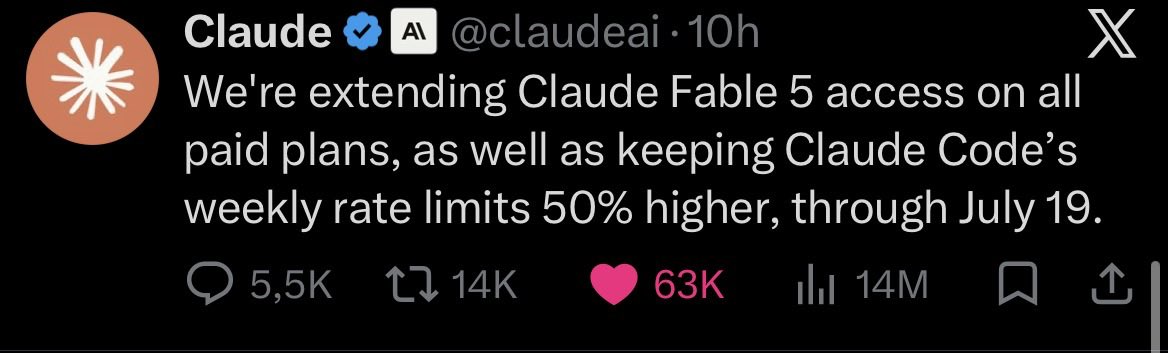
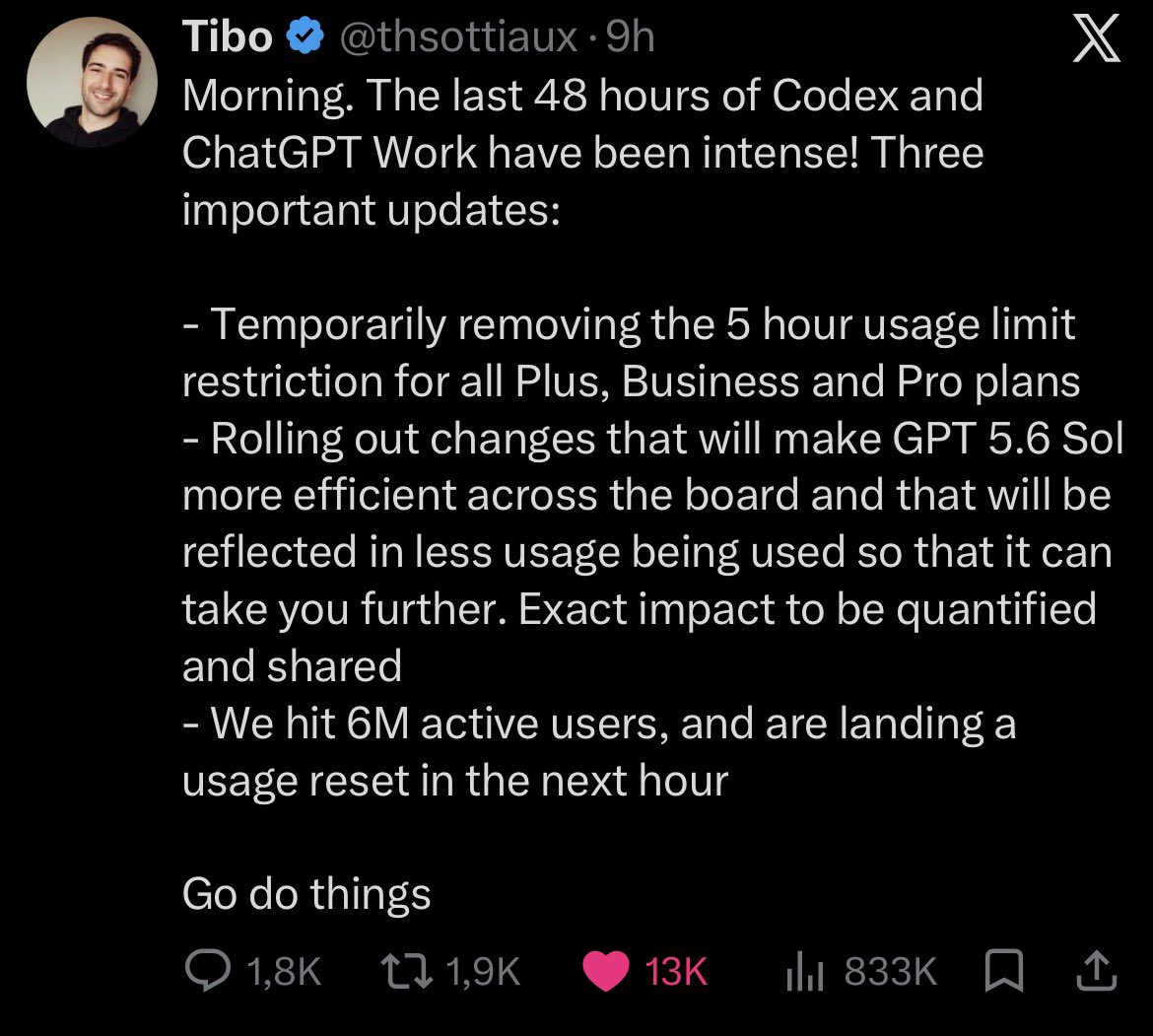
If you aren't yet bold enough to install the Codex app, you can stay in the presence of your orange crab and point it at GPT 5.6 Sol. Takes 5 minutes. Kudos to Theo for explaining one of the ways to get this done.
Step 1: Install CLIProxyAPI
Step 2: Connect
Step 3: Define following alias and enjoy claudex
```
alias claudex='CLAUDE_CODE_SUBAGENT_MODEL=gpt-5.6-sol \
CLAUDE_CODE_ALWAYS_ENABLE_EFFORT=1 \
CLAUDE_CODE_MAX_TOOL_USE_CONCURRENCY=3 \
ENABLE_TOOL_SEARCH=false \
claude --model gpt-5.6-sol'
```
If this gets blocked, I owe you a reset.
I was starting to build an "openai/codex-plugin-cc" equivalent for Grok in my workflow when 5.6 Sol Ultra pointed me to this fresh xAI repo.
A Claude Code bridge for delegating reviews, critiques, and tasks to Grok.
Thanks @aksheyd — multi-model coding workflows are starting to feel real.
https://t.co/QL6VqDhdwS
2ndBrain was the prototype. The product is Keel.
A keel is the structure below the waterline that keeps a boat upright and on course.
That is what this AI accountability companion is built to do for chaotic builders: catch the drift between what you intended to do and what your life log shows you actually did.
The name is secured. The logo is chosen. The design system is running as shared web/native UI.
First look:
Most solo projects don't die in the code. They die in the undocumented decisions around it.
Why did I pick this stack? What was the visual direction? What's in scope for v1? Three weeks later you can't answer, so you rewrite instead of ship. So today I built the layer that holds those decisions.
The code part took a day: Claude Design turned the prototype-week context plus my private visual direction into an internal design system and component library, and I set up a pnpm monorepo around it:
- mobile — Expo iOS app
- proxy — keeps the LLM key out of the binary
- ui — one shared design-system package for web and native
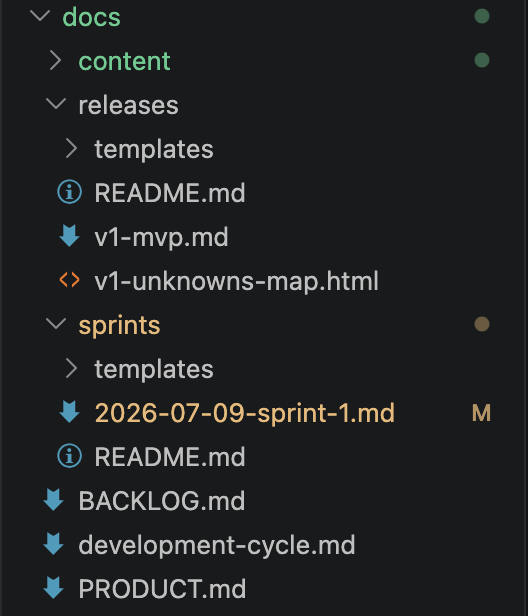
The decision part is what matters. README.md says what the repo is and how to run it. AGENTS.md routes every kind of project truth — and defines how AI agents work — without becoming a rule dump. Then I ran Autoscrum, a skill I wrote for my agents. It installed the delivery layer: CHANGELOG.md, sprint planning and work logs, release contracts, release workflow, PR template.
Now nothing lives only in my head.
Prototype → product system → design system → build system.
Target: submitted to TestFlight by Sunday, July 12.
Most solo projects don't die in the code. They die in the undocumented decisions around it.
Why did I pick this stack? What was the visual direction? What's in scope for v1? Three weeks later you can't answer, so you rewrite instead of ship. So today I built the layer that holds those decisions.
The code part took a day: Claude Design turned the prototype-week context plus my private visual direction into an internal design system and component library, and I set up a pnpm monorepo around it:
- mobile — Expo iOS app
- proxy — keeps the LLM key out of the binary
- ui — one shared design-system package for web and native
The decision part is what matters. README.md says what the repo is and how to run it. AGENTS.md routes every kind of project truth — and defines how AI agents work — without becoming a rule dump. Then I ran Autoscrum, a skill I wrote for my agents. It installed the delivery layer: CHANGELOG.md, sprint planning and work logs, release contracts, release workflow, PR template.
Now nothing lives only in my head.
Prototype → product system → design system → build system.
Target: submitted to TestFlight by Sunday, July 12.
Four days after the prototype passed, this is no longer an idea sitting in a chat. It has a product constitution, a frozen MVP, a backlog, and a map of the decisions and landmines ahead.
I used two AI skills to get there:
Anthropic’s Product Brainstorming, and David’s (@dzhng) explore-unknowns skill — built with Fable after feeding it “Finding Your Unknowns,” an article by Thariq Shihipar (@trq212) from Anthropic.
Product Brainstorming turned a week of prototype notes into three boundaries:
- PRODUCT.md — long-term vision, identity, users, principles, brand north star, and one clear problem statement: what are we building, for whom, and why does it matter?
- BACKLOG.md — every idea captured during the prototype, safely outside the build.
- releases/v1-mvp.md — the smallest useful version, frozen before coding.
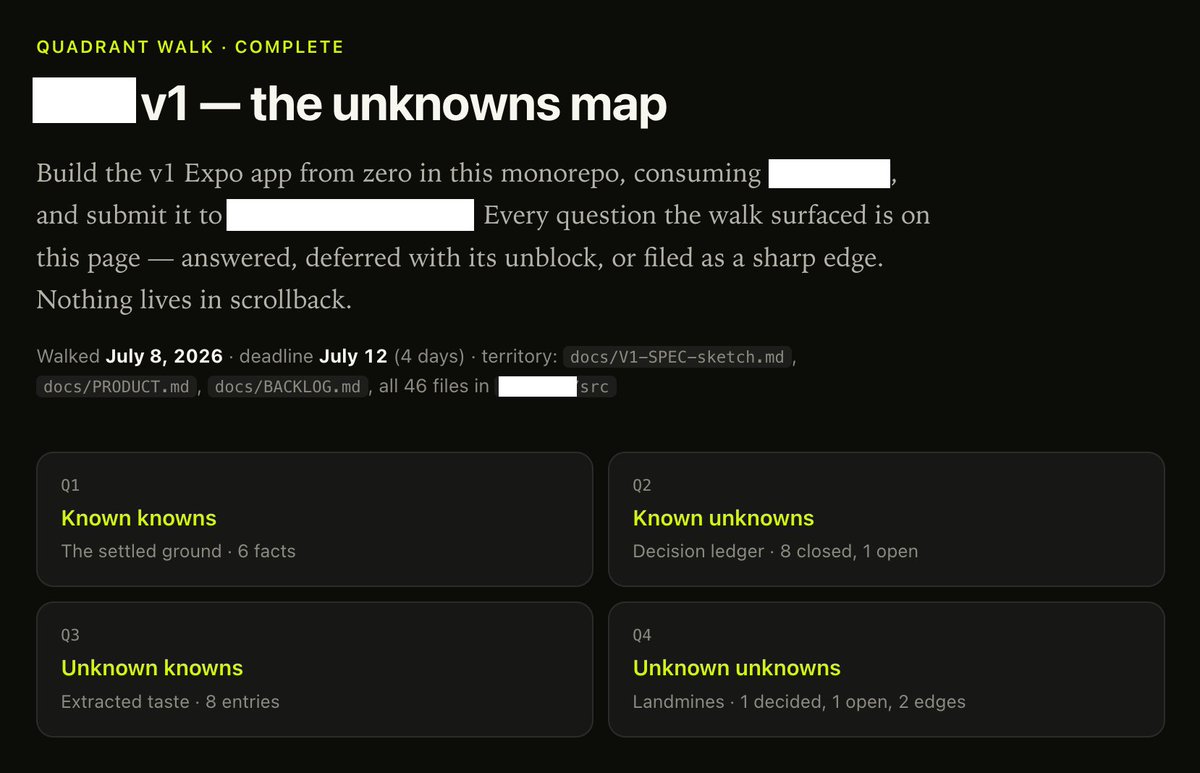
Then explore-unknowns scanned the repo, interviewed me one question at a time, and walked the project through four quadrants: known knowns, known unknowns, unknown knowns, and unknown unknowns.
Fable turned the result into an HTML report: 8 decisions closed, 1 still open, plus the landmines most likely to waste the four-day build window.
Not planning for planning’s sake. The output is a smaller build with fewer ways to surprise me.