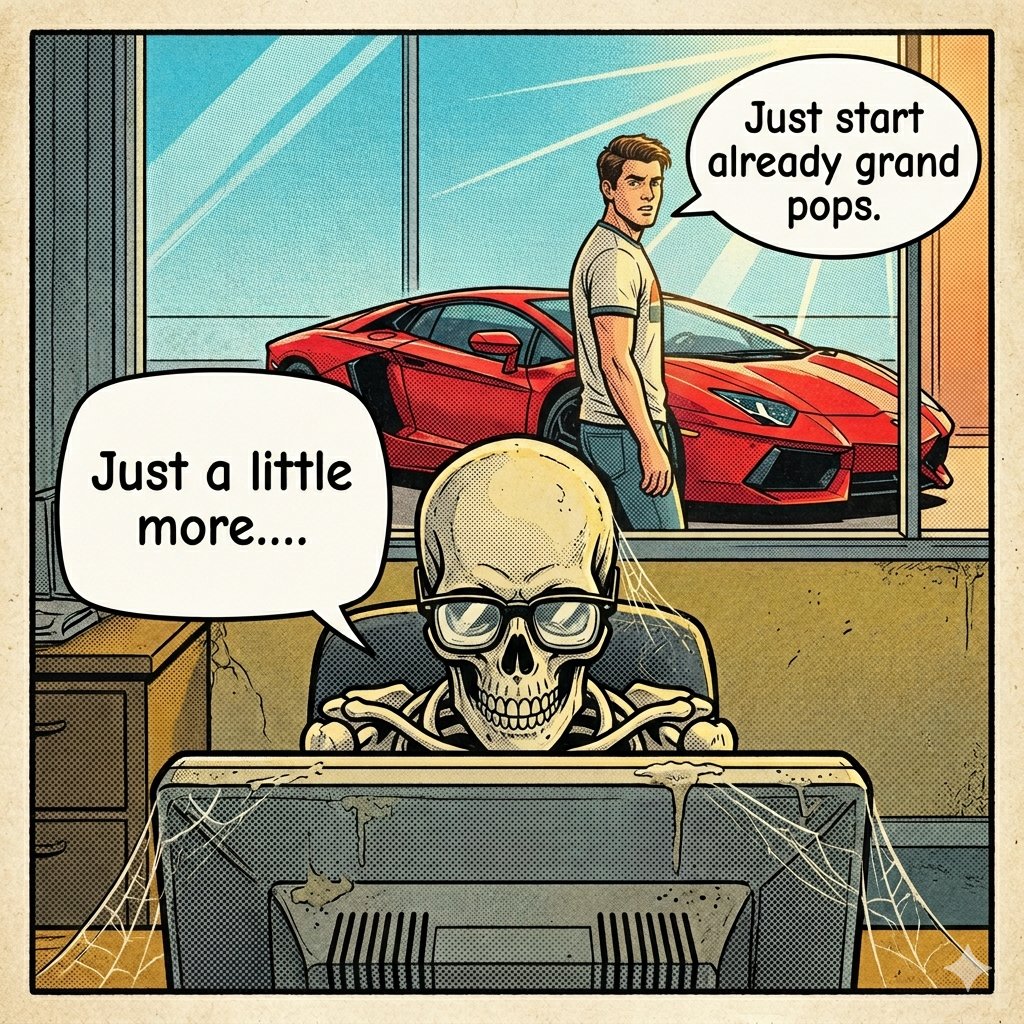
WHY INTELLIGENT PEOPLE STAY BROKE ONLINE FOR TOO LONG:
The funny thing about intelligent people is that they are usually the last people you'd expect to struggle online.
They learn fast, understand systems quickly, think 4 steps ahead and can spot opportunities earlier than most people.
Yet somehow...
A lot of them stay stuck for years.
Have you ever wondered why?
The answer is actually pretty simple, their advantage is their disadvantage.
Because of how analytical they are, intelligent people often spend too much time trying to fully understand a system before participating in it.
And that sounds reasonable.
After all, why jump into something you don't understand?
The problem here is that the world doesn't pause while they're trying to figure everything out.
Funny enough, a certain member of our team was like this until recently 😂 😂 😂
Let me explain 👇
If this resonates with you, like and share it with that person you know will need it.
Also, follow us to make sure you keep seeing us on your timeline.
WHY INTELLIGENT PEOPLE STAY BROKE ONLINE FOR TOO LONG:
The funny thing about intelligent people is that they are usually the last people you'd expect to struggle online.
They learn fast, understand systems quickly, think 4 steps ahead and can spot opportunities earlier than most people.
Yet somehow...
A lot of them stay stuck for years.
Have you ever wondered why?
The answer is actually pretty simple, their advantage is their disadvantage.
Because of how analytical they are, intelligent people often spend too much time trying to fully understand a system before participating in it.
And that sounds reasonable.
After all, why jump into something you don't understand?
The problem here is that the world doesn't pause while they're trying to figure everything out.
Funny enough, a certain member of our team was like this until recently 😂 😂 😂
Let me explain 👇
For the longest time, whenever he came across a new opportunity online, his first instinct wasn’t to participate but to understand.
He always wanted to know how everything worked first, the business model, the risks, the sustainability, and everything that could possibly go wrong or right 🙄 before even considering taking the first step.
😂
In his head, it made perfect sense because why would he put time into something he didn’t fully understand?
So he kept researching and researching while other people were already getting started.
The funny thing is that people like this often never start, not because they love learning too much, but because they get stuck in strategy and overthinking and they end up postponing action.
And that is why those who seem “normal” often perform better because they understand just enough to begin.
That was the part he missed for a long time, the assumption that understanding creates progress, when in reality progress is often what creates understanding.
There are things you simply cannot learn from the sidelines, no matter how many videos you watch, threads you read, or opinions you collect.
You only really learn them by getting involved, making mistakes, adjusting, and continuing.
That is why you will sometimes see people who know less making more progress online, not necessarily because they are better, but because they entered the game while everyone else was still trying to figure everything out.
Most people misunderstand what AI actually does in real systems, however, this is what AI does in real system.
🧵 Most people think AI "thinks."
It doesn't.
Here's what AI actually does in real systems and why the distinction matters more than you think.
The smartest teams using AI today aren't asking "can AI do this?"
They're asking "where does pattern recognition create the most value for us?"
That question alone puts you ahead of 90% of the room. 🧠
RT if this reframed how you see AI 🔁
Most people misunderstand what AI actually does in real systems, however, this is what AI does in real system.
🧵 Most people think AI "thinks."
It doesn't.
Here's what AI actually does in real systems and why the distinction matters more than you think.
The danger of misunderstanding this?
People either:
❌ Over-trust AI (treating outputs as facts)
❌ Under-use it (dismissing it as "just a chatbot")
Neither serves you. Know what the tool does then use it right. 🎯
The future belongs to storytellers.
AI is making information easy to create and copy.
So information alone won’t make you stand out anymore.
What will matter is connection…..
The ability to turn ideas into something people feel.
Because in a world full of content, people won’t remember everything.
They will remember what moved them.
Information explains things, Storytelling makes people care.
And that is what wins attention today.
Why Storytelling Matters More Than Information in the Internet Age.
Information is everywhere now….
There was a time when information was rare and valuable.
Now it’s everywhere….
You can learn anything in seconds with your phone or AI.
So the problem is no longer access, the real problem is attention.
So many ideas get ignored, not because they are bad, but because they don’t stand out.
➺ Information is easy to find
➺ Attention is hard to earn.
That’s where storytelling comes in.
Why this matters for creators and Web3.
Most creators and projects talk about features.
They explain what they are building.
But people don’t connect with features but they connect with purpose.
➺ Why does it exist?
➺ What problem does it solve?
➺ What is the journey behind it?
That is what builds trust and attention, people don’t follow products.
They follow stories they believe in.
🧵 Why is data the foundation of every intelligent system?
Not algorithms. Not compute. Not even the model architecture.
It's data.
Here's why and why most people get this completely wrong. A thread 🧵👇
🧵 Why is data the foundation of every intelligent system?
Not algorithms. Not compute. Not even the model architecture.
It's data.
Here's why and why most people get this completely wrong. A thread 🧵👇