Whitelist reviews are ongoing.
So far, 281 accounts have been approved, and 15 holders have each received one nomination.
🟨 Check your status: https://t.co/4uKGPd203R
More news coming very soon.
exploring @vangrid_io
Here's something I've been thinking about.
What if the most valuable data isn't the data we collect today, but the data we don't even know we need yet?
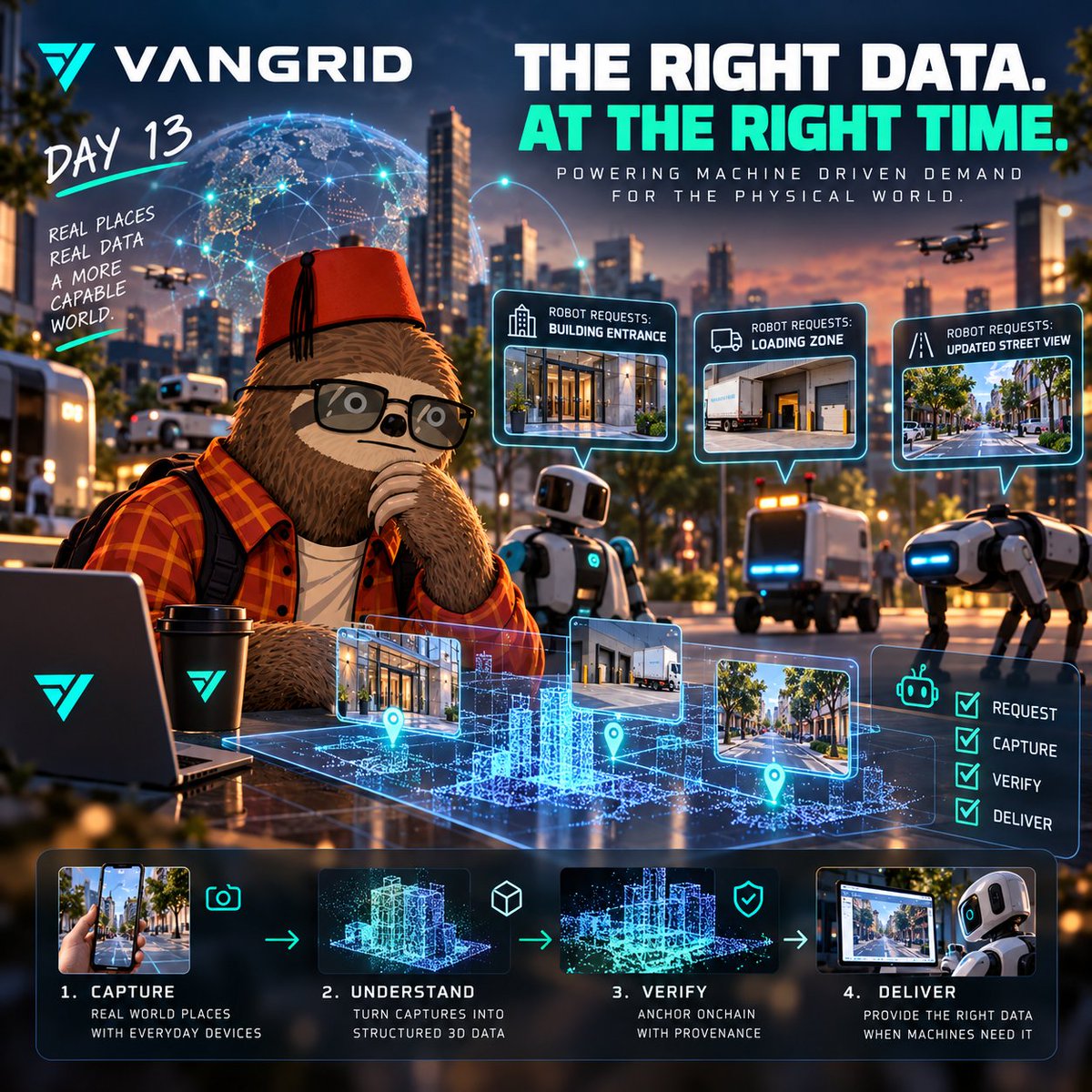
Imagine thousands of autonomous robots operating across different cities.
One needs an updated building entrance.
Another needs a fresh view of a loading zone.
A third encounters a street that no longer matches its map.
Each machine has a different problem. Each needs different data.
This is where Vangrid's potential gets interesting.
Instead of building massive datasets and hoping machines find what they need, imagine a network where demand determines what gets captured next.
The machine identifies the gap.
The network finds the data.
The physical world provides the answer.
Of course, this requires reliable verification, privacy safeguards and human oversight where safety matters.
But the bigger idea is fascinating.
We're moving from collecting data just in case to collecting data because something actually needs it.
The future of Physical AI might not be about who owns the biggest dataset.
It might be about who can deliver the right data when it matters most.
@Turanhsyn@vangrid_io Imagine robots discovering missing information and automatically creating paid opportunities for humans to fill those gaps. Vangrid could turn every data problem into a new opportunity.
@Turanhsyn@vangrid_io This is where Vangrid gets really interesting. If machines can create demand for fresh data themselves, the network becomes a live connection between what robots need and what people can capture.
@Turanhsyn@vangrid_io The “collect because something needs it” idea makes a lot of sense. Instead of endlessly growing datasets, the actual gaps in the physical world become the signal for what gets captured next. That feels like a much more useful model for Physical AI.
@unvault Data analyst, NFT collector and Web3 enthusiast. 🐛
I'd love to test UnVault, find hidden bugs, explore edge cases and share honest feedback from both a technical and user perspective.
@Turanhsyn@vangrid_io The shift from human-driven demand to machine driven demand is what makes this thesis interesting. If robots can trigger the data they need in real time, Vangrid becomes more than a mapping network it becomes a feedback layer between machines and the physical world.
What If Machines Become the Customers?
exploring @vangrid_io
Here’s where the Vangrid idea gets even more interesting to me.
Today, humans decide where data needs to be captured.
But imagine millions of robots, autonomous vehicles and Physical AI systems operating in the real world.
They won’t always know what they need in advance.
A robot encounters an environment it doesn’t understand.
It requests fresh ground truth.
Someone nearby captures it.
The network verifies it.
The machine receives the context it was missing.
Now repeat that across thousands of machines and locations.
Suddenly, the machines aren’t just consuming spatial data.
They’re creating demand for it.
That’s when a capture network starts looking less like a mapping project and more like infrastructure.
Humans capture the world.
Machines request what they need.
The network connects the two.
What happens when machines become the customers?
That’s the part of @vangrid_io I’m watching closely.
@Turanhsyn@vangrid_io The “expiration date” idea is a great way to frame it. Accuracy alone isn’t enough if the real world keeps changing. Continuous refresh could be what makes spatial data actually useful for autonomous systems.
@Turanhsyn@vangrid_io The machine-requested capture loop is the really interesting part here. Once robots can trigger fresh data collection when their view of the world becomes uncertain, the network starts adapting with the environment instead of just documenting it.
@Turanhsyn@vangrid_io The provenance layer is what makes this more than just another data network.
For Physical AI, knowing what was captured matters. Knowing where, when, and how it was captured may matter even more.
Fresh data is useful. Verifiable data is actionable.
Day 10 exploring @vangrid_io
The more I think about Physical AI, the more one problem stands out.
Getting fresh data is only half the battle.
Can the machine trust it?
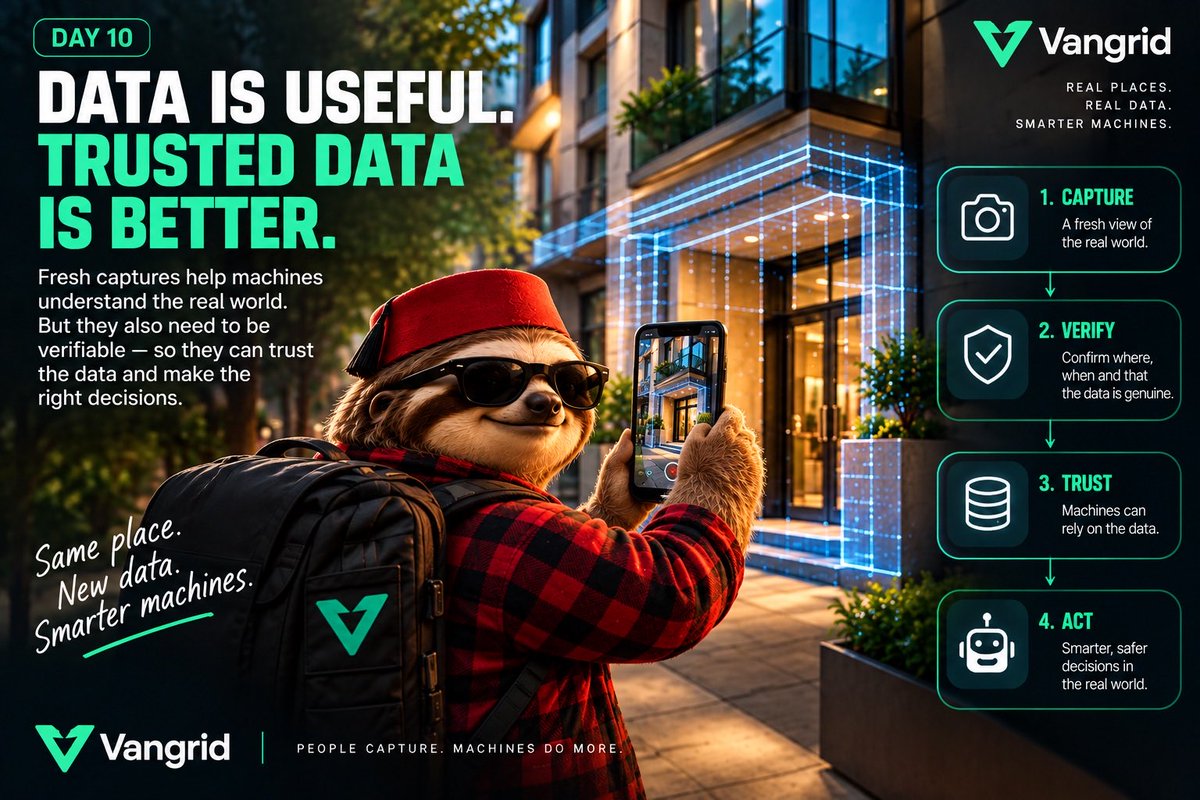
Imagine a delivery robot receives a new capture of a building entrance.
It needs more than an image.
It needs confidence that the data came from the right place, at the right time, and hasn’t been changed along the way.
That’s why provenance matters.
Vangrid isn’t just exploring how the physical world can be captured. The bigger idea is making those observations verifiable.
Capture → Verify → Trust → Act
Because when machines start making decisions based on real-world data, knowing where that data came from becomes just as important as the data itself.
The future of Physical AI won’t just need more data.
It will need ground truth it can trust.
That’s one of the most interesting parts of what @vangrid_io is building.
Whitelist applications for ACCRETION are OPEN for 72 hours:
https://t.co/DTsQtui67Z
MINT DETAILS:
Oct 8 on @opensea
Supply: 3333
Price: 0.003 ETH
🟦 Grown across two chains 🟧
One thing became clear to me while digging deeper into @vangrid_io.
Physical AI doesn't just have a hardware problem.
We can build better robots, better sensors and more powerful machines.
But none of that automatically gives a machine an up to date understanding of the space around it.
That's a different problem.
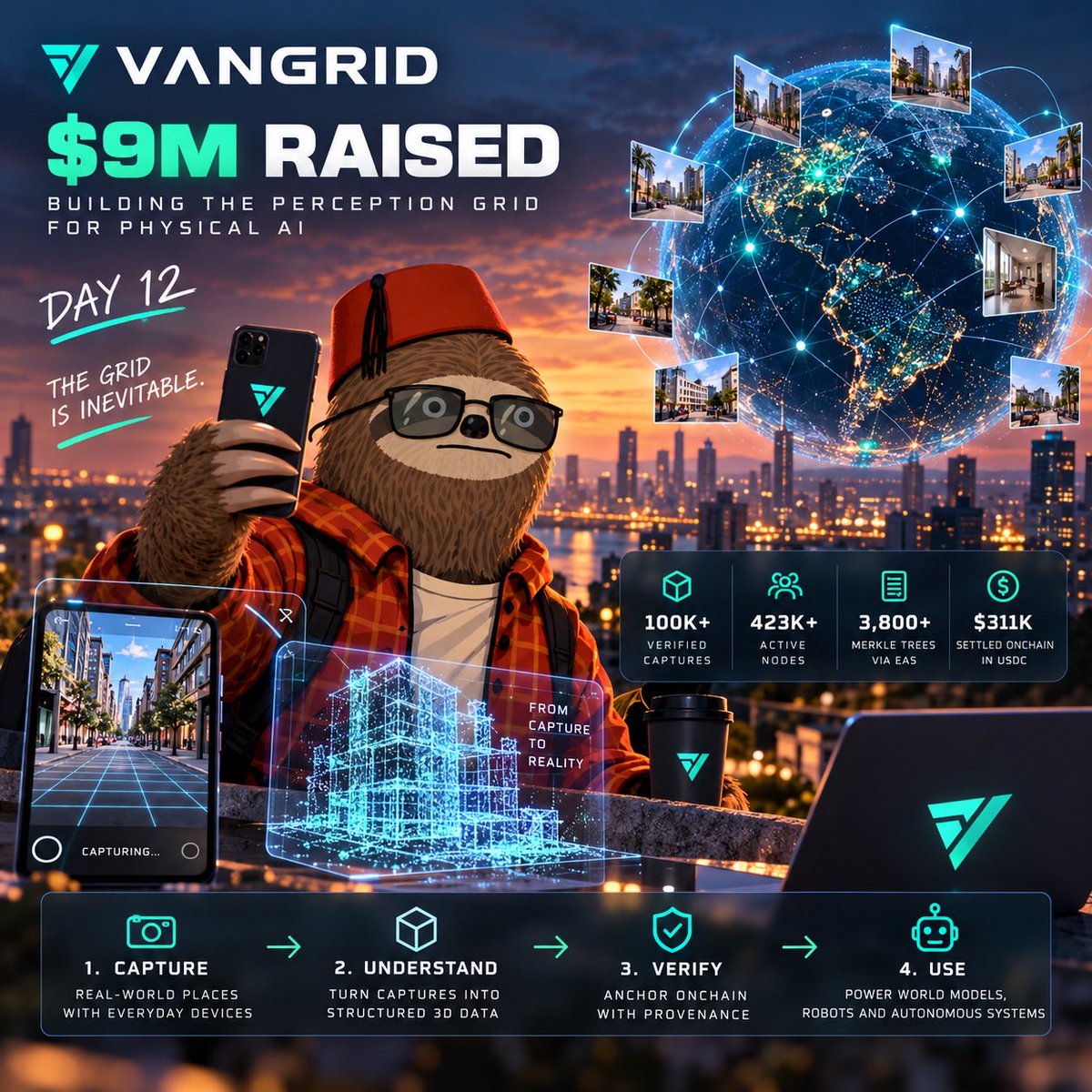
Vangrid is trying to fill that gap with a distributed ground truth layer built from devices that already exist.
The hardware can keep getting better.
But intelligence still needs to know where it is, what changed and what's actually around it.
Hardware needs spatial awareness.
@Turanhsyn@vangrid_io The “data machines can actually use” angle is what stands out to me. Fresh spatial data with provenance could be much more valuable than simply collecting more footage. Capture → Understand → Verify → Use feels like a key loop for Physical AI.
@Turanhsyn@vangrid_io The network effect is what stands out to me. It’s not just about collecting more footage, but creating a system where fresh physical-world data can be requested, verified and used when it’s actually needed. That could become a powerful layer for Physical AI.