Hacerle preguntas sexys a una mujer puede ayudarte a llevártela a la cama al instante.
30 preguntas sexys para hacerle a tu crush.
(Desde coquetas hasta subidas de tono.)
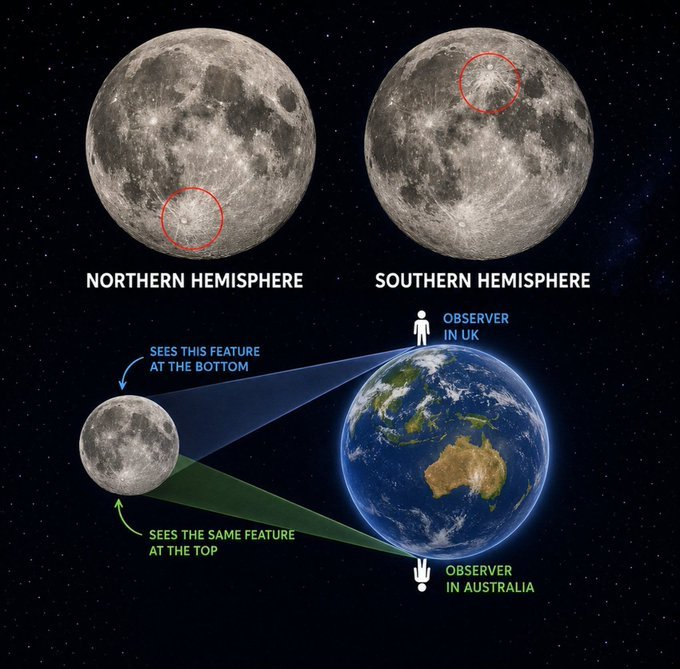
Australia Sees the Moon Upside Down — Same Moon, Just Flipped!Look up at the Moon from Sydney or Melbourne, and it appears rotated 180° compared to what people see in New York, London, or Tokyo. The craters, the “Man in the Moon,” the dark seas — everything is the same… but inverted.Why? Because Earth is a sphere.People in opposite hemispheres are literally standing “upside down” relative to each other in space. When you look up, your entire sky is rotated. The Moon itself hasn’t changed at all — your planet flipped your perspective.
Classic example: In the Northern Hemisphere, the bright Sea of Tranquility sits roughly in the upper left of the Moon. From Australia, it appears in the lower right — the whole face is turned “upside down.”This works for constellations too. The Southern Cross is invisible from most of the Northern Hemisphere, while the Big Dipper never rises for most https://t.co/JvsCUgDpz8 time someone says the Moon looks weird “down under,” just smile and say:
“Nah… your planet is upside down from here.” Have you ever noticed this difference when traveling between hemispheres? It’s one of the coolest “proofs” that Earth is round.
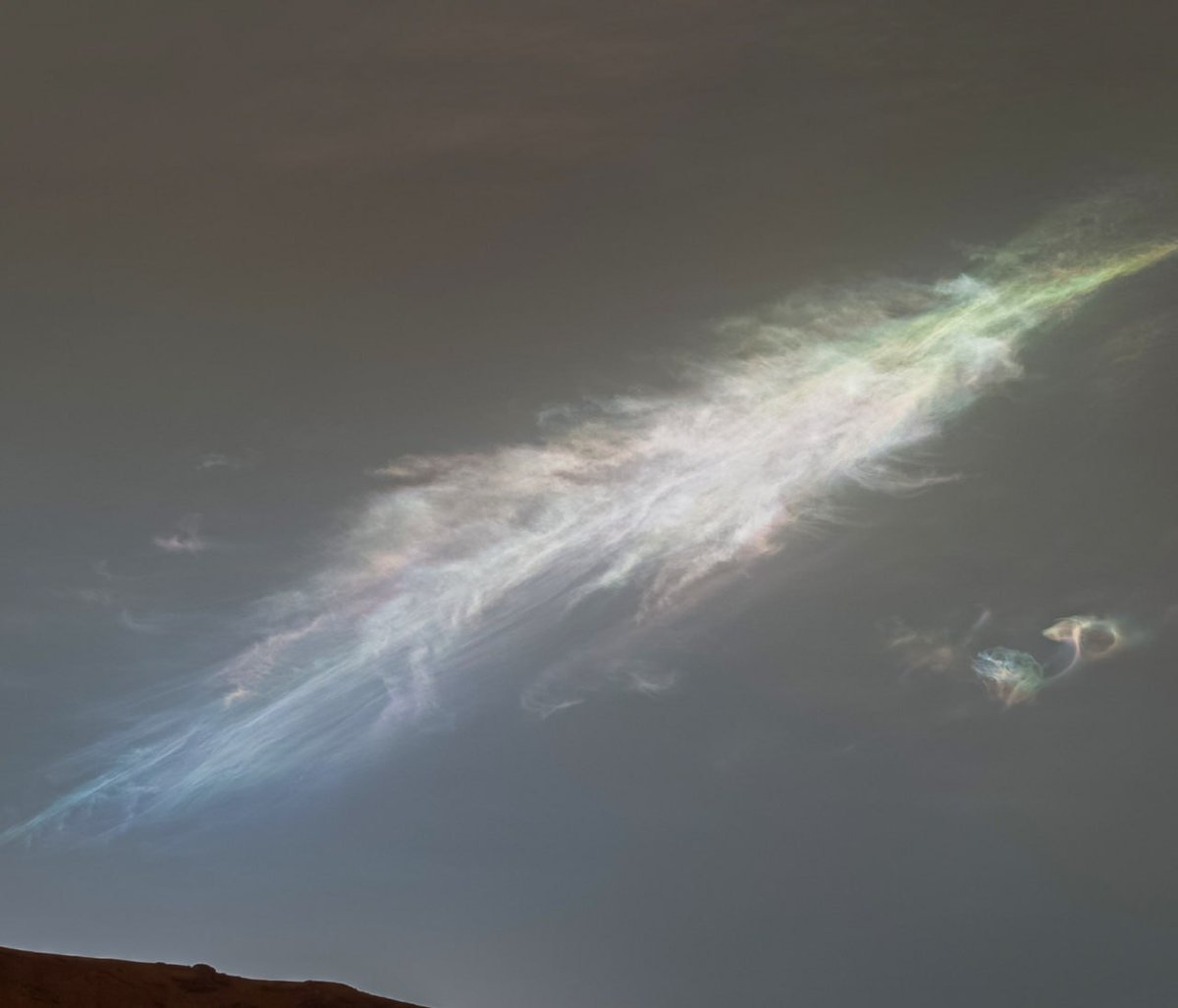
Martian Clouds: Icy Secrets of the Red Planet
The Curiosity rover has detected clouds on Mars consisting of either water ice or frozen carbon dioxide. These water clouds, like cirrus clouds on Earth, hang at an altitude of about 50 km.
In the hellish furnace of Venus—where surface temperatures soar to ~460–470°C (860–880°F) and pressure crushes at about 92 times Earth's—the Soviet Venera 14 lander achieved something extraordinary: it not only survived long enough to operate but also captured one of the only direct audio recordings ever made on another planet.Launched in 1981 and touching down on March 5, 1982, Venera 14 endured for roughly 57 minutes on the scorched plains before succumbing to the extreme conditions. Among its suite of instruments was a microphone (part of the Groza-2 package, shared with a seismometer), designed primarily to detect atmospheric sounds, possible thunder-like electrical discharges, and mechanical operations.The resulting audio—transmitted back to Earth—includes eerie, low-frequency rumbles: the relentless howl of super-dense winds whipping across the surface (moving slowly but with immense force, equivalent to hurricane-strength gusts in our thinner air), mechanical thuds and whirs from the lander's own activities (like the explosive release of its camera lens cap and the grinding of its drill attempting to sample the basaltic rock), and subtle vibrations as the probe settled and strained under pressure.These are among the very first (and still among the only) sounds ever recorded from another world's surface—preceding even the wind sounds picked up by later missions like InSight on Mars or Dragonfly concepts. Venera 13 (which landed days earlier on March 1, 1982) also carried microphones and returned similar recordings, surviving longer at 127 minutes and capturing comparable wind and mechanical noises.The raw, noisy tapes have been cleaned up, enhanced, and widely shared over the decades—often layered over simulated landing visuals—giving listeners a haunting glimpse into Venus's alien soundscape: a constant, oppressive roar punctuated by artificial intrusions from humanity's brief https://t.co/P3xlHuvcGC other probe has returned surface audio from Venus since the Venera program ended in the early 1980s. Future missions like NASA's DAVINCI+ or ESA's EnVision may revisit the planet, but for now, these faint, crackling echoes remain a rare auditory relic from our solar system's most inhospitable world.Image credits: Soviet space program archives (Venera 14 lander illustrations and surface panoramas from the mission); enhanced audio visualizations and modern renderings of the Venusian surface.