Where to find me:
Youtube: https://t.co/8hhI2MD3kJ
Community: https://t.co/eseTqEUnGn
Watch: https://t.co/4EmxMlB1vV
Support: https://t.co/dZTlKPq8sF
Consult: https://t.co/TEiYZsREHL
If my work has positively impacted you, you can find 150 more videos on my Patreon for $5.
@NeverSinkDev you've put a ton of time into helping the Path of Exile community and all of us are better for your work. congrats on the full time switch man. DM me anytime if there's anyway I can help support your projects.
Tapping in on the Twitch viewbotting discussion as an actual agency brand advertising executive.
This Twitch post is unlikely to convince any advertisers or streamers that the issue is improving.
Here's how to actually address this problem -
Viewbotting is an engineering and incentives problem disguised as a cultural one. There is no solution to this problem that can ever be achieved via culture change or moderation. People are debating the efficacy of the solution in Twitch’s post when the entire implementation isn’t even relevant.
Given Twitch’s track record, no one should believe Twitch will enforce this “viewer cap” change appropriately even if they did have the proper backend data (and I think they don’t.) They won’t even enforce against popular streamers who have viewbotting programs visible on their screen, streamers who roleplay bringing slaves on their broadcasts and feed them treats, or broadcasters who advocate blatent political violence, and so on.
Many streamers are on their 8th or 9th temporary bans for various TOS-breaking content. No one believes Twitch's intervention via moderation will change anything.
So again it’s a matter of engineering and incentives. I’ll break down each one. But first a productive question to ask. Why does Youtube Live - which now eclipses Twitch’s live viewership by 40% - have nearly no problems with bots and viewbotting?
Well first the engineering problem. Viewbotting gets solved by better detection, pattern recognition, IVT analysis, device fingerprinting, IP patterns, watch-time anomalies, removing off-platform embedding, and other boring backend stuff. As Dan correctly noted, these are things you can’t be public about because they’ll quickly see counterplay from the viewbot services. You just have to lock in and fix it. Google has spent billions of dollars solving this because advertisers don’t like invalid traffic. Their IVT rate now sits at a healthy 11% or so, easily beating competing live services like Tiktok (24%) and Twitch (35%+.)
Twitch hasn’t taken this problem seriously. I’ve spent hundreds of thousands of dollars on Twitch, and no team member has ever communicated to me or any of the agencies I work with about their IVT rates accurately. On the contrary it often feels like they throw raw viewership numbers around in pitch decks and presentations as the REASON to go advertise there. That used to work, but money is getting smarter in digital. Brands correctly care about return on spend and engagement with real people rather than just the perception that there are viewers around.
You need both bravery and expertise in engineering to make massive changes. Twitch actually has phenomenal engineers, many who were brought on by the former CEO to develop the world’s most advanced CDN (content delivery network) from 2015-2022 before Youtube Live recently surpassed it. But I’m not sure the company has the bravery to make real, necessary changes that many commentators on this post have noted must happen. Successfully “fixing” this would represent a 30-35% global drop in viewership for a website already perceived as ailing against its competitors.
To solve the engineering side you just have to apply more of the above technical solutions and spend money and time. Communicate with advertisers, refund us in high IVT events, keep improving your CDN, etc. It’s not a moderation issue, it’s not a viewer cap issue, that’s crowd pandering and will fix nothing. Both advertisers and the community begged for years for attention on this topic, while viewbotters bled us all and collected millions of dollars. Twitch has eroded trust and should just stop making these posts to the public. Users have lost tolerance for the platform and just need to see the actual changes.
The second problem is the incentive problem. Every system to succeed on Twitch is set up based on the number of viewers you have. The entire Partnership/Affiliate pipeline is viewership based. The entire discovery funnel is viewership based. Sponsorships are calculated on CCV per $. And the entire culture of the website is “more viewers = better.” So of course everyone will do anything possible to get more viewers. This not only encourages viewerbotting but also toxic streamer culture (IRL nuisance streamers, etc) because, again, it’s all about the views.
On Youtube Live monetization rewards sustained engagement and overall channel performance. Ads, super chats, channel memberships, etc. Discovery is pushed by an interest-based recommendation algorithm. Viewers will find you because of interest alignment - not because you have the most viewers. Barely anyone viewbots there because there’s no point. Adding viewers won’t help your channel, and Google’s AI/ML will instantly and automatically suppress your channel and shut off your ads.
It is frustrating that the C-Level over at Twitch keep posting about viewbotting as if it’s going to get solved by human moderation. As if Twitch is going to magically have an amazing enforcement team with “the data” that goes after the serial offenders and returns everything to normalcy. This is all solvable, even from where Twitch is now. But you have to make the investments on the engineering/CDN side and just get to work. Everyone is waiting and hoping for these changes.
Twitch’s viewbotting epidemic is a downstream effect of what every major streamer and industry professional told them would happen for years. They didn’t implement discovery engines, they didn’t change the incentive systems, they didn’t invest aggressively against obvious botting cases, and they didn’t communicate. Now they have an existential advertising and creator crisis. You reap what you sow.
A note on our work to combat viewbotting, from CEO Dan Clancy:
There’s been a lot of discussion recently about viewbotting on Twitch, and I wanted to share an update on our enforcement efforts.
Viewbotting is bad for our business. We don't benefit from it, and we believe it harms the creator ecosystem overall. However, effectively combatting viewbotting is challenging. As we deploy updates to our real-time detection algorithms, viewbotting companies quickly respond with updates to avoid detection. Also, our detection systems must be precise to ensure that legitimate viewers are appropriately counted.
Today, we’re introducing a new enforcement type that we plan to roll out over the next few weeks. For channels identified as persistently viewbotting, we will apply a cap to the streamer’s CCV for a fixed period of time, on all of the Twitch surfaces. The cap will be based upon historical data regarding that creator’s non-viewbotted traffic. Repeated violations will result in longer penalties. Streamers will be notified when an enforcement is applied, along with the duration of the penalty, and can appeal through the appeals portal.
While streamers will be notified, we will not make a follow-on announcement when we begin issuing these enforcements, and will not publicly share details about when and where these enforcements are applied. Unfortunately, providing details simply makes it easier for companies to work around our interventions.
We believe this approach will help us make meaningful progress against viewbotting. We will continue refining our systems and expand when we apply these enforcements over time.
- Dan Clancy
I will break your side of it (Kick) down more in the upcoming video. What your program is doing for your streamers makes a lot of sense. As I mentioned in the OP, I see it as an alternative (and probably superior) marketing strategy to putting your site on the map versus what Twitch did from 2015 -> 2020.
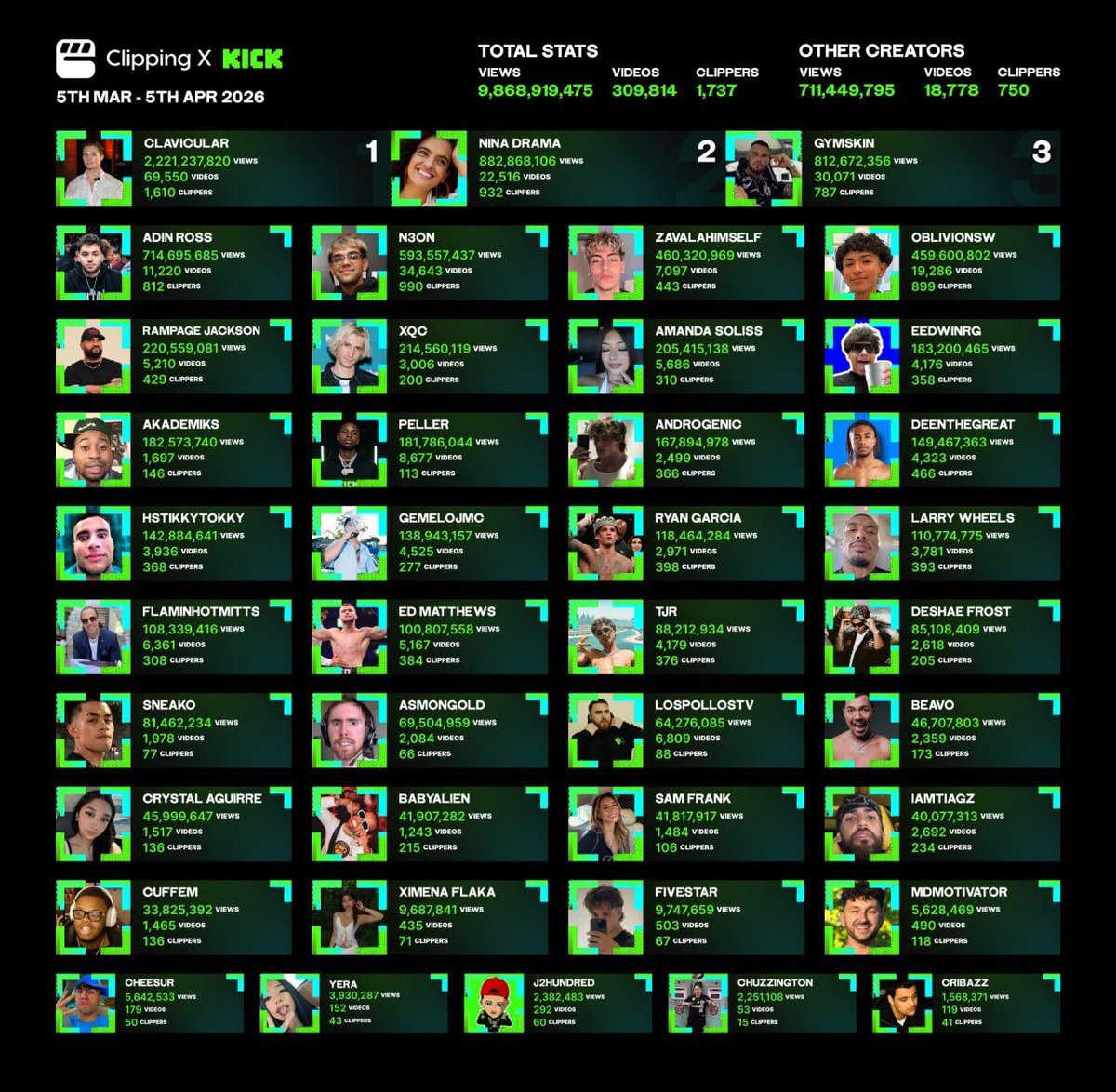
If you understand this chart you understand the state of livestreaming in 2026. You can propel any influencer to high viewership regardless of content quality by tricking algorithms into featuring them. It guarantees followers and is basically pay to win.
Here's how it works:
Central Discord servers post opportunities for anyone to clip any content from a streamer in exchange for CPM ($s per 1000 views.) Typical CPMs are .50c to $2, with a minimum view limit for payout of 100,000 views.
The clippers are mostly second or third world where the USD currency exchange rate is more favorable. Platforms are usually Tiktok, Instagram, and YT Shorts, but also sometimes X. Clavicular has said payouts are sometimes as high as $30 CPM, but I don't believe that.
Because of the view limit, many of the views on these charts are free. Clavicular had 2.2 billion views on 70,000 clips, putting the average clip at 31,700 views. That would suggest most of the views are free (below the 100,000 view limit.)
I am also told a single clipper can count multiple clips towards that view limit. If that is true, it would make these campaigns much more expensive than what I state below.
Assuming 90% of the views are free, it would cost about $222,123 a month to run his campaign alone at $1 CPM. That number goes up to $666,371 if only 70% of the views are free. It's also exponentially higher if the CPMs are even remotely where Clavicular says they are (it would be in the millions per month.)
Now here's the interesting part. None of these people are running these themselves. With respect to these streamers, some of them are quite smart but none of them have the marketing prowess to run a campaign like this.
These campaigns are being run and funded by Kick themselves. To quote Clav on stream last month: "I believe it’s about a thousand clippers right now. A billion views a month. Kick has helped push me a lot with their clipping budget, over six figures a month in that campaign going towards pushing me out to new audiences."
Kick is spending MILLIONs of dollars a month promoting these streamers, and then is also paying them via their partner program as well. It seems to be totally arbitrary who gets promoted and who doesn't, a "who you know" sort of thing.
This is a different approach to Twitch's growth marketing strategy that they executed from 2012-2019ish, which was to pay streamers for exclusivity and the number of viewers they had with MGs and bonuses.
It's a much more effective strategy because it abuses algorithms. 70,000 clips in a month of Clavicular tells an algorithm "hey a ton of people are posting about this person, make sure anything he posts blows up."
You could be the most uninteresting person ever (indeed some of the people on this list are) and still get massive reach because it's not the people that are voting on your popularity with engagement. It's the algorithm pushing it no matter what because it's taught that sheer volume of posts about the same thing = that thing is important.
From one perspective this is astroturfing content creators and creating false ecosystems. From another it's a new age multi-million dollar marketing campaign from a platform to drive viewers to itself.
Wherever you stand on it, streaming is a much more "gamed" ecosystem now and will remain so. There's no real way to police this behavior since it hijacks how algorithms perceive growth and serve content.
This makes livestreaming the most "rigged game" in content creation and you will see very few broadcasters come up in the next couple years who aren't utilizing this strategy.
@nmplol Huh, this is a really smart insight I never thought of. For all extents and purposes it is absolutely an ad. I will include this in the upcoming video and mention you.
@TanisAtTheDisco Thank you!! Post did better overnight, so I will leave the post up. It originally had 50k views in 5 minutes but editing the post reset and bugged it. I will do a video in 1-2 days with WAY more information. Since this post I learned a lot more. I will post it on my main YT.
This strategy looks overwhelming at scale but still works for a small creator or someone with limited budget. You could get a couple friends together and post your content across multiple platforms. You won't generate billions of views but you will meaningfully grow your audience relative to the work you put in.
@aawkdys Cool. If that's true, here are your options:
1) Educate me on how it works so I can better explain it.
2) Make your own post on how it works.
3) Have the audience conclude whatever they want based on my research.
Your call.
@aawkdys That was already pointed out to me and I made an edit to clarify it, thank you. That would just make the campaigns more expensive to run but everything I said would stay intact. We can DM if you want I'll clarify it better if I'm wrong.
@d3ad1n51de Interesting. Thanks for posting this. Everything I stated would hold true if this were the case, it would just mean these campaigns are much more expensive to run.
I'm honored you believe I've had that much influence on this space, but I'm not that important. My business is brand advertising and the last time more than 5% of my budget was in livestreaming was 2020ish. I make no money based on what Kick does or doesn't do (they have no advertisers) and hope primarily to educate.
Nah. I have nothing to do with this program and never did. I've never worked with Kick or been paid $1 by them.
I study this stuff because it's interesting and I have a natural drive to understand new media and talk about it.
From a certain perspective it's one of the most interesting and effective marketing campaigns ever run by a platform. Though I'm deliberately vague on where I stand on it morally because I'd rather the reader decide.