Kolkata has officially joined the elite league of cities pioneering quantum computing . 3rd quantum computer in the country has been successfully installed at TCG CREST,Salt Lake Sector V.
An important milestone in India’s Tech achivement
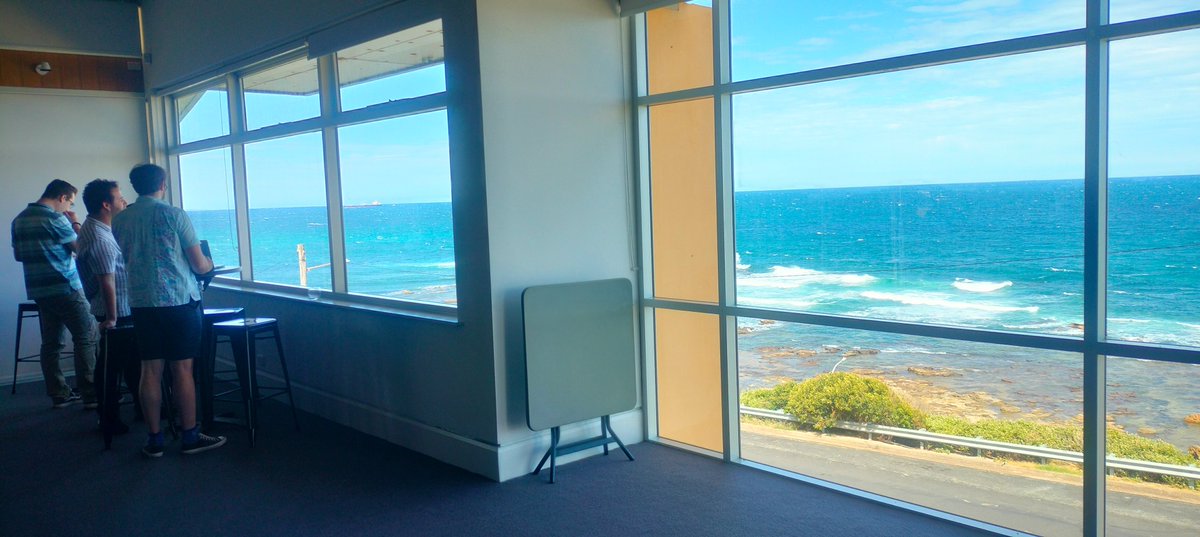
Nothing could be better than starting the week in such a place. This is Stars in Newcastle and the 11th Australian Exoplanet Workshop at Fort Scratchley, just beside the Pacific! Happy to be a LOC member and a participant. #Astrophysics
As part of the IYQ-2025 celebrations, CQuERE @ TCG CREST is delighted to welcome Physics Nobel Laureate Prof. Anne L’Huillier (Lund University, Sweden) for the 19th IYQ Talk: “Attosecond Physics: From the Source to the Applications”.
Details : https://t.co/HgNQ1UGxrl
𝗧𝗖𝗚 𝗹𝗮𝘂𝗻𝗰𝗵𝗲𝘀 𝗰𝗲𝗻𝘁𝗿𝗲 𝗳𝗼𝗿 𝘀𝗰𝗶𝗲𝗻𝗰𝗲 𝗿𝗲𝘀𝗲𝗮𝗿𝗰𝗵 𝗮𝗻𝗱 𝗲𝗱𝘂𝗰𝗮𝘁𝗶𝗼𝗻.
Technocrat-turned-entrepreneur Purnendu Chatterjee has come up with TCG CREST (The Chatterjee Group Centres for Research and Education in Science and Technology). The university comprises five schools — natural sciences; mathematical and computer science; health, environment and sustainability studies; humanities and social sciences; and economics. The facility in Salt Lake would also house East India's only quantum computer.
Former vice-chancellor of Presidency University and a mentor at CREST, Malabika Sarkar stated, "Kolkata has historically been known to produce some of the brightest minds. Even today, some of the brightest students come from Kolkata." Admissions for the PhD programme will start in August this year, followed by the master’s programmes in August 2026.
"Jana Gana Mana" (Bengali: [ɟənə gəɳə mənə]) is the national anthem of India, originally composed in Bengali by poet Rabindranath Tagore, who was awarded the #NobelPrize in Literature in 1913.
Pictured: An English translation of Jana Gana Mana by Tagore
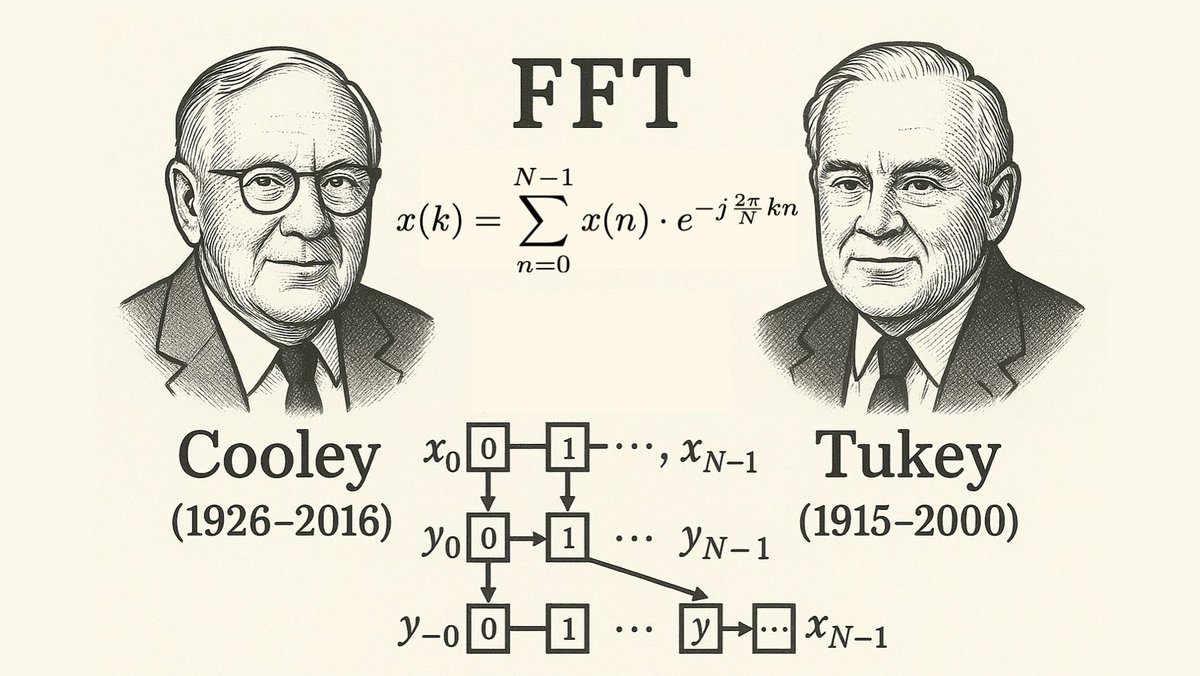
60 years ago this month, the Fast Fourier Transform (FFT) was introduced by Cooley & Tukey (1965) - one of the most important algorithms in signal processing and data analysis.
In 1805, Gauss - studying the orbits of asteroids Pallas and Juno - came up with a method to interpolate their trajectories from discrete samples. What he came up with was mathematically very close to the modern FFT but Gauss never published that work, and didn’t analyze its computational complexity. It predated even Fourier’s 1822 work on heat diffusion - but without the framing or generalization that Cooley & Tukey would bring 160 years later.
In 1965, Cooley & Tukey published their now-famous algorithm that reduced the cost of computing a Discrete Fourier Transform from 𝑂(𝑛²) to 𝑂(𝑛 log𝑛). This leap made real-time signal processing and digital media compression feasible.
From radio telescopes to JPEGs, from audio codecs to quantum mechanics - the FFT is everywhere. It’s one of the most important (and elegant) algorithms of the 20th century - rooted in the genius of Gauss, but brought to life in the computer age.
My documentary of capturing the Aurora in Ladakh while cycling to the highest pass in the world at 19,000ft is out!!! Here’s a small part from it, do watch the entire film - link in bio.
👩🔬 Remembering Rohini Godbole, trailblazing physicist and champion for women in science.
📖 On #InternationalWomensDay, let’s honor her legacy by making science more inclusive and equitable.
🔗 Read more:
https://t.co/MT7YaXdnGQ
#NatureIndia#WomenInScience
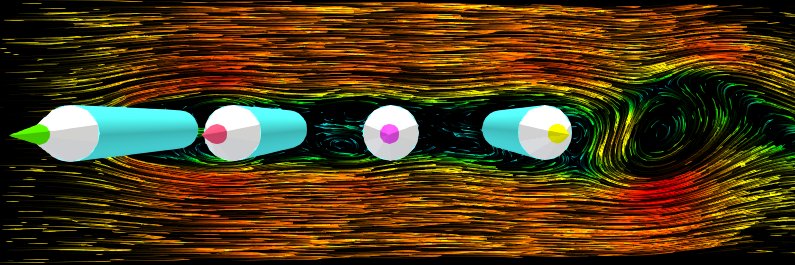
The launch of @ISRO/@ESA#Proba3 mission as seen from 100km away.
I love the contrast between #India's rich cultural ancient heritage and its ambitious spaceflight program in one frame.
Video credit: @nkknspace for Space Intelligence
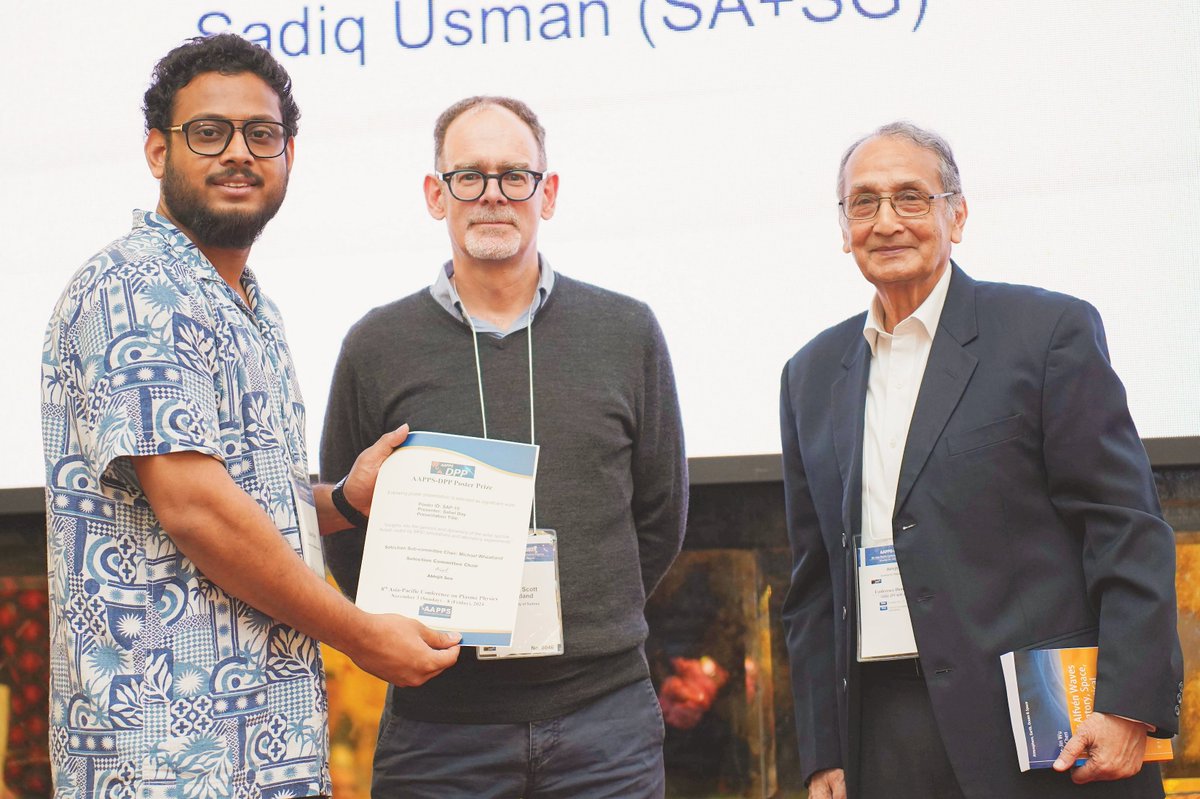
A memorable moment from the Asia-Pacific Conference on Plasma Physics,Malaysia: our poster was selected as one of the best posters in the Solar and Space Plasma group. Heartfelt gratitude to @piyalico, alma mater @IIABengaluru,@Physics_at_IISc & current institute @Uni_Newcastle
An integral part of the thesis work relied on the availability of large-scale computing resources.
Thanks to @IIABengaluru, SERC @iiscbangalore, @DiRAC_HPC for their generous support.
#InfosysPrize2024 in Mathematical Sciences is awarded to Prof. Neena Gupta of @ISIKolkata for her work on the Zariski Cancellation Problem, a fundamental problem in algebraic geometry first posed in 1949 by Oscar Zariski, one of the founders of modern algebraic geometry. In 2014 she proved the striking result that Asanuma’s 3-dimensional affine variety yields a negative answer to Zariski’s original Cancellation Problem in positive characteristic.
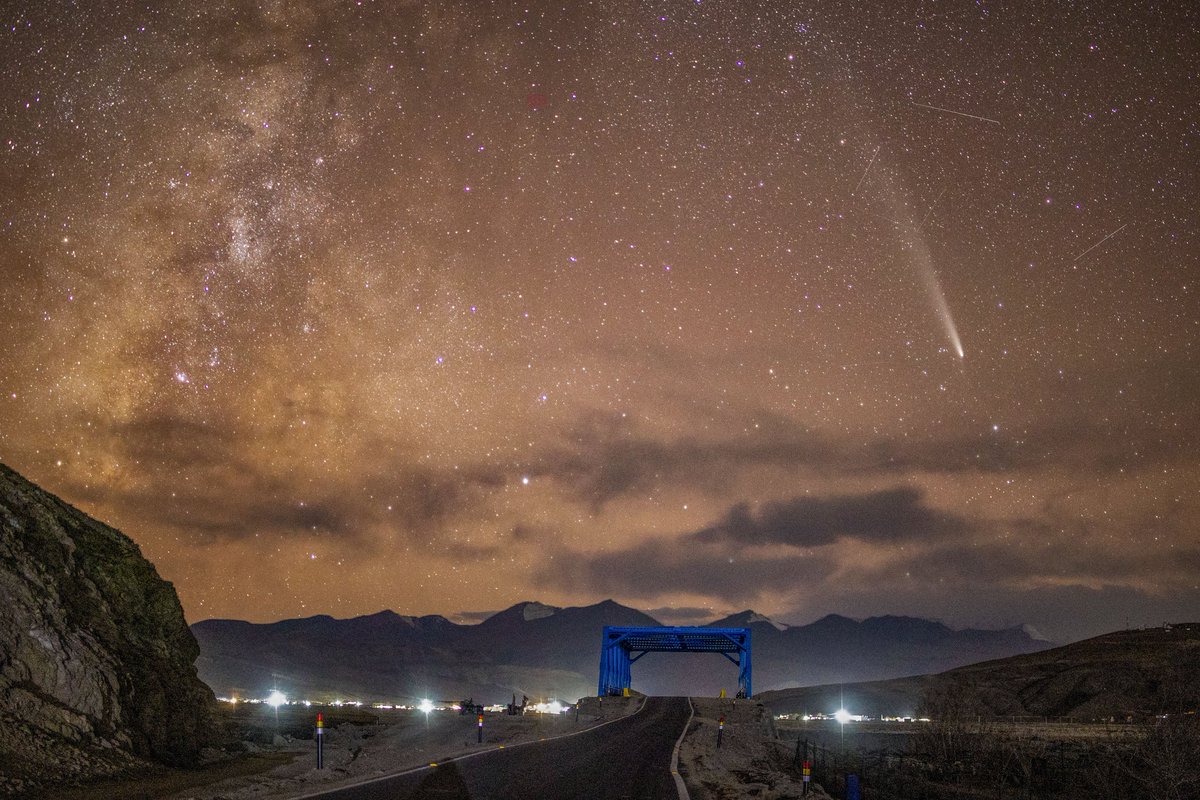
A fleeting moment where the eternal and the transient meet. Comet A3 (Tsuchinshan- Atlas ) captured with Stupa in the foreground at Tsemo , Ladakh
Before the comet fades into oblivion, tried another shot at it .
It's @Aus_ScienceWeek! 🧬🧪🔬👩🔬
In honour of celebrating all things #science, meet Dr Rogers (@quantumdiamonds), whose research involves not just diamonds, but making diamonds glow with the help of lasers! 💎👇