Today it is the end of the 9th Summer School on Multimessenger Astrophysics that I organized at @ice_csic. Excellent group of students, lots of good questions and interest! Thanks to all participants and lecturers for a wonderful school.
In-depth: Temporal evolution of the periodic GeV signal from 4FGL J1913.2+0512 and analysis of the SS 433 / W50 lobes (https://t.co/pD3RuCeUVm). We find a temporally unstable, periodic gamma-rays from 4FGL J1913.2+0512 and favor a leptonic origin for the western lobe.
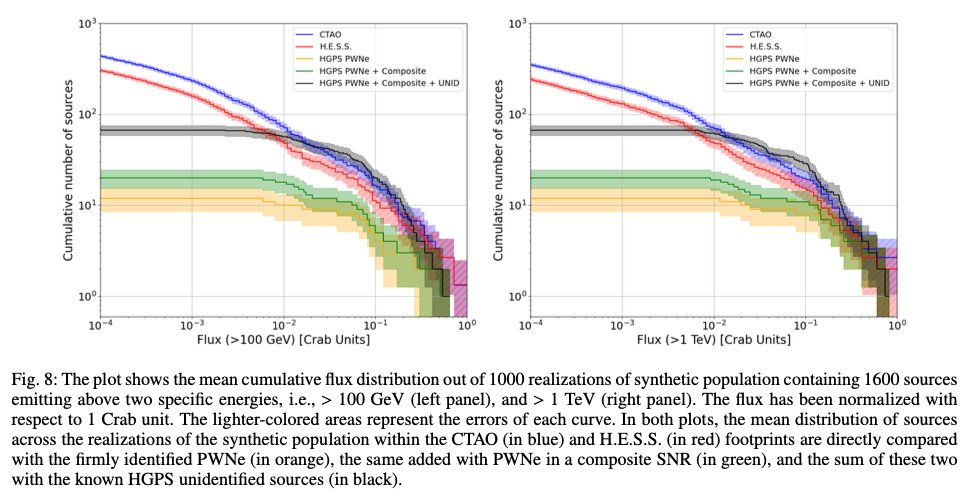
Today, we release the 1st part of 'Population synthesis of Galactic middle-aged pulsar wind nebulae' focusing detection prospects for current and future instruments (https://t.co/TXXdTY7gV2, A&A). We study the effects of reverberation in the expected PWN population in the Galaxy.
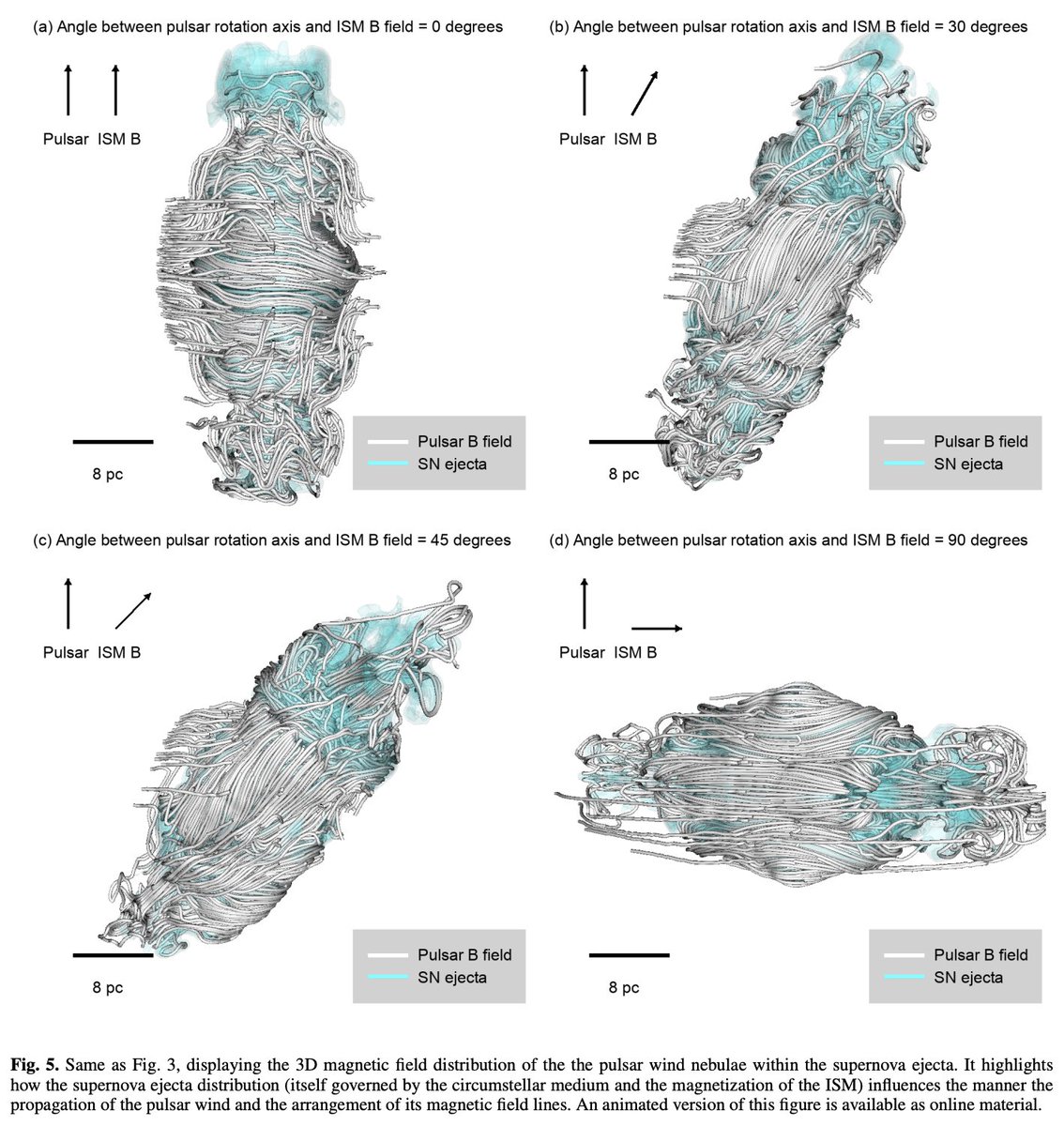
Today, I'd like to comment to our A&A paper https://t.co/F2J7eeUwjs "Classical, large scale 3D MHD simulations of interacting pulsar wind nebulae" deepening the study of morphology and mixing in PWNe when affected by the circumstellar medium.
Predoctoral 4-years post in our group; deadline: January 8, 2026. https://t.co/3MzyElCB0W -you should hold a degree or a MsS (preferably) -your title should be from Spain or homologation must be initiated at the time of the application. Details: https://t.co/gioxk1MSee
Today, we are releasing the first circular of the 2026 Summer School on Multimessenger Astrophysics, at @ice_csic Get full details at https://t.co/ZSe3POgCVb and join us in 2026 for 10 days of in-depth lectures and hands-on experience on this fascinating topic.
I'd like to introduce our recent A&A Letters https://t.co/e07uXcLU99 analyzing the origin of the dispersion in pulsar gamma-ray efficiency. The intrinsic efficiency of the emission mechanism is the leading factor (smaller influence of distance or moment of inertia uncertainties).
I will soon have an opening for a PhD position, in the context of the Spanish Ministry PIF2025 program. Brief details of my project can be found here https://t.co/T3IX5FiZJv @CSIC@DPE_CSIC Contact me if interested in more details look for the Ministry's formal announcement.
The first week of the academic year started with two of my students successfully defending their Ph.D. research. Congratulations, Dr. García and Dr. Zhang!
We have also recently released 'A Systematic Search for MeV-GeV Pulsar Wind Nebulae without Gamma-ray Detected Pulsars' (ApJ https://t.co/mOrB13qO2b ) We report the analysis of 58 regions, with 9 likely PWN counterparts. This would increase the GeV PWN population from 12 to 21.
We have just released 'Probing multi-band variability and mode switching in the candidate transitional millisecond pulsar 3FGL J1544.6-1125' (A&A) https://t.co/9yNsUNdLXY Our findings reinforce the mini-pulsar nebula picture for tMSPs in the sub-luminous state.
I am glad to share good news: The Fermi Collaboration has just been awarded with the 2025 Giuseppe and Vanna Cocconi Prize of the European Physical Society for outstanding work in particle astrophysics the last 15 years! @ICREA@CSIC@IEEC@ice_csic
We recently released "Fermi-LAT and FAST observation of the gamma-ray binary HESS J0632+057" (JHEAp) https://t.co/nJF81AtAGx We carried out six deep radio observations. No radio pulsation was detected. Gamma-ray luminosity at the lowest of gamma-ray binaries.
Our paper 'Galactic transient sources with the Cherenkov Telescope Array Observatory' has been accepted for publication in MNRAS. The article will be available at https://t.co/ZF2Sy5wQ5C
3) The light curves that a pulsar may produce are dominated by geometry, with little influence of timing and spectral properties. As a result, a single pulsar can fit the whole population producing a similar distribution of errors.
Today we release "Synchro-curvature description of gamma-ray light curves and spectra of pulsars: concurrent fitting" https://t.co/WCQLe9w8eX Main points are:
2) We introduce and develop gamma-ray light curve fitting techniques, using a weighted reduced chi in time domain, and the Euclidean distance of the Fourier transform of the light curves, i.e. transforming the light curves to the frequency domain, fitting, and transforming back.