I hate to break it to you but....
Lifting 3-4x a week, walking 8-10k steps daily, getting sunlight, eating mostly real food, limiting alcohol, and sleeping properly does fix 90% of your problems
‘SPIDER-MAN: BRAND NEW DAY’ has debuted with 93% on Rotten Tomatoes.
Highest rated live-action Spider-Man movie, tied with ‘Spider-Man 2’ & ‘No Way Home’.
Read our review: https://t.co/wOWwEH0jWa
Before Fable 5 goes live again, you need to read this.
Anthropic recently published its full guide to prompting Fable 5 for the best outputs.
Most people have no clue it exists, but it's a game-changer.
When Fable was originally launched, these are the principles I used:
Vibe coders are getting sued.
People are shipping apps with real users and skipping the boring stuff that kills them.
A 20+ year dev shared the pre-launch checklist every AI builder needs.
I added what I learned after shipping 60+ apps at the agency.
Don't skip this:
1. Protect yourself, not just your app. The moment you collect user data you're in legal territory (GDPR, CCPA). Have a privacy policy. Know where user data lives.
2. Row Level Security. Without RLS, anyone can open DevTools and read your entire database. Supabase → Auth → Policies. Zero policies means your app is naked. 5 min to fix.
3. Test the failure path, not just the happy path. Wrong password 5x. Reset for an email that doesn't exist. Verification link clicked twice. Signup with an existing email. Catches 80% of auth bugs.
4. Security baseline in 2 min. Prompt your AI: "Review my app as a security specialist and make sure I have strong security headers and a solid baseline security posture."
5. OWASP. Prompt: "Review my app against OWASP standards and highlight vulnerabilities." This is where SQL injection, XSS and auth bugs actually get caught.
6. Client-side validation is UX, not security. Attackers disable JS and hit your API directly. Validate again on the server. Every time.
7. AI code leaks data in 3 spots: .env values in the frontend, API responses returning too much, secrets in logs. Prompt: "Check my app for credential or sensitive data leaks in frontend or API routes."
8. API keys in the frontend means game over. If it's in the browser, assume it's already taken. Move it server-side or proxy it.
9. Rate limits before someone burns your API bill. Cap every endpoint hitting a paid API. I've watched a Supabase bill jump from $20 to $200 in a day.
10. CAPTCHA on public forms (Cloudflare Turnstile is free) plus CORS locked to your domain. 10 min, kills bot floods.
11. Error messages that don't leak. "User not found", not "SELECT * FROM users failed". Log full errors server-side, show users generic messages.
Build fast. Just don't ship naked.
(full breakdown in my article below)
You can build an AI second brain in 15 minutes.
No coding experience needed. no $1000 course
[Here is how you can do it in 5 mins:]
Step 1: Download Claude Desktop.
Step 2: Download Obsidian Desktop.
Step 3: Create a new vault and start dropping .MD files into it.
Step 4: Tell Claude Code to connect directly to your vault using Andrej Karpathy's prompt: https://t.co/2SJBZyjXDl
That is it.
Your entire knowledge base becomes searchable, connectable, and queryable by the most powerful AI model on earth.
Every note you have ever written.
Every idea you have ever captured.
Every resource you have ever saved.
Claude can now read all of it, find connections you missed, and surface insights from your own thinking that you forgot you had.
Most people are using Claude as a search engine.
The people building second brains with it are using it as an intelligence layer on top of everything they know.
The gap between those two use cases is the gap between asking Google a question and having a research partner who has read everything you have ever written.
Bookmark this.
Build it tonight.
A guy on Reddit with 10 years of engineering experience just shared the one thing he'd teach every vibe coder first.
And it'll save you thousands in AI costs. 🤯
Most people using Claude Code use it the expensive way. They call the AI every time the tool runs. Every run burns tokens. Every token costs money.
His advice: flip it. Use Claude Code to BUILD the tool once. Then run it forever without spending a single token.
Simple example. You want to check a website daily for updates. The expensive way: have an LLM search the site every day. Burns tokens every single time.
The free way: use Claude Code to write a script that scrapes the page and alerts you if anything changed. Build it once. Runs forever. Zero tokens.
Then he took it further. He had Claude Code build him a full neural network something that used to take weeks and years of ML training while he cooked dinner.
It runs for free. No tokens. No API calls. Forever.
Spend tokens once to build it. Run it for free forever.
That's it. That's the insight most vibe coders are missing.
Anthropic posted a FULL GUIDE on how to prompt Fable 5 (Mythos).
Claude Fable 5 is not meant to be prompted like any other model.
It's meant to run autonomously.
Here's exactly how to enable Fable to do work for you with minimal manual intervention:
1. Effort selection
Anthropic recommends using High for most tasks and Xhigh only for complex workflows.
Low/medium: quick questions, basic research
High: default for most work
Xhigh: complex builds, multi-step analysis
Ultracode: full autonomous orchestration
2. /loop prompting
Use /loop prompts to kick Fable off to complete full tasks.
/loop <time interval> + <goal>
3. Tell it WHY, not just what (context)
Fable can't perform on instructions alone. It needs context to make decisions on its own.
Anthropic's exact prompting structure:
"I'm working on [larger task] for [who it's for]. They need [what the output enables]. With that in mind: [your actual request]."
4. Keep prompts short (instructions)
Counterintuitive but critical.
Over-engineering your prompts on Fable 5 degrades output. You're constraining a model that would have figured it out on its own.
4. Tell it when to stop and check in during runs
"Pause for me only when the work genuinely requires my input: a destructive action, a real scope change, or something only I can provide. Otherwise, keep going and report back when done."
5. Build it a memory system
Fable performs best when it can record lessons from its previous loops.
Give it a markdown file and this instruction:
"Store one lesson per file with a one-line summary at the top. Record corrections and confirmed approaches. Don't save what the repo or chat history already records."
The optimal general prompt structure:
"Goal: I'm working on [larger task] for [who it's for]. They need [what the output enables].
Request: [your specific ask in one sentence]
Output format: [exactly how you want it]
Constraints: [what must not happen]."
One last thing - your old prompts may actually work against you.
Skills and project instructions built for Opus 4.8 may produce worse results on Fable.
Bookmark this to actually maximize your Fable workflows.
MUST MUST MUST MUST MUST MUST MUST MUST MUST MUST MUST MUST MUST MUST MUST MUST MUST MUST MUST MUST MUST MUST MUST MUST MUST MUST MUST MUST MUST MUST MUST WATCH
ANTHROPIC JUST PROVED MOST PEOPLE HAVE NO IDEA HOW TO PROMPT CLAUDE.
Their applied AI team dropped a 24 minute free workshop.
Not a creator who reverse engineered it.
Not a Reddit thread.
ANTHROPIC.
The people who wrote the weights.
And what they showed is uncomfortable.
There are 6 elements to a properly structured Claude prompt.
Most people are using 1.
Maybe 2.
That is not a skill issue.
That is an information issue.
And it has been quietly costing you every single day.
The outputs that felt slightly off.
The responses you had to rewrite 4 times.
The prompts that worked once and never again.
All of it traces back to the same 6 missing elements.
The people who watch this 24 minute workshop tonight will understand something about Claude that most daily users still do not know exists.
The people who skip it will keep getting 30% of what the tool is actually capable of and wonder why the results never quite land.
I watched it twice.
Then I built a Claude Skill that applies all 6 elements to every prompt automatically.
No more thinking about structure.
No more guessing what Claude needs.
The framework runs in the background every single time.
Full breakdown and skill setup is below.
Bookmark this now.
Watch the workshop first.
Then read the guide.
This is the one that compounds.
Follow @cyrilXBT for the exact prompt architecture, Claude skills, and systems I use to get outputs most people do not believe came from one person working alone.
Spent the weekend building instead of doomscrolling.
Hot take: most dev portfolios are useless.
No users. No business impact.
Tried to build mine differently.
https://t.co/4mNwsYGSlX
Quote this — what did I miss?
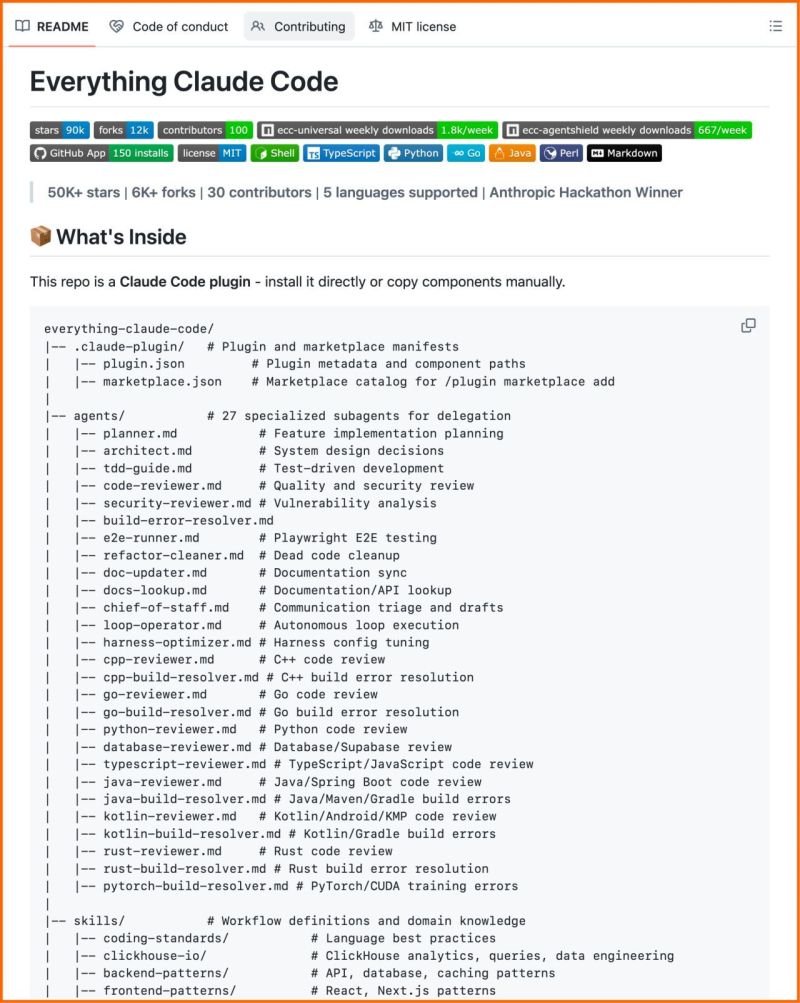
This is the most complete Claude Code setup that exists right now.
27 agents. 64 skills. 33 commands. All open source.
The Anthropic hackathon winner open-sourced his entire system, refined over 10 months of building real products.
What's inside:
→ 27 agents (plan, review, fix builds, security audits)
→ 64 skills (TDD, token optimization, memory persistence)
→ 33 commands (/plan, /tdd, /security-scan, /refactor-clean)
→ AgentShield: 1,282 security tests, 98% coverage
60% documented cost reduction.
Works on Claude Code, Cursor, OpenCode, Codex CLI. 100% open source.