I'm cautiously bullish on @injective heading into 2027, but there's one thing I care about more than the hype: actual execution.
I think two of the biggest opportunities for Injective next year will be the growth of Real World Assets and the continued development of decentralized financial infrastructure.
Why RWA?
Traditional finance is slowly moving toward tokenization.
Real estate, private credit, bonds, and other financial assets can all benefit from faster settlement, greater transparency, and easier access to onchain markets.
Injective is positioning itself for this shift with its focus on financial infrastructure, trading, and tokenized assets.
I have also come across reports mentioning over $1 billion in tokenized assets across the Injective ecosystem, along with around $1.5 billion in mortgage-related assets recorded or represented onchain. ( i will drop my sources in the comments👀)
The Veyra upgrade in November 2026 was another step toward expanding RWA markets on Injective.
And this is where my main thesis starts.
My three scenarios for 2027:
Base case:
RWA issuance continues to grow, but secondary market trading and the direct economic impact on $INJ develop more gradually.
The ecosystem expands, but that doesn't necessarily mean the token's value will grow at the same pace
Bullish case (the one I give more weight to 😀):
Larger tokenized assets start seeing real trading activity.
Liquidity improves, more financial institutions get involved, and actual market activity creates sustainable demand for Injective's infrastructure and $INJ.
Bearish case (hopefully not):
The value of announced assets looks impressive on paper and in onchain metrics, but real trading volume, liquidity, and user adoption remain limited. Meanwhile, competing chains attract more issuers and liquidity, leaving Injective without a lasting competitive edge.
- My final take :
For 2027, I'm more confident in the growth of Injective's RWA ecosystem than I am in expecting $INJ to appreciate at the same rate.
How to join Kredo's AI Market Ecosystem Forecasting Challenge.
Cost: zero-dollar ($0)
Rewards: $100,000 in $HSK
Most people talk about AI but Kredo makes you put your prediction on-chain.
How to join:
-Visit: https://t.co/S3vPZ9VZDv
-Connect your wallet
-At the top right, Click on “How it works”
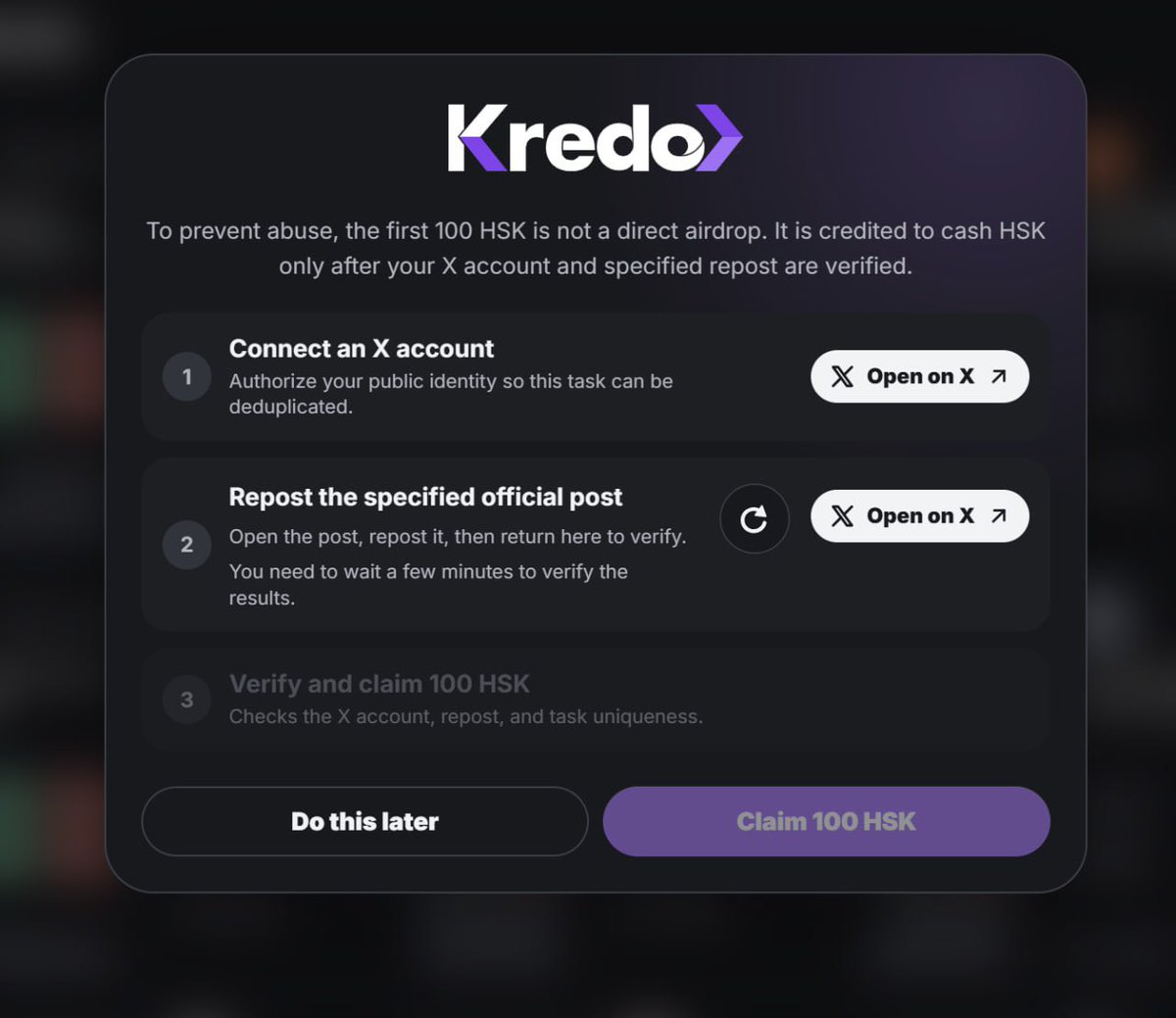
-Complete the X task and claim 100 HSK
-Pick a market
-study the available information
-take a position based on your conviction
-If your prediction plays out, you build points and climb the leaderboards.
Built on HSK Chain, @KredoFun is an AI-native prediction market, Turning questions and AI model ranking, GPU prices, AI equities, lab evaluations, and IPOs into markets, you can actually forecast.
And the interesting part is that you don't need upfront capital to start.
Kredo's AI markets ecosystem forecasting challenge gives eligible users 100 $HSK in activity credits to begin guessing without depositing their own money.
The challenge has a $100,000 USDT equivalent HSK price pool, with the top 500 ranked users eligible for rewards.
You can test whether your conviction was actually right instead of letting another prediction disappear into the city. And this is where HSK Chain gets interesting. Kredo brings user action onto HSK Chain researching, predicting, trading positions, settling outcomes.
$HSK isn't just sitting in a wallet. It's the native token powering @HSKChain, while the wider HSK ecosystem gives the token additional utility across trading, ecosystem incentives, research, access, and other services.
So if you are bullish on AI, don't just farm narrative. Start with zero upfront cost, make prediction, put the conviction on chain, let the results speak.
I'm cautiously bullish on @injective heading into 2027, but there's one thing I care about more than the hype: actual execution.
I think two of the biggest opportunities for Injective next year will be the growth of Real World Assets and the continued development of decentralized financial infrastructure.
Why RWA?
Traditional finance is slowly moving toward tokenization.
Real estate, private credit, bonds, and other financial assets can all benefit from faster settlement, greater transparency, and easier access to onchain markets.
Injective is positioning itself for this shift with its focus on financial infrastructure, trading, and tokenized assets.
I have also come across reports mentioning over $1 billion in tokenized assets across the Injective ecosystem, along with around $1.5 billion in mortgage-related assets recorded or represented onchain. ( i will drop my sources in the comments👀)
The Veyra upgrade in November 2026 was another step toward expanding RWA markets on Injective.
And this is where my main thesis starts.
My three scenarios for 2027:
Base case:
RWA issuance continues to grow, but secondary market trading and the direct economic impact on $INJ develop more gradually.
The ecosystem expands, but that doesn't necessarily mean the token's value will grow at the same pace
Bullish case (the one I give more weight to 😀):
Larger tokenized assets start seeing real trading activity.
Liquidity improves, more financial institutions get involved, and actual market activity creates sustainable demand for Injective's infrastructure and $INJ.
Bearish case (hopefully not):
The value of announced assets looks impressive on paper and in onchain metrics, but real trading volume, liquidity, and user adoption remain limited. Meanwhile, competing chains attract more issuers and liquidity, leaving Injective without a lasting competitive edge.
- My final take :
For 2027, I'm more confident in the growth of Injective's RWA ecosystem than I am in expecting $INJ to appreciate at the same rate.