The discussion of Somalia's sub-national political landscape is quite ironic. It is said there will be an "election", yet the president has given the seats to certain candidates in the upcoming "dispensation." This is a contradiction in terms. This implies that the seats in South-West, Galmudug, and Hirshabelle are effectively owned by President @HassanSMohamud, who can easily hand them over to friends.
Subsequently, the president's party and the Election Commission will orchestrate a theatrical performance around his decision, finishing it off with a lineup, cameras, and computers. This is a joke. Why not simply make direct appointments?
The whole exercise reveals that the government's electoral and party systems are not suitable for the Somali context.
Soomaali
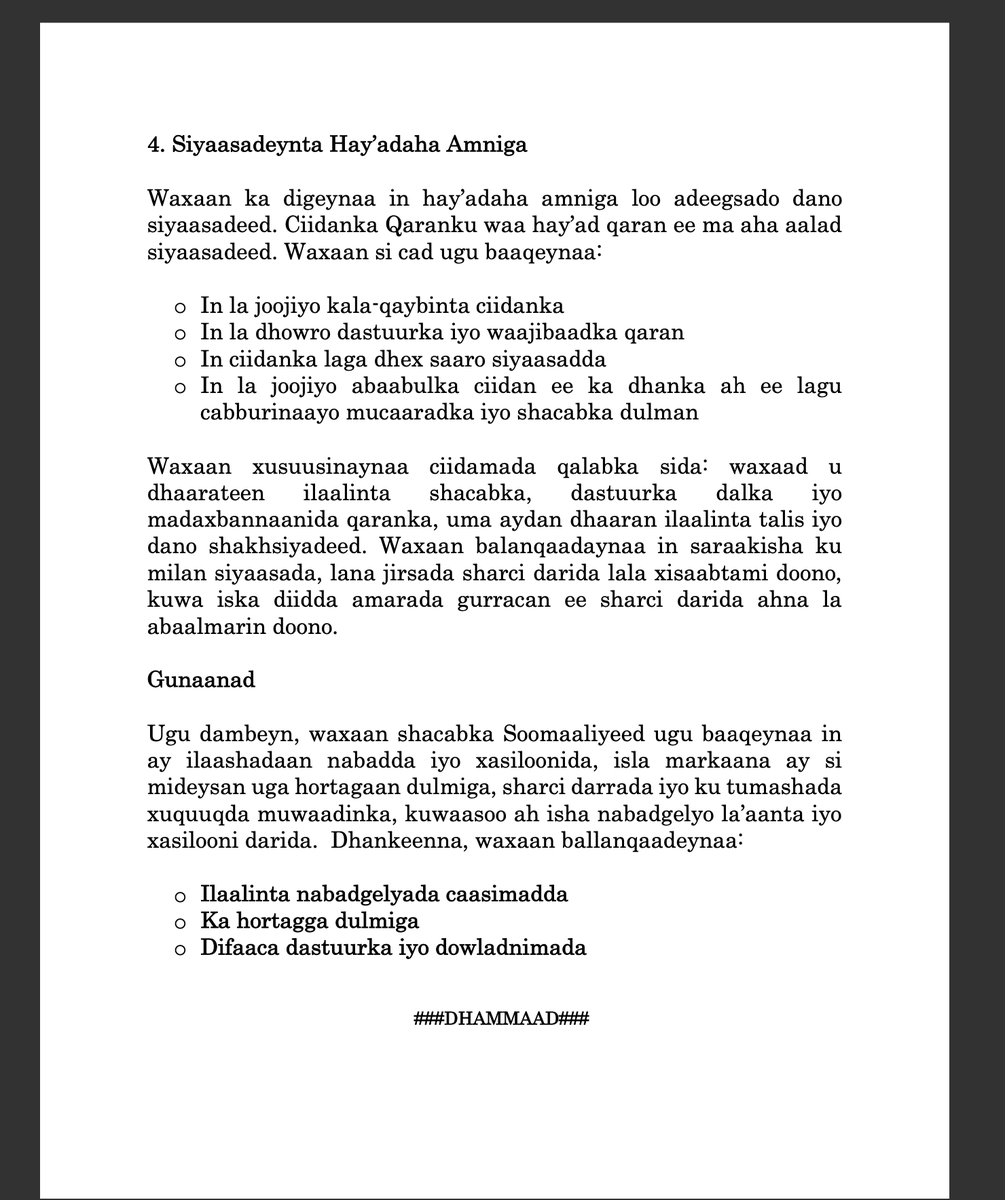
Beryahaan warka beledka yaal wuxuu u badan yahay doodaha la xiriira sida loo abbaarayo maamul-goboleedyada muddo-dhaafka ah. Waxaad maqlaysaa “Madaxweynuhu wuxuu kuraasta maamul-goboleedyada siiyey musharraxiin saaxiibadiis ah” Haddana, waxaa hadalka ku jira ‘ereyga doorashada.” Macnuhu waa in kuraasta maamul-goboleedyada uu Xassan Sheekh leeyahay oo uu qofkuu doono siin karo. Yaab!
Marka uu madaxweynuhu bixiyo kuraasta ayaa xisbiga iyo guddiyadu billaabayaan jilitaanka riwaayad lagu xalaalaynayo go’aanka – dad la safayo iyo kaamerooyin iyo computer-kii tiradu ku jirtay. Haddiiba ay sidaas tahay oo kuraasta uu madaxweynuhu leeyahay maxaa dadka loo wareerinayaa? Muu magacaabo dhammaantood?
Waxa kaliya oo ka soo baxay isku-dayga dowladda waa in nidaamyada doorashooyinka iyo kan xisbiyada ee ay wataan, aysan ahayn kuwii ku habboonaa Soomaalida.
The direct polls in Somalia's South West State do not meet minimum democratic standards.
The Somali Wire delves deeper into the granular details of how the vote was conducted, the divisions it has sowed and risks of post-election instability.
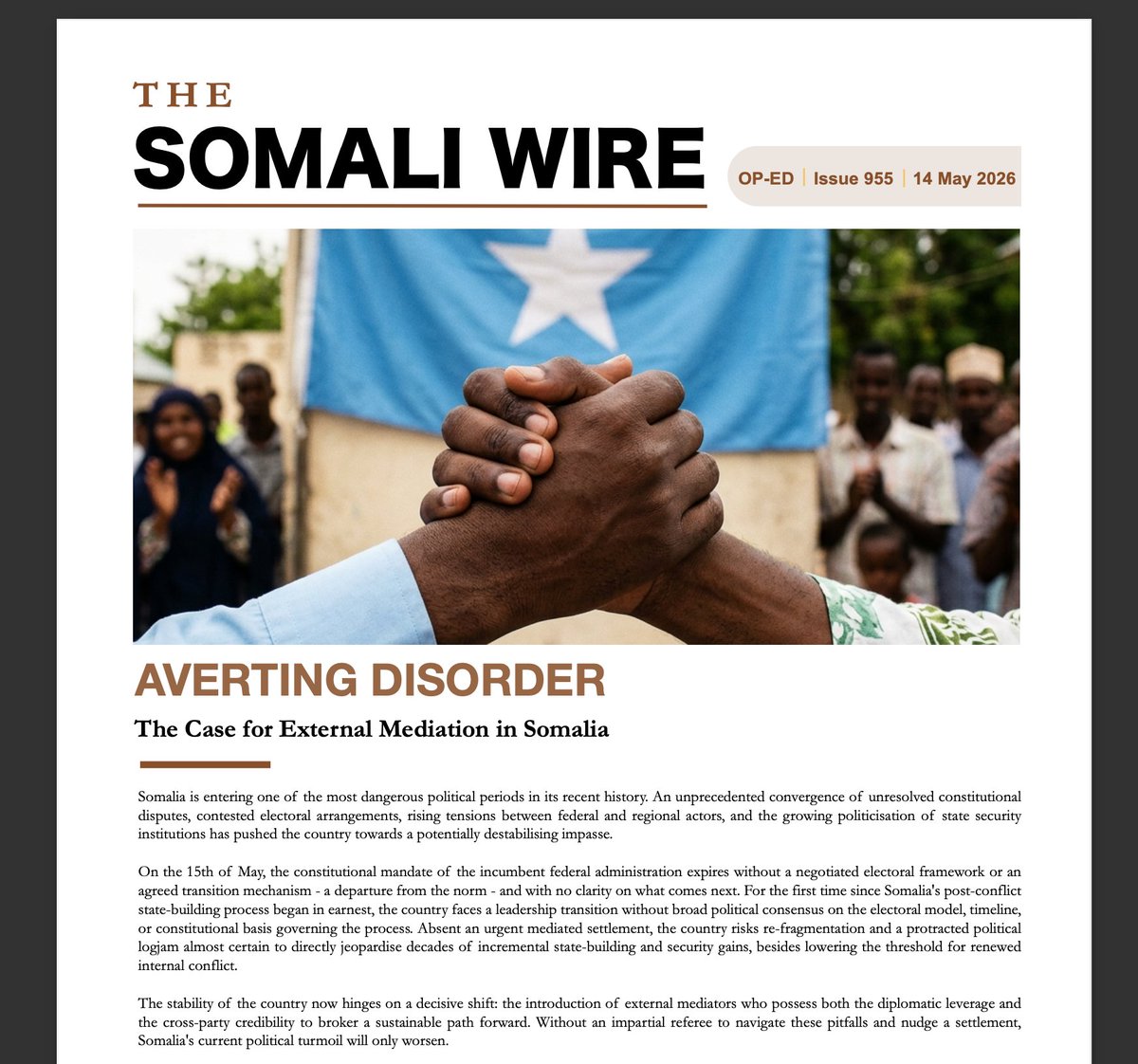
The Somalia Wire this week focuses on a big topic: the electoral and constitutional impasse in Somalia, the uncertainty about what comes next after May 15.
It delves deeper into the roots of the current crisis, welcomes the resumption of dialogue this week between the FGS and the opposition, appeals for external mediation and recommends a set of policy options for the partners of Somalia to improve prospects for a lasting settlement.
For the first time since the international community declared Somalia's transition ended in 2012, President @HassanSMohamud's government mandate is set to expire without a political agreement among Somali stakeholders. Even during the former president's controversial term extension, Somali groups reached a political agreement on September 17, 2020, about five months before his mandate expired. Now, with Parliament's mandate having expired last month, the president's mandate is due to expire on Friday, May 15, 2026. Yet there is NO political agreement for the way forward and political dispensation.
This situation did not happen by accident. Given recent developments, it is evident that President @HassanSMohamud is determined to maintain power through gerrymandering, fake elections, manipulation, closing civic space, and using force to repress dissidents, journalists, and activists. The government has led the country into a political deadlock that threatens the survival of the Third Republic. This is a very bad legacy for @HassanSMohamud.
Reportedly, there are U.S.-led efforts to help prevent a complete collapse and encourage dialogue among the parties. I hope these efforts will result in a political agreement between the government and the opposition.
In my view, regardless of how the agreement is presented, four principles must be adhered to during the elections/selections at the Federal Government and Federal Member States levels:
1. Political Agreement: This must include the government, opposition, and Federal Member States. There is an urgent need for this agreement and political dispensation because Parliament's mandate ended in April 2026, and the executive's mandate, including the presidency, expires on Friday, May 15, 2026. Therefore, the governance vacuum should be filled as soon as possible with a political dispensation negotiated between the parties.
2. Competitiveness: Any model used must allow candidates to compete for seats. To my knowledge, the tribal clan power-sharing system, often referred to as 4.5, is here to stay, and all political forces accept that reality. That said, all potential gatekeepers, whether they are FGS leaders, opposition, FMS leaders, or elders, should be controlled to the extent possible. There must be open competition for every seat, and no fake competitors should be allowed (Malxiis). The biggest want-to-be gatekeeper is the government, its commission, its computer system, and its arbitrary laws.
3. Inclusivity and Independence: An inclusive and independent commission that can fairly arbitrate among competing candidates is necessary, and the system (if any) should be subject to international audit. Even if there is going to be a limited election where clan delegates elect candidates, some form of a system can be used as a trial. In the past, the government has refused to allow its system to be audited by one of the Big Four companies. @VillaSomalia missed a big opportunity because the president did not want a fair election.
4. Controlling Corruption: Corruption has always been endemic in Somalia, but the government's approach to land management has taken it to a new level. Upon election, Martin Ronceray and Bruce Byiers reported on various strategies that African leaders employ to manipulate elections: changing the constitution, removing term limits, excluding candidates or voters, weakening watchdog organizations, and manipulating timing. On election day, these leaders resort to vote-buying, intimidation, control of information, falsification of results, and claiming victory early. Based on the so-called municipal elections in Mogadishu and the government's approach to this issue since 2024, Villa Somalia has effectively implemented all of the above tactics. (See the report here: https://t.co/567IWZGSHY).
In short, it is unfortunate that President @HassanSMohamud has become the first president to openly attempt to unilaterally change the political settlement agreed upon by Somalis, and his term will expire without a political agreement. Let us hope that a deal is reached before Friday, May 15, 2026.
Just in case you want to read my previous writings on this issue, here are two:
1. Can Somalia’s Third Republic Be Saved? Available at https://t.co/oHhFV91Grh
2. Somalia’s 2026 election risks a legitimacy crisis: Available at https://t.co/KcdDzPSQua
Ex-President @HESharifShAhmed says the opposition will not recognize the results of elections in the Southwest state and other Federal States, arguing the processes lack legitimacy.
The former leader who leads an opposition alliance said the elections were not based on a broad political agreement and therefore cannot be considered credible. He accused FGS of failing to ensure that the votes were free, fair, and transparent. #Somalia
#BREAKING
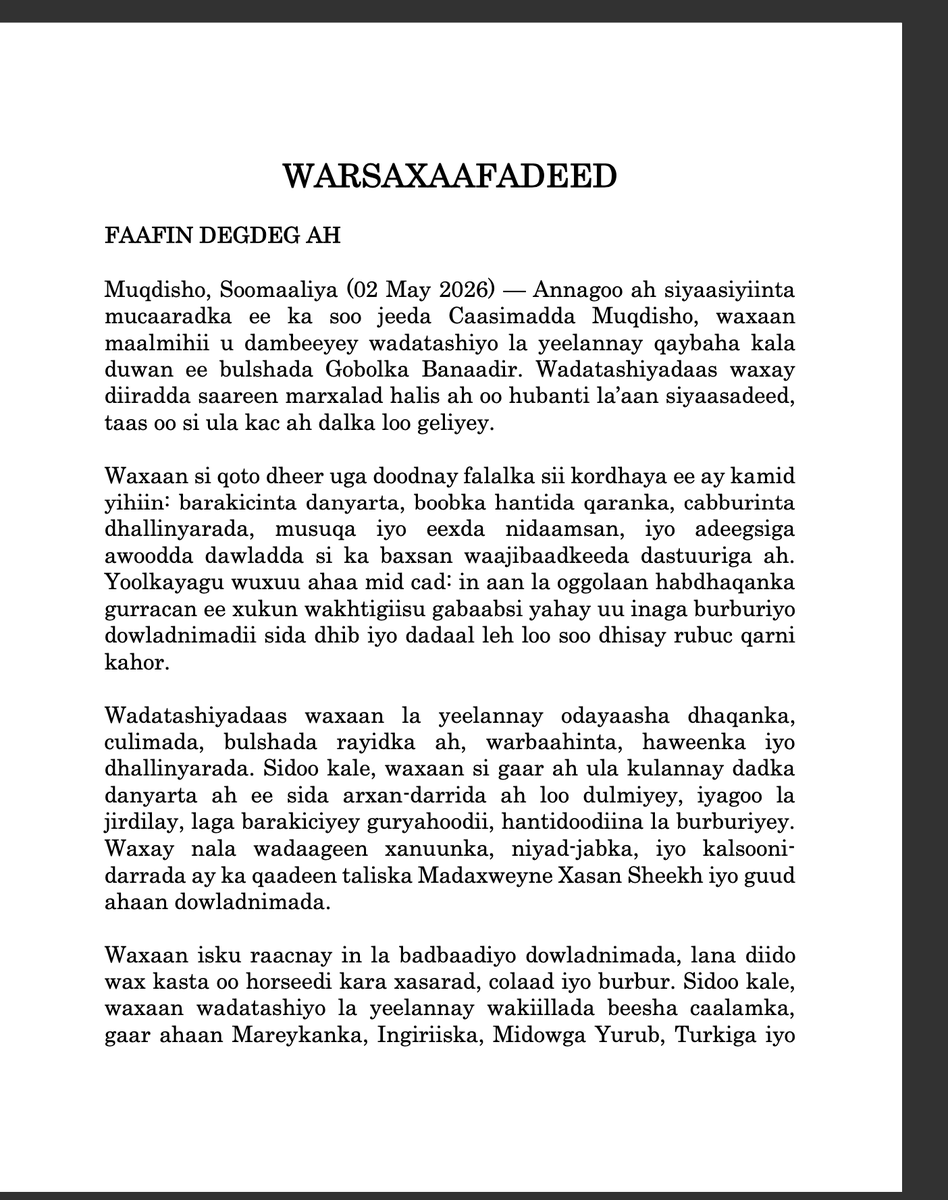
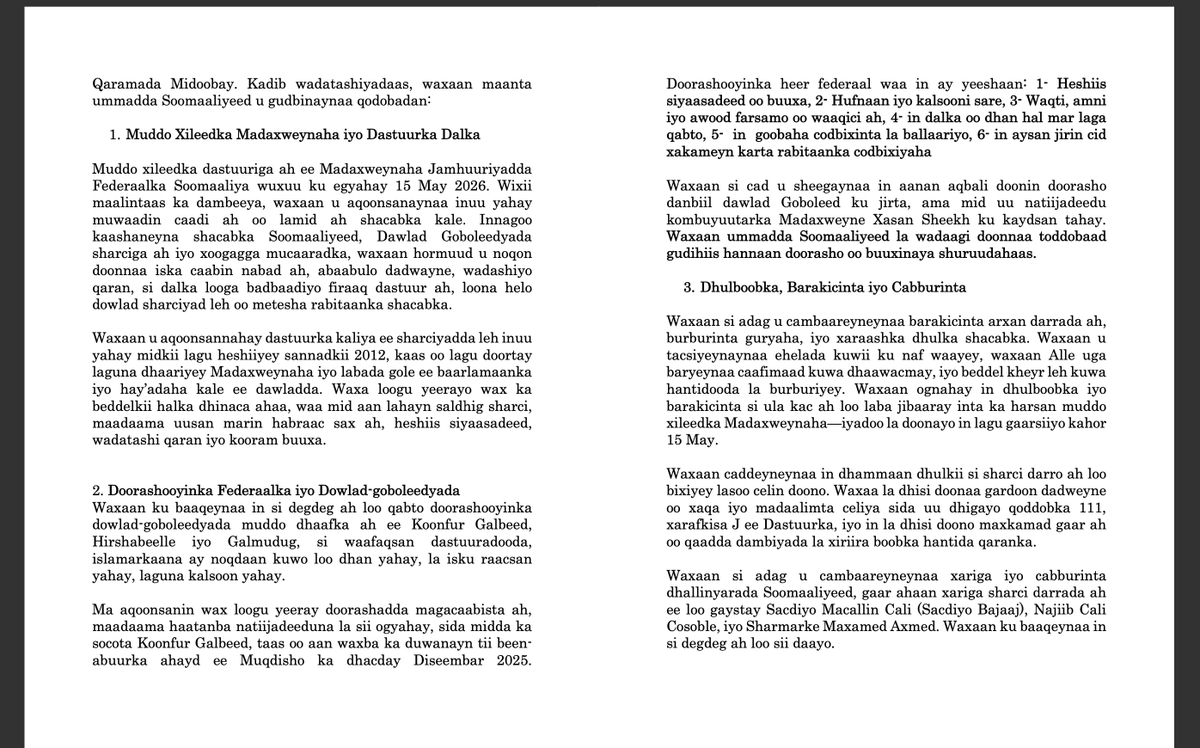
Somali opposition leader Sheikh Sharif Sheikh Ahmed has issued a strongly-worded statement warning incumbent President Hassan Sheikh that his mandate ends on 15 May and that from that date onwards "he would be treated as an ordinary citizen."
Full statement:
...and without the consent of the majority of political actors and in violation of the stipulated national democratic principles, rules and procedures for constitutional amendment."
#Somalia#democracy#elections
African Union Declaration on Unconstitutional Changes of Government includes: "manipulation of democratic processes to tamper with constitutions and effecting amendments to electoral laws within a short span before the elections..." 1/2🧵
#Somalia#democracy#elections
The Somali Wire in a commentary looks at the coronation of the Murusade ugaas in Mogadishu and reflects on the broader question of how clans relate to the state, how in times of serious national crisis, clan intervention could help.
Somalian lawmakers failed to elect a new president as the parliament’s current term came to an end on Tuesday, creating fresh uncertainty in the Horn of Africa nation that’s suffered years of political instability https://t.co/kTnnp7566m
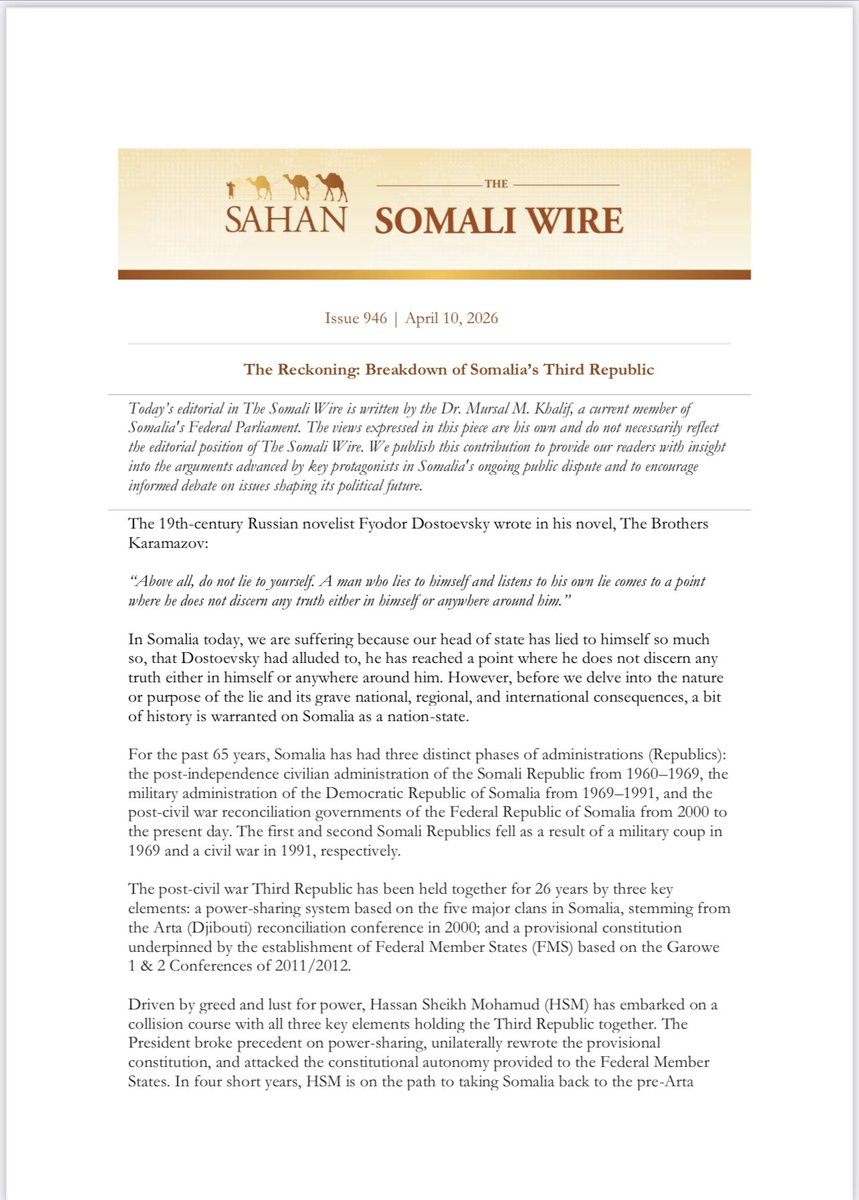
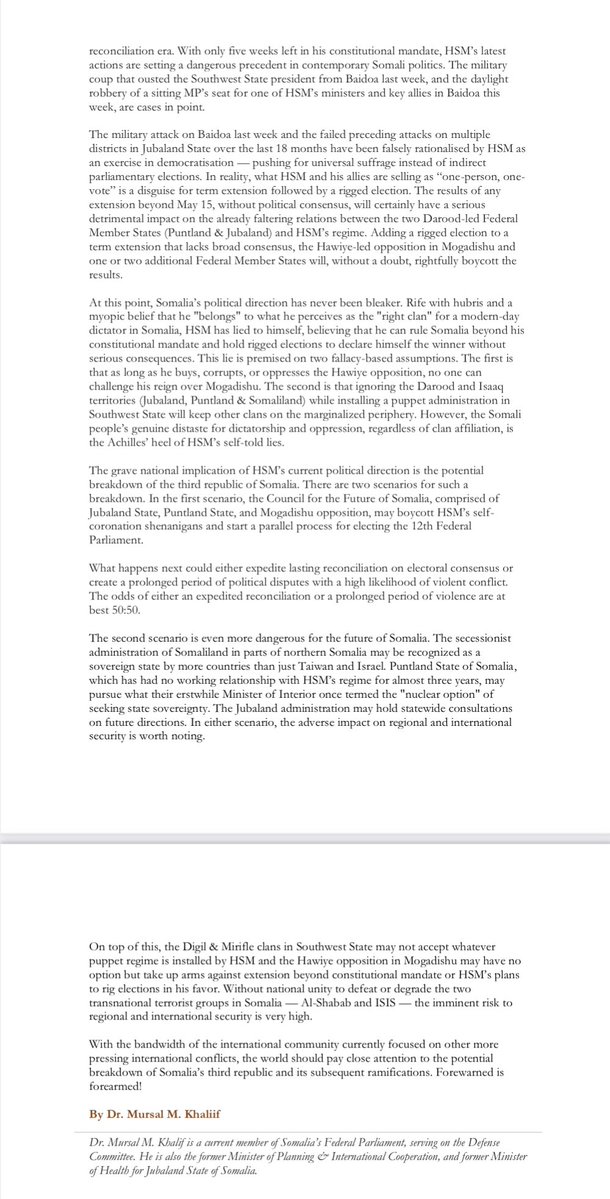
Thanks to @SahanResearch for featuring my article on today’s SOMALI WIRE editorial
“world should pay close attention to potential breakdown of Somalia’s third republic & subsequent ramifications. Forewarned is forearmed”
THE RECKONING: Breakdown of Somalia’s 3rd Republic 👇
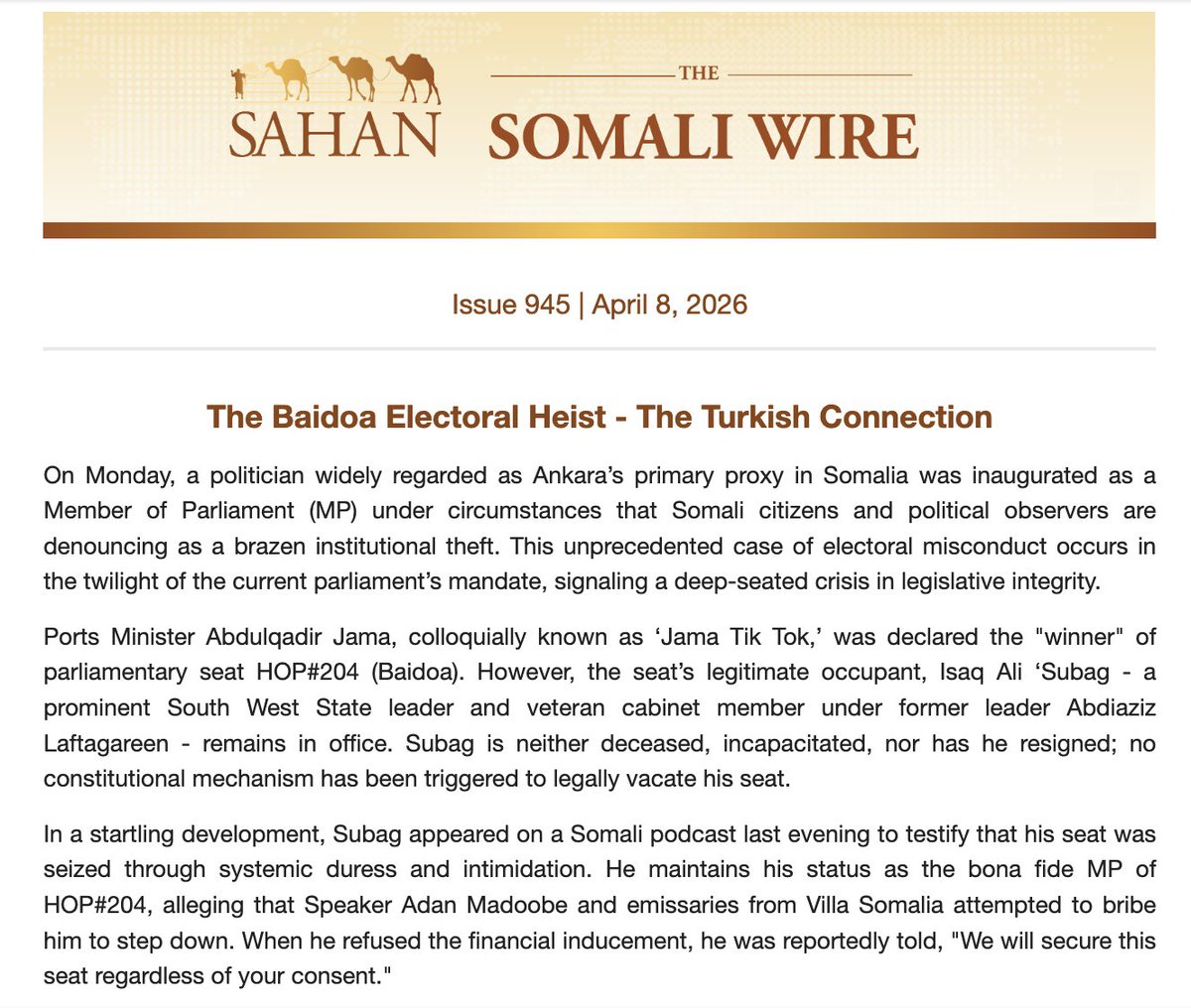
The electoral heist in Baidoa and the installation of Abdulqadir M. Nur, aka Jama Tik Tok, as MP has stunned Somalis.
It was not entirely unexpected.
Rise of Tik Tok marks not just consolidation of HSM's proto-dictatorship but also institutionalisation of Turkish influence in Somalia.
Read "The Baidoa Electoral Heist - The Turkish Connection" in the Somali Wire.
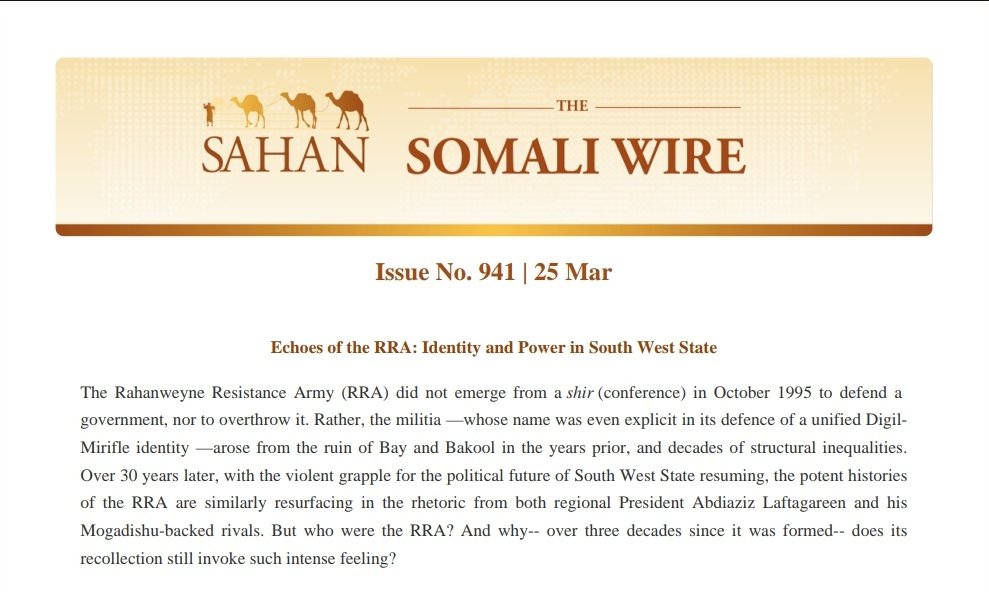
"The Rahanweyne Resistance Army (RRA) did not emerge from a Shir (conference) in October 1995 to defend a government, nor to overthrow it." Read the latest #TheSomaliWire at https://t.co/oAgiFYm35j #RahanweyneResistanceArmy#Laftagareenleadership
“The Horn of Africa's political fate has always been wired to external commercial interests, with its expansive eastern edge on the Red Sea serving as an aorta of trade for millennia.” Read the most recent #TheSomaliWire on https://t.co/ZjN3VfXLPN #RedSea#oilcrisis2026
“At the collapse of the Somali state in the early 1990s, the bloated, corrupt, and clan-riven national army was nevertheless in possession of vast quantities of light weapons.” Read the latest #TheSomaliWire at https://t.co/UsPbuaPhEV #Somalia#Security
“More than a century after Adwa, the battle remains a potent symbol shaping Ethiopia’s politics, nationalism, and contested visions of empire.” Read the latest #TheEthiopianCable on https://t.co/bOnIhhxAVC #Adwa#Tigray#Abiy
“Behind Somalia’s shifting political and security dynamics lies a deeper struggle over power, legitimacy, and control within a fragile federal system.” Read the latest #TheSomaliWire at https://t.co/iDqAKHo6pV #Governance#Democracy#politicalcrisis