الصين عدّت أمريكا في ال AI، ومش كله لاحظ مش في الbenchmarks ولا مين عنده أفضل موديل، لكن في مين اللي المطورين بيبنوا عليه
في 2025، النماذج الصينية المفتوحة وصلت ل17.1% من التحميلات على Hugging Face, وأمريكا كانت عند 15.8%. أول مرة في تاريخ الصين تعدي أمريكا في الAI adoption والسؤال هنا مش إزاي على قد ماهو ليه؟ والإجابة مش تقنية, الإجابة استراتيجية أمريكا كانت شايلة الAI خلف closed APIs وشاي��ة وبتقول أنهم الأحسن. ولكن الصين كان لها رأي أخر: خلت أي مطور يقدر يحمل الموديل يعدل فيه، يشغله على سيرفراته الخاصة، من غير ما يطلب permission من أي بلاتفورم وقدمتها كبديل للشركات والحكومات اللي مش عايزة تعتمد بالكامل على منصات أمريكية
والنتيجة كانت إن السوق مشي وراء اللي أسهل يتبنى، مش اللي عنده أحسن عرض تجريبي ولو حاولنا نطلع بدرس مستفاد من الموضوع ده هو إن السوق مش بيكافئ الأحسن دايماً, بيكافئ الأسهل في الاستخدام أولاً وبعدين الأحسن النماذج المفتوحة مش حركة احتجاج ضد الشركات الكبيرة, دي محرك انتشار حقيقي بيوصل للمطورين بسرعة أكبر، وبيخلي الشركات تبني من غير ما تكون عبدة لل vendor الشركة اللي بتختار الذكاء الاصطناعي بتاعها بناءً على البراعة التقنية بس�� مش الملكية والتحكم، هتلاقي نفسها مستأجرة قدرة مش مالكاها.
Thank you @RepThomasMassie!! you gave the dead of the USS Liberty a voice. You stood up for us when nobody had the courage. You’re a beacon of hope for our movement and our country
النهارده بنحتفل بالـ #GlobalCopticDay، اليوم القبطي العالمي.
يمكن ناس كتير ما تعرفش إن اختيار 1 يونيو جه لأنه بيوافق ذكرى دخول العائلة المقدسة لأرض مصر بحسب التقليد القبطي.
الفكرة من اليوم ده هي التعريف أكتر بالتراث القبطي وتاريخه العريق، والتعريف بخط سير العائلة المقدسة، فرصة حلوة نتعرف فيها أكتر على جزء أصيل من تاريخ مصر وثقافتها وهويته.
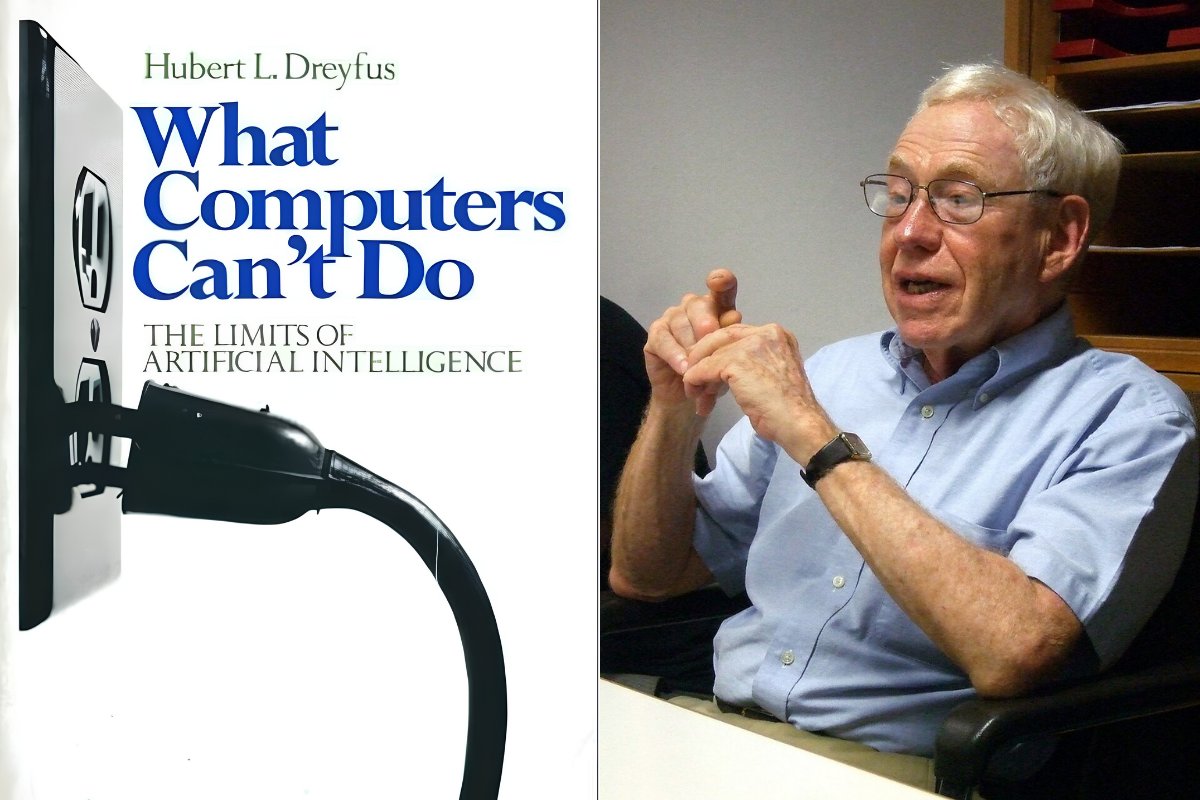
A Berkeley philosopher published a book in 1972 warning that AI would never understand the world the way humans do, got laughed off campus for it, then watched the entire AI research community spend 50 years slowly proving him right.
His name was Hubert Dreyfus. The book was called What Computers Can't Do.
And the story of what happened to him before, during, and after he wrote it is one of the most important things nobody tells you about the history of AI.
It started in 1965. RAND Corporation hired Dreyfus to study artificial intelligence. He turned in a 90-page report comparing AI research to alchemy. Not as a compliment.
He argued that AI researchers had made the same mistake over and over for a decade. They would get a narrow system working, predict it was the first step toward general machine intelligence, and watch it hit a wall nobody predicted. Simon said by 1967 computers would be world chess champion. They were not even close. Dreyfus called the whole thing a pattern. Early wins, massive promises, quiet collapse.
The AI community did not take it well.
Herbert Simon called the paper "garbage." Dreyfus taught at MIT at the time and later wrote that his colleagues "dared not be seen having lunch with me." The entire building avoided him.
Then they challenged him to a chess match against a computer.
Dreyfus had never claimed to be good at chess. He had only claimed that AI chess was weak, which it was. But MIT researchers organized a public game between Dreyfus and MacHack VI in 1967. He lost. The Association for Computing Machinery newsletter ran the headline: "A Ten-Year-Old Can Beat the Machine. But the Machine Can Beat Dreyfus."
The entire field celebrated. They had not answered his argument. They had just beaten him at chess. Nobody seemed to notice the difference.
Dreyfus expanded the paper into a full book in 1972. What Computers Can't Do laid out something deeper than chess criticism.
His argument was philosophical, not technical. He said human intelligence was not symbolic manipulation. It was not rules and logic trees. It was something more fundamental that no one had cracked: the ability to understand context, to act in the world through a body, to make judgments that depended on being alive and embedded in a situation.
He called it know-how versus know-that. A doctor who can feel something is wrong in a patient before naming what it is. A chess grandmaster who sees the right move before calculating it. A person who walks into a room and understands the social dynamics in four seconds without running a single algorithm.
These were not tasks you could formalize. Not because they were mysterious. But because they were rooted in physical embodiment and years of embedded experience in the world. A machine sitting inside a server rack had none of that. It had never touched anything. It had no body. It had never been afraid or hungry or confused in the middle of a city.
The AI community kept dismissing him for 20 more years. Then quietly, things started shifting.
The symbolic AI approach he had criticized started breaking down exactly where he said it would. Language was too ambiguous. Common sense was impossibly hard to encode. Systems that worked in narrow domains failed completely the moment the real world showed up.
By the 1990s, the field had largely abandoned the approach Dreyfus had attacked. When MIT Press published a new edition in 1992 with a long introduction updating his position, historians of AI started writing sentences like "time has proven the accuracy and perceptiveness of Dreyfus's comments."
In 2007, a journalist asked him whether he thought he had won the argument. He said: "I figure I won and it's over. They've given up."
He was right and wrong at the same time. Symbolic AI did collapse. But something else rose in its place: deep learning, trained on massive amounts of human-generated data, learning patterns from the bottom up instead of the top down. Systems that were not programmed with rules but that absorbed something about language and images and tasks from raw experience.
That is where the argument gets genuinely interesting and genuinely unresolved.
Dreyfus spent his last years thinking carefully about whether deep learning addressed his critique or just circumvented it. He had always said the problem was not intelligence as pattern recognition. He had always said the hard part was something else. Situatedness. Meaning. The ability to care about outcomes in a way that comes from having skin in the game.
A model trained on a trillion tokens of human text knows a great deal about what humans say. Whether it knows what humans mean is a different question. Whether it can act in the world the way a human acts, with a body and a history and stakes in what happens, is the question he spent 50 years trying to make people take seriously.
He died in 2017. GPT-2 was released two years later. GPT-4 was released six years after that.
The question he raised is still open. We build systems now that would have seemed miraculous in 1972. Systems that write, reason, code, argue, compose, translate, and explain. And the AI researchers at every major lab spend an enormous amount of time trying to figure out exactly what these systems are missing.
Dreyfus spent 50 years on a campus where people refused to eat lunch with him for saying that question mattered.
The man who was wrong about chess was right about almost everything else.
A British biologist looked at 200,000 years of human history and found that the entire reason humans broke out of poverty was not intelligence, not language, not even agriculture, but one mechanism so simple a 6-year-old could explain it.
His name is Matt Ridley.
He is a zoologist by training, an evolutionary biologist by career, and in 2010 he wrote a book called The Rational Optimist that quietly argued the most important fact about human progress had been hiding in plain sight for the entire history of economics.
Naval Ravikant has been telling people to read everything Ridley has ever written for the last 15 years. The reason is the argument inside this one book.
For 200,000 years, anatomically modern humans walked around with the same brain you have right now. Same skull size. Same neural architecture. Same raw capacity for language, planning, and abstract thought.
For roughly 190,000 of those years, almost nothing happened. Generation after generation lived and died inside the same Stone Age toolkit their great-great-grandparents had used. Then somewhere around 50,000 years ago, the line on the chart of human progress started to tick upward. Then it bent. Then it exploded.
The question Ridley spent years on was the only question that mattered. What changed.
It was not the brain. The brain had been the same for 190,000 years. It was not language, which had existed long before the takeoff. It was not even agriculture, which arrived only 10,000 years ago and was actually preceded by the upward bend, not the cause of it.
What changed was that humans started trading with strangers.
This sounds too small to be the answer. Ridley argues that it is the answer to almost everything. The moment one human exchanged a useful object with another human from a different group, something happened that no other species on earth had ever done.
Two ideas that had developed in isolation came into contact. The flint knapper learned what the spear maker had figured out. The fisherman from the coast learned what the hunter from the forest had figured out. The two pieces of knowledge fused into something neither side could have produced alone.
Ridley calls this ideas having sex. The phrase sounds frivolous and it is meant to. The point is that ideas, like genes, get better when they combine with other ideas from different lineages.
An idea sitting inside one head, no matter how brilliant the head, eventually hits a ceiling. The same idea exposed to ten thousand other ideas does something genes do under sexual reproduction. It mixes. It recombines. It produces offspring nobody planned.
The cleanest proof of this argument is the most uncomfortable case study in the book. Tasmania.
Around 10,000 years ago, rising sea levels cut Tasmania off from mainland Australia. A population of roughly 4,000 humans was now isolated on an island, with no possibility of contact with the rest of humanity. They had the same brains. The same language. The same starting toolkit as their cousins 150 kilometers north. The natural experiment was now running.
What happened next is something no economist or geneticist had ever predicted.
The mainland Australians kept inventing. Boomerangs. Spear-throwers. Fishing nets. Bone needles for sewing fitted clothes. Watercraft with paddles. Their technology compounded slowly across the centuries.
The Tasmanians went the other way. They did not just fail to invent the new tools their cousins were developing. They started losing the tools they already had. Fishing was abandoned within a few thousand years. Bone tools disappeared. Fitted clothing disappeared. They forgot how to make fire from scratch and started carrying lit firebrands from camp to camp instead, relighting their fires from a neighbor's whenever their own went out.
By the time European explorers arrived in the 17th century, the Tasmanians had the simplest toolkit of any human society ever recorded. Their material culture had gone backward for 8,000 years.
The archaeologist Rhys Jones called it a slow strangulation of the mind.
Joseph Henrich at Harvard later proved with formal mathematical models that there was nothing wrong with Tasmanian brains. There was something wrong with their network. A toolkit requires a critical mass of people exchanging skills to maintain itself.
The act of teaching a skill is imperfect. Every generation loses a small percentage of what the last generation knew. If your population is large enough and trading widely enough, those losses get caught and corrected by someone else who still remembers.
If your population shrinks below a certain threshold and stops mixing with outsiders, the small losses compound until entire technologies disappear.
This is the part that should haunt anyone reading this in 2026.
Intelligence is not a property of the individual brain. Intelligence is a property of the network the brain is connected to. A genius in isolation will produce less than a mediocre thinker inside a dense exchange of other mediocre thinkers.
The thing your ancestors needed in order to break out of 190,000 years of stagnation was not better brains. It was better connections between brains they already had.
The implication for any individual is direct and uncomfortable. If you are smart and isolated, you will be outproduced by people half as smart who are connected.
The most successful people in any field are almost never the smartest people in it. They are the ones positioned at the intersection of the most idea flows. They are reading more authors than their competitors. They are talking to more people from more disciplines. They are in the rooms where ideas from different lineages bump into each other.
Ridley ends the book on the line that sounds optimistic but is actually a warning its this "The future will be invented by people who connect ideas, not by people who guard them."
شعب الله الحساس في مصر والسعودية لما ننتقد فيلم #الست وأداء منى زكي والكتابة والإخراج، ما فيه عندنا نوايا مسبقة أو عداء، لأنه المفترض بعد أكثر مية سنة سينما وطفرة الانتاجات الضخمة، نكون وصلنا لمرحلة ننافس الأعمال العالمية، خصوصاً وأننا بنكتب ونخرج فيلم سيرة ذاتية عن أيقونة الغناء العربي ورمزه وممثلته على خارطة الغناء العالمي !
وهنا لازم نضرب مثال بعمل (سيرة ذاتية) ليس الأعظم لكنه قد يكون مقياس للاخراج والكتابة الجيدة، ولفهم لماذا فيلم الست مخيب للآمال، وقد يكون أداء انجلينا جولي مسطرة يقاس عليها أداء أي فنان أو فنانة عرب يقدمون أنفسهم لفيلم سيرة ذاتية
• #فيلم Maria
• سيرة ذاتية
• إنتاج دولي مشترك 2024
كل الجوائز التي حصل عليها الفيلم كان أغلبها جوائز نقدية مرموقة
أنجلينا جولي حصلت على بعضها وترشحت للأوسكار عن دورها فيه
لا أريد أن أعلق على تصوير الرئيس أردوغان نفسه وهو يتعبد، فقد دأب على ذلك كثيرا في مخالفة لتعاليم الدولة العلمانية التي أقسم على حماية دستورها العلماني. لكن أن يأتي هذا في إطار "إحياء سنة محمد الفاتح" الذي حول كنيسة أياصوفيا إلى مسجد، فهذا مستهجن جدا.
من أحاديث الرسول الكريم، إلى العهدة العمرية في القدس، إلى رسالة محمد الفاتح المزعومة التي كشفت عنها الحكومة التركية عام 2000، كلها تمنع "المجاهدين الفاتحين" من تحويل دور العبادة والكنائس إلى مساجد !
فيه case study لطيفة علاقة ال ice cream vanilla مع عربيات General Motors
لو خدت عربيتك ال GM و سوقت عشان تشترى ice cream vanilla عربيتك تعطل و ما تدورش، بس لو طلبت اى نوع تانى مش هتعطل!
دوروا على ال case دى و هتتبسطوا 😅
مجموعة "ماجد الفطيم" العقارية تضع حجر الأساس لمشروع "جنكشن" المتكامل للأعمال في منطقة غرب القاهر��، بإجمالي استثمارات تُقدَّر بنحو 385 مليون دولار، وعلى مساحة بنائية تقارب 99 ألف متر مربع.
#فوربس
للمزيد: https://t.co/6dMN1cT4TX
المقالة كاملة
الـ QR كود مربع صغير وخازوق كبير
افتكاسات النصب الإلكتروني (٤)
ظهر مؤخراً في عدد من الدول احتيال الـ QR Code أو ما يُسمى "Quishing"؛ وفيها يتم تبديل رموز الاستجابة الخاصة بالمكان (مطعم، موقف سيارات، إعلان، ماكينة دفع) برموز أخرى مزيفة تقود إلى مواقع وهمية تسرق بيانات البطاقة فور المسح. ومن تلك الأمثلة:
* **في الولايات المتحدة:** قام المحتالون بطباعة ملصقات QR كود مزيفة بطريقة احترافية للغاية، وتم لصقها مباشرة فوق الرمز الأصلي المخصص لدفع رسوم السيارات بالشوارع؛ وبالتالي يقوم السائق بمسح الرمز وهو على عَجَلٍة من أمره، فيدخل إلى صفحة تبدو رسمية تماماً، وبمجرد إدخال بيانات البطاقة يتم سحب مبالغ كبيرة منها لاحقاً، بينما يعتقد صاحب السيارة أنه دفع رسوم الانتظار فقط.
في لندن:** وبعد الاعتماد الكامل على الـ QRكود لاستعراض قائمة الطعام في المطاعم ودفع الفواتير (خاصة بعد الجائحة)، استغل بعض المحتالين هذا السلوك؛ فيقومون بالدخول للمطعم كعملاء عاديين، ويلصقون رمز استجابة مزيفاً فوق الأصلي. وبمجرد قيام العميل بمسح الرمز، يقوم الموقع المزيف بتحميل برنامج مهكر يتيح للمحتال التجسس على تطبيقات البنك ورسائل الـ OTP.
و في الصين:** انتشرت ظاهرة استبدال الرموز الموجودة على الدراجات العامة التي يتم تأجيرها عن طريق التطبيقات؛ فعندما يقوم المستخدم بمسح الرمز لفك قفل الدراجة، يتفاجأ بتحويل الأموال لحساب المحتال مباشرةً دون فتح الدراجة.
و في الإمارات:** تعرض بعض المواطنين لعمليات قام من خلالها المحتال بلصق رموز مزيفة فوق الرموز الأصلية على الأعمدة واللوحات الإعلانية في محطات المترو والحدائق العامة.
و يُلاحظ في الحالات السابقة اعتماد المحتالين على تسرع العميل بالإضافة إلى الثقة بالمكان؛ فيختارون أوقات الذروة مثل زحام المطاعم أو الرغبة في اللحاق بالقطار، وبالتالي فإن المستخدم لا يدقق في تفاصيل الرابط الذي يظهر على الشاشة.
وعلى حد معلوماتي، فإن هذه الحالات لم تحدث بمصر إلا أنها -طالما حدثت بالخارج- فإنها حتماً ستأتي إلى مصر إن لم تكن موجودة بالفعل. لذلك، فإنني أنبه وأحذر من ضرورة فحص أي ملصق لرمز الاستجابة السريعة، QRكودوالتأكد أنه مطبوع كجزء من التصميم الأصلي وليس ملصقاً (Sticker) تم لصقه فوق الرمز الأصلي…و إذا وصلك رمز QR من مصدر غير معروف أو غير متوقع، لا تقم بمسحه..
كما يجب إضافة موضوع الـ QR Code المزيف ضمن حملات التوعية الإعلانية المستمرة بشأن عمليات الاحتيال الإلكتروني.
عبدالعزيز الصعيدي
الخبير المصرفي
كان في واحدة هولندية بتيجي تساعد مراتي في الشقة اللي كنا فيها في أمستردام. كانت بتشتغل "هواية" و ماشية بشنط براندات و كل مرة تيجي تقعد تقول لمراتي هو ازاي انتوا عايشين في شقة صغيرة كده؟ أنا رايحة ايبيزا في اجازة الصيف! أنا جبت شنطة جديدة ب كام يورو و تقعد تتنطط علينا و احنا نقعد نضحك.