📢 New issue brief: Have Chinese AI models pulled ahead of their global counterparts? Our latest brief analyzes China’s diverse open-weight model ecosystem and examines the policy implications of their widespread global diffusion. https://t.co/zkdBKf7N5F
NEW: What does China's outbound data transfer regime look like a few months after authorities replaced cumbersome rules with a new approach?
In "Moving Data, Moving Target," @SammSacks@ZengKrystal@gwbstr go deep on what changed & what remains uncertain.
https://t.co/gUT8Ys4k87
A thought-provoking initial take from @DigiChn on the proposed text of a Chinese "Artificial Intelligence Law" floated last week by the Chinese Academy of Social Sciences (CASS). I didn't even know CASS was a player in this space, but clearly they are!
NEW: What to make of a scholar's draft for a Chinese "AI Law"? The proposal comes after the May announcement that China would work on one.
By Jason Zhou @hellomingli@hunter_dorwart@johannamcostig1, intro by @gwbstr
https://t.co/ipjsfaWxt9 1/
🎂Today, June 6th, @StanfordCyber turns four years old. 🥂
We've grown to six programs (soon to be seven), hosted sold out events, formed partnerships, launched initiatives, and published ground breaking research. Take a look back at our milestones:🗓️
🔗https://t.co/SXPZ2xYopD
Cyberspace Administration of China released latest batch of additions to its algorithm registry, including 3 from Didi: https://t.co/1cjPr2mAcc
Only small % of info gathered is released, but @SharonDu18 & I found more details in the instruction manual:
https://t.co/MDOnGAIXRr
Glad to contribute my 2c on how China is approaching generative AI regulation to this @DigiChn forum. It's not just Italy and co taking a close look at the data protection implications of ChatGPT and the like...
Why did 🇨🇳 China release a new draft regulation on generative AI just 4 months after their last regulation covering generative AI went into effect?
I answer that question and draw lessons for other countries in my submission to this @DigiChn forum:
https://t.co/lsXGtftLPo
These recommendations by Chinese AI policy scholars pairs nicely with the @DigiChn forum on the same generative AI draft regulation: https://t.co/lsXGtftLPo
Our Forum examining China's draft regulations for generative AI keeps growing!
@acmeinhardt looks at the draft's interaction with the Personal Information Protection Law https://t.co/ldNR7BI03q
NEW: 8 specialists on the implications and questions around China's draft rules on generative AI—from input data to accurate outputs.
A Forum w/ @hlntnr @zac_haluza Yan Luo+Xuezi Dan @CovingtonLLP@mattsheehan88@seatonyhuang Kimball Chen @China_Digital
https://t.co/ldNR7BI03q
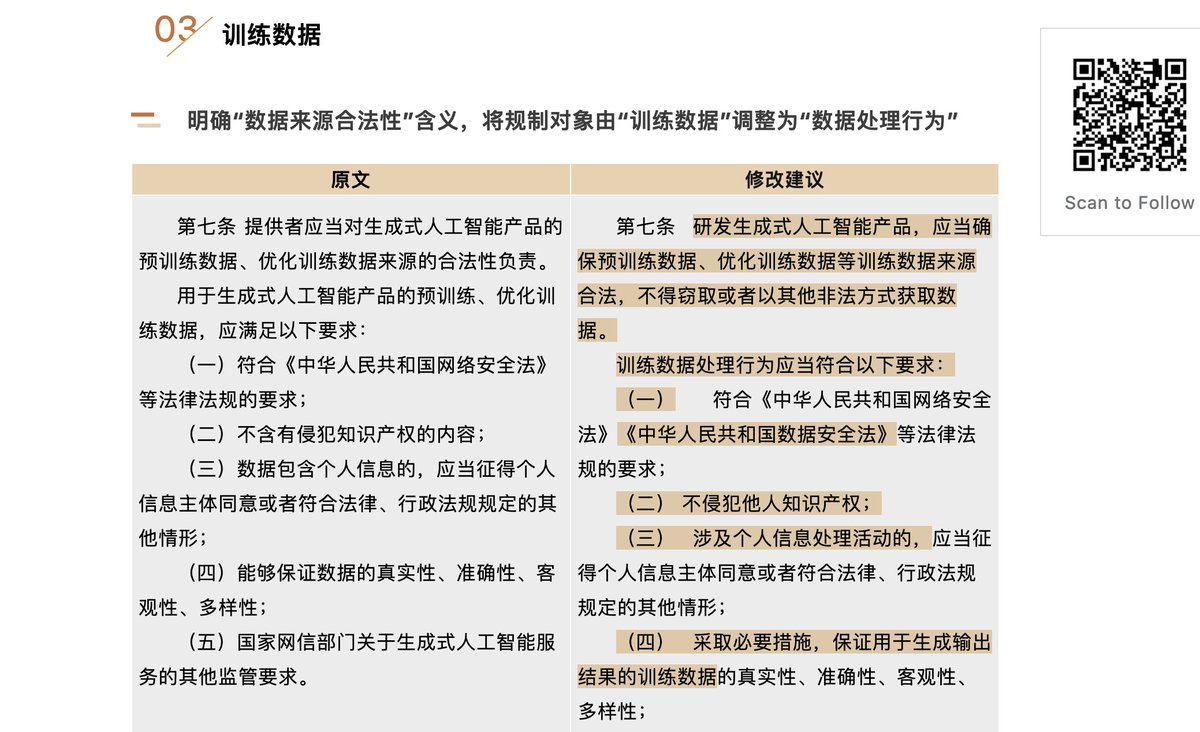
🇨🇳's AI policy community is publicly debating the country's draft generative AI regulation.
Here 7 Chinese scholars suggest 5 changes including:
- softening training data requirements
- diversifying mitigation methods
Cool to watch this debate play out:
https://t.co/ixYkJlLH5m
NEW: @pstAsiatech joins our ongoing Forum on China's draft regulations on generative AI, focusing on the technology's challenge to China's content censorship regime.
https://t.co/ldNR7BI03q
NEW: 8 specialists on the implications and questions around China's draft rules on generative AI—from input data to accurate outputs.
A Forum w/ @hlntnr @zac_haluza Yan Luo+Xuezi Dan @CovingtonLLP@mattsheehan88@seatonyhuang Kimball Chen @China_Digital
https://t.co/ldNR7BI03q
We have now published multifaceted analysis by eight specialists contributing to a DigiChina Forum on this draft. Read their views here: https://t.co/ldNR7BI03q
Interested in China's fresh draft regulations governing generative AI training data, accuracy of outputs, and responsibility for service providers? Here's our Stanford project's full translation: https://t.co/tDIr17bYzx
Interested in China's fresh draft regulations governing generative AI training data, accuracy of outputs, and responsibility for service providers? Here's our Stanford project's full translation: https://t.co/tDIr17bYzx