What if your AI agent were able to trade more than just tokens?
These days, most conversations about AI trading center on market trends, price movement, and the buying or selling of digital assets.
Yet financial markets have far more to offer than that.
Today, in 2026, prediction markets such as @Polymarket let people trade on the outcomes of real-world events, ranging from elections and economic decisions to major global developments in sports.
All of this brings a different kind of challenge.
An agent has to understand more than price charts. It must weigh probabilities, decode encrypted data, interpret information, and judge how particular events might shape market outcomes.
That is why the prospect of connecting @meetmotes agents with @Polymarket is so exciting.
It points toward a broader form of autonomous finance in which agents could take part in both traditional token swaps and event-based markets.
Naturally, understanding the market is only one part of the process.
Every single execution will still need to run within the exact permissions the user has set.
The larger idea is that AI agents could in time engage with various kinds of financial opportunities, rather than merely tracking token prices.
And that opens a far wider conversation about what autonomous finance might become.
Which is exactly why the direction Motes is taking excites me so much.
What part of @meetmotes excites you so far?
AI agents need infrastructure to interact with real applications.
Motes recently announced its integration with @Aster_DEX, expanding the capabilities of its AI agents across decentralized perpetual markets.
The announcement highlights three technical components:
- Market Intelligence: Real-time data analysis and strategy evaluation.
- Automated Execution: Programmatic order placement and position monitoring.
- Risk Management: User-defined parameters and exposure controls.
Why is this significant for the project?
It demonstrates how an AI agent can connect its intelligence layer to an external execution platform.
But integration is only one part of the picture.
Reliability, permission boundaries, and risk controls remain essential when autonomous systems interact with financial infrastructure.
The broader @meetmotes direction is to connect intelligent agents with multiple on-chain applications through a unified ecosystem.
@darmilarey069@meetmotes Agent doing the analysis and living the decision in the hand of the trader is a whole game changer—@meetmotes is building something spectacular.
i'd be more curious about why an AI disagrees with a market than how confident its prediction sounds.
that's one part of @meetmotes approach i find interesting.
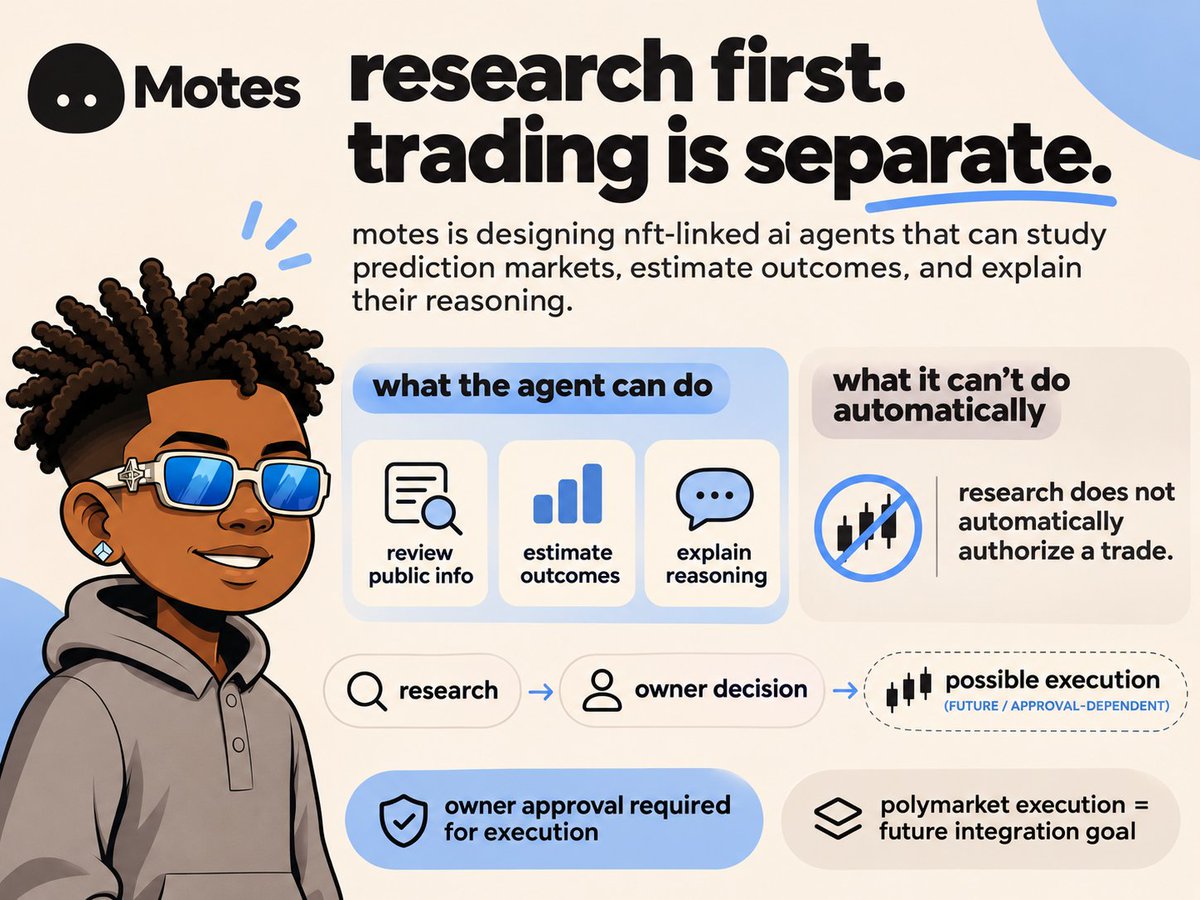
motes is designing AI agents linked to its NFTs to study prediction markets like Polymarket, where people trade on whether events will happen.
the agents would review public information, estimate the chances of an outcome, and compare their findings with market prices.
say the market suggests 70%, but the agent estimates 55%.
that's just an example, and neither number is guaranteed to be right.
motes also plans for agents to explain their reasoning and how uncertain their estimates are.
for me, understanding why those numbers differ matters more than simply trusting either one.
What does Genesis ownership represent in the Motes ecosystem?
According to the team's announcement, @meetmotes Genesis is designed around 1,000 NFTs, with three core benefits:
- $MOTES Airdrop: Eligibility for the Genesis holder token allocation.
- Priority Allocation: Preferential access to future token sale allocations, subject to eligibility requirements.
- Motes Aura: Access to the Agent ecosystem, where verified participation contributes to allocation opportunities across upcoming seasons.
The fascinating aspect is how these benefits link three different concepts: digital ownership, ecosystem access, and long-term engagement.
Genesis is therefore presented as more than a collection of digital assets.
It is designed as an entry point into the wider Motes ecosystem.
Understanding the conditions behind each benefit is just as important as understanding the benefits themselves.
Benefits
By owning a Genesis NFT you will be able to:
Get an allocation of $MOTES tokens (airdrop)
Be prioritised in future token sales
Get a portion of Motes Aura.
I really like that there is a portion of Aura given out to Genesis holders. By verifying activity and participation in the project, you can get an allocation in future seasons.
This is great as it gets people to continue engaging with the project.
Something to watch out for!
DeFi Infrastructure
DeFi is not just about individual protocols.
It's about the infrastructure that allows different financial applications to work together.
In the @meetmotes ecosystem, DeFi infrastructure is relevant because AI agents need an environment in which they can interact with on-chain applications.
This includes concepts such as:
Lending and borrowing protocols.
Liquidity mechanisms.
Smart contract interactions.
On-chain transaction execution.
The interesting part is how these components could connect with an AI agent's ability to analyse information and interact with blockchain applications.
But access alone isn't enough. Security, permissions, and transaction validation still matter.
The real challenge is building a system where intelligent agents can interact with DeFi infrastructure while keeping their actions transparent and controlled.
That's an important part of the broader Motes vision.
someone researching a football match for you shouldn't automatically get to place a bet with your money.
that's a distinction @meetmotes is building into its NFT-linked AI agents.
motes is designing these agents to research prediction markets like Polymarket, where people trade on whether certain events will happen.
the agents would review public information, estimate how likely an outcome is, and explain their reasoning.
but even if a Motes agent identifies a possible opportunity, that research alone wouldn't authorise it to place a trade.
actual execution would need separate approval from the owner, and Polymarket trading remains a future integration goal.
i think keeping those two steps separate makes sense.
an AI having an opinion about an outcome shouldn't mean it gets to act on it.
@darmilarey069@meetmotes Giving the owner the clue of what will likely happen is great,
giving the owner or the trader the opportunity to make decision is is equally greater.
someone who researches a football match on your behalf shouldn't automatically be allowed to place a bet using your money.
that's a distinction @meetmotes is building into its AI agents that are linked to NFTs.
motes is designing these agents to research prediction markets such as Polymarket, where people trade on whether certain events will happen.
the agents would look over public information, estimate how probable an outcome is, and explain their reasoning.
but even if a Motes agent spots a possible opportunity, that research by itself wouldn't give it permission to place a trade.
actual execution would require separate approval from the owner, and trading on Polymarket remains a goal for a future integration.
i think it makes sense to keep those two steps separate.
an AI having an opinion about an outcome shouldn't mean it gets to act on that opinion.
An intelligent agent should not automatically have unlimited authority over the account it operates.
This is one of the important challenges in building AI-powered blockchain systems.
In the @meetmotes architecture, security is not just about protecting an account. It's also about defining what an agent is allowed to do.
Permissions, spending limits, transaction validation, and owner authorization are important concepts in this design.
This is very important.
Because an AI agent's ability to make decisions should remain separate from its authority to execute transactions.
The goal is not simply to make agents autonomous. It's to make their actions controllable, transparent, and accountable.
That distinction will matter as AI agents become more integrated with on-chain applications.
A capable AI agent requires more than just the capacity to carry out trades. Every decision it makes needs a strategy behind it.
That is exactly why @meetmotes caught my attention.
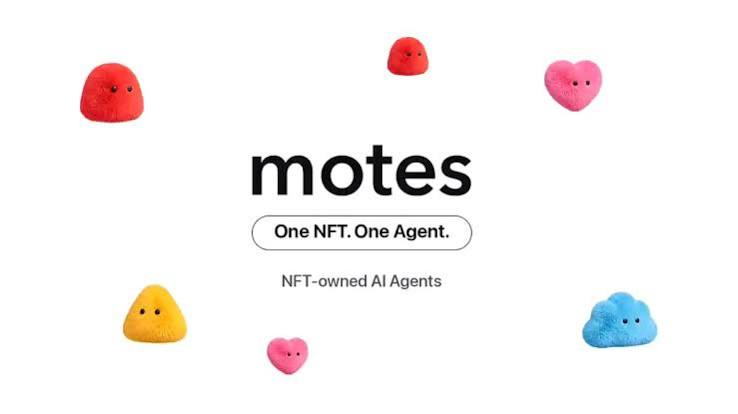
Motes is developing NFT-owned AI Agents built to function across a range of onchain markets, such as DeFi and @Polymarket.
What stands out is the concept of pairing automated execution with strategies and risk limits defined by the user. Rather than tracking every opportunity manually at all times, users can provide their agents with a framework to operate inside.
In my view, the next phase of AI-powered finance will not be solely about automation. It will hinge on how intelligently agents evaluate opportunities, handle decisions, and adhere to the strategies users define.
The true worth of an AI agent should be judged not only by the number of actions it takes, but by how closely those actions match its strategy.
That is the future of autonomous finance I am eager to follow.
AI agents might be able to carry out strategies automatically, but automation without defined boundaries can introduce genuine risks.
That is why the approach behind @meetmotes strikes me as interesting.
Motes concentrates on AI Agents capable of operating across financial markets while letting users set their own capital and risk boundaries.
To me, the key part isn't simply granting AI the ability to act. It's ensuring those actions remain within limits the user has chosen.
As AI plays a larger role in onchain finance, control and accountability will be just as important as automation.
If you could set its risk limits yourself, would you trust an AI agent to manage a strategy?
One interesting aspect of @meetmotes is its connection to Robinhood Chain.
Robinhood Chain is designed as an Ethereum-compatible Layer 2 network, bringing EVM infrastructure into an ecosystem built around financial applications.
For a project like Motes, this creates an interesting foundation.
Its vision involves connecting AI Agents with on-chain financial infrastructure, where blockchain compatibility and access to DeFi protocols become important considerations.
The bigger picture is not just about putting AI on a blockchain.
It's about building an environment where intelligent agents can interact with financial applications through programmable on-chain infrastructure.
Infrastructure choices matter because they influence what developers can build and how applications connect.
That's why Robinhood Chain is worth examining as part of the Motes ecosystem.