A real long shot but can people retweet this please.
Yesterday all my items were stolen in Eastbourne including my stats book which has 20 years worth of details in. Laptops, phones, clothes, shavers etc can all be replaced but this can’t and is useless to anyone else. It’s in a plastic folder you can see in the left hand side of this photo. Can anyone in that neck of the woods please keep an eye out. I’m gutted about this.
Across Britain right now, farmers are shearing their sheep, bagging up the wool, and burning it. Some bury it. Some leave it to rot in a corner of the field. The wool-burning has made the odd headline as a protest, but the truth is duller and sadder. The fleece is worth less than the diesel it would take to haul it to the depot.
The numbers are grim. In recent years a kilo of British wool has fetched somewhere between twenty and sixty pence, and hill breeds like Swaledale and Welsh Mountain sank as low as ten. A whole fleece off a mountain ewe might bring thirty pence. Shearing that same ewe costs the farmer around two pounds. One Lincolnshire farmer added it up out loud: over three pounds to shear and cart a single fleece to the depot, and twenty-six pence back. So she burns them. A great many do.
Here is the part that stings. The shearing still has to happen, every year, whatever the wool will fetch. A sheep left in full fleece overheats, struggles to move, and gets eaten alive by maggots. So the job carries on purely as welfare, a cost the farmer simply eats to spare the animal, with the wool itself going on the fire straight after.
And think about what this fibre once was. For centuries wool was the engine of the English economy, the country's greatest export and the crown's main source of tax. It raised the soaring wool churches of the Cotswolds. It turned merchants into princes. To this day, whoever presides over the House of Lords sits on the Woolsack, a literal cushion of wool, put there in the fourteenth century so nobody would forget where the nation's wealth began.
Prices have lifted off the floor this past year, the first real relief in a long while. It still does not cover the shears for a hill farmer. The fibre that built England now smoulders in a heap behind the barn, and almost nobody notices the smoke.
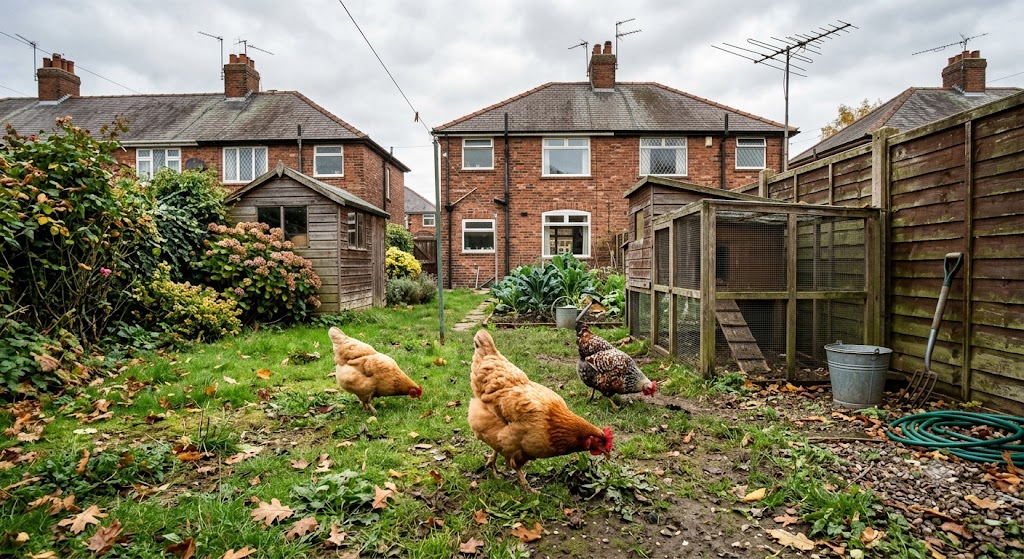
Not so long ago, a few hens at the bottom of the garden were as ordinary in Britain as a washing line, and remarked on about as much.
The run sat down past the vegetables, a patch of bare earth and a henhouse knocked together from offcuts and tarred felt. Four or five birds, a Rhode Island Red, a Light Sussex, a leghorn or two, and every one of them had a name. Brownie. Speckle. The one with the bad foot. A child's first job of the day was to go down with a basin and lift the eggs from the straw, still warm, sometimes still mucky, and carry them up to the kitchen cupped in both hands like something holy.
There was a bucket under the sink for them. In went the peelings, the crusts, the outer leaves of the cabbage, the cold porridge, the scrapings of every plate, and on a Saturday it was boiled up with a bit of bran into a grey mash that left the whole house smelling like the inside of a kettle. The hens turned that bucket of leavings back into breakfast. Nothing was wasted, because the hens ate what the bin gets now.
In the war it became a patriotic act. You could hand back your weekly egg ration for a sack of feed and keep your own birds, and people raised hen houses out of old oil drums and scrounged chicken wire and fed the country one back garden at a time. The cockerel woke the street. The broody hen sat in a tea chest in the shed. The spare eggs went over the fence to the woman three doors down, who sent back a twist of sugar.
Then the whole world of it quietly went. The garden was paved over for the car. The supermarket sold six eggs for less than the feed cost. The young family who moved in would not know where to begin, and the rules tightened until it became, of all things, illegal to feed a hen the kitchen scraps every household once saved for exactly that.
A few hundred thousand keep a few birds still, and bless them for it. But the ordinary garden hen, the one your nan had, the one that gave a child his first lesson in where food really comes from, is leaving the country quietly, coop by coop.
The egg in the shop will never be warm in your hand on a cold morning. That one you had to go down the garden and lift for yourself.
🤯 what on Earth have I just watched - @peterkyle: “It’s not a question”… to a literal question asked by @CamillaTominey. It’s a question that he doesn’t want to acknowledge, that he refuses to answer, but a question, it is. What a car crash interview.
A FARMER can't sell his sheep's WOOL...
...so it ends up as MULCH.
Meanwhile we're encouraged to wear clothing made from PETROCHEMICALS.
NATURAL fibres are being turned into waste...
...while what we're wearing is increasingly recycled GARBAGE.
You gotta ask...
WHAT the actual.... is going on?! 🐑
An interview with actor Pierce Brosnan in June 1985 on the BBC's popular chat show Wogan, hosted by Terry Wogan.
His path to acting: He shared that he was initially a commercial artist. Later, he joined an experimental theater club and even worked as a fire-eater in a circus for about two weeks before deciding to pursue acting professionally.
3/3 There was a local cult of the beheading of John the Baptist in north Norfolk, and this roof boss at Swafield may well represent that. You can also find his head nearby on the font at Irstead and on the roodscreen at Trimingham, where the church is dedicated to the beheading.
Swafield: https://t.co/ncifjZHLZu
2/3 One of the delights of Swafield is its 15th Century roodscreen, the dado panels painted with the Apostles. What they lack in artistic perfection they easily make up for with their folksy character. Here's St Jude with his boat.
More about Swafield: https://t.co/gZi86X76Xe
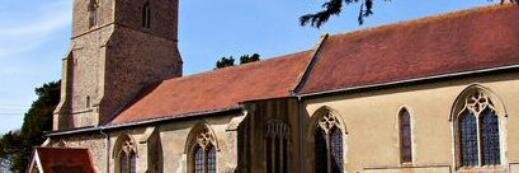
Five years ago today I was at Swafield (pronounced sway-field) in north Norfolk as rural churches began to reopen after Covid. It's a church I've long been fond of, not least for its idiosyncrasies, but the setting on its own a mile or so from the village is special too. 1/3
Do the orphans try to play with their Keepers?
Generally speaking, our Keepers play parent rather than playmate. They're there to feed, comfort, guide and supervise, not to wrestle. Think a finger to suckle on, or a calf resting their trunk on a familiar shoulder. When the orphans want to push and shove, they do it with each other. That's how a calf learns to be an elephant.
That being said, some characters are have such a joie de vivre that every interaction turns into play, Toto, for instance, liked to try and climb onto his Keepers and Bondeni would play chase with Peter!
In every corner of house and garden there’s a small drama unfolding. This morning, Gwydir’s mighty Gothic door provides a take-off and landing platform for fledging swallows. Good luck little ones.