Welcome to the official page of the Former Director of Criminal Investigation Directorate (CID) of the Somali Police Force, Colonel Muhudin Ahmed Osman.
ISIS-Somalia: 200–300 fighters, but a financial hub for the Islamic State from Mozambique to Afghanistan. Operation Hilaac cut off its port revenue. In 2026 it is back. Why a small army with a global bank still matters 👇 https://t.co/2nl16YnFZi
A job offer arrives by text. The pay is good. The work is simple. Then they ask YOU to pay.
In 2024, Americans reported losing $501 million to job scams (US Federal Trade Commission). Abroad, a fake job offer can cost more than money. It can cost your freedom.
As a former Director of the Criminal Investigation Directorate, I wrote The Job Offer Trap to show the five steps every job scam follows, and the 10-minute check that exposes almost any fake offer.
📘 Now on Amazon: Kindle and paperback
🔎 Search "The Job Offer Trap M. Othaman" on Amazon
Share this with someone who is looking for work. It could save them.
#JobScams #FraudPrevention #ScamAwareness #HumanTrafficking #OnlineSafety #JobSearch #CheckBeforeYouTrust
922 dead or missing on the Eastern Route in 2025, the deadliest year on record. Now migrants leave one war and arrive in another, while Yemenis flee the other way. Every migrant surveyed said smugglers deceived them. They went anyway. Why 👇 https://t.co/1f7icuWsYs
Ethiopia closed its Asmara embassy and expelled 10 Eritrean diplomats. Eritrea cut all ties within hours. For the first time since the 2018 peace, there is no channel between them. What it means for the Horn 👇 https://t.co/jl2UOfneyB
Ethiopia's war has reached Afar, and the road to Djibouti that carries almost all of Ethiopia's trade, including its fuel. Not cut, but contested for the first time since the last war. What it means for Djibouti, Somalia and the Horn 👇 https://t.co/aDT9maYoIb
New CSIS imagery: China has added two communications compounds to its Djibouti base, 35 miles from the Bab al-Mandeb and 10 miles from US, French, Italian and Japanese bases. What it shows, what it can't prove, and why it matters for the Horn 👇 https://t.co/wyvb4MgVy4
Africa isn't fighting in Hormuz or the Red Sea, but it's paying: Somali fuel $0.60 → $1.50, Kenya +17–28%, Sudan food +40%. Two shocks, not one. And Puntland's recovery of Sibu 1 from pirates, with no ransom, shows the security bill can be cut. 👇 https://t.co/Wv1uNegeT5
3,000+ Yemenis have crossed to Djibouti; 130,000+ displaced inside Yemen. Djibouti has the law and goodwill to host them, but a camp built for 5,000 and a response 15% funded. UNHCR warns crossings may rise after mid-October. Full analysis 👇 https://t.co/kfHlH4iTvW
Somalia killed Al Shabab's finance chief in Jan 2026. In Feb, they killed the man chosen to replace him. Seven senior leaders eliminated in 44 months — a real achievement, backed by evidence, with the honest caution still intact. Full analysis 👇 https://t.co/OmoeJSZl7T
A US-Puntland strike hit an Al Shabab depot on 17 Sept — easy to mistake for ISIS-Somalia's known stronghold. It isn't. Two separate mountain ranges, two rival enemies, one shared nickname. Here's why the distinction matters. https://t.co/veiCYWxaIp
The Houthis are Shia. Al Shabab is Sunni, with a history of hostility toward Shia Islam. Not natural partners. New reporting names the missing link: AQAP — Al Shabab's own sister franchise, with its own 2022 truce with the Houthis. Full analysis 👇 https://t.co/ttu8O0GwIG
A 16-year Iran-Eritrea paper trail most Red Sea coverage misses. Satellite tracking shows Iranian cargo flights landing drones and munitions at Massawa as recently as Nov 2025 — and Sudan's RSF has directly threatened to strike the port. https://t.co/ZjxfcOTquw
Finland. The UAE. Kenya. Uganda. Cyprus. The Netherlands. Six countries, one US Treasury designation, one thirteen-year prosecution history — all describing the same thing: Al Shabab's financing doesn't stop at Somalia's border. https://t.co/r1Twwd5d35
A Yemeni National Resistance Forces spokesman, on the record, described a network that has moved more than thirteen weapons shipments from Iran's port of Bandar Abbas through Djibouti and Horn of Africa hubs to Yemen's coast. https://t.co/opx3V0uyzJ
A former Al Shabab member near Bosaso put it plainly: cooperation across the Gulf of Aden isn't judged "by ideology" — it's judged "by shared interests."
Full analysis below 👇 https://t.co/VdB1F2kOFP
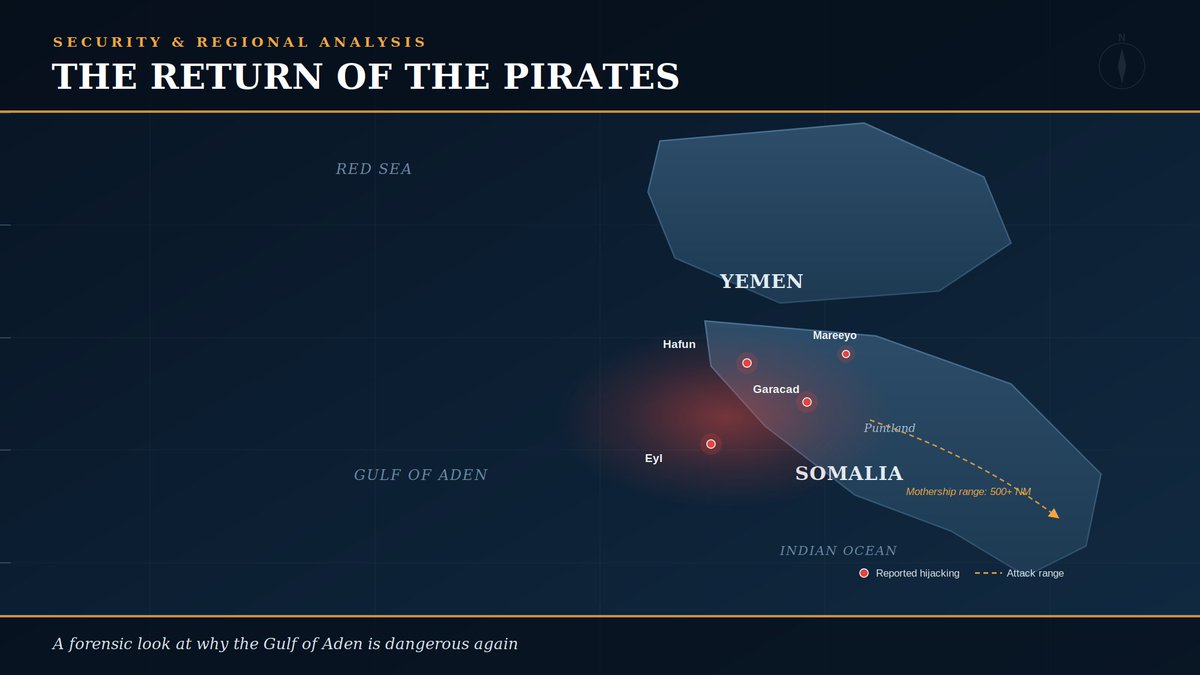
The Return of the Pirates: A Forensic Look at Why the Gulf of Aden Is Dangerous Again
For more than a decade, Somali piracy was treated as a closed case — a rare example of a seemingly intractable maritime crisis that coordinated naval power, private armed guards, and sustained international resolve actually solved. Successful hijackings off the Somali coast fell from a peak of 237 incidents in 2011 to a handful annually by the mid-2010s, and stayed there for nearly a decade. The 2013 film that immortalized the crisis, Captain Phillips, had by 2024 come to feel like a period piece about a danger the world had already defeated.
That assumption has not survived 2026. By mid-August, Sheba Intelligence's running tally recorded at least 19 piracy-related incidents across Somali waters and the Gulf of Aden this year, including successful hijackings of dhows and commercial cargo vessels — with at least five vessels held simultaneously by mid-August, and a sixth, the Cameroon-flagged MV Lutuf, seized on 17 August roughly four nautical miles off Somalia's coast near Mareeyo. This is not a reversion to 2011-scale chaos. But it is the sharpest and best-documented reversal the shipping industry has recorded since piracy was declared contained — and unlike most resurgence narratives, this one comes with names, dates, and coordinates attached to nearly every incident, which is what allows the pattern to be assessed rather than merely asserted.
The chronology, vessel by vessel
Precision matters here, because vague characterizations of "rising piracy" are exactly what allowed the threat to be under-priced for the first several months of 2026. The documented incident sequence this year reads as follows:
21 April — the Somali-flagged fishing vessel Alkhayr 2 hijacked near Hafun, and the oil/fuel tanker Honour 25, carrying 17 multinational crew and 18,500 barrels of fuel, hijacked off Hafun while en route to Mogadishu — two seizures on the same day, in the same waters.
23 April — an armed approach southeast of Eyl, in which two skiffs approached a cargo vessel and shots were fired.
26 April — the general cargo vessel Sward, flying the flag of St. Kitts and Nevis, hijacked six nautical miles off Garacad — a location notably south of the traditional Hafun–Bandarbeyla–Eyl piracy cluster, indicating geographic expansion of active pirate groups. A Puntland security official told AFP the group behind the Sward seizure was composed largely of "rural youth" from an area "awash with weapons," motivated by poverty and anger over illegal foreign fishing.
2 May — the bulk carrier Eureka seized at anchorage near Qana in Yemen's Shabwa governorate; pirates reportedly demanded as much as $10 million for its release, a figure that would rival some of the largest payouts of the 2011 peak.
17 July — the tanker Asana, Tanzanian-flagged, hijacked after departing Mukalla, Yemen, and taken toward Puntland.
17 August — MV Lutuf boarded and seized by eight armed men near Mareeyo, days after a separate Eritrean-flagged oil products tanker was also captured — two hijackings inside a single four-day window.
Two further data points illustrate both the volatility and the murkiness of the picture on the ground. On 18 August, four people were reportedly killed when an unidentified aerial or missile strike hit a small boat near Garmaal in Puntland's Eyl district; local accounts linked the boat to suspected pirates guarding hijacked vessels, but as of this writing no Somali authority or international naval force has confirmed the strike, identified the casualties, or claimed responsibility — a reminder that even the counter-piracy response itself is now operating with reduced transparency. And for context on how established the mothership tactic already was before this year's escalation: in November 2025, EUNAVFOR Atalanta and the Spanish frigate ESPS Victoria intervened within 24 hours to secure the Maltese-flagged tanker Hellas Aphrodite, attacked 550 nautical miles off the Somali coast by gunmen firing RPGs from a skiff launched by the mothership Issa Mohhamdi — the same pirate cell later linked to a near-simultaneous attempted hijacking of the LNG tanker Al-Thumama, 530 nautical miles southeast of Eyl. That 550-nautical-mile range is itself significant: it is roughly the operating radius that defined the worst years of the original 2008–2012 crisis, when mothership tactics allowed pirate groups to strike far beyond what coastal patrol craft could realistically cover.
What has changed operationally, and what has not
Two pirate action groups have been assessed as operating simultaneously during the current escalation — a level of concurrent capacity not seen in years — supported, according to maritime intelligence assessments, by land-based logistics networks inside Puntland. The tactics are consistent with the pre-2012 playbook: hijacked dhows and fishing vessels are being used as mother vessels to carry smaller attack skiffs, fuel, and supplies far beyond the range coastal patrol craft can cover, precisely the method that made the original piracy wave so difficult to suppress.
What has changed is the strategic environment around the threat. Analysts at Horn Review, reviewing the 2026 resurgence, make an important structural point: the 2012–2024 lull did not reflect the elimination of piracy's underlying capacity, only its suppression. "The structural conditions that enabled piracy remained largely unaddressed," their assessment concludes. "Rather than disappearing, piracy networks adapted, reducing visibility while preserving knowledge, logistical familiarity, and social linkages along coastal communities." What 2026 represents, in this reading, is not a new phenomenon but the re-emergence of dormant capability the moment the external suppression pressure eased.
That easing has an identifiable cause. Since the escalation of hostilities between Iran, Israel, and the United States beginning in late February 2026, international naval assets that historically policed the Gulf of Aden and Somali Basin have been redirected or stretched thin by the simultaneous Strait of Hormuz crisis. Operation Atalanta — the EU's longest-running maritime security mission, in continuous operation since December 2008 — has effectively acknowledged the resulting gap, framing its current posture as working to contain rather than eradicate the renewed threat, a materially different ambition from the saturation-patrol model that suppressed piracy after 2012.
The Puntland response: a genuine test case, not yet a solved problem
The most operationally significant recent development is not naval but ground-based. In late August, Puntland security forces launched a ground operation in Garacad against the group believed responsible for the Sward hijacking and its ransom, killing one suspect and capturing two others, while four reportedly escaped. The operation followed a public warning from Puntland President Said Abdullahi Deni, delivered in Garacad itself, that his administration would move against piracy networks directly.
Analysis from WardheerNews rightly frames this as a genuine but incomplete test: capturing individual gunmen is not the same as dismantling the business model behind them. "A serious crackdown cannot stop with capturing individual pirates," the analysis notes. "It would require targeting the wider infrastructure that enables hijackings — including financiers, ransom negotiators, recruiters, logistics networks, and those providing safe harbor." Whether the Garacad operation becomes the opening move of a sustained campaign or a one-off show of force in response to political pressure is, as of this writing, genuinely unresolved — and it is the single most important indicator to watch over the coming months.
It is also worth noting the institutional actor conspicuously absent from this crackdown: the Puntland Maritime Police Force (PMPF), the UAE-funded, roughly 4,800-strong counter-piracy and counterterrorism unit created in 2010 specifically for this mission. That the Garacad operation was reportedly conducted separately from a visible PMPF-led response raises its own questions about institutional coordination that deserve scrutiny as this story develops.
The financial mechanics: how this reaches the global economy
The re-escalation is not confined to the ships directly involved — it is already reshaping the cost structure of transiting the wider region. On 3 March 2026, the Joint War Committee of the Lloyd's Market Association issued circular JWLA-033, expanding its Listed Areas designation to formally include the Gulf of Aden south of 18°N, alongside the Red Sea, the Strait of Hormuz, and expanded zones off the Somali and Pakistani coasts. That designation is not symbolic: it triggers Additional Premium charges and more restrictive underwriting terms for any vessel transiting the zone. Market data reviewed by Howden Re and reported via S&P Global showed Gulf tanker war-risk pricing reaching roughly 2.5 percent of hull-and-machinery value per seven-day period at the height of tension in March 2026, before easing to roughly 1 percent by month's end — figures that, for a large tanker, translate into millions of dollars in additional cost per voyage. Crucially, this pricing already reflected the Hormuz/Iran conflict; the Puntland piracy resurgence layers an entirely separate, geographically distinct risk premium on top of an insurance market that had already repriced dramatically once this year.
For context on scale: at the height of the original crisis, in January 2011, Somali pirates held 736 hostages and 32 vessels simultaneously, at an estimated annual cost to the global economy of $18 billion. The 2026 figures are a fraction of that scale in absolute terms. But insurance markets do not price current losses — they price trajectory and tail risk, and the trajectory across April to August 2026 has been consistently upward.
Why the Al Shabab and Houthi dimension changes the risk calculus, not just the headline
Everything documented so far — the vessels, the dates, the insurance premiums — describes a serious but familiar pattern: a criminal economy re-establishing itself once outside pressure eased. What follows is the part of the picture that makes this resurgence categorically different from anything the shipping industry has faced since 2012, and the reason this threat cannot be assessed as ordinary piracy alone.
What separates 2026 from earlier, smaller piracy upticks is the credible possibility of organizational convergence with two adjacent militant networks. A 2025 UN Panel of Experts assessment documented that Al Shabab representatives held at least two meetings with Houthi counterparts inside Somalia in July and September 2024, in which Al Shabab requested advanced weapons and training in exchange for expanding piracy activity and collecting ransoms — with Carnegie Endowment research subsequently reporting that Al Shabab receives an estimated 20 percent share of resulting ransom proceeds. This financing arrangement was documented before this year's resurgence began, which makes its relevance to the current wave a matter of mechanism, not speculation.
Corey Ranslem, CEO of the maritime risk intelligence firm Dryad Global, has been explicit about the resulting risk: that Houthi weapons technology — potentially including drones and guided-missile components already documented moving through the same Yemen–Puntland smuggling corridors used for arms trafficking — could migrate into Somali pirate hands, disproportionately escalating the threat to shipping beyond what small-arms-and-skiff piracy has historically posed. Puntland Maritime Police Force deputy intelligence director Mohamed Musa Abulle has separately told Somali reporters that some pirate groups have already acquired GPS satellite tracking devices and weapons sourced from Houthi militants and their affiliates in Yemen — equipment that allows far more accurate targeting of commercial vessel routes than pirate groups possessed during the 2005–2012 wave, and that some pirates are believed to have received military training in Yemen itself.
What a credible response requires
Naval presence sized to the actual, current threat — not the threat level assumed under the 2012-era assessment that piracy was solved. Atalanta's shift toward a "contain" posture is an honest acknowledgment of resource constraints, but those constraints are a policy choice about competing priorities, not a fixed limit.
Sustained follow-through on the Puntland ground campaign — the Garacad operation is the first credible test of political will in years; its outcome over the next two to three months, not the initial arrests, will determine whether this becomes a genuine disruption of financiers and ransom networks or another short-lived show of force.
Closing the intelligence gap between piracy financing and militant financing. If Al Shabab's ransom cut is real and ongoing, as documented, counter-piracy and counterterrorism-financing efforts cannot continue operating as separate institutional tracks without leaving an exploitable seam.
Addressing the illegal fishing driver directly. Puntland officials themselves cite foreign illegal fishing fleets — from China, Yemen, Iran, and elsewhere — as an active grievance fueling recruitment into piracy among "rural youth" in coastal communities; this is a solvable governance and enforcement problem, not an intractable one.
Treating the insurance market's response as an early-warning indicator, not background noise. The JWLA-033 designation and subsequent premium movements are, in effect, the market's own real-time risk assessment, updated faster than most government threat briefings — and they are already pricing in a threat picture more serious than most public commentary has acknowledged.
The world spent over a decade and billions of dollars concluding that Somali piracy had been solved. The named vessels, dated incidents, and named officials documented above tell a more precise story: it was suppressed, not resolved, and the underlying capability — the boats, the coastal knowledge, the recruitment pool, and now a documented financing relationship with two adjacent militant networks — never actually went away. It only waited for naval attention to move elsewhere.
THE HOUTHI–AL SHABAB NEXUS: IRAN'S NEW PLAYBOOK FOR THE HORN OF AFRICA.
When Yemen's anti-Houthi National Resistance Forces announced this month that they had identified the bodies of Somali Al Shabab fighters among Houthi casualties on Yemen's west coast — confirmed through documents and personal effects — the story briefly made international headlines and then faded. It shouldn't have. It is the latest, and most visible, confirmation of a pattern that regional analysts, UN monitors, and independent research institutions have been tracking with growing alarm since 2023: two of the most resilient non-state armed actors on either side of the Gulf of Aden are no longer operating in parallel. They are converging.
This is not a distant Middle Eastern conflict with no bearing on East Africa. It is the emergence of a new axis of instability stretching from the Bab al-Mandeb strait to the Somali interior — and it deserves far more attention than it has received.
HOW THE RELATIONSHIP EVOLVED
The Houthi–Al Shabab relationship did not begin as an alliance. Coastal communities on both sides of the Gulf of Aden have been linked by kinship, trade, and smuggling networks for centuries, and for years these contacts remained ad hoc and opportunistic — workarounds for arms embargoes rather than a coordinated partnership.
That changed from around 2023–2024. A UN Panel of Experts monitoring Al Shabab documented at least two meetings between Al Shabab and Houthi representatives inside Somalia in mid-2024, in which the Somali group sought advanced weapons and training in exchange for expanded piracy and ransom-sharing arrangements. Yemeni immigration authorities have reportedly issued passports to Al Shabab operatives to ease their movement across borders — one such individual was killed in a February 2026 drone strike while travelling under a Yemeni alias.
By early 2026, cooperation had reportedly moved beyond logistics and intelligence-sharing into political, media, and direct military collaboration. Houthi trainers are reported to travel regularly to Al Shabab-held areas in Bari, eastern Sanaag, and Lower Jubba, while hundreds of Somali fighters have reportedly been sent to Yemen for combat training — consistent with the UN Panel's findings on organized troop rotations.
WHAT IS ACTUALLY BEING TRANSFERRED
The most detailed open-source assessment to date comes from the Century Foundation's August 2026 report, "From Spoke to Hub: The Houthis in Africa." Its central finding is that the Houthis are replicating the model their own patron, Iran's Islamic Revolutionary Guard Corps, and Hezbollah developed over decades: cultivating regional non-state partners by offering what those groups lack — arms, technical know-how, supply chains, and indirect access to Iranian backing.
For Al Shabab specifically, the reporting points to weapons and technical transfer risk, with the group seeking anti-aircraft systems, drones, and shoulder-fired rockets to counter aerial strikes; training exchanges, including Al Shabab members receiving drone and explosives instruction in Yemen; financial interdependence, with Al Shabab reportedly receiving a share of ransom proceeds tied to Houthi-linked piracy; and a wider logistics corridor now extending into Sudan, where Port Sudan has become a financial and logistical node, and into Eritrea, where the Houthis appear to be building a coastal presence. Analysts warn this could knit together three separate conflicts — Sudan's civil war, the Somali insurgency, and the Red Sea shipping crisis — into a single, mutually reinforcing theatre.
One caveat matters for analytical rigor: despite the depth of operational cooperation, Al Shabab has not formally aligned itself with Iran, and the Shia Houthis and Sunni Al Shabab remain ideologically distinct. What binds them is not doctrine but mutual utility, and a shared adversarial posture toward the United States and its regional partners.
WHY THIS MATTERS FOR REGIONAL STABILITY
The consequences extend well beyond Somalia's borders. The Gulf of Aden and Bab al-Mandeb strait carry more than a tenth of global trade, and a Houthi–Al Shabab logistics corridor operating on both coasts raises the risk of coordinated maritime disruption. This escalation is also occurring precisely as the African Union Support and Stabilization Mission faces a funding crisis following the announced end of US logistical support beyond 2026 — a weakened multinational counterterrorism presence arriving at the same moment Al Shabab's external options are expanding.
The same smuggling infrastructure that moves weapons and fighters across the Red Sea also moves people, meaning irregular migration routes across the Gulf of Aden are becoming more entangled with organized militancy, not less. A better-resourced, better-trained Al Shabab also means a longer, harder fight for Somali and international forces alike. And all of this lands on top of a severe hunger crisis, with an estimated 6.5 million Somalis projected to face crisis-level food insecurity in 2026 — a feedback loop extremist groups have historically exploited to expand recruitment.
WHAT A CREDIBLE RESPONSE REQUIRES
Reversing this trajectory will take more than another airstrike or naval deployment. It requires predictable, sustained funding for AUSSOM at the exact moment Al Shabab's external options are expanding; treating arms trafficking, human smuggling, and militant financing as one interconnected threat rather than three separate policy silos; real investment in maritime domain awareness across the Gulf of Aden; and genuine diplomatic alignment among Gulf states, Turkey, Egypt, the United States, and other Western partners, so that competing bilateral interests don't fragment the response to a threat that is, by its nature, transnational.
The United States in particular occupies a split position worth reconciling: it strikes Houthi targets in Yemen unilaterally to protect shipping lanes, while simultaneously winding down logistical support for AUSSOM — the mission best placed to contain this same threat on the Somali side of the network.
The discovery of Al Shabab fighters among Houthi dead on a Yemeni beach is a small, tragic data point. But it confirms what the open-source research community has been warning for over a year: a once-transactional relationship between two of the region's most resilient non-state armed actors is hardening into something closer to strategic interdependence. The window to respond before that capability transfer becomes irreversible is narrowing — and it is closing faster than the current level of international attention suggests.
#Somalia #Yemen #Houthi #AlShabab #RedSea #HornOfAfrica #CounterTerrorism #RegionalSecurity
📘 New book, live now: Before It’s Too Late
If your child’s world suddenly changed — new friends, closed doors, a different tone — and you didn’t know why, this book is for you.
Drawing on nearly two decades preventing and countering violent extremism, Before It’s Too Late gives parents, teachers, and youth workers a clear, practical guide to spotting the warning signs of radicalization — before it’s too late.
📖 Get it here (all formats): https://t.co/DHaYt1aYUC
If you know a parent or educator who needs this, please pass it along.
Happy 26 June – Somalia’s Independence Day! 🇸🇴
Warmest congratulations to all Somalis on this historic day. As we commemorate 26 June, we honor the courage and sacrifice of those who fought for our freedom and reaffirm our commitment to unity, peace, and lasting progress.