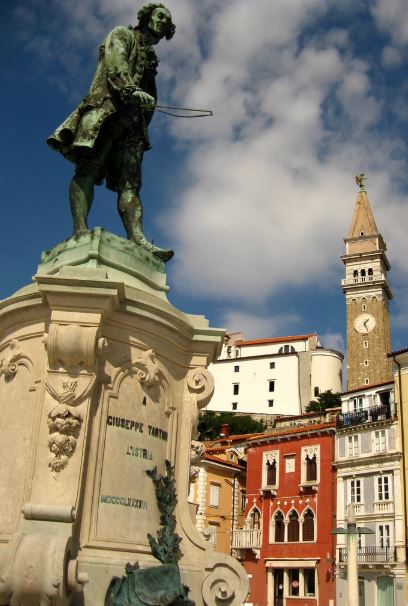
The unveiling of the statue of Giuseppe Tartini in Piran in 1896 was an extremely important event that was reported on by newspapers from Vienna to Venice. Steamers and other vessels brought more than 4,660 curious passengers to Piran from towns along the Istrian coast.
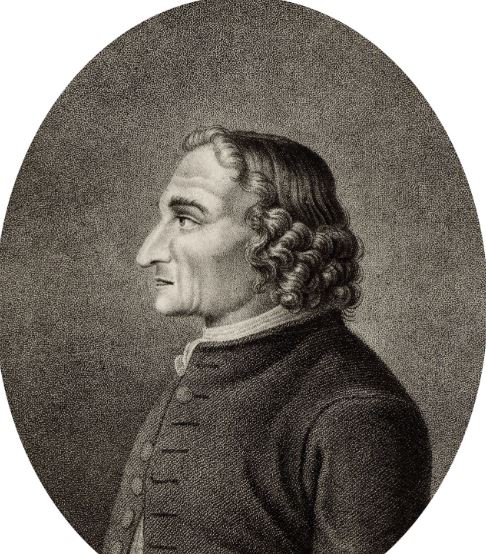
The life of this musical genius came to an end in Padua on 26 February 1770. No matter all manner of stories are told about his life, Tartini was without a doubt one of the leading figures in the musical world of his day, with a Europe-wide reputation.
Tartini called the phenomenon of combination tones the terzo suono or “third sound” and published his findings in a work called Trattato di musica secondo la vera scienza dell’armonia (“Treatise on Music According to the True Science of Harmony”).
Tartini’s bowing technique was based on the breathing technique used by singers. It is no coincidence that Tartini’s collection of variations on a gavotte by Corelli should have been given the title L’arte dell’arco (“The Art of the Bow”).
After returning from Prague, the Piran-born Tartini opened a school that became known as the “school of nations”. He enjoyed a lofty reputation of international dimensions, with students coming to him from various countries.
Did you know that among his many talents Giuseppe Tartini was also an excellent fencer? After he married and moved to Padua, where he began studying law, he spent most of his time mastering his fencing skills.
The unveiling of the statue of Giuseppe Tartini in Piran in 1896 was an extremely important event that was reported on by newspapers from Vienna to Venice.
The statue was made by the Venetian sculptor Antonio dal Zotto
250th anniversary of the death of the famous violinist, G. Tartini On 16 and 17 November 2020, the Int. Musicological Symposium will take place in the composer’s native Piran and in Ljubljana, with a focus on Tartini’s ideas on musical theory and his creativity as a composer.
Some of Tartini’s works are a regular feature in the repertoires of the finest violinists of the present age and recent past. Many of them have immortalised their interpretations of Tartini’s works: Itzhak Perlman, Isaac Stern, Anne-Sophie Mutter, Julia Fischer, Andrew Manze, ...
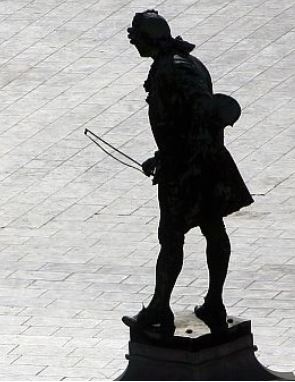
In the middle of the main square in Piran, the town of Tartini’s birth, there stands a monumental full-length bronze statue of more than life size, made in 1896 by the Venetian sculptor Antonio dal Zotto.
The figure of Giuseppe Tartini is a powerful presence in Piran’s main square, which also bears his name. Tartini Square was once part of the town harbour, specifically the mandracchio or inner harbour, destined for smaller craft.
Today Tartini’s discovery of combination tones and difference tones is acknowledged by music historians and physicists alike. He called this acoustic phenomenon the terzo suono or “third sound”.
Due to paralysis in his right arm, Tartini stopped performing outside Padua in 1740, and had to give up performing entirely after 1750. He died on 26 February 1770. Tartini and his wife are buried in the Church of St Catherine in Padua,opposite the house where they lived.
Tartini was not only a musician and composer; his manuscripts are invaluable as well, such as his geometrical and mathematical studies of the circle and discussions on music theory.
Did you know that Tartini was the first renowned owner of a Stradivarius violin? He bequeathed it to one of his talented students, Mazzurani, who passed it on to the Polish composer and violinist Karol Lipiński (today, the violin is known as the Lipinski Stradivarius).
The new museum trail tells the story of the great composer and the bygone Piran of the Baroque, Classical, and Neoclassical periods. The wall paintings in the house, inspired by the artistic models of the time.
Tartini’s oeuvre consists of more than 130 violin concertos and almost 200 violin sonatas, with or without accompaniment. Many of Tartini’s works survive in manuscript form. The Luciano Benincasa Municipal Library in Ancona holds the manuscripts of 62 of his compositions.
Tartini House with renovated wall paintings depict a variety of views–landscapes,triumphal arches,ornamentation–that will take you on a voyage through time and the life of the great 18c master. #Tartinihouse
One of Tartini’s best known and most frequently performed works is his Sonata for Violin and Basso Continuo in G minor, commonly known as the Devil’s Trill Sonata. Listen to the Devil’s Trill Sonata https://t.co/YTklW2aR05
If you would like to hear the sound of the violin now kept in the house where the composer was born, listen to the album Tartini’s Violin released by the internationally renowned Genoa-based record label Dynamic in 2016.