Super excited to share our new paper introducing MOSA, a generative model that integrates and augments 7 different types of cancer data across 1,500+ cell lines! 🧬🔬 https://t.co/rPfiv3VEXd @Garnettlab@sangerinstitute@CMRI_AUS@InescID@istecnico
New preprint from Tam Lab @CMRI_AUS
- In this study, we investigated and characterized the mesendoderm progenitor in invitro differentiation models of mouse, human embryonic stem cells and in gastrulating mouse embryo.
Our benchmarking of Spatially Variable Gene (SVG) detection methods is finally out in @GenomeBiology! Thank you to @hani_jieun and my PhD supervisor @PengyiYang82, as well as @CMRI_AUS@sydneybioinfo for their support!
See the🧵 for more details! https://t.co/EcrbETgEBz
Look for a "wet-lab" postdoc researcher to join our ComputationalSystemsBiology lab at Children's Medical Research Institute. Send your app if you work with stem cells @AusStemCell@StemCellsAus@the_ASSCR and epigenetics @AEpiA. Ads:
https://t.co/y5kt862xhF. Close date: 10 Jan
🚨Job Alert! Interested in the 🧬#epigenome and #cell_fate_decisions? We are looking for a highly motivated #postdoc to join our multi-disciplinary lab at @CMRI_AUS 🇦🇺. See below for more details. Please RT
https://t.co/1OWjVZJR6R
Our recent study (https://t.co/ldLrTzlS6g) highlighted the potential use of deep learning for selecting features in scRNA-seq data. Our new lab study (https://t.co/56afmwHs7f) by @haohuang1999, @ChunleiLiu0, and @manojmwagle examines their suitability and necessary improvements.
I'm extremely proud to see our work on ensemble deep learning applied to kinase-substrate prediction using phosphoproteomics data published https://t.co/VoyvuNVgXi. This wouldn't be possible without @SeanJHumphrey@Ben_Leo_Parker@jimmib_78 and outstanding PhD student @DiXiao22.
Thrilled to share our latest publication in #NAR_Genomics_and_Bioinformatics – SnapKin, a cutting-edge ensemble deep learning method for kinase-substrate prediction, that's been selected as Editor’s choice 🌟! Dive into our findings here: https://t.co/yKUJG6L07Z
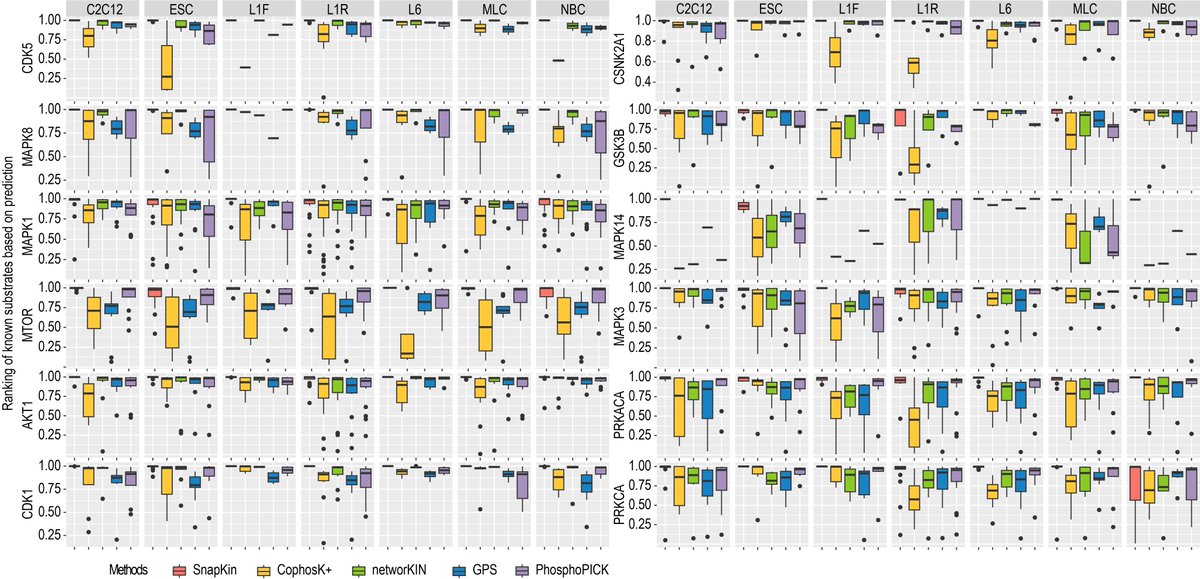
4/7 SnapKin's superior predictive capabilities are evident as it consistently ranks known kinase substrates higher than alternate methods. This performance establishes it as a vital tool in the phosphoproteome research toolkit.
3/7 Standing out in a competitive field, SnapKin integrates both 'pseudo-positive' and ensemble strategies within a snapshot model, and leverages CKSAAP encoding to refine predictions, setting a new benchmark for kinase-substrate prediction models in phosphoproteomic research.