Buying $NVDA here.
May full port if it slides further down.
To be fair, buying any semiconductor company wasn’t my plan.
I have been a pessimist since June and sold all my $AVGO.
But such conflicts have always turned to be an opportunity later. You’ll know why
Winners continue winning, no matter what.
$NVDA could compound 20%+ from here for next 3 years
it's high time you admit that you're playing the wrong game in crypto.
you can't spend all day doomscrolling on x, getting your alpha from the same KOLs as everyone else, buying the same tokens, and somehow expect to consistently outperform the market.
crypto is one of the most aggressive PvP markets in the world, yet some people are playing a game you don't even know exists.
a few days ago, i came across the story of @3i, a trader who claims he and his friends made over $6m trading CASHCAT and PONS.
these guys were monitoring BitGo's public GitHub repo, tracking Wintermute wallets and studying patterns from previous Robinhood listings. they spotted a code update for CASHCAT 10 days before Robinhood announced its listing.
anyone could have seen that code update. very few would have understood its significance.
that's the kind of edge people are competing with in this industry.
look at someone like Cbb0fe. from farming Blur to arbitraging equity perps on Hyperliquid against TradFi markets, he keeps finding ways to make money without necessarily having a directional thesis on the asset he's trading.
meanwhile, some of you are emotionally attached to tokens because you've convinced yourselves that good tech automatically translates into price appreciation.
the market doesn't owe you money for being intellectually right about a project.
crypto is mostly game theory and mechanism design played by irrational actors in a PvP format.
you and a VC can be bullish on the exact same project, but your cost basis and incentives are completely different. by the time you're celebrating a 2x, the VC could be sitting on a 50x and looking for liquidity to exit.
human psychology explains why people refuse to buy something at a $50m valuation but suddenly develop conviction in the same thing at $500m.
copywriting and distribution explain why mediocre products sometimes attract more capital than products with superior tech.
on the uglier side, you have hackers who understand certain pieces of infra better than the devs who built them, and dishonest KOLs who have figured out how to monetize the financial desperation of their followers.
you need to understand that these are some of the people you're up against.
and no, the solution isn't necessarily to become a better trader. some people have had the balls to start building because they've realized there's more money to be made solving the problems traders have than competing with them every day.
even the little i've managed to achieve in this space came from refusing to follow the crowd and being willing to go the extra mile. learning copywriting, understanding DeFi and figuring out distribution opened doors for me that buying the right token never did.
of course, going the extra mile comes at a cost. you could spend six months learning something without making a dollar from it. you could build something nobody wants. hell, you could do everything right and still lose money.
but imagine spending five years in crypto and the only skill you've developed is knowing which accounts to follow for alpha.
in an industry where people are increasingly outsourcing their thinking to KOLs and AI, curiosity and the ability to figure things out independently are becoming more valuable.
if your entire strategy depends on someone else discovering an opportunity and being generous enough to tell you about it, you're probably the easiest player to beat in this market.
i haven't felt this bad about crypto in years.
i've watched markets crash, seen my bags bleed, and lived through some pretty terrible cycles. but i don't think i've ever been this frustrated with how difficult it's become to actually make money in this industry.
and the more i think about it, the more i realize how much of this mess we created ourselves.
paul makes some really good points here.
for years, crypto was largely a zero-sum game for traders. someone made money, someone lost money, and the whole thing kept going because people believed there was another opportunity around the corner.
back then, a lot of the money people made went straight back into crypto. someone made a 10x on one alt, rotated into another, and the cycle continued.
it was never a fair game, but ordinary participants still had opportunities to make serious money.
now it feels like everyone has figured out how to get paid before the average trader even gets a chance.
founders raise millions and launch tokens at ridiculous valuations. VCs get allocations at prices retail will never see. exchanges collect fees regardless of market direction. KOLs get paid to promote the next big thing, and memecoin launchers can make money even when almost everything they launch goes to zero.
none of these things is automatically wrong on its own, but look at what happens when you put them all together.
you have an entire industry where so many participants can make money without the average token buyer ever making a profit.
and unlike traders who used to rotate their winnings into the next opportunity, the people collecting these fees and cashing out allocations have no obligation to put that money back into crypto.
i think this explains a lot about why the market feels so different now.
look at how fast narratives rotate. one week everyone is convinced a particular chain or protocol is the future. the next week, liquidity has moved somewhere else, the timeline has forgotten about it, and people are already searching for the next trade.
nobody wants to be the last person holding anything anymore.
and honestly, can you blame them?
imagine spending months studying a protocol, understanding its business, and getting the investment thesis right, only for its token to launch at a $1 billion FDV with barely enough revenue to justify a fraction of that valuation.
you then spend the next year watching unlocks hit the market while the business keeps growing and the token keeps bleeding.
the funny thing is that you might have been completely right about the project and still lost money investing in it.
we've made it so easy to monetize attention, launch tokens, and attract temporary liquidity that actually building something people want to use can feel like the harder way to make money.
and i think this is where we've done the most damage.
we keep blaming people for having no conviction, but we've spent years giving them reasons to sell as quickly as possible.
the faster everyone rotates, the harder it becomes to sustain demand for anything. and when people keep losing money holding tokens, they become even more desperate to catch the next narrative early.
it's a cycle that keeps feeding itself.
and before anyone says this is simply how markets work, i understand that speculation is part of crypto. people are supposed to take risks, some businesses will fail, and nobody is entitled to make money.
but there's a difference between losing money because your investment thesis was wrong and repeatedly buying into a market where other participants have already structured their profits around your arrival.
the irony is that crypto has genuinely useful tech. stablecoins are solving real problems, DeFi protocols are generating revenue, and some of the businesses being built here could become enormously valuable.
but none of that guarantees the average person buying their tokens will make money.
we've spent years celebrating adoption, TVL, fees, and billion-dollar valuations while paying far less attention to whether the economics actually work for the people holding these assets.
and we're all part of this problem. we chase airdrops, celebrate ridiculous valuations when our bags are pumping, promote narratives, and move on the moment something stops making us money.
i still believe there's an enormous amount of money to be made in crypto, and i don't think another bull market is going to be difficult to celebrate.
what worries me is that another bull market could bring back the profits without changing any of the incentives that made this one so miserable.
because if the easiest way to make money in crypto continues to be selling something to the next person rather than building something that creates genuine value, we're going to keep having this conversation.
and i really don't want to spend another cycle watching people make fortunes from an industry whose own participants can barely make money anymore.
Reading Rockefeller's biography helped me understand how much we can all do if we take things more slowly. No matter how intense his work ethic, he never stopped taking daily naps and Sundays off for Churchgoing. Playing the long game helps you keep doing what's important. Buffett always said how his advantage in his younger years was that he knew he'd become rich; he just didn't have to rush it. Great work takes time. Results are guaranteed with consistently good input.
Money is created from printing and from credit creation
Globally higher rates is putting pressure on the credit creation side
Not very good for any investment short term - but as mentioned thats why investing is so hard because the best time to buy is when the logic of buying doesnt match the current situation
Investing is looking passed today and seeing how thats an opportunity for whats to come
If you dont look long term the current logic would suggest you should be buying bonds or holding cash which makes no sense long term but thats what happens when you nowcast
Will they not print money? Will they not expand credit again? - long term thats pretty obvious
Till the time you wait for certainty, it’ll be reflected in price. Bottoms are never form in certainty. It’s the uneven factors that combinely come into play and that’s how you get to buy a business cheap.
Not saying Huang’s resignation is not going to dent Nvidia, but they’ll find a fix for that. They’ve access to best resources in the world and until the demand for compute slows down, they’re priced perfectly for a double digit returns over multi year timeframe
Buying $NVDA here.
May full port if it slides further down.
To be fair, buying any semiconductor company wasn’t my plan.
I have been a pessimist since June and sold all my $AVGO.
But such conflicts have always turned to be an opportunity later. You’ll know why
Winners continue winning, no matter what.
$NVDA could compound 20%+ from here for next 3 years
one pattern I’ve increasingly noticed among exceptional businesses is their willingness to make fewer decisions, take their time understanding an opportunity, and commit only when the conviction is there.
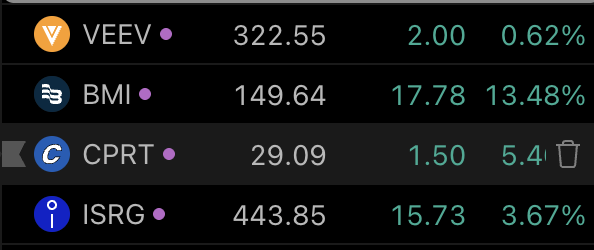
Berkshire Hathaway, Apple and Copart are interesting examples, each in their own way.
take Apple. It’s been criticised for not being at the forefront of the AI race, particularly during what could be one of the most consequential periods in technological history.
but there’s another way to look at it. Apple has historically been deliberate about what it integrates into its ecosystem and how. It doesn’t necessarily need to be first. It needs to get the implementation right, at a scale that matters to its users.
that doesn’t mean its approach is infallible, or that it should be immune to criticism. But there’s a distinction between missing an opportunity and refusing to chase one before you understand its economics and implications.
Berkshire operates on a similar principle in capital allocation. Buffett and Munger never needed to make hundreds of brilliant decisions. They needed to avoid the bad ones and recognise a handful of exceptional opportunities.
Copart, too, has spoken about making investment decisions on a 10, 20 and even 30-year horizon.
what’s interesting is that these businesses aren’t necessarily short on ambition. They’re selective about where they deploy it.
at their scale, a poorly understood bet can cost years of accumulated advantage. The pressure to participate in every major opportunity can be just as dangerous as the fear of missing out.
i think there’s a lesson here beyond business.
every individual is, in some sense, running a startup called themselves. We allocate our time, attention, money and energy, constantly making decisions with incomplete information. More often than not, emotions, impatience and the pressure to keep up get in the way of sound judgement.
studying businesses and people who’ve compounded success over decades can teach us something that conventional productivity advice rarely does: how to think before acting, recognise what we don’t know, and become more comfortable with not participating in everything.
there’s probably a lot to learn from people who've spent decades getting this right. Not just how they make decisions, but how they resist the temptation to make the wrong ones.