There is still time to submit to our special issue on tailored and personalized interventions.
The deadline has been extended to the 1st of March 2025.
Follow this link for more details: https://t.co/Rb99w8SEE5
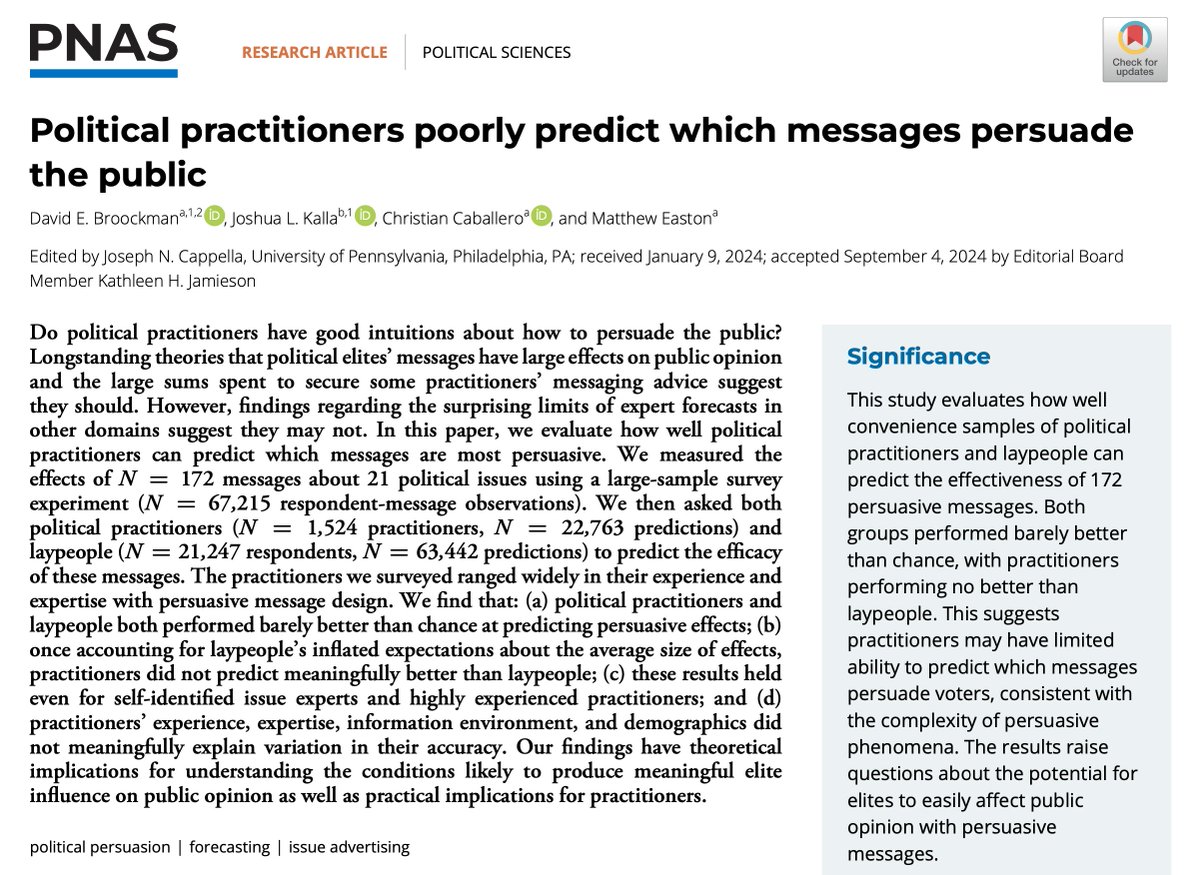
Yale researchers put political professionals head-to-head with laypeople in predicting the effectiveness of 172 campaign messages. They found that neither group performed much better than random chance: https://t.co/UWuWsebuND #Yale
New at @PNASNews with @dbroockman, @chriscaballero_ & @easton_matty: "Political practitioners poorly predict which messages persuade the public." As we head into the last week of the campaign, a good reminder that political practitioners have poor intuitions as to what persuades
Interventions that enable individuals to circumvent obstacles, offer social support, provide incentives, and highlight healthy social norms are very effective at changing behavior.
Changing emotions, attitudes, and beliefs, doesn't help much. https://t.co/eAuWWTL1kd
NEW PAPER w/ @eriksantoro@j_kalla@ronchuli
There's a widespread idea that we will persuade other people more effectively if we listen to them first
The NYT has said it, social psych says it, & my previous research has assumed it
In a new study, we find it's likely wrong 🧵..
NEW📚 Our *free* #openaccess book Measuring Exposure and Attention to Media and Communication: Solutions to Wicked Problems is out🚀
A privilege to work w/ @PeterNeijens, @judith_moeller & @theoaraujo on this.
📢Share the joyful msg on this sad platform
https://t.co/VTvXiDXCzp
NEW w @j_kalla at @mattyglesias' "Slow Boring":
What's better than calling Trump weird? Convincing voters Harris is normal
In survey testing 76 messages w >100k people, we find:
- anti-Trump messages doesn't work
- pro-Harris messages do, especially "typical" Dem messages 🧵
🌟 Excited to share my latest publication! In this experimental study, I explored how different levels of psychological uncertainty impact the effectiveness of one-sided and two-sided narratives in promoting updated COVID-19 vaccinations. https://t.co/Pa2qJKbuLe
Q: Does matching the moral language of climate messages to a person's moral foundations enhance the message's effectiveness?
A: Not really, and a mismatch may have downsides!
New paper (Open Access) in Enviro Comm, led by @CassandraLCTroy & @nicholasejh:
https://t.co/VBJipPxnUe
📢I’m recruiting 1-2 PhD students for the 2025 intake. Full funding for 4 years available. Students who are interested in media psychology, persuasion, artificial intelligence, health communication, and advertising are encouraged to apply.
A new meta-analysis by @nehamalewis, Emily Andrews, Denali Keefe and Nathan Walter (@compsi_lab) describes antecedents and consequences of information seeking and scanning - Related but distinct behaviors, with different antecedents but similar effects. https://t.co/fu95txnNB9
Overall, it seems predictions made by repeated exposure theories may not hold so well when using different (but non-identical) messages about a single topic. We also reflect on implications for message fatigue & reactance theorizing.
Here's hoping for more repetition research!
Q: How do people respond to positive messages depicting a future where climate change is meaningfully addressed?🌎🌱🙂
A: Depends on your efficacy beliefs!
Read our paper in @JEnvPsych, led by @CassandraLCTroy w/ @meganlpnorman@NahyunKim7 & @JessMyrick
https://t.co/xOB8NXMSLY
Cost-effectiveness analysis of in-survey RCT pre-testing to increase the impact of public health campaigns in a pandemic. https://t.co/k8pNP9mEnc via @Ben_Tappin & @lukebeehewitt