Climate science and technology policy since 1989. Building Climate Systems Engineering @UChicago. Founded Carbon Engineering. Bluesky: @davidkeith.bsky.social
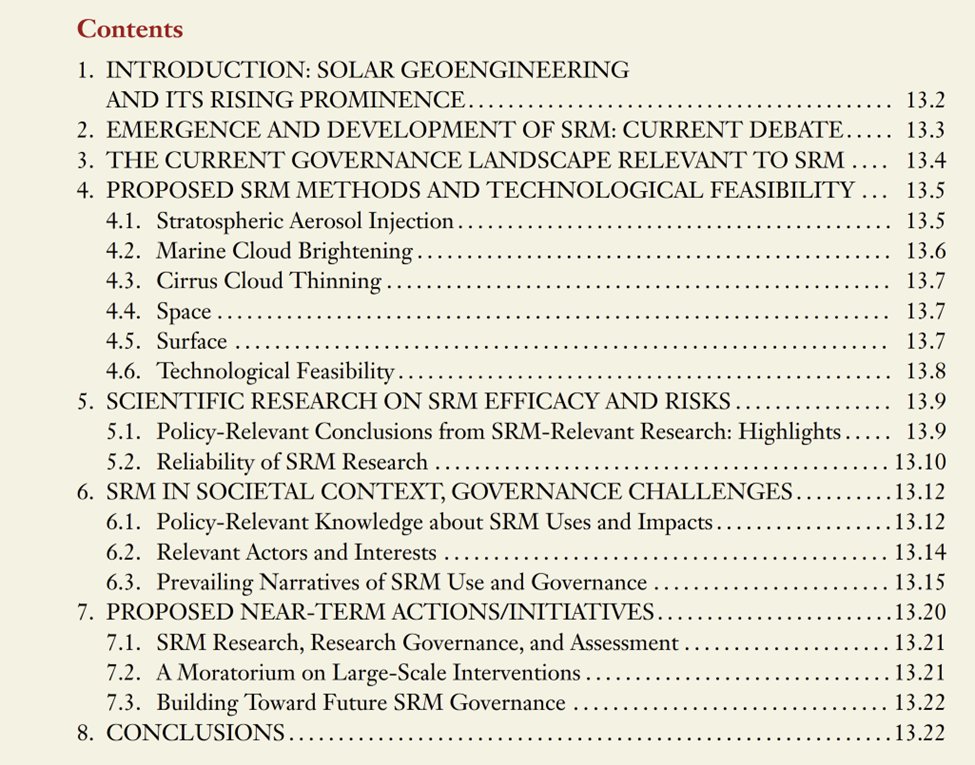
New paper: "Solar Geoengineering: History, Methods, Governance, Prospects" by @parson_ted & me in Annual Reviews.
Full text at: https://t.co/tMzbu7RZrW
I am particularly proud of this paper. This thread provides some highlights:
1/8
@UChicago If you’re interested in how these ideas are evolving and how they might (or might not) fit into climate policy, I hope you’ll join us.
Register and learn more here: https://t.co/fPSi35X3nK
On May 18–19, the @UChicago Climate Systems Engineering initiative is bringing together researchers, policymakers, and practitioners for a public symposium we're calling "Frontiers in Climate Systems Engineering.”
The goal is simple: rigorous analysis and open debate.
@UChicago May 18 starts with an introductory overview and policy discussions. Presentations on May 19 will be tilted towards science and technology with more expert-oriented discussions.
Daniele Visioni and I explain our concerns about Stardust and the commercialization of climate engineering in Technology Review:
https://t.co/im4VY3QsyN
@mattkahn1966 It is false to claim that we assume no adaptation.
We used the strong adaptation case in Carelton et al.
Caveat: The temperature mortality econometric are not mine, and I am no expert.
@DoctorVive@nytimes@nytopinion This is false.
Carbon engineering has nothing to do with solar geoengineering, folks at CE oposed my involvement in SRM.
And, while I was the founder, I have no involvement anymore. Not do I have a financial interest in any other climate commercial venture.
Please retract.
@hausfath @logicsmightwork @nytopinion Second, one can slowly phase out SRM, even if concentrations have not been reduced with carbon removal. The result is same temperature than without SRM, but Earth reaches that temperature more slowly, and that can be a big benefit as many climate risks depend on rate of change.
One can imagine this rule is simple enough to be useful in international negotiations over sunlight reflection.
My prior NYT op-ed's on this topic: https://t.co/XFxHiRlvXQ, and https://t.co/X8spwHU2If
4/4
First, it ties use of SRM to clean up of pollution, and since this pollution is mostly from burning fossil fuels, this is roughly equivalent to tying use of SRM to cuts in fossil fuels; and second, it provides a non-arbitrary fixed upper limit on how much SRM can be deployed.
3/4
@DegreesNGO@hollyjeanbuck@MutisoRose And Holly Buck is a powerful writer on geoengineering. See her book "After Geoengineering." Also, her article "The Rise of Green MAGA" is essential reading for the current political environment: https://t.co/GnoFf84Mtw
Here's Holly on our pod: https://t.co/HCgzKAxzbg
Enjoyed Cape Town last month at the @DegreesNGO Forum 2025. I had the pleasure of joining @hollyjeanbuck and @MutisoRose for a plenary session on how sunlight reflection methods (SRM) fit into the broader climate response toolbox. #DGF2025 https://t.co/SO1pQFT8GC
@DegreesNGO@hollyjeanbuck@MutisoRose Rose Mutiso is a great rising voice in the climate and energy space, and I recently spoke with her about the energy transition in Africa on my Energy vs Climate podcast: https://t.co/MEbHWAdvjM
Rose's Ted Talk on the subject is also a must watch: https://t.co/1DSq83V37n