Choosing a funnel shouldn’t become a three-week clusterfuck. Start with the price and how much explanation the buyer needs.
For services and info, $1–2k could suit a sales page with checkout, while $2.5–3k might suit a webinar. At $3–10k, consider a call funnel, webinar, or free training leading to a call. At $10k+, calls, webinars, or challenges may fit a longer buying process. You’re helping someone buy, mate, not building an airport.
For software, trials or checkout may fit below $500/mo, while demos or calls may fit above it. Pick a sensible starting point and test the economics. All this carrying on before launch isn’t bringing in customers.
I’ll rebuild your landing page within 72 hours of receiving the required materials and test it against your current one.
Pay $97 upfront and $197 when the new page beats the agreed conversion benchmark. If it doesn’t win under the agreed test terms, the $197 isn’t due and you get the $97 back.
We settle the conversion action, traffic, and testing period before starting. Nobody gets to move the goalposts because the screenshot looked bloody lovely.
DM me “READY” for the details.
We are expensive: our setup fee usually sits around $15–25k, depending on the deal. We want fewer clients we can give proper attention to because the work continues after the funnel goes live.
Ads need testing, pages need checking, and leads and sales feedback need reviewing. That takes time to understand what’s happening and fix the weak parts.
We’d rather do that well for fewer clients and give them a reason to stay. Signing more clients is fun until they all ask what the fuck is happening on the same morning.
If you’re testing a brand-new offer without clients, expect work finding what sells. We usually set aside $5–7k and spend around $1.5–2.5k before deciding whether to kill or scale a campaign.
You need useful data on what happens after the click: whether people apply, book, show, and buy. Depending on the results, you may need another test and sometimes more spend.
A clear offer and good ads help, but the budget doesn’t buy a promise. Meta doesn’t owe you a winner because the card went through. Find and fix the weak step before paying for another round of the same shit.
Before you buy more traffic, let’s see whether the page is doing its bloody job.
We’ll rebuild your landing page for free within 72 hours of receiving what we need. That includes the agreed copy, design, and build, with a clear plan for testing it against your current page.
If people need a sales call just to understand what the page was trying to say, we’ve found something worth fixing.
DM me “FIX.” Let’s stop making strangers solve a fucking puzzle before they can book.
These illustrations are based on reported results. The dialogue, names, profile photos, and timestamps are illustrative.
A B2B software company was already paying for traffic. People were dropping off before they booked, and some who booked never made it to the demo.
We rebuilt the page around one booking action and shortened the form. After booking, prospects got a confirmation explaining what the demo would cover and a reminder with one question to think about. Anyone who missed it could reschedule in one click.
In the first 60 days after the rebuild, 63 demos were booked and 85% of the people who booked showed up.
If an agency charges $2–3k/mo and has 100 clients, ask who’s paying attention to your account. Someone needs to write new ads, check the funnel, read sales feedback, and work out why calls aren’t turning into money.
That takes time and people who know what they’re doing. A big team alone proves nothing; you can hire a room full of people and still have nobody who knows what the fuck is happening.
Ask who owns your account, how many others they handle, and what happens when results drop. Your logo shouldn’t get more attention in their sales deck than your campaign gets all month.
No one talks about what you need to get right before you run ads.
A lot of business owners get stuck on this:
• Should I build the funnel?
• Should I get more people to my page?
• Should I work on my offer?
• Should I work on how I sell?
Your offer needs the most work before you spend a damn dollar on ads.
You still need a big group of buyers with money to spend and a big problem you think only you can fix.
But if you want to make your life hard as fuck, run ads with an offer that only sells to people who know you.
There's a good chance it will flop with people who don't.
People who find you through your posts or friends may trust you already.
People who see your ad don't know who the fuck you are.
So you go from selling through posts and word of mouth to paying for ads. Then people don't want that shit.
They don't trust you. They ask if it's worth the price. They're scared they'll waste their money.
Your price feels too damn high when they can't see what they'll get from it.
Some owners then think they're getting the wrong fucking leads.
We've built 150+ sales funnels, and we keep seeing this same fuckery. Most offers only work once people trust the business.
That makes it much harder to grow with ads.
How well your ads work depends a lot on how good your offer is.
We've seen an insurance offer bring in $8 in sales for each $1 spent on ads. The ads looked like shit, but people wanted the offer.
One of our funnels gets calls with the right buyers for just $89 each. It gives people something they want.
We've put out 30+ offers for people who sell what they know, coaches, agencies, and firms that sell software or do work for other firms.
The offers that keep selling to people who don't know you have eight things:
• People get what you sell.
• It fixes a big problem.
• It's easy for the buyer to use.
• You say how long it will take.
• You say what they'll get.
• You say how you'll do it.
• People believe you can do it.
• You take on more of the risk.
Get all eight right, and you'll make a lot of fucking money fast, even if your ads aren't the best.
But an offer that's easy to sell can be hard as hell to do well. You still have to do what you said you would.
Take firms that help people get business loans.
You could book calls for $20 each. You could get firms to pay you $5,000 or more for leads.
But if you're shit at running ads, you'll lose money and run your business into the ground.
Choose between cold email, LinkedIn, Instagram, and calls by looking at the buyer and offer. Email can carry a clear business pitch, LinkedIn gives work context, and Instagram can provide a relevant way to show useful work. Calls let you ask questions and hear answers; texts and voice notes can help a conversation move when they fit.
Make the opening suit the setting. Pasting an email into an Instagram DM isn’t a channel strategy, and paying for a tool doesn’t mean every buyer needs it.
Choose a sensible path and track conversations, calls, and sales. The buyer doesn’t need a fucking tour of your subscriptions.
These illustrations are based on reported results. The dialogue, names, profile photos, and timestamps are illustrative.
One buyer was already doing 30–50 jobs a month. The salesperson felt they were ready to buy before the call, so they went through the conversation using their existing approach.
The team planned to try the new sales process on the next calls. That gives them a chance to see what it does when buyers still have questions about price, timing or whether the offer fits.
Before buying another pre-call system, check whether anyone calls the leads. Sometimes the missing automation is your setter getting off their arse.
If you’re aiming for an 80%+ show rate while struggling around 50%, speed is worth reviewing. Make contact within 3–5 minutes a working-hours goal, ask something useful, and explain the next step while they still remember booking. A reminder email can’t rescue every conversation your team ignored.
Speed alone won’t guarantee attendance, but check it before buying more software. You’ve got a whole tech stack and nobody wants to make the damn phone call.
If you charge $5k+ and still can’t pick a funnel, start with a call funnel.
I get this question like 6-7 times a month.
“Webinar?”
“Challenge?”
“Direct to checkout?”
You’re trying to pick a funnel without looking at how people buy the offer.
You’re scrolling through funnel types like Netflix. Pick something you can actually test.
Start there.
1. High-ticket services and info
We default to call funnels for a lot of these.
My preferred starting point is $5k+.
At $3k-$4k, it can still work, especially if people pay in full.
But PLEASE look at the cash you collect.
You signed someone for $5k.
Great.
They paid $1k upfront.
That means you have $1k now.
If it cost you $1,500 to acquire and close them, the other $4k on the contract doesn’t magically fund the gap.
You have to cover it until the payments arrive.
Your landlord is unlikely to accept “but it’s signed in the contract” as rent. Collect the fucking money.
Track cash collected.
2. Software around $500/month and above
I’d look at demos when the product needs explaining, the buyer needs approval, or setup is involved.
Give them a chance to understand how it fits what they’re trying to do.
But price alone doesn’t mean every buyer needs a call.
Not every buyer needs a meeting just to find the checkout.
Look at the buying process.
3. Lower-priced, self-serve software
A free trial or direct checkout can make sense.
Then watch what happens after signup.
Do people use it?
Do trial users become paying customers?
Do those customers stay?
A thousand trial signups look good until you realise barely anyone pays.
A room full of people clapping for free still leaves you paying for the room.
For any funnel, know:
• What it costs to acquire a customer
• What you collect upfront
• What the customer is worth over time
• What it costs to serve them
• How long it takes to get your acquisition spend back
Pick a funnel that fits the offer.
Run it.
Find out where people drop off.
You’ll learn more from that than another week asking people on Twitter which funnel is best.
At some point you have to close the tab and run the fucking thing.
If buyers want the outcome but hesitate at the offer, examine how much risk you’ve dumped on them. “You take all the chances and I get paid” is a cheeky fucking arrangement.
They may doubt delivery, their workload, or what happens if it goes wrong. A useful first step, clear deliverables, relevant proof, or a guarantee you can honour may help. Another PDF doesn’t automatically solve that; now the worried buyer has homework too.
Solve the doubt instead of decorating it. You can’t keep saying “trust the process” when the process looks like you’re winging the whole damn thing.
A “qualified call” shouldn’t mean anyone with a pulse and a calendar, mate.
Before starting, we agree on the business type, buyer role, need, and other qualification requirements relevant to your offer. Then we build the outreach and booking process around those criteria.
It’s $197 to set up and $150 for each qualified call that actually happens. No qualified attendance means no call fee. Domains, inboxes, data, and tools cost extra, agreed upfront.
DM me “QUALIFIED.” Let’s define the result before some random booking gets dressed up as a bloody opportunity.
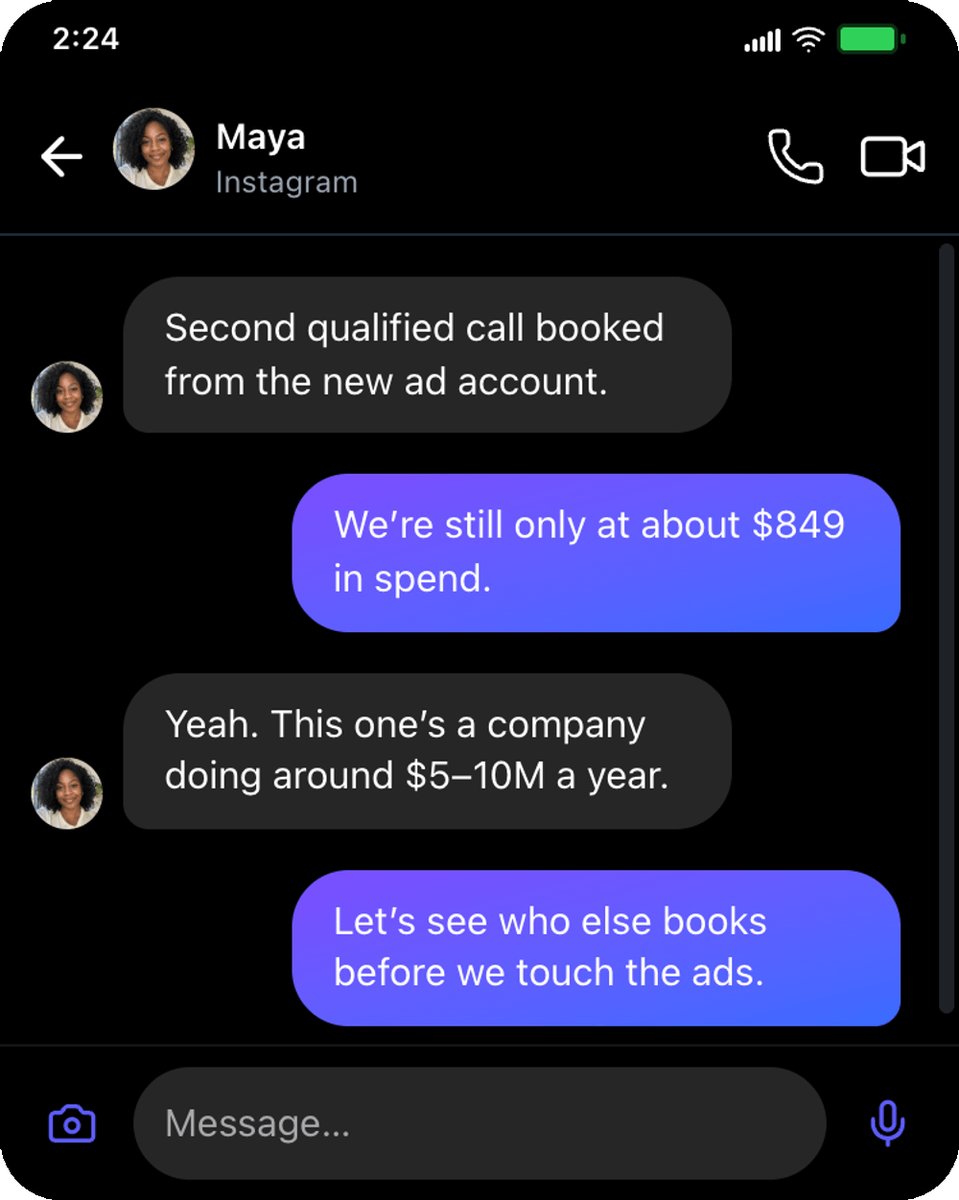
These illustrations are based on reported results. The dialogue, names, profile photos, and timestamps are illustrative.
A brand-new ad account had spent about $849 when the team booked its second qualified call. The second prospect appeared to be a company doing $5–10M a year.
The team had capped the calendar at 72 hours out. The plan was to open more availability as those first slots filled, so leads could choose a time within the next few days.
Two calls is early. I’d watch who books, how well they fit the offer and what happens when they actually get on the phone.
Meta needs about 50 results per ad group each week to leave its learning phase.
Under $500 a day, getting enough data can be hard.
At first, your form may need to let more people through so the same group keeps getting results.
That means some leads will fit and some won't.
Once you're getting 30 to 50 or more results a week, make the form stricter.
9. Grow and fix what slows you down.
Raise spend by 10% to 30% every 1 to 3 days while the numbers stay where you need them.
Find the biggest thing you can fix first.
If sales don't cover ad spend, look at the ads.
If calls cost too much, look at what the ad says and the page it leads to.
If the leads don't fit, look at the ads.
If people reach the page but don't act, check the main line and the line below it.
Keep fixing the part that holds things up.
Send me a message if you have questions. I'll answer them.
This is the full plan for getting paid ads live and making money in the next 7 to 10 days.
We used it to close a $21,000 deal after spending $2,500 on ads.
We also brought in $50,000 for a client in the first 20 days from $3,800 in ad spend.
Some people keep this shit to themselves. I'm laying out the steps.
1. Run the numbers before you spend.
Work out how much you need to spend to reach your goal.
Know what each step needs to cost for you to make money.
Check which path from ad to sale makes sense for what you sell.
Don't spend a damn dollar without knowing what you're aiming for.
2. Build an offer that works on people who don't know you.
They need to know:
What you sell.
What big problem it fixes.
How easy it is for them to use.
How long it takes.
What they get.
How you do it.
Why they should believe you.
How much of the risk you take on.
Tie the result back to money. Even if you save them time, show how that helps their business make more.
Make the buyer do as little work as you can.
Use one payment where it makes sense. Give them a clear, short wait for the result and back the offer with a promise.
You can also add a small first offer that only the right buyer would want.
It could be free, $27, or $197.
3. Learn why your best clients bought.
Pick your best 3 to 5 clients.
Watch their sales calls. Don't just throw the words into ChatGPT and call that research.
Listen to how they talk.
What was going on when they bought? What had they tried? What made them doubt the offer?
Write down 10 to 15 reasons each person bought.
4. Turn those reasons into different ads.
Making 20 ads that all look the same won't cut it with Meta's Andromeda system.
That fuckery can leave you paying more.
Meta said more than 1 million sellers used its AI tools to make over 15 million ads in one month.
That rise in ads was one reason it built Andromeda.
The system can now work through 10,000 times more ads and match them to the people they fit.
Your ads need to show real differences in what they say and how they look.
Launch 25 to 30 ads in each group.
Keep filming simple. Make about half with your phone in your hand and half speaking straight to the camera.
5. Build a page for people who don't know you.
Say who the offer is for.
Tell them what they get and how long it takes. Show how you do it and give them proof.
Explain their problem, what didn't work before, and how your offer helps.
Make the page look clean and feel like your business.
6. Get people ready for the call.
On the page they see after booking, add a 1 to 3 minute video that tells them what to expect.
Make short videos that answer the doubts and questions your team hears on calls.
Set up 9 to 16 emails over 72 hours.
Use them to welcome people, answer questions, get replies, show proof, explain the offer, share tips, give real reasons to act, and remind them about the call.
Text each person and call twice within 1 to 3 minutes.
Send a short phone video that mentions what they wrote when they booked.
Remind them the day before and the morning of the call.
On that first phone call, spend 2 minutes checking that they're a fit and plan to show up.
7. Set up the ad spend.
Under $500 a day, use CBO. That means Meta shares one budget across the ad groups.
Above $500 a day, use ABO. Each ad group gets its own budget.
Test broad groups, groups based on interests, and groups like your past good leads.
Only build that last group once you have 100 or more good leads.
Use 25 to 30 ads per group.
Turn off each AI feature that changes your ads.
8. Get enough results to learn from.
If an outreach agency charges $2–3k/mo and has 100 clients, ask who checks your list, learns what buyers care about, tests messages, and handles replies. Sending emails is only part of the work; a full schedule can still have nobody paying attention to what comes back.
Find out who owns the campaign, how many accounts they handle, and what they do when replies are weak or when someone wants to talk.
A big send count doesn’t answer those questions. Your monthly report shouldn’t be a receipt for a large amount of automated fuckery.
If the list targets one buyer, the email speaks to another, and the sales team pitches something else, no wonder the whole thing is cooked.
We’ll build the outreach around one clear offer, from buyer selection and checked data through messages, follow-ups, qualification, and booking.
You pay $197 to set up, then $150 per qualified call that actually happens. We agree on qualification and separate running costs before launch.
DM me “OUTBOUND.” Let’s get the list, message, and sales process talking about the same damn business.
You’re selling a $5–10k service while finding leads, checking addresses, writing messages, sending DMs, chasing replies, taking calls, and doing delivery. Where’s the time coming from? Have you found another day in the week and kept it a fucking secret?
Usually, client work wins: the list gets rushed, follow-ups get skipped, and good replies sit there until you remember them. Then you decide outreach is inconsistent.
Build a process around the work, give each task an owner, and keep the conversation history where the team can see it. Someone needs to handle replies while you deliver; steady outreach can’t depend on whatever energy you have left at night.