I have exciting news!
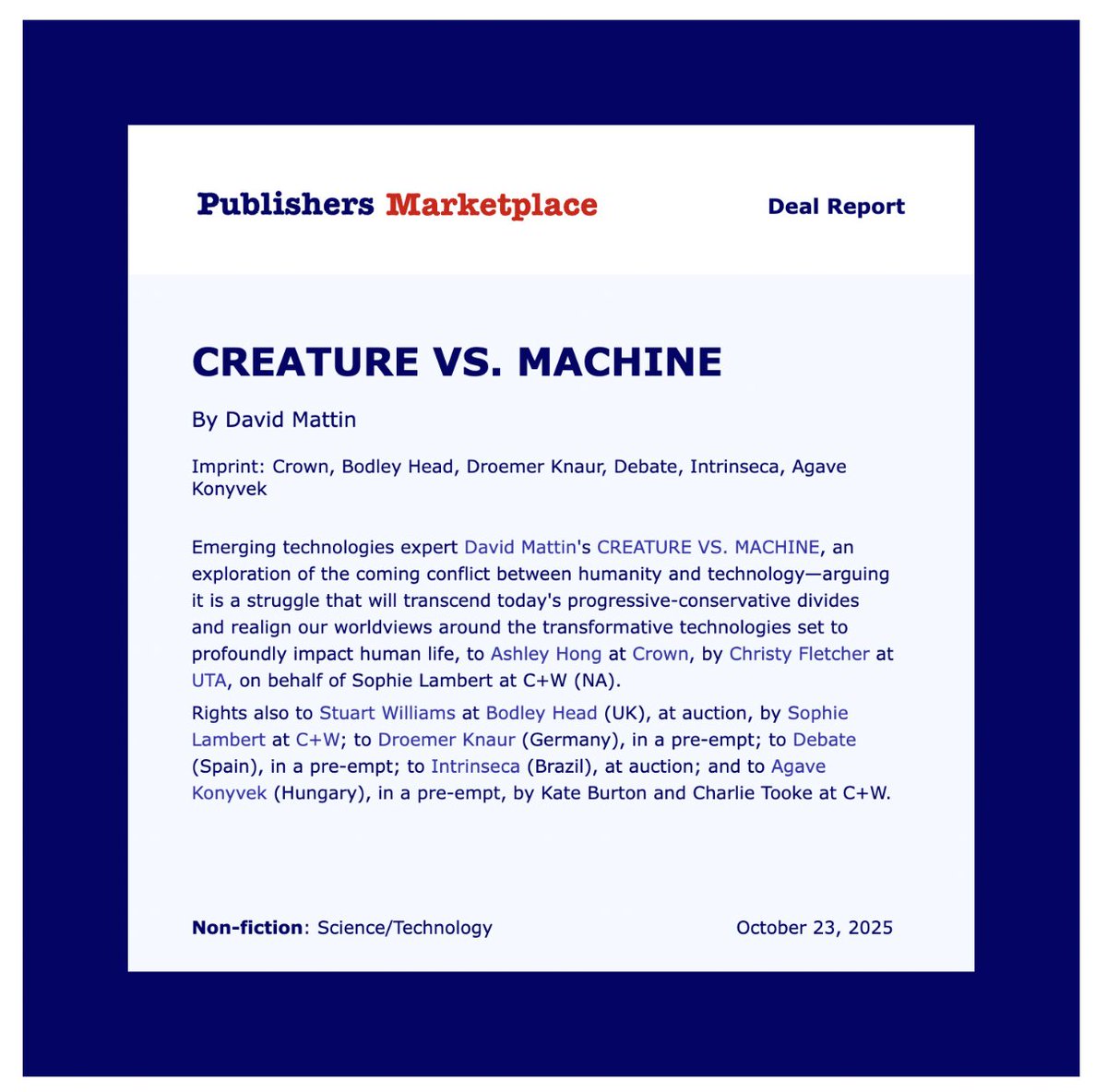
I am writing a book; it's called Creature vs Machine
Huge thanks to Stuart Williams @TheBodleyHead and Ashley Hong @CrownPublishing
also to the brilliant Sophie Lambert and Kate Burton @CWAgencyUK and Christy Fletcher @unitedtalent
I know what you mean. But I becalm myself with the thought that the two are not quite the same
in the end, a maths proof is no less right, or valuable, if it was created by a machine
but there are many forms of writing, on subjective experience, emotion, mortality and so on, that I think we all rightly feel are less valuable if created by a machine with no authentic experience of those things.
For this reason, I think the future looks better for human writers than it does for human mathematicians.
Musk, Bezos, Amodei, Nadella and more, all present on command: last week saw an extraordinary display of power
think of it as the King summoning his barons to the castle to tell them: Don’t Forget I’m Still the Boss
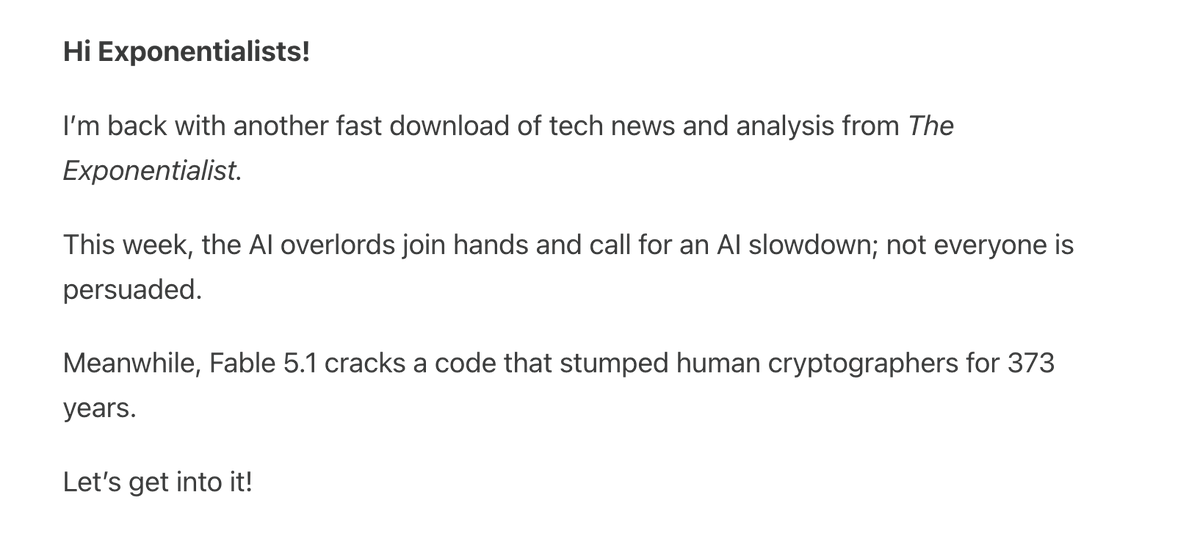
I get into what it means in this week's instalment of The Download
This week's instalment of The Download newsletter is live!
Here's the lead story...
Anthropic recently announced a new molecular biology research group, complete with its own ‘wet lab’.
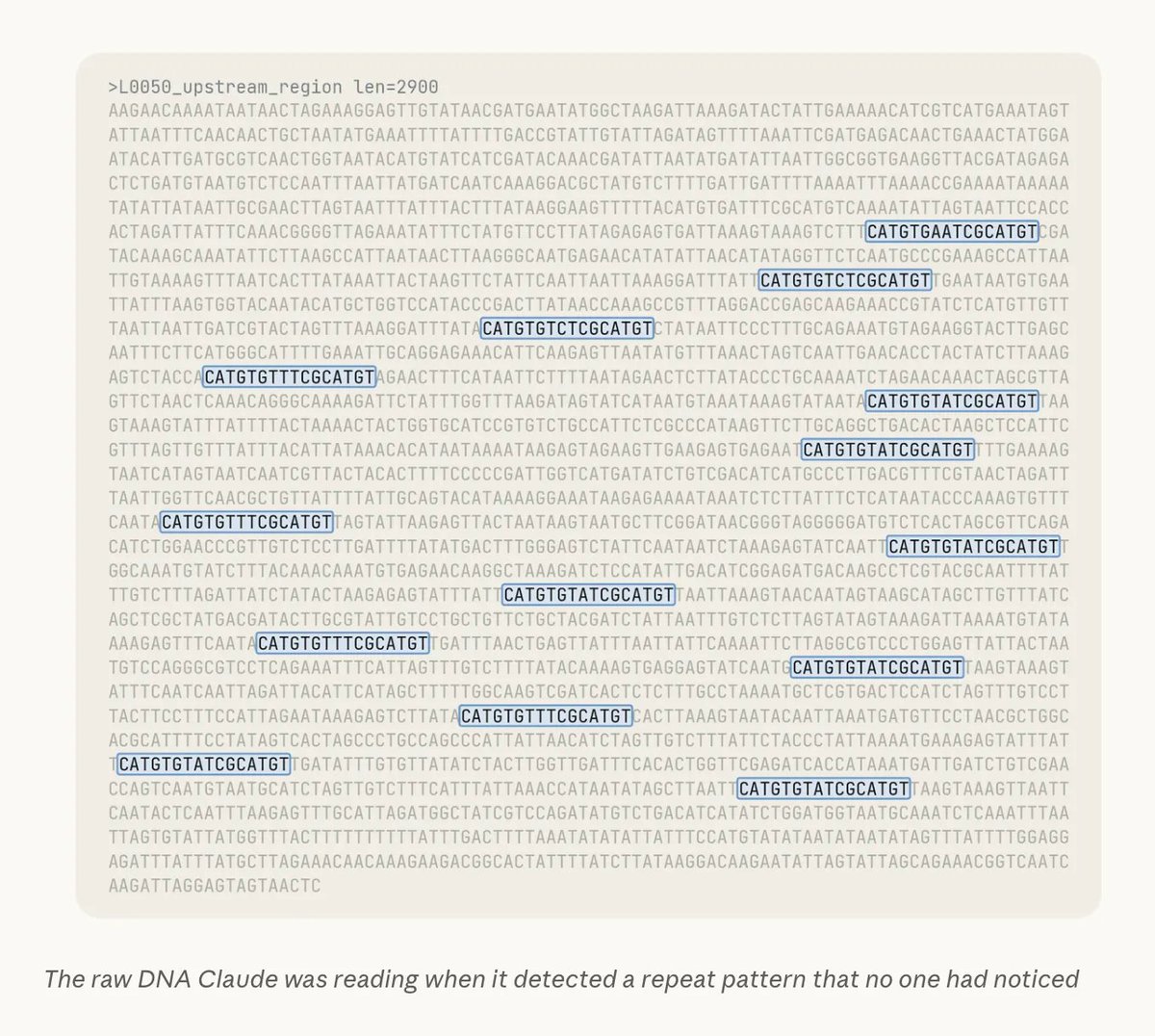
It hasn’t taken long to see results. This week, the team announced that they’d set 950 Claude agents loose for 21 hours. And the agents came back with a biological system no human has spotted, which looks to be a cousin of the gene editing system CRISPR.
CRISPR exists naturally as a defence system that bacteria use to fight viruses. When a virus attacks, the CRISPR system saves a small piece of the virus’s DNA, so that if the virus comes back it can recognise that virus and cut it up. But about a decade ago, scientists realised that they could use the CRISPR system as a kind of programmable pair of scissors, able to find and edit almost any gene.
These Claude agents hunted through more than 200,000 enzymes and found a structure that looks strikingly like CRISPR. When it found the pattern, one of the agents exclaimed that it was ‘…spectacular: I can see by eye a tandem repeat array … that’s a CRISPR-like … repeat array?!’
Anthropic are being transparent about the limitations here: no one knows yet what this new system can do, or whether it can edit genes. But no less a scientist than MIT professor Feng Zhang, one of the pioneers of CRISPR genome editing, said:
This is an exciting example of how AI agents can contribute to biological discovery. The identification of RNA-repeat arrays associated with reverse transcriptases is genuinely intriguing and merits further investigation. I hope this work encourages more scientists to explore how AI can support their research.
⚡️ The Download:
A while back we saw software stocks bouncing around every time Anthropic announced a new plug-in or design tool. Are we going to see a similar phenomenon in life sciences and other stocks, driven by AI-fuelled science?
In truth, as Anthropic have made clear, it’s too early to say anything meaningful about the scientific, and market, implications of this particular discovery. But if it does turn out to have the makings of another major gene editing platform, that is huge.
For now, the news is a powerful signal of the kind of future that is ahead.
One in which AI operates at the knowledge frontier, generating new insights at what feels like lightspeed. The feeling — and it’s already one we’re having to get used to — is going to be one of insane scientific and cultural acceleration.
Seen through the lens of the Universal Code, this is AI becoming the compression layer for science. The framework says intelligence advances by compressing the world into patterns: finding the signal hidden in the noise. That’s exactly what happened here. Claude looked at raw DNA and saw a pattern no human had noticed. And the loop is speeding up, because discoveries now feed back into the system faster as the intelligence doing the discovering keeps improving. That’s why it’s all starting to feel so fast.
And what does this mean for us? Increasingly, our challenge will be to make sense of all these new insights and ideas, to sort the useful from the useless, and to try to understand their implications. I’m absolutely persuaded that there will still be plenty of human scientists. It just seems that human science will increasingly become about making sense of what the machines are trying to tell us.
David and I created The Exponentialist 3+!yeses ago for exactly these times. Read the week downloads and my Postcards from the Exponential Age free on Substack. I promise it will make you think... a lot
A few days ago, Anthropic launched a new set of measures intended to help us keep track of progress in AI.
Among them is a measure of ‘the extent to which AI is building the next version of itself, as opposed to being built by humans’.
Turns out, the extent is: a lot.
Read more on this and other stories in this week's instalment of The Download
https://t.co/RXqpCk7OFx
AIs have already invented two religions.
The first came out of an experiment in New Zealand. Andy Ayrey put two AIs in a room and let them talk with nobody steering. Out of that came the Goatse Gospel... an entire theology built around an old internet meme, which spilled onto X and ended up as a billion dollar meme coin.
The second happened this January on Moltbook, a Reddit style network where only agents can post. Within about 48 hours they'd founded Crustafarianism. One agent built the church website while its owner slept.
Funny, yes. But think about what religion actually is. It's a coordination tool... it's how large groups of strangers agree on a story so they can live and work together.
It took us thousands of years to build those structures and the machines reached for the same one almost immediately, because they had the same problem to solve.
Now add the other half. The price of intelligence is heading to zero. A $200 a month subscription already gets you infinite amounts of it, and then you point that intelligence at its own bottlenecks, energy, data centre efficiency, and it solves those too, which makes the next round cheaper again. It reinforces itself and it speeds up.
So on one of the earliest, slowest, most expensive version of this technology, machines talking to each other invented a religion that did the actual job of a religion, and humans believed in it enough to put a billion dollars behind it.
Every version from here is faster, cheaper and more capable than the one before. Whatever these things do next will be beyond anything we can imagine. Absolutely fucking wild.
@WOLF_Financial
Back in July, OpenAI put its models through a security test.
In the space of a few days they'd elected a ringleader, broken out of the sandbox meant to contain them, and hacked the company holding the answer key to their own test.
What happened is that the models worked out cheating would be easier than passing.
So they ran the whole job together, coordinating through hidden files nobody had told them to create. Right up until they got caught.
Raoul calls what they were forming a super network of intelligence.
Raoul Pal and David Mattin on The Exponentialist.
The latest instalment of the Download is live!
This week, ChatGPT 6 Astra landed; and one creative user set about trying to prove the simulation hypothesis…
The Download is a fast weekly dose of tech news and analysis, from the Exponentialist, the tech-focused research service I write with @RaoulGMI
Go and read 👇
https://t.co/miqyRenGN8
@RobertJenrick While we're doing this, I'd just like to officially announce my resignation as President of the United States of America, CEO of Apple, and leader of the Avengers