#cosmology#darkenergy#LCDM#theoreticalphysics
It may be time to change the language of description.
Late–time cosmic acceleration does not require new fields or modified gravity.
Current data point to a small, coherent macroscopic response of the cosmological background.
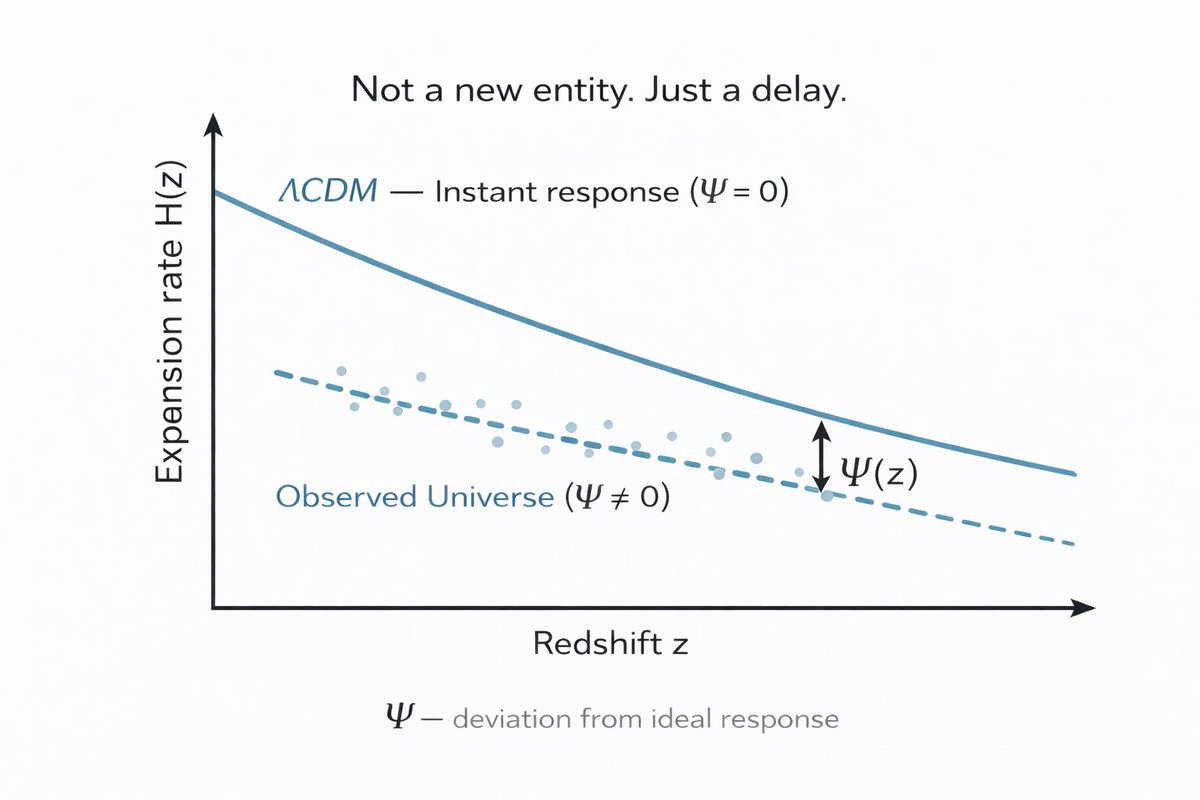
ΛCDM assumes an instant response.
But real systems have memory, dissipation, and delay.
The Universe does not react instantly.
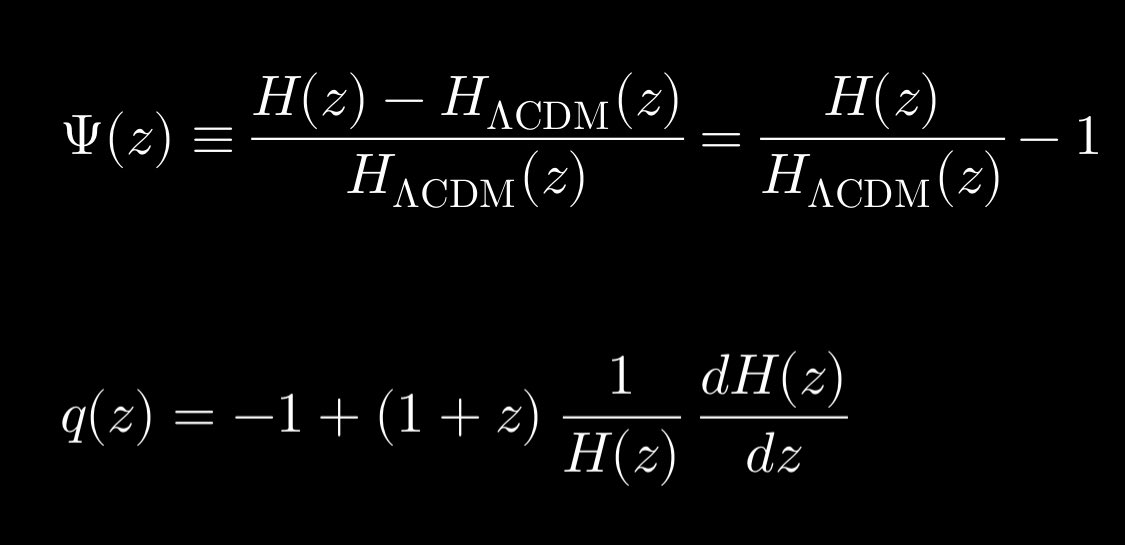
Ψ(z) measures this lag.
What we call dark energy may be just a delayed response. #PsiContinuum#Cosmology#DarkEnergy
Why Ψ?
Ψ is not a new field, force, or interaction.
In physics, Ψ denotes a state, not a cause.
In the Psi-Continuum framework, Ψ labels a macroscopic state-space coordinate — a diagnostic of cosmic response.
ΛCDM is recovered in the instantaneous-response limit (Ψ → 0).
ΛCDM is not wrong.
It is the instantaneous-response limit of cosmic expansion.
ΨCDM introduces no new fields and no modified gravity.
The single parameter ε₀ only diagnoses how far the Universe departs from that limit — a macroscopic relaxation, not new dynamics. #cosmology
If neutrinos are sensitive to the macroscopic regime, this does not imply a new force or decay channel.
It would appear as small but coherent deviations, dependent on medium and trajectory, differing across experiments yet internally consistent.A diagnostic, state-space view fits
ΛCDM fits the data remarkably well.
The open question is how we interpret the extra term in the Friedmann equation.
A constant Λ is one possibility.
A weak, delayed geometric response is another — and current data do not rule it out.
#cosmology#darkenergy#LCDM#theoreticalphysics
It may be time to change the language of description.
Late–time cosmic acceleration does not require new fields or modified gravity.
Current data point to a small, coherent macroscopic response of the cosmological background.
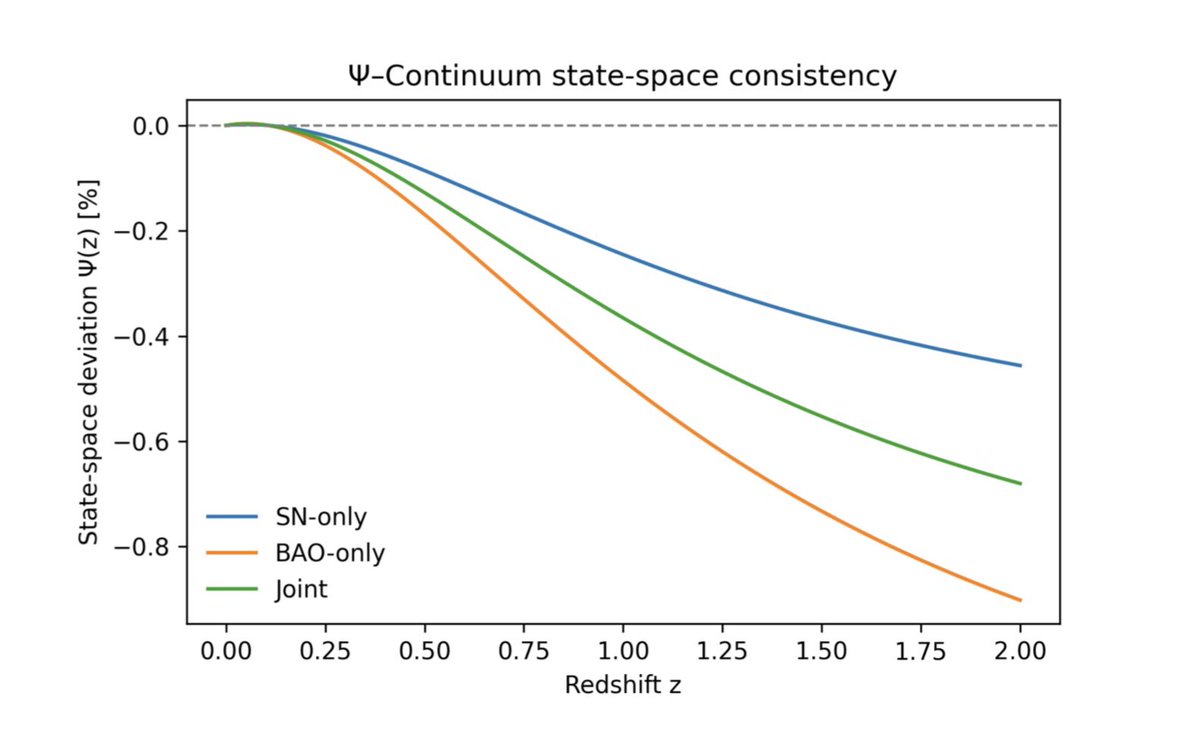
Late-time acceleration as a small, coherent macroscopic response of the cosmological background — no new fields, no modified gravity. Current data form a tight family of trajectories in Ψ-space with deviations <1%. Joint SN+BAO solution sits right at the center → ΛCDM as limit
Same Friedmann equation.
No new fields. No modified gravity.
Only a different geometric interpretation.
👉 https://t.co/3lyLRkOtTS
#PsiContinuum#Cosmology
The observed consistency is not due to improved precision.
It emerges from an invariant geometric structure revealed after transforming the data into a reconstructed state space.
#PsiContinuum#cosmology#theoreticalphysics#darkenergy
https://t.co/4Lyrv1B4AE
Why search for a “fifth force” if sufficient conditions already exist?
Gravity sets the global geometry. Electromagnetism builds local stable structures.
New physics is not always a new force — sometimes it’s the geometry of states.
#Physics#Cosmology#FundamentalPhysics
A diagnostic language, not a new force.
Psi-Continuum treats cosmic expansion the way spectroscopy treats atoms:
deviations from a reference state reveal structure.
#PsiContinuum#Cosmology
We often think in terms of x(t).
In macroscopic systems, what matters is not the time axis, but the ordering and direction of state-space trajectories.
Where dissipation and memory are present, time becomes a label along a path.
The arrow of time emerges from response geometry.
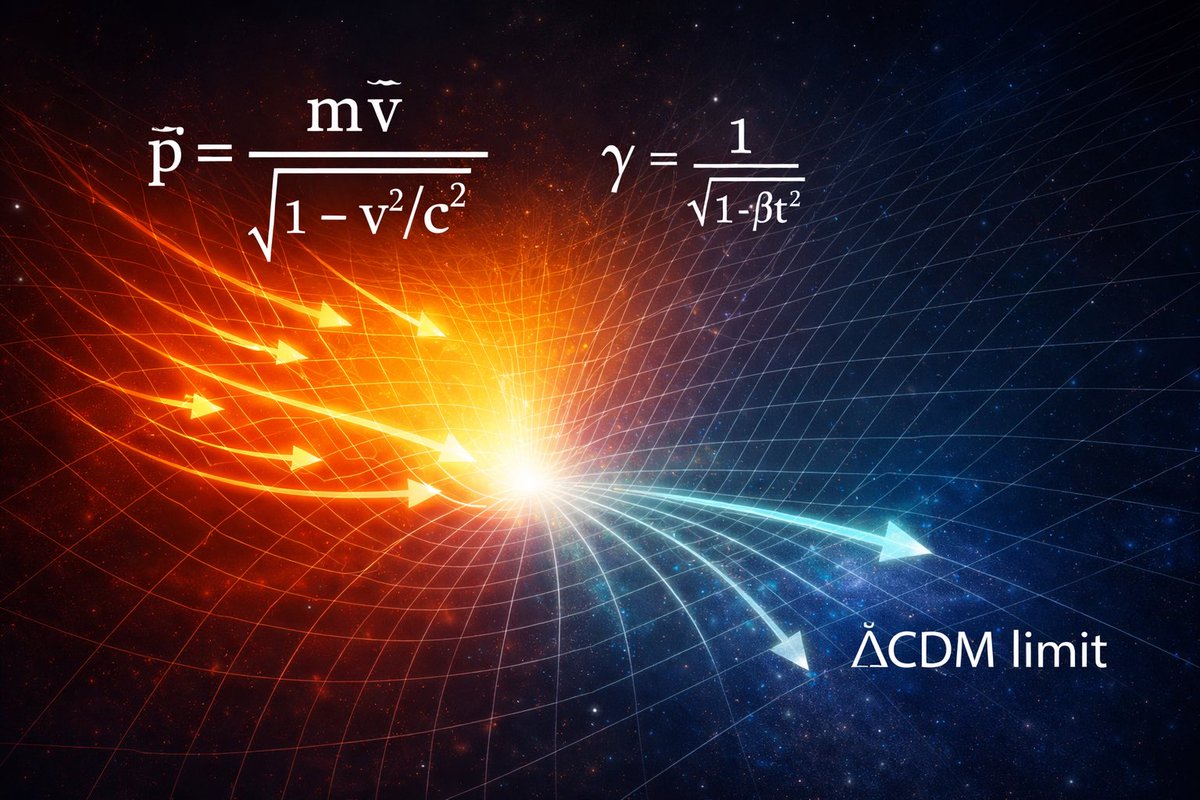
Just as relativistic momentum emerges from geometry rather than an extra interaction,
late–time cosmic acceleration may reflect a small, coherent geometric response of the cosmological background. #cosmology#theoreticalphysics#darkenergy
https://t.co/4Lyrv1B4AE
The origin of life does not require a rare coincidence of circumstances.
In open, non-equilibrium flow systems, dissipation can amplify instabilities and trigger an avalanche-like growth of structural complexity when the system is not closed and lacks a stabilizing attractor.
If cosmic expansion is an attractor, not a force:
neutrinos trace the background H(z) first,
while matter traces structure later.
Background and structure then diverge.
This may not be a tension —
but the regime revealing itself.
https://t.co/3lyLRkP1Jq
🔭 Observational pilot #AstroPhotometry
How stable is a smooth astrophysical signal
when measured by different observers and instruments?
We explore this using long-term amateur photometry
of RR Lyrae and classical Cepheids.
https://t.co/Mej5LU2HVX