Indonesia was once seen as a darling of investors. But fears of corruption and policy missteps are raising concerns about the country’s economic future
https://t.co/Himk6JYfLr
Apakah secara historis reversal dari bottom harus didukung foreign net inflow?
IHSG naik 7,6% Selasa dan 2,7% Rabu.
Asing? Masih net sell Rp 2,45 T dan Rp 3,13 T.
Banyak yang menyimpulkan Asing masih buang barang atau ini rally ini palsu.
Sounds logical.
Tapi premisnya layak diuji dengan data.
Apakah flow Asing/Domestik ini relevan dalam menentukan ini reversal atau bukan?
Saya backtest 4 crash terbesar IHSG: GFC 2008, Taper Tantrum 2013, koreksi 2015, dan COVID 2020.
Tiga dari empat reversal dimulai saat asing masih net sell.
Di 2013 dan 2015, kumulatif flow bahkan masih negatif di bulan keenam, padahal index sudah naik 15–16%.
Inflow besar baru datang di bulan ke-5 sampai ke-12, setelah recovery terbentuk.
COVID paling ekstrem: IHSG naik 56% dalam 12 bulan, dan sepanjang itu asing tetap kumulatif net sell sekitar Rp 27 T.
Asing baru berbalik net buy bulanan pertama kali November 2020, saat index sudah jauh di atas bottom.
Apakah ini berarti 8 Juni sudah pasti THE bottom?
Tidak ada yang bisa menjamin itu, termasuk saya.
Yang bisa dikatakan dengan jujur: rebound dua hari ini terjadi di atas turnover yang naik (Rp 21,7 T → 28,0 T → 31,7 T), breadth-nya lebar, dan absennya foreign inflow bukan alasan valid untuk mendiskreditkan rally, karena secara historis memang tidak pernah jadi prasyarat.
Satu catatan lagi yang jarang dibahas. Label "asing" di data bursa itu flag pada order broker, bukan beneficial ownership.
Dengan makin umumnya struktur nominee dan jasa "masking" kepemilikan.
Garis pemisah antara "real" foreign vs domestic makin kabur.
Watch the tape, not the nationality flag on it.
Indonesia is moving to centralise commodity exports.
Under the new model, a state‑owned firm will purchase commodities from domestic producers and handle all sales to foreign buyers. That’s a big deal when Indonesia controls:
- 50% of the world’s nickel
- 43% of seaborne coal exports
- 58% of global palm‑oil production
Higher government involvement and policy risk will discourage new investment and ultimately cap how much of these key commodities the world can get.
WATCH OUT INDONESIA.
The US is putting massive pressure on Indonesia right now as part of its desperate plan to contain China.
The goal?
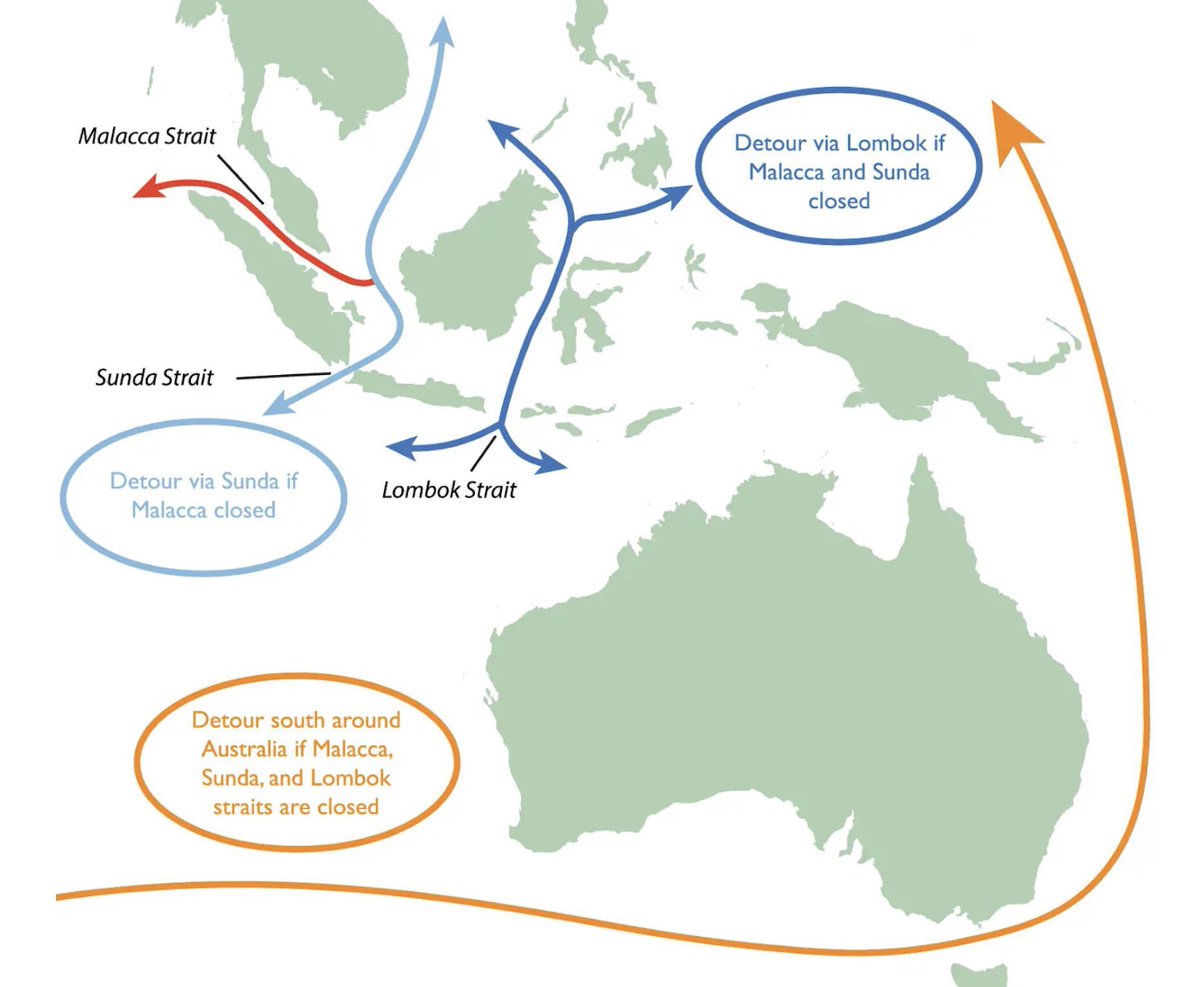
Turn Indonesia into a US client state that helps enforce an extended blockade around the Malacca Strait >> choking off China’s main energy lifeline.
We’re already seeing the signs: a flood of new hit pieces on the Prabowo government popping up everywhere.
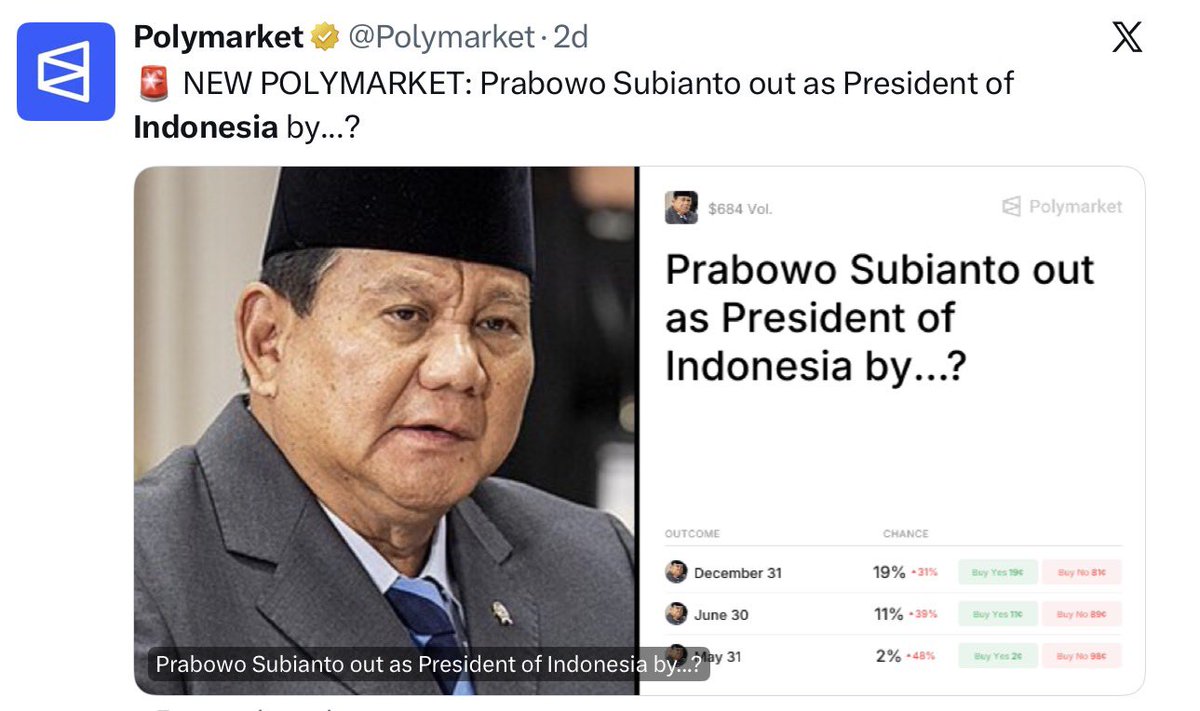
Polymarket (that classic US psyop betting tool) is suddenly running projections on regime change.
Western-controlled media outlets are sliding into DMs with Brian Berletic and myself, fishing for angles >> because we were among the few who called out the last color revolution attempt and exposed the Soros/NED funding networks behind the 2025 unrests.
This is coordinated.
There’s a clear plan to destabilize Indonesia and flip it fully into the Western camp.
Don’t be surprised when your feeds (including X) get flooded with more and more negative coverage of the Indonesian government >> “authoritarian,” “corrupt,” “unstable,” the usual script.
Indonesia is too important: biggest Muslim country, strategic geography, resources, and balancing act between powers. The US doesn’t like that independence.
They want control over those sea lanes for any future Taiwan or South China Sea showdown.
Stay vigilant, Indonesia.
Separate real domestic issues from foreign-funded chaos.
The hybrid war playbook is in full swing >> info ops, NGOs, media smears, and political pressure.
Don’t let them turn your country into the next pawn.
President Prabowo’s speech was interesting because it revealed both the strengths and weaknesses of the current policy direction.
What I dislike is that there still appears to be insufficient discussion around upside inflation risk, fiscal vulnerability, and exchange rate stress if oil prices remain elevated for much longer than the government currently expects. Indonesia remains highly sensitive to energy prices through subsidies, imported inflation, fiscal pressures, and rupiah stability. If oil enters a prolonged higher-price regime, the impact on the budget deficit, subsidy burden, and external balances could become much larger than current assumptions imply.
This matters because global conditions are already becoming more difficult. US yields remain high, global liquidity is tightening, and capital is becoming increasingly selective toward emerging markets. In that environment, fiscal credibility and exchange rate management become extremely important.
That said, on the positive side, I do think Prabowo understands one of Indonesia’s deepest structural problems: the country’s persistently low tax revenue-to-GDP ratio.
Indonesia has been blessed with enormous commodity wealth for decades, yet state revenue collection has consistently underperformed relative to the scale of natural resources extracted from the economy. A large part of the issue historically comes from leakages across the commodity ecosystem itself.
One major mechanism is underinvoicing. For example, commodity exporters may sell coal, CPO, nickel, or other resources to related offshore trading entities at artificially lower declared prices. The offshore entity then resells the same commodities to final global buyers at the true market price. The profits effectively accumulate offshore rather than domestically, reducing taxable income reported inside Indonesia.
Another mechanism often discussed globally is transfer pricing optimization. Large conglomerates with complex cross-border structures can shift profits between subsidiaries across jurisdictions through management fees, financing structures, procurement contracts, intellectual property arrangements, or intra-group commodity transactions. If not monitored carefully, taxable profits inside the producing country become artificially suppressed while profits appear in lower-tax jurisdictions instead.
This is not unique to Indonesia. Resource-rich countries globally have struggled with similar issues for decades because commodities naturally involve international pricing, offshore trading hubs, and complicated ownership structures.
That is why I can understand the broader strategic logic behind stronger state monitoring over commodity exports and FX flows.
Assuming the execution remains disciplined and commercially rational, a stronger state presence could theoretically improve transparency around export proceeds, pricing declarations, royalty collection, and taxable income reporting. In turn, that could potentially increase state revenue available for infrastructure, healthcare, education, and poverty alleviation programs.
Similarly, regulations requiring export proceeds to remain domestically within the banking system for a certain period may help stabilize FX liquidity and reduce pressure on the rupiah during periods of external volatility.
In many ways, what Prabowo appears to be pursuing resembles a more assertive form of state capitalism where the state attempts to regain greater control over strategic sectors, commodity rents, and capital flows.
The challenge, however, is always execution and balance. If implemented professionally with legal certainty, transparency, and predictable rules, stronger oversight could improve fiscal capacity and state effectiveness.
But if execution becomes overly interventionist, politicized, or unpredictable, markets may instead interpret it as rising state intrusion and weakening investment freedom. That balance will define if this is a good move or not.
It is time to make America the crypto capital of the world.
It is time to pass the Clarity Act.
It is time for America to lead.
The future of digital assets belongs to us — if we choose to act.
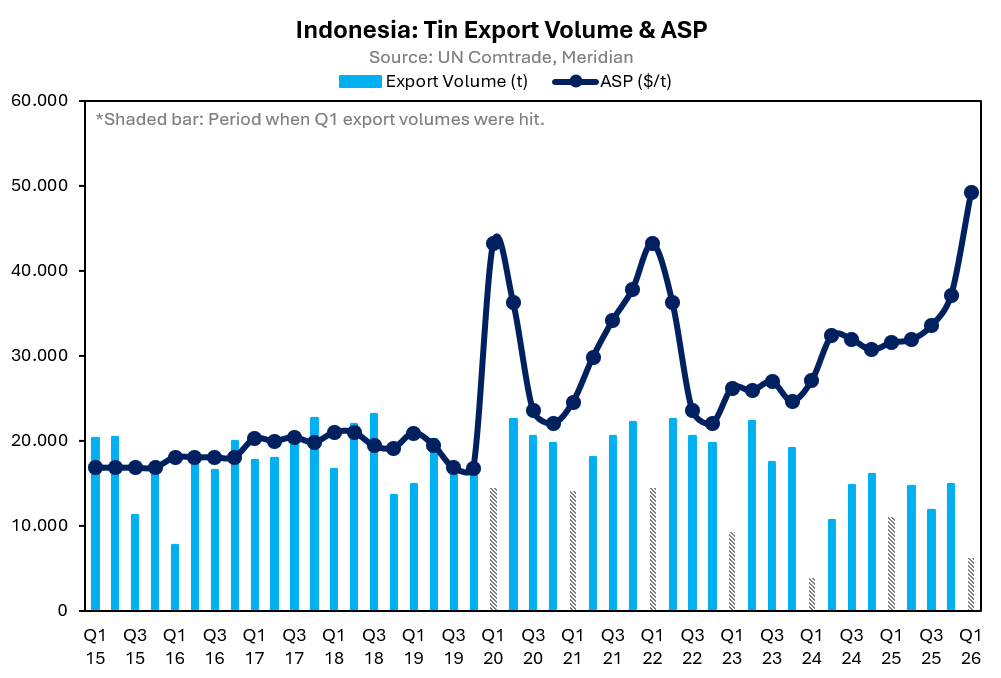
ChartOfTheDay #2 by Meridian.
Interesting chart regarding Indonesian Tin.
1. We haven't seen Tin ASP below 20k USD/t since COVID.
2. We also haven't seen quarterly exports touch 20kt/quarter since 2023.
3. We are seeing ATH prices for Tin since Q4.
4. Exports always drop in the first quarter since 2020: RKAB problem.
$TINS is still sitting pretty in our watchlist despite current market conditions. The funny thing is, the real problem was never volumes or ASP. It was always the money flowing OUTSIDE TINS itself. If the government becomes serious about plugging that leak, combined with a healthier JCI backdrop, this thing could get very interesting very fast. We might deep dive into TINS soon. Just not today.
“THE REAL ENGINE BEHIND AI — SEMICONDUCTOR VALUE CHAIN”
Gw udah banyak banget nulis soal semiconductor industri.
Dan di thread ini gw bakal kumpulin semua itu jadi satu.
A Thread!