Nine soldiers and officers went on trial in September 1991, in a proceeding the Center for Justice and Accountability says was full of irregularities.
The army ignored the judge's requests for evidence and witnesses.
Only two men were convicted of murder: Benavides and a lieutenant, Yusshy René Mendoza. Each got 30 years.
El Salvador's legislature passed an amnesty law in March 1993, within days of the Truth Commission's report. On 1 April 1993 both men walked out of prison.
The law stood for 23 years. In July 2016 the Supreme Court found it unconstitutional, and Benavides returned to prison.
Spanish courts claim jurisdiction over crimes against humanity, and five of the dead priests were Spanish citizens. In 2008 two human rights groups sued former president Cristiani and 14 officers in Madrid. The court's ruling didn't include Cristiani.
On 30 May 2011 a Spanish court convicted 20 members of the Salvadoran military, who weren't in court, of murder and terrorism. In 2017 the United States extradited Colonel Inocente Orlando Montano, a former vice-minister, who had been living in Massachusetts. In September 2020 Spain's court sentenced him to 133 years.
The killings came in the middle of the offensive, and they changed what the war meant in Washington. The United States had been paying for the Salvadoran army for years. That's what made the killings a problem in Washington and not only in San Salvador.
Speaker Tom Foley asked Representative Joe Moakley of Massachusetts to look into it. The Moakley task force found that the murders were ordered at the highest levels of the army, and Congress cut military aid. The UN-mediated peace talks that followed ended with an agreement at Chapultepec Castle in Mexico in January 1992.
Historians call the murders one of the turning points, not the only one. The offensive had already shown that neither side could win, and the Cold War was ending, so they don't give the killings all the credit. The Jesuits had died arguing for exactly the settlement that came.
First verdict: about 1 year, 10 months. Final disposition: Montano was convicted in Spain in September 2020, about 30 years, 10 months after the killings.
Eight people in a garden changed what Washington was willing to pay for.
Before dawn on 16 November 1989, soldiers walked into the Jesuit residence at the Central American University in San Salvador and shot six priests, their housekeeper and her 16-year-old daughter.
The army blamed the guerrillas, but a witness and an American officer helped show otherwise. The killings pushed Washington to press its ally, and El Salvador's long civil war ended in a negotiated peace two years later.
The man at the center was Ignacio Ellacuría, the rector of the university. He was Spanish by birth, a philosopher and theologian, and he'd lived in El Salvador since 1948.
By 1989 he was one of the few people both the government and the guerrillas of the FMLN would talk to. He used that trust to argue for a negotiated end to a war that had lasted nearly ten years.
Five other Jesuits lived with him. Ignacio Martín-Baró, the vice-rector, was a psychologist and a leading expert on Salvadoran public opinion. Segundo Montes ran the social sciences department and studied the refugees.
Juan Ramón Moreno, Joaquín López y López and Amando López worked at the university and the parish. A sixth Jesuit, Jon Sobrino, was lecturing in Thailand and survived.
The army didn't see scholars. Senior officers called the university a refuge of subversives, and a vice-minister said the Jesuits were "fully identified with subversive movements."
Death threats were routine. The Jesuits had lived with them for years.
On 11 November the FMLN launched its biggest offensive of the war and took parts of the capital. The army was caught off guard.
Colonel Guillermo Benavides was given command of the zone that held the Military College, the Defense Ministry and the UCA campus. Soldiers searched the campus on 13 November and posted a detachment at the gate.
On the night of 15 November Benavides met his officers at the Military College. He told them the high command wanted all known subversives eliminated. He said he'd been ordered to kill Ellacuría and leave no witnesses.
He asked whether any officer objected. Nobody raised a hand, and the order stood.
The job went to soldiers of the Atlacatl Battalion, an elite unit created in 1980 with training at the U.S. Army's School of the Americas. The planners decided to make it look like a guerrilla raid, and they handed the soldiers an AK-47 captured from the FMLN.
The soldiers passed through the army's own checkpoints in the early hours of 16 November, and nobody stopped them.
They tried to force the door of the priests' residence, and the priests opened it themselves.
The soldiers ordered them into the back garden to lie face-down on the ground. A lieutenant gave the order to fire.
Ellacuría, Martín-Baró and Montes were killed by one soldier. Amando López and Moreno were killed by another.
López y López was found inside the house and killed there. Julia Elba Ramos, the housekeeper, and her daughter Celina, 16, were shot too, and then shot again to be sure.
The soldiers took a suitcase with photographs, documents and $5,000. They fired a machine gun at the front of the building, then rockets and grenades, and left a cardboard sign that said the FMLN had executed the Jesuits for informing. Nobody in the army had been hurt.
A woman who lived on the campus, Lucía Barrera de Cerna, had seen men in uniform near the residence that night. According to the Lawyers Committee for Human Rights, she said she had seen armed soldiers at the residence. Under questioning by American investigators she retracted her account, and she later reaffirmed it.
Inside the army, the evidence was being destroyed. Colonel Emilio Ponce, the chief of the joint staff, ordered the stolen suitcase destroyed, and the Military College's entry and exit logs were burned.
The president, Alfredo Cristiani, handed the first inquiry to a special police unit. Two witnesses who'd seen Atlacatl soldiers near the campus that night changed their statements.
Then a U.S. military adviser, Major Eric Buckland, told his superiors on 2 January 1990 that a Salvadoran colonel had said Benavides arranged it and the Atlacatl had done it. The colonel denied saying so when he was brought in. But Washington had been told.
Under pressure, Cristiani formed an honor commission. Some of the soldiers confessed. A civilian lawyer on the panel, Rodolfo Parker, changed their statements to delete any mention of orders from above, according to the United Nations Truth Commission.
The Japanese still had a convoy and a second chance.
Admiral Nobutake Kondo built a new bombardment group around Kirishima and sent it south for the night of 14-15 November. Admiral William Halsey had almost nothing left to meet it.
He detached two new battleships, Washington and South Dakota, and four destroyers under Rear Admiral Willis Lee. The battleships had worked together for only a few days. The destroyers came from four different divisions and were picked mainly because they had the most fuel.
Lee's destroyers took the first hit. Four of them ran ahead of the battleships, and the Japanese cut them up. Preston and Walke sank within ten minutes, Benham lost her bow, and Gwin was knocked out.
Then South Dakota lost her electricity. Reports say a circuit breaker held shut against procedure sent her circuits into a loop that knocked out her radar, radios and most of her guns. She turned to dodge a burning destroyer and lit herself up against the flames.
Just after midnight she took 27 hits from Kirishima, two cruisers and others. Lee said they made her "deaf, dumb, blind, and impotent."
Thirty-nine of her crew died. She turned away without telling him.
The Japanese kept firing at South Dakota and never noticed Washington. She had come to within 9,000 yards on radar, and Lee couldn't tell which big ship was his own until the Japanese lit South Dakota up. Then Washington opened fire on Kirishima with her nine 16-inch guns.
At least eight and perhaps as many as twenty main-battery shells hit, and Kirishima's rudder jammed and she circled helplessly. Lee turned northwest to draw the enemy away from South Dakota. By 1:30 the Japanese had given up.
Kirishima capsized before dawn.
In that night's fight 242 Americans and 249 Japanese sailors died. It was one of only two battleship-against-battleship fights in the Pacific war.
The four transports still left ran themselves aground at Tassafaronga before dawn on 15 November. Planes from Henderson Field, artillery ashore and the destroyer Meade pounded them all morning.
Between 2,000 and 3,000 of the 7,000 soldiers got ashore, and most of their food and ammunition burned on the beach. Six transports had already been sunk by air attack the day before.
Japan never mounted another major attempt to retake Henderson Field. By 7 December its men on the island were losing about 50 a day to hunger, disease and bullets. On 31 December Imperial headquarters agreed to withdraw, and the last Japanese left in early February 1943.
The historian Richard Frank wrote that Callaghan's men "purchased one night's respite for Henderson Field." General Alexander Vandegrift, who commanded the Marines ashore, put it more simply: "our greatest homage goes to Callaghan, Scott and their men." President Roosevelt said he thought the turning point of the war had been reached.
Two Japanese battleships and a convoy were gone, and the airfield was still flying.
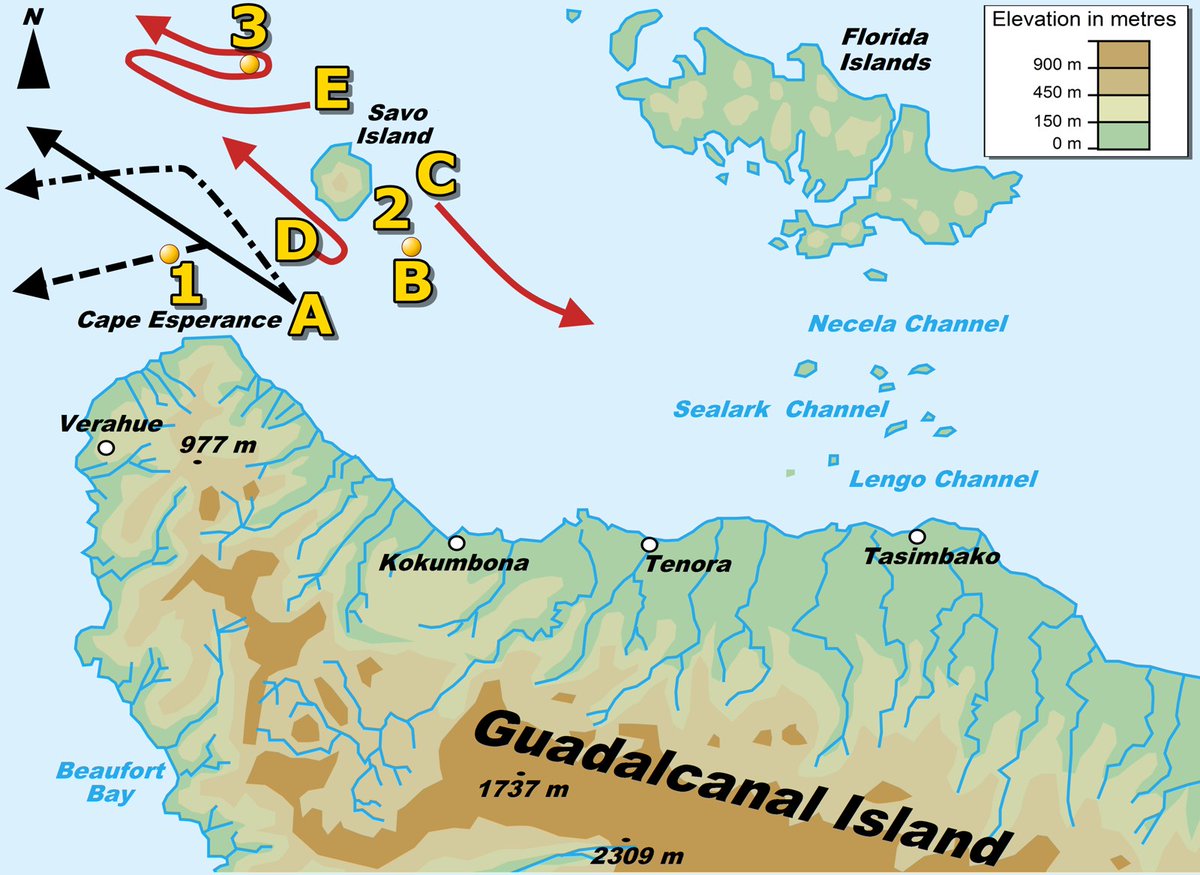
In November 1942 two American admirals led a scratch force of cruisers and destroyers into a pitch-black Guadalcanal sound to stop a Japanese battleship raid, and both of them were dead within minutes of the first shot.
The Americans lost six ships in the first day and a half, and the Japanese lost a battleship. Then two new American battleships went out against a third in the dark, and a battle that began as a brawl ended as a gunnery lesson. It decided who would own Guadalcanal.
The whole fight was about a strip of mowed grass and coral. Henderson Field sat on the north coast of Guadalcanal, and as long as American planes flew from it, slow Japanese transports couldn't cross the sea in daylight. So Japan had been bringing its soldiers in by night on fast warships, the "Tokyo Express," and landing them with rifles and little else.
In November 1942 Admiral Isoroku Yamamoto decided to do it properly. Eleven big transports would carry 7,000 men of the 38th Division, with their artillery and food, from Rabaul to the island.
Two battleships, Hiei and Kirishima, would come first. On the night of 12-13 November they would shell Henderson Field with special fragmentation rounds, wreck the planes on the ground, and clear the sky for the convoy.
American intelligence saw it coming. Rear Admiral Richmond Turner had just landed a supply convoy, and he sent every warship he had to meet the raid: two heavy cruisers, three light cruisers and eight destroyers. Rear Admiral Daniel Callaghan was in command because he was a few days senior to Rear Admiral Norman Scott, who was more experienced and had won the night battle at Cape Esperance a month earlier.
Callaghan had a problem on his hands, and he made it worse. Five of his ships carried the new SG radar.
He put none of them at the head of the column, and he didn't use one as his flagship. He didn't give his captains a battle plan either.
The Japanese came in at 1:25 in the morning, through a rain squall, on a moonless night. Their formation had come apart in the weather and the orders were confused. The Americans were in one long column, and their radar had been picking up the enemy for minutes.
The reports never reached Callaghan in a form he could use. He was trying to square the radar ranges with what he could see from the bridge, and he couldn't see anything.
At 1:48 two Japanese ships switched on searchlights and lit up the cruiser Atlanta from 3,000 yards. Firing began on both sides at once. Callaghan, with half his ships already out of position, ordered "Odd ships fire to starboard, even ships fire to port."
Nobody had ever told the ships which number they were. The Japanese had drilled night fighting for years and the Americans hadn't, and it showed.
Within minutes the two fleets were mixed together at point-blank range.
The destroyer Cushing nearly collided with two Japanese destroyers. The destroyer Laffey passed Hiei so close that the two missed each other by about 20 feet.
Hiei couldn't depress her guns far enough to hit the little ship, and Laffey raked her bridge with 5-inch shells and machine guns. The fire wounded Admiral Hiroaki Abe and killed his chief of staff. An officer on the destroyer Monssen said later it was like "a barroom brawl after the lights had been shot out."
Then the night turned deadly. The cruiser San Francisco, caught in the confusion, put nineteen 8-inch shells through the drifting Atlanta. Most accounts say they killed Rear Admiral Scott and most of his staff.
Moments later Hiei, Kirishima and two destroyers hit San Francisco's bridge and killed Callaghan, her captain Cassin Young and most of the people around them. They are the only two American admirals killed in a surface fight in the war.
The first salvos from the Japanese battleships were bombardment rounds, built to burn an airfield and not to pierce armor. It probably saved San Francisco. By the time the gunners switched shells, she had steamed clear.
Torpedoes tore the destroyer Barton in half in a ball of flame and steam, and Laffey blew up and sank within minutes. Cushing and Monssen burned until their crews abandoned them. At 2:26 the two sides broke contact.
Abe had one battleship almost untouched and the American line in pieces. Henderson Field was a few miles away and defenseless. He turned around anyway.
His ammunition was mostly spent, he was wounded, he'd lost part of his staff, and Hiei was crippled and not answering. Whatever the reason, the bombardment never happened.
Dawn showed Hiei wallowing north of Savo Island. American planes from Henderson Field, the carrier Enterprise and Espiritu Santo hit her all day, and she sank that night.
Yamamoto relieved Abe of command and later forced him out of the navy. He may have been more angry about losing the battleship than about the failed mission.
The Americans were still paying. Atlanta sank that evening. Earlier that day a Japanese submarine had fired at the crippled San Francisco and hit the light cruiser Juneau instead, in the same place where a torpedo had already hurt her.
She blew apart in under a minute. More than a hundred men reached the water. Rescue planes didn't come for eight days, and only ten of them lived.
Among the dead were the five Sullivan brothers. The Navy kept the full casualty count secret until late in the war. From the first night and Juneau, 1,439 Americans died, and the Japanese lost between 550 and 800.
In the 1930s, a patient lying on Sigmund Freud's couch in Vienna was never alone with the doctor. A big chow named Jofi lay on the carpet, and she kept the time.
Freud had never owned a dog until late in life. His daughter Anna brought home a German Shepherd named Wolf in the mid-1920s, and the old man was charmed. In 1928 a friend of Anna's, Dorothy Burlingham, gave him a chow named Lun-Yu. Lun-Yu was hit by a train about fifteen months later, and Freud mourned her as he would a person. Seven months after that he took in her sister. He named her Jofi, from the Hebrew word for "beauty."
Jofi went to work with him. She lay in the consulting room through his sessions, and he said he never needed to look at his watch. When the fifty minutes were up, she got to her feet and yawned. Freud also liked to speak through her. A patient, Dr. Roy Grinker, later wrote that if Jofi scratched to be let out, Freud would say, "Jofi doesn't approve of what you're saying." If she wanted back in, he would say, "Jofi has decided to give you another chance."
At the table she was a bigger problem. Freud's cancerous jaw made eating painful, and he often pushed his plate her way, so Jofi ate a good share of his dinner. When he went to Berlin for treatment, she stayed in a kennel because his wife, Martha, did not care for dogs, and he wrote home to ask, "Is anyone visiting Jofi? I miss her a great deal."
Through years of surgery and pain, he told his friend Princess Marie Bonaparte that he wished she could see "what sympathy Jofi shows me during these hellish days, as if she understood everything."
In January 1937 Jofi had ovarian cysts removed. The operation went well, but she died of a heart attack three days later, on January 11. Freud wrote to Arnold Zweig that one could not easily get over seven years of intimacy.
He took another chow, Lun, and in 1938 the family left Nazi-occupied Vienna for London. Lun had to sit out six months of quarantine, and Freud, who died in 1939, lived to see him released.
At least 198 people were charged.
Witnesses were few and afraid, and the trial moved so slowly that a senator remarked that it could take 200 years. Andal Ampatuan Sr. died of liver cancer in July 2015 before it ended.
On 19 December 2019 Judge Jocelyn Solis-Reyes read her verdict at a special session in Taguig. Twenty-eight people were convicted of 57 counts of murder and sentenced to reclusion perpetua, up to 40 years without parole, among them Andal Jr., his brother Zaldy Ampatuan and six other members of the clan. Fifteen more were convicted as accessories and given six to ten years.
Fifty-six were acquitted, including the brother Datu Sajid Islam Ampatuan. The judge ordered about 155.5 million pesos in damages to the victims' families.
Killing to verdict: 10 years, 1 month.
As of the most recent reporting, from November 2025, the Court of Appeals had still not ruled on the appeals. Between 80 and 88 of the accused have never been caught. As of that reporting, the families said they hadn't been paid the damages.
The Committee to Protect Journalists called it the single deadliest event for journalists since it began keeping records in 1992. At home it made the private armies of provincial warlords a national scandal, exposed how an unreported arsenal could sit behind a governor's wall, and broke the Ampatuans' hold on the governorship. Mangudadatu was elected governor in 2010 and served until 2019.
The National Press Club of the Philippines put up a memorial in Manila that lists the 32 media workers by name. At the University of the Philippines a tree was planted on the third anniversary, with a sign that says there is no Filipino word for impunity.
They went to file a form, and the graves were already dug.
On the morning of 23 November 2009, a convoy of seven vehicles set out across southern Mindanao to file a candidate's papers.
It was sent that way because its organizers hoped women and reporters would be safe on the road. By nightfall 58 people were dead, 32 of them journalists and media workers, and the graves had been dug two days before. It was the deadliest attack on reporters ever recorded.
For years the Ampatuan family ran Maguindanao province in the southern Philippines. Andal Ampatuan Sr. had been governor since 1998, and he was elected three times unopposed.
Eighteen of the province's mayors came from his clan. The family was a major ally of President Gloria Macapagal Arroyo, and in 2004 she won 69 per cent of the province's vote.
By 2009 the governor couldn't run again. He wanted his son, Andal Ampatuan Jr., the mayor of Datu Unsay, to take his place. Esmael "Toto" Mangudadatu, the vice mayor of Buluan, decided to run against him.
Mangudadatu said he had been threatened. Rival politicians, he said, had told him they would chop him to pieces if he filed. He asked the regional police for protection that week, and the request was turned down.
So Mangudadatu changed the plan. He wouldn't go himself. His wife Genalyn, two of his sisters and an aunt would go, along with female lawyers, to file his certificate of candidacy at the Commission on Elections office in Shariff Aguak.
Some reports say he was counting on an Islamic tradition that women are not to be harmed. He also invited 37 journalists to come along, because he thought witnesses would keep the peace.
Before they left, Aquiles Zonio, a reporter for the Philippine Daily Inquirer, texted the army's 6th Infantry Division and was told the road was safe. The convoy left about half an hour late, around 9:30. It had five vans, a DZRH reporter's SUV and a UNTV van.
At about 10 a.m. the convoy reached a police checkpoint in the town of Ampatuan, at Barangay Masalay, about ten kilometers from Shariff Aguak.
At least ten vehicles of armed men pulled up and surrounded it.
Prosecutors said Andal Ampatuan Jr. led them. The police at the checkpoint were told to step aside.
Two other vehicles had the bad luck to be there. One held a government worker who had suffered a mild stroke that morning, on his way to a hospital in Cotabato City, with his wife, two co-workers and a driver.
The other was driven by an employee of a statistics office. The gunmen took them for part of the convoy and seized them too.
The gunmen drove the captured vehicles to a remote area. At about 10:15 Genalyn Mangudadatu managed to call her husband. She told him they were being held by at least 100 armed men, and that she recognized Ampatuan Jr.'s men.
The call cut off. Gunfire began around 10:30.
The court record shows that several of the women were sexually assaulted before they were killed. That detail isn't included here.
Three graves had been dug two days earlier with a backhoe that carried the name of the provincial government. The killers began burying the victims, and some of the vehicles, in them. They stopped when they learned soldiers were coming.
Soldiers reached the site at about 3 p.m., more than four hours after the shooting. Thirty-five bodies were in the graves.
By the authorities' count, 58 people had died. The 58th, a 61-year-old photographer for the Midland Review named Reynaldo Momay, was never found, except for his dentures. His family is still asking a court to count him.
On 24 November President Arroyo declared a state of emergency in the province. Her party threw the Ampatuans out the next day. On 26 November Ampatuan Jr. surrendered and was flown to Manila.
He said he had been at the provincial capitol that morning and blamed Muslim rebels. The rebels called that absurd.
On 4 December Arroyo put Maguindanao under martial law, and she lifted it on 13 December. Soldiers raided clan homes and a warehouse.
They found more than 330,000 rounds of ammunition and enough guns to arm a battalion. At the time, Philippine law let local officials buy as many weapons as they liked without having to report them.
The British could not afford to win like that again.
By 3 November, of the 84 infantry battalions the BEF had brought to France, 75 had fewer than 300 men left, and 18 had fewer than 100. Fabeck's group had lost 17,250 men in five days, and still hadn't broken through.
So the Germans prepared one more try, and this time they sent the Prussian Guard. On the morning of 11 November, after the heaviest bombardment of the battle, the Guard division and five other corps attacked from Messines to Polygon Wood. Thirteen Guard battalions came along the Menin Road, and FitzClarence's brigade, with a little over 800 men, took the blow.
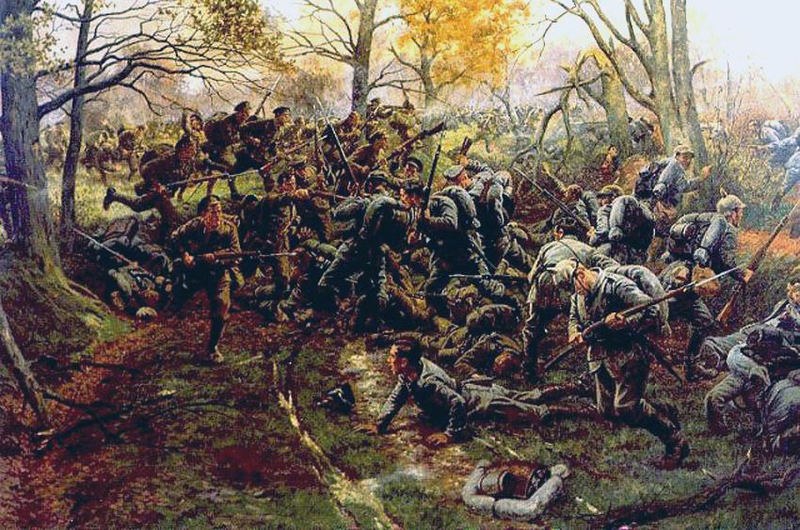
The Guard broke through in three places, and some of them got into Nonne Bosschen, "Nuns' Wood," a triangle of oaks and chestnuts that had belonged to a Benedictine convent four hundred years before. Some got almost to the British guns, where the gunners stopped them with point-blank fire.
In the afternoon the 2nd Oxfordshire and Buckinghamshire Light Infantry, fewer than 400 men, attacked the wood from the north-west with a company of the Northamptonshires on their flank, and drove the Guard out. William Barnes Wollen painted the fight in 1916.
It's a fanciful picture, made to honor the regiment, not a record of what the wood looked like that day. The Germans kept only a stretch of the old British front line.
FitzClarence tried a counter-attack the next day, and he was killed on 12 November, leading from the front.
The fighting went on in local actions until about 22 November. The weather turned cold and rain gave way to snow.
Men stood in trenches half full of freezing water and fell asleep on their feet. On 17 November the German Fourth Army was ordered to stop attacking, and two of its corps were sent east.
Nobody won. The German armies lost about 80,000 men at Ypres, and 134,315 across Belgium and northern France from 15 October to 24 November. British losses at Ypres were around 54,000 to 58,000.
The French lost between 50,000 and 85,000, and the Belgian army was reduced to a shadow. Falkenhayn had accepted by 8 November that Ypres was out of reach. Within weeks the line he'd tried to break ran in trenches from the Swiss border to the sea, and it wouldn't move much for more than three years.
For Britain, the battle meant that the professional army of 1914 was gone. For Germany, it gave the Langemarck legend, which politicians, and later the Nazis, would use to teach schoolboys that a young man's best death was a charge into the guns.
Nearly 80,000 Germans and 54,000 British were lost around one small Belgian town, and Ypres held.
In October 1914 the German army sent four brand-new reserve corps against a thin line of British, French and Belgian troops around the Belgian town of Ypres, and the Germans meant to be in the Channel ports within a week.
Seven weeks later the line was still there, and it was nearly all that was left of the old British army.
By October 1914 both sides had run out of room. After the Marne and the Aisne, each army had been trying to get around the other's northern end, and the "race to the sea" had pushed the whole front up into Belgium. The last gap was Flanders, a flat, wet country of hedges, ditches and small farms where it was hard to see anything coming.
The Germans had a new chief of staff, General Erich von Falkenhayn. He had moved a fresh army north and given it four new reserve corps, raised from volunteers since the war began. On 10 October he told the German Fourth Army to cross the Yser, push on regardless of losses, and cut off Dunkirk and Calais.
What stood in the way was an improvised line. The British Expeditionary Force had been shifted north in secret. The Belgians had come out of Antwerp with 80,000 men.
The French general Ferdinand Foch was trying to run all three armies, and he didn't have formal command over two of them. Foch wanted to attack. So did the British commander, Field Marshal Sir John French.
Neither of them had enough men to make it work.
On 21 October the fighting around the village of Langemarck began, and for four days the German reserve corps came on in dense formations, poorly trained and badly supported by their own guns. Losses in some units ran as high as 70 per cent, and the line held.
A German communiqué of 11 November called it a "Kindermord," a massacre of the innocents. The idea was that thousands of student volunteers had walked into British rifle fire singing "Deutschland über Alles." It became one of the most famous stories of the war in Germany.
The historians Jack Sheldon and Karl Unruh later took it apart. The corps did hold volunteers. But at most about 30 per cent of the men in the reserve corps sent to Flanders were volunteers.
Only about 30 per cent of German casualties at Ypres were young student reservists. Reserve Infantry Regiment 211 had 970 untrained volunteers, but also 1,499 older Landwehr men and nearly 300 former soldiers from the reserve. Singing was probably a way to find your own unit in the dark.
About 44,000 German dead are buried at Langemark today.
When the reserve corps failed, Falkenhayn tried something heavier.
He built a new force out of regular troops under General Max von Fabeck, gave it 250 heavy guns and sent it up the Menin Road toward Ypres.
It struck on 29 October in thick fog. By nightfall it had taken the crossroads at Gheluvelt and 600 British prisoners, and it had come within about three kilometres of Ypres.
The crisis came on 31 October. That morning German attacks broke through near Gheluvelt, and at about 12:45 p.m. Major General Samuel Lomax, who commanded the British 1st Division, came to the château at Hooge, where both divisional staffs had gathered, and told General Monro, "My line is broken."
At about 1:15 p.m. German shells hit the château. Six staff officers were killed.
Lomax was badly wounded and died the next April, and Monro was stunned.
By then the one reserve the British had was already moving. Brigadier General Charles FitzClarence, who had a Victoria Cross from the siege of Mafeking, had ordered it forward. About 370 men of three companies of the 2nd Battalion, Worcestershire Regiment, came out of Polygon Wood at 1 p.m. under Major Edward Hankey.
They ran a mile across open fields in full view of the German guns. More than a hundred of them were hit before they reached the crest. The rest went on, crossed a stream and a narrow-gauge railway, and ran into the château grounds.
The Bavarians who were there had not expected an attack, and they fled.
In the grounds the Worcesters found a handful of men from the 1st South Wales Borderers, who had been holding out all day and were nearly surrounded. Neither party knew the other was there.
The regimental history says Hankey recognised their colonel, an old friend, and said, "My God, fancy meeting you here." The colonel answered, "Thank God you have come."
The Worcesters lost 187 of those 370 men. Sir John French wrote in his despatch that the recapture of Gheluvelt was "the most critical moment in the whole of this great battle." That night Haig pulled the line back to a reverse slope where German guns couldn't see it, and the Germans didn't notice until five the next morning.
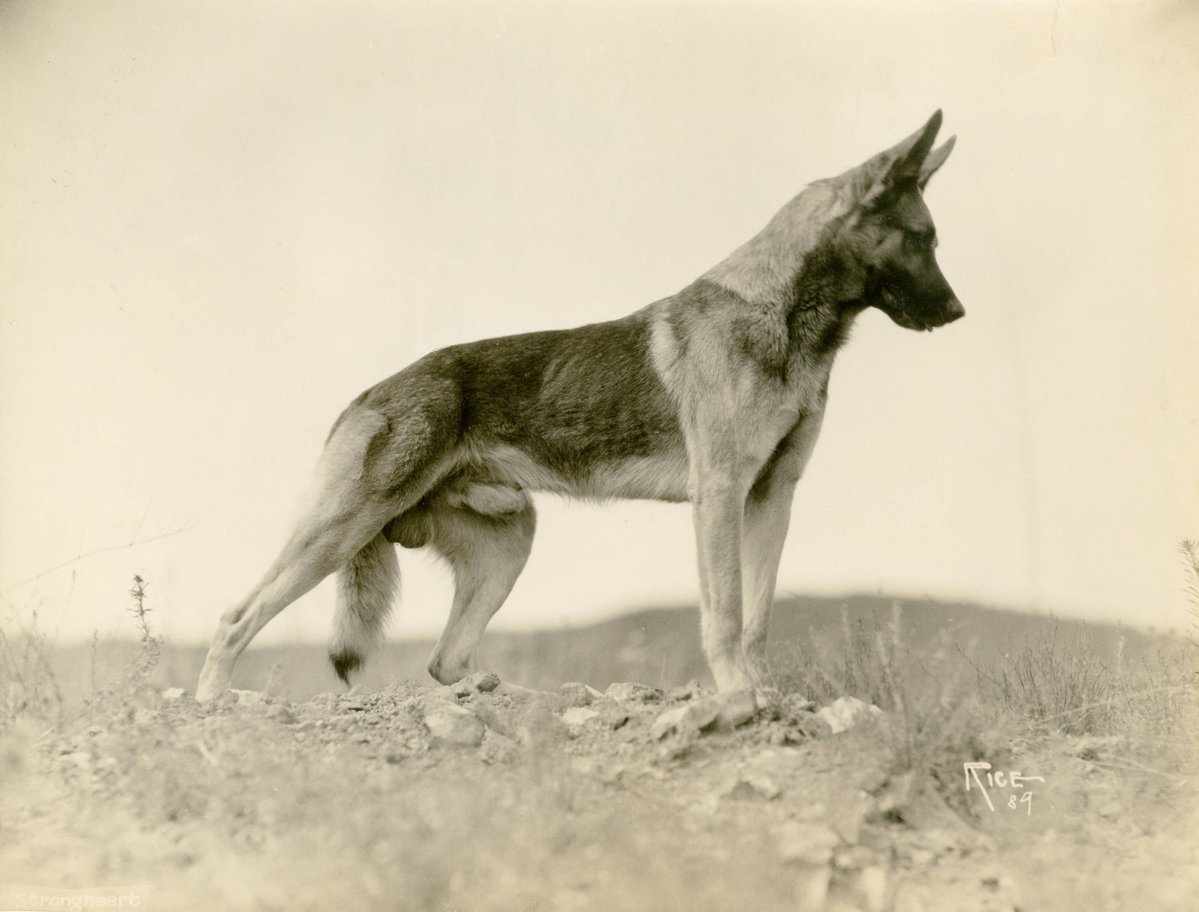
In October 1920, at a Shepherd Dog Club of America show, a three-year-old German Shepherd placed third in his class. A report in the magazine Dogdom called him "immense in body and hind leg formation." His name was Etzel von Oeringen, and he was new to America.
He'd been born in Germany on October 1, 1917, and trained in Berlin as a police dog. He served with the German Red Cross in the First World War. After the war his owner was broke and couldn't even feed him. He turned down bigger offers and sent the dog to a friend who ran a kennel in White Plains, New York, where Etzel was to be sold.
The film director Laurence Trimble saw him. Trimble had already guided Jean the Vitagraph Dog, America's first canine movie star, and he knew what he was looking at. He talked the screenwriter Jane Murfin into buying the dog. The publicity people at First National Pictures gave him a new name: Strongheart.
Trimble trained him and directed him in four rugged outdoor pictures that Murfin wrote: The Silent Call (1921), Brawn of the North (1922), The Love Master (1924) and White Fang (1925). Strongheart became the first major dog star of feature films, two years ahead of Rin Tin Tin.
Almost none of it survives. Nearly all his films are lost. A print of The Love Master turned up in France, and The Return of Boston Blackie, from 1927, survives on 16mm.
A Washington Post correspondent named J. Allen Boone looked after Strongheart for a long stretch while Murfin and Trimble were away. The two reportedly formed a deep bond, and in 1939 Boone published a book called Letters to Strongheart.
In 1929 Strongheart brushed against a hot studio light and was burned. He died on June 24 that year at Murfin's home. He was eleven.
In 1932 a packing company put his name and picture on a can of dog food. It was still being made more than ninety years later. And on February 8, 1960, he got a star on the Hollywood Walk of Fame, at 1724 Vine Street.