Intel guided Q4 revenue to $15–16bn vs $17.06bn consensus and gross margin to 37.1%. The Fab28 blast is ~2pt; the other ~4pt is PCs, with client seen down 20%+ QoQ as memory costs bite. We think CPU price hikes can't carry PCs anymore. $INTC https://t.co/NIgpWPKKBr
Nebius has about a quarter of CoreWeave's revenue and lower margins, yet a bigger market cap. It sells more compute on short contracts at market prices, so it earns more while GPUs are tight. We think its depreciation ratio climbs sharply by 1H27. $NBIS https://t.co/3JmfLSOK3k
@RYANHINGSHING Agree it's mostly B300. Per an industry expert call, Google has paused TPU v8 and v9 production to rework the interconnect for post-training, and TSMC is letting it push orders back. ASIC substrate pull slips, so Nvidia takes more of the pool for now.
@SKundojjala Packaging looks closest of the three. Google/MediaTek TPU and Meta MTIA have finished EMIB-T evaluations, with volume from late 2027. External foundry was $411mn in Q3, mostly one customer project. Full Q3 math is in our Intel piece.
@jukan05 One buyer few people model in that queue: Google. Per an industry expert call (unconfirmed), Gemini 4 post-training moved to Nvidia GPUs, and Google is renting GPUs through several channels while TPU v8 is respun. With hyperscalers served first, enterprise buyers wait longer.
@SKundojjala Packaging looks closest, with a catch. Per an industry expert call, Ibiden aims for ~50% EMIB-T yield by end-2027, so 3mn units of capacity net ~1.5mn good ones. And the first big EMIB-T job, Google's TPU v9, has reportedly slipped. Volume lands later than the headline numbers.
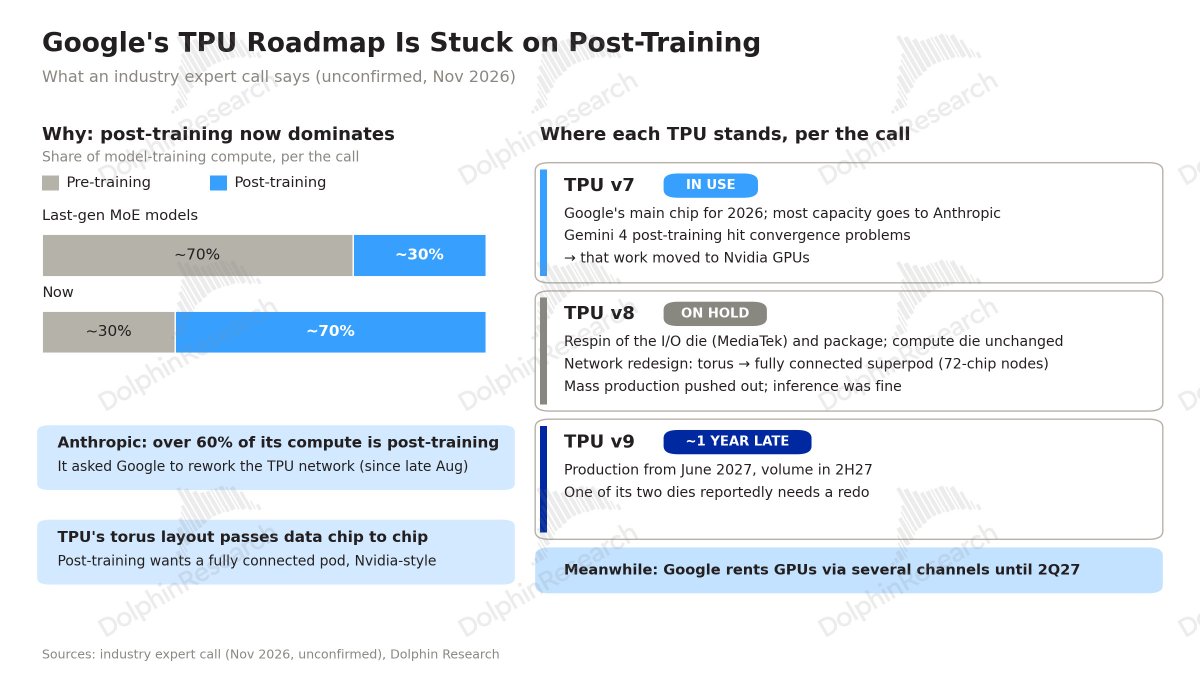
Has anyone else heard that $GOOG.NE put TPU v8 and v9 production on hold?
Unconfirmed, from a recent industry expert call:
• TSMC reportedly gave Google a special window to push orders out through a respin
• The trigger is post-training. Over 60% of Anthropic's compute now goes to it, and since late August Google has been reworking the TPU interconnect at Anthropic's request, from its torus layout to an Nvidia-style fully connected superpod
• TPU v7 hit convergence problems on Gemini 4 post-training, and that work moved to Nvidia GPUs
• The v8 respin covers the I/O die (MediaTek) and the package. Compute die unchanged
• v9 slips close to a year: production from June 2027, volume in 2H27
• Inside Google, the model team wants to go GPU. Cloud and infra are pushing back
Parts of this match what we had. In our Alphabet Q3 review, our channel checks had large v8i deliveries slipping a quarter to year-end. And on the call, Google said supply constraints made it switch on third-party compute at the end of Q3.
The strange part is where it breaks. TPUs are the most credible alternative to Nvidia, and inference still looks fine. The trouble sits in post-training, the work that now decides how good a model gets.
Our call: Google keeps renting outside capacity well into 2027, and the TPU revenue climb it guided for 2027 shifts toward the back half. That matters for $GOOGL cash flow, which in our model only turns positive if TPUs ship and get paid on schedule.
Anyone hearing the same from the supply chain, or the opposite?
Agree on tooling. Applied Materials says hybrid bonding roughly doubles its HBM market vs micro-bumps.
But we'd read JEDEC the other way: more height buys a layer or two at most, and a yield race is MR-MUF's home turf: one pass, while TC-NCF presses each layer and one bad layer scraps the whole stack.
日本語がまだまだなので、読み違いがあればぜひ教えてください!🙏
Hynix's HBM edge has a height limit, and Samsung and Micron are camped right at it.
パウロさん's note argues MR-MUF, the one-shot bonding that put Hynix on top, hits a physical wall at 16-high. In early Oct we wrote that Samsung and Micron were skipping this round to bet on hybrid bonding, the method built for taller stacks.
So we think the next HBM share fight happens at 16-high. Nvidia trimming stack heights buys Hynix time, and the "memory hierarchy" push looks like Hynix moving the contest away from the spec where its moat runs out. $SKHY
@pequityresearch Rates are the crack. CoreWeave's 2032 unsecureds yielded ~14.5% on Oct 13, and our Oct 15 note said above 10%, neocloud project IRRs can't cover interest, so project financing basically shuts. A full order book doesn't change that math.
@paurooteri Our Hynix deep dive found the same: buyers pre-buy and double-order when prices rise. On UBS's restocking estimate, ~80% of this year's DDR shortfall is inventory build. So we suppose next year the risk is buyers destocking.