90% of robotics startups are dead on the launchpad.
They fail on these three bottlenecks:
1. They build for high-entropy environments. Generalist robots to handle infinite edge-cases on a messy job site instead of isolating and capitalising on narrow workflows.
2. They ignore the customer API. Inventing machines to automate tasks (eg bricklaying) that aren't a major bottleneck, and where robot performance doesn't exceed human labour enough to justify the CapEx. If there is no existing port to plug into, you have no power source.
3. They push CapEx friction. Forcing low-margin legacy industries (like farming or construction) to buy, maintain, and troubleshoot beta-stage, $250k hardware.
The solution? Don't sell the robot, sell the outcome. Don't sell a bricklaying machine; just lay the bricks and send them the invoice.
Super enthusiastic about this as well. Though I think folks are heavily discounting the risk that probabilistic, very deep neural nets yield endless capability but near zero predictability. The latter being key to deployable and commercially useful robotics. There is a way, however.
@justinskycak That's right. On the other hand, you also don't need to white-knuckle through life. A rocket only needs one well-calculated burn to get to geo-sync orbit
How to win friends and influence people bible:
1) Get past the firewall - We all have natural firewalls. The API for authentic auth with their firewall is dopamine. A well-intended "your post was super interesting to me because XYZ" goes a long way.
2) Align with their vector field - We all have momentum directed at something or the other. Our own unique ambitions, biases, etc. The key to influence isn't to redirect that kinetic energy, it's in tacking your ends onto theirs. Align your vector field with theirs. Positive sum games only, please.
3) Vent heat - any interaction will have friction. Minimise. If entropy builds, vent it with an authentic display of vulnerability.
@adriannalakatos' example ticks all 3 boxes
Excellent point on being goal-oriented.
That said, so much of ML for robotics is in the 'Tycho Brahe' stage of development: "Here's what I observed from training X on Y". What we need is 'Newton': "F=ma".
Godspeed those who are tinkering on model architectures. May you discover the fundamental physics we need for physical AGI
@_joe_harris_ Ah yes, the phase transition of eating glass and staring into the abyss.
0->1: Build the machine
1->n: Build the machine that builds the machine.
Fortunately lots of good operators in industrial history who've built great meta-machines. The lessons are out there
That's right. But Darwin also says the fittest survive.
Most times leaning on the 'scaling paradigm' is an excuse for sub-optimal architecture and poor product. You don't survive by throwing cash at training a black box, you survive by killing bad ideas and generating cashflow before entropy catches up. I don't see a lot of that happening in the current ecosystem. Natura' selection's going to be doing a lot of pruning (!)
The difference between a functional Gigafactory and a manslaughter charge is 50 milliseconds.
The KUKAs on a factory floor move at 2 meters per second. If a worker steps past the perimeter, and that sensor data has to ask a data center in Virginia "Human or Door Panel?", the 50ms delay means that arm travels another 10cm completely blind. That is broken ribs or a rivet to the torso.
If you have to reduce your available power budget and payload, so be it. Buy an Orin/Thor, and save your limbs.
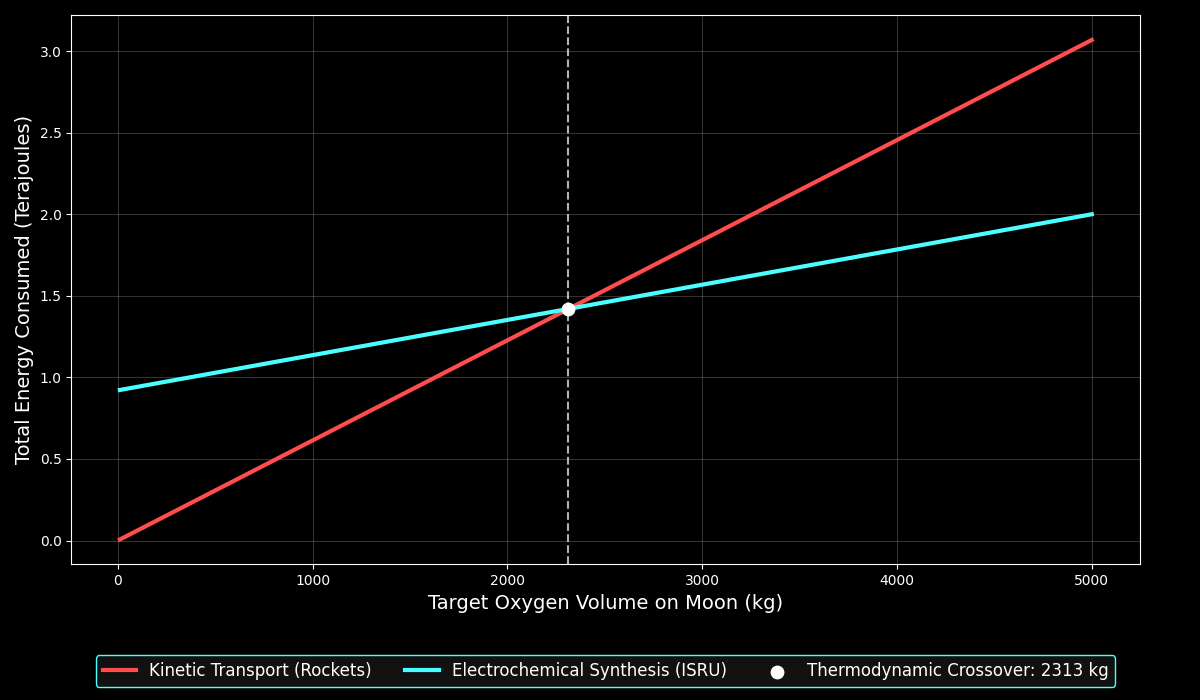
The Joules don't lie. For any appreciable quantity of Oxygen generated, ISRUs >> rocket transport.
Add oxygen generation for methalox propellant to the spec and you have breathing astronauts who also return home on the cheap
This is one of my favourite things I have seen recently.
The price of oxygen on Earth is very low, the price of oxygen on the Moon is very high, the cost of transporting oxygen from Earth to the Moon is also very high. Too high.
The solution is to make oxygen on the moon.
If you’re looking for an engineering problem to apply yourself to, what you should start with is a price signal.
Where do you see a big pricing dislocation?
This can be a geographic dislocation, a temporal dislocation, an assembly dislocation, a process dislocation, an information dislocation, there are many things like this.
You then take the pricing disparity and you multiply it by the applicable volume to calculate the unrealised value.
If you bridge the dislocation you capture some of the value, usually 80% of the value goes to the user, 80% of the remaining 20% goes to your costs, and the last 4% of the unrealised value is the available profit. This is a crude rule of thumb, but it broadly works out this way.
Why do you need this price signal?
It tells you the resource constraints that you must operate inside of, to deliver your solution. It tells you the profit that you might expect to make, if you realise the unrealised value.
Making oxygen on the moon is a good example of this, but so is drilling oil, or fabricating microprocessing chips.
So you don’t really need to solve some hypothetical untested problem. The world is full of very real problems, with very calculable opportunities to realise value and make some money.
An industrialist is really just an engineer who gets their technical requirements from capital markets.
Please steal this and apply it. We will all benefit.
@DeanReds70@Ryanair Was a passenger on this too. Hope you got somewhere okay. Good luck with the rest of your journey.
Will Def be angry phone calls to HQ come sunrise