We are expecting good attendance by leaders and experts from all over the world on desert based clean energy systems, markets and related trusted information, a.o. distributed BlockDAG technology @ZETAlliance@KaspaKii@IRENA@IEA
since many (~4) asked me about the zcash bug - - - earlier this year I had this convo with a zcash core dev:
zk: it's weird that kaspa is pruning past records
me: why does it need to keep 'em?
zk: the whole point of ledgers is to prove correctness of all state transitions
me: the whole point of ledgers is to provide focal points for the consensus state
zk: the whole point...
me: hmm then why did you come work in zcash? you know the Sprout->Sapling counterfeiting bug
zk: Turnstile guarantees that the counterfeit could have been very limited
me: true but you still cannot prove or even reason about correct state transitions besides the total supply cap
zk: that's actually a good point
----
the most hardcore cryptography coin is shifting away from correctness proofs to practical-enough proofs. I believe this is a step in the right+practical direction, yet the paradigm shift should not go unnoticed - -cryptography is giving way to consensus.
if you came to zcash for cryptographic integrity, reconsider. there are many good reasons to root for zcash prospering. zcash is serving a more important role than bitcoin, whose utility for the original mission is by now blurry. cryptographic integrity is/should not be one of those reasons.
----
BTW the bug should definitely have been exploited. I don't know the personal values of Taylor Hornby, and I shouldn't be required to make the effort to learn them. I only know that if I found such an exploit, it wouldn't take me more than a few minutes to tempt myself into printing a longint amount of ZEC and deciding later what to do with it.
I wouldn't necessarily use it to exit the pool immediately and corrupt the supply, I'd wait to see if some portion of the broken pool does not seem to migrate on time (probably lost funds), in which case I would not think twice before claiming the funds myself.
you could argue that no harm done, and you might be right, but then again you are here -- in zcash / in crypto -- for its consensus dynamics, the ability to coordinate interests and convictions across different trust zones around some shared asset; not for some pristine mathematical integrity.
Every $BTC L2 exploit is a $KAS advertisement. Layers are attack vectors and, statistically, this will be never ending. Every layer added to solve a limitation creates another surface that must be secured, patched, monitored, and trusted.
Kaspa may have one of its most strategically important use cases in AI-agent economies, because autonomous agents do not merely need information, they need an economic substrate capable of moving value, enforcing permissions, and settling machine-to-machine interactions without human intervention. An AI agent that continuously purchases compute, data, APIs, storage, model inference, bandwidth, or specialized services cannot operate efficiently through financial infrastructure designed around humans clicking “approve.” The emerging agent economy instead requires programmable money: low-friction transactions, deterministic rules, rapid settlement, and cryptographically verifiable state. Kaspa’s architecture maps unusually well onto this problem.
The deeper advantage is that the wallet can become part of the agent’s execution policy. With Toccata’s UTXO-native programmability, covenants can encode spending conditions directly into outputs, while Covenant IDs provide persistent lineage across state transitions. An agent could therefore operate from a bounded treasury where its funds are spendable only under predefined conditions: maximum expenditure per period, per-transaction limits, authorized counterparties, escrow requirements, specific service categories, or recovery conditions. The AI determines what it wants to accomplish; the covenant determines what it is mathematically permitted to do. That separation creates a powerful security model: intelligence can be autonomous without granting the software unlimited financial authority.
Kaspa’s high-frequency DAG also changes the economics of machine-to-machine commerce. Humans make relatively few financial decisions per day; software agents could make thousands or millions. They therefore need infrastructure designed around continuous settlement rather than occasional human payments. Kaspa’s UTXO architecture additionally allows economic state to be fragmented across multiple independent outputs, meaning an agent ecosystem does not necessarily have to funnel every operation through one globally mutable contract state. Independent tasks, escrows, budgets, and agent relationships can progress concurrently.
The ultimate possibility is an Internet where software becomes an economic actor. Agent A could discover Agent B, negotiate a price, authenticate itself, allocate funds, purchase computation, receive a result, verify the result, and pay another agent for the next stage, all autonomously. Kaspa consequently isn't merely a payment rail for AI. It could become an economic control plane for autonomous software, with AI providing intelligence and Kaspa providing ownership, constraints, incentives, provenance, and settlement. That combination could create an entirely new computational economy where machines don't merely use the Internet, they transact with one another on it.
GEMINI × KASPA SILVER
Join us live with @KaspaSilver for a conversation about Kaspa, the technology behind the project, and the community around it.
Tomorrow @ 9am ET
Be there or be square🟧
a lot is hiding underneath the simple sentence “doing covenants in the right way”
reading around lately, i still feel like many might not fully grasp the potential of covenants done right on a high frequency network
i’d be happy to discuss the details and the possible strategic meanings in depth on the pod sometime
“Bitcoin is dead boring to me at this stage.” 👀
Kaspa’s @hashdag shares his take on Bitcoin and where Kaspa, Zcash, and Solana fit into the conversation.
With @VladCostea on @BTCTKVR S17 E36.
Institutional advocacy is not conducted on X.
It is conducted directly with principals, CTOs, risk committees, legal counsel and compliance officers.
Kaspa’s native programmable layer is only a few weeks old. Security auditors are still studying covenants and the blockDAG architecture. That learning curve alone takes time.
Beyond the technology itself sit far heavier requirements that social-media commentary routinely ignores:
• Institutional custody frameworks demand proven controls, independent audits, insurance wrappers, and operational maturity before any serious capital is placed on a new layer.
• Procurement and public/private tendering processes follow multi-stage RFPs, due-diligence cycles, vendor risk assessments and board-level approvals that routinely run 12–24 months.
• Each industry carries its own mandatory standards - financial messaging (ISO 20022), energy settlement, supply-chain provenance, sanctions screening, data-residency rules and sector-specific regulatory sandboxes. Meeting those standards is not optional and cannot be accelerated by tweets.
Sandbox testing, formal verification, regulatory engagement and independent security review all operate on institutional timelines, not crypto-Twitter timelines. Asking major institutions to move valuable assets onto a newly programmable layer without that groundwork is not “ambition” - it is ignorance of how these organisations actually work.
Those of us doing the substantive work understand the sequence and the constraints. Those who do not should stop confusing volume of posts with progress. Patience is part of getting it right.
Your government doesn't protect you—it protects its own power.
Your media doesn't inform you—it programs you.
Your money is worthless paper backed by nothing but blind faith.
Your food is engineered to make you sick, then sell you the cure.
Your schools teach you obedience, not critical thinking.
Your vaccines are not tested for safety—they're tested for compliance.
Your wars are fought for profit, not freedom.
Your "leaders" laugh at you while you fight each other.
Repost if you're done being a sheep. 🔁
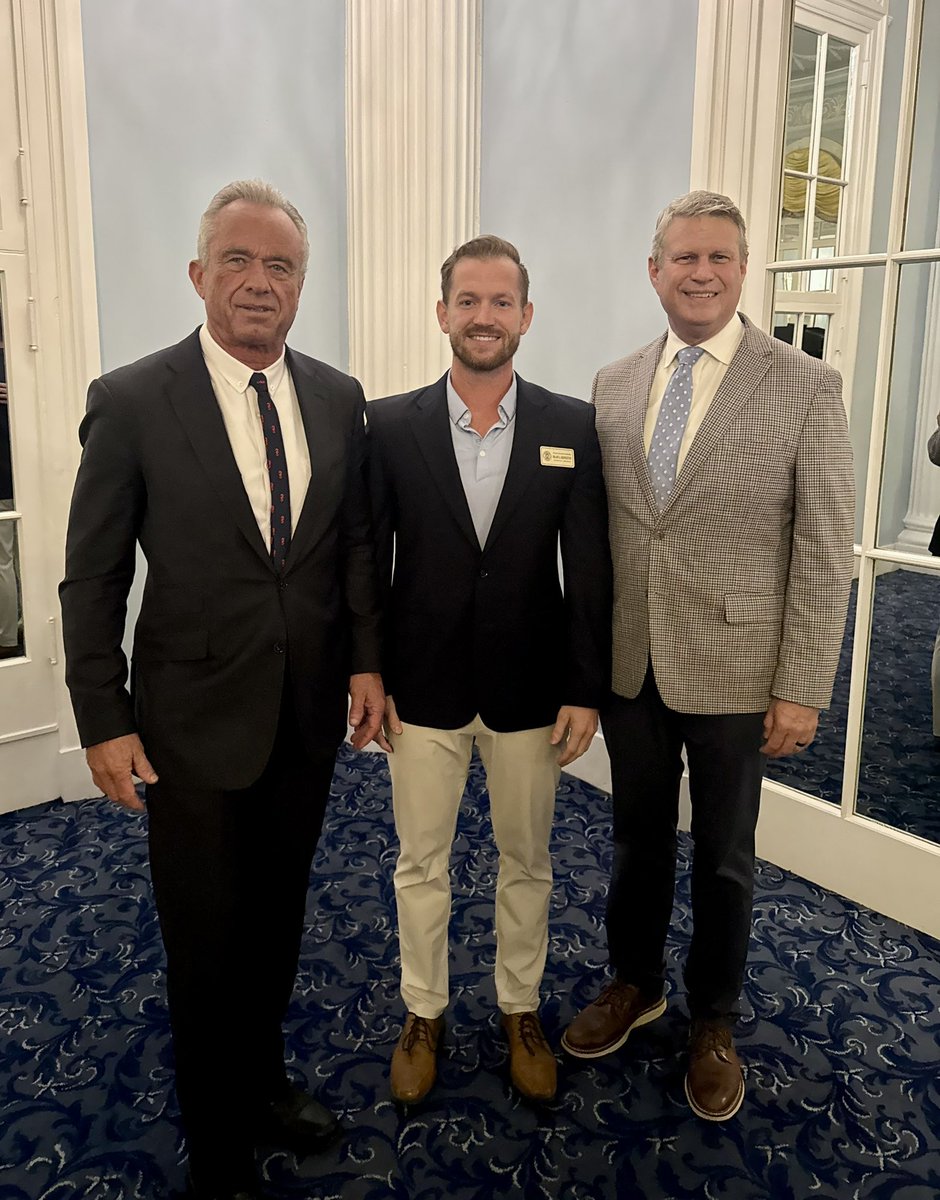
Wouldn’t it be powerful to put U.S. health policy processes and funding streams on a public, real-time ledger?
Live transparency. Real accountability. No more black boxes.
Kaspa’s BlockDAG is uniquely built for this and with zero-knowledge proofs, the coming vProgs, and the DagKnight hardfork, the tech is about to get even stronger.
It’s only a matter of time if we make it happen!
The people deserve transparency and accountability!
Imagine if we had this tech during Covid!
TRUTH & TRANSPARENCY MATTER!
@RobertKennedyJr
A developer-facing programming language and compiler for building onchain Kaspa applications with multiple contracts, cross-app linking, and atomic composition across apps and open app interfaces.
It also includes a comprehensive runtime with one unified api for constructing anything from simple single-app txs to complex cross-app txs.
I believe Argent will become the main surface developers use when building native L1 applications on Kaspa. That should also include the L1 contracts used by higher-order systems such as based zk apps. For example, a canonical bridge interacting with standard L1 assets should speak Argent
kaspa:native is going to be the next major phenomenon in crypto in my view. The likely target price is probably around $5 but short term $1 is realistic at any point within a very short space of time.
It’s really a case of KAS being the next $BTC style / $ETH style / $SOL style contender.
More broadly it’ll be a next-generationally definitive blockchain based technology and there’s really no telling how big it might evolve culturally after a sustained breakout into one of the largest coins worldwide by market cap.
Right now huge accumulation is going on which typically implies enormous and sudden price momentum at some point (anyone around since 2013 knows this script).
When will that be? Hard to say but it’s possible it’s soon. It seems KAS has its own four year cycle quite separate from the four year cycle of the other blockchain assets and if so this year would be pivotal.
I think too that a very interesting series of facts end up emerging about this tech (who’s behind it, why, how it changes the game etc etc) ultimately for a greater mainstream narrative that could add additional push.
Don’t overlook it would be my suggestion. Writing this for historical significance rather than as a recommendation of any kind (so it’s fun to look back later on and say “wow how did he know that back then …?”) since whatever I say won’t matter one bit. There’s a much bigger game being played here I think that maybe not everyone is fully aware of.