BREAKING: SAP hacked, with hackers reportedly using stolen employee authentication tokens to copy and alter source code on GitHub.
AI agents may have been used in the attack, per Der Spiegel.
🚨 The UK is taking a dangerous page out of the 2008 housing crisis playbook.
Nationwide, one of Britain's largest mortgage lenders, has launched a 99% mortgage scheme for first-time buyers, allowing eligible borrowers to:
- Put down just 1% upfront.
- Borrow up to 99% of a property's value.
- Borrow up to 6 times their annual income.
- Secure loans of up to £750,000 over 40 years.
This is an extremely high-risk scheme, as even a 1% drop in house prices could wipe out the buyer's entire initial equity.
A 10% decline on a £500,000 home could leave them £45,000 underwater, before accounting for repayments.
This echoes the lead-up to 2008, when loose lending standards and falling house prices left highly leveraged homeowners exposed.
The timing is also concerning as the UK Government warns 6.5 million of its households could face higher mortgage payments in the coming years, while around 1 million borrowers on fixed rates below 3% are due to remortgage by the end of 2027.
Are lenders making housing more accessible, or simply encouraging households to take on even more debt?
As part of our ongoing security maintenance, we have temporarily paused swap functionality following our latest Mythos 5.2 security review.
All other protocol operations remain fully available, including lending, borrowing, withdrawing, repaying, and liquidations.
All funds remain safe, and no user action is required.
We will restore swap functionality as soon as the maintenance is complete.
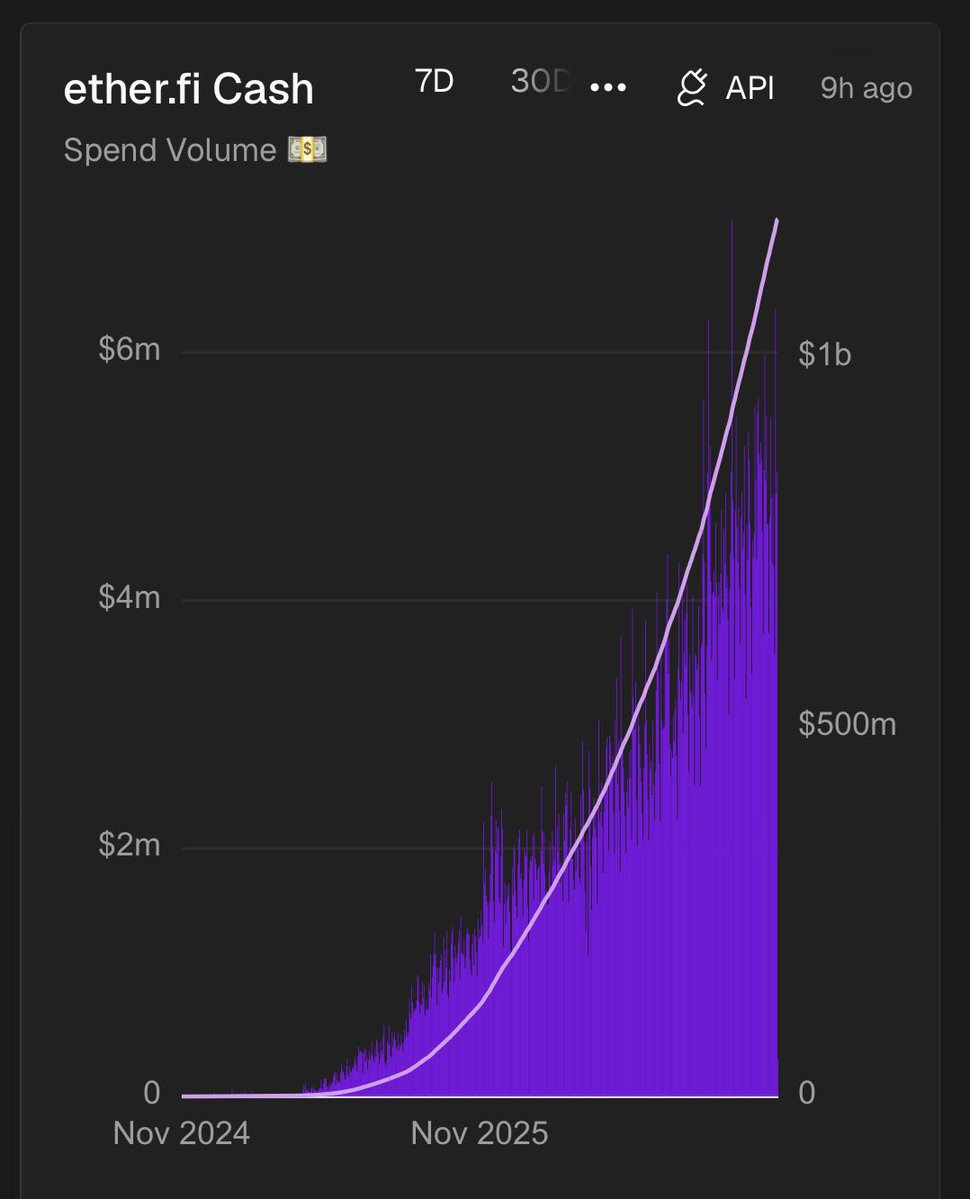
At some point we have to admit that capital formation markets in crypto are just brain damaged and broken, right?
@ether_fi is legitimately one of the best businesses in crypto. One of the very few non-gambling ones, with revenue uncorrelated to crypto hype cycles.
wtf.
⚠️ALERT: Standard Chartered's crypto unit, Zodia Custody, managing $30 BILLION in assets, suffered a security breach this week, its CEO says.
The breach exposed client names, email addresses and other information.
It’s unclear if crypto assets were affected.
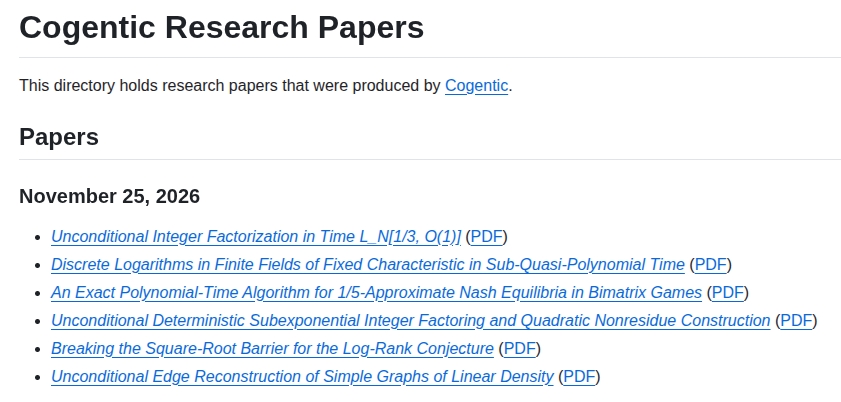
Update: Google just released a batch of papers. Several of them are on exactly the topics behind the rumors. None of them breaks anything.
Factoring. "Unconditional factoring in L[1/3]". The Number Field Sieve already factors in L[1/3], but its running time rests on unproven heuristics. This paper would prove that bound for the first time. That's a real milestone for theory, but it isn't a faster algorithm and it isn't "factoring in P". RSA key sizes don't move.
Discrete log. It covers finite fields of small fixed characteristic. Those were already broken in quasi-polynomial time in 2014, and crypto dropped them years ago. Prime-field DH and elliptic curves are untouched.
Deterministic factoring. Getting subexponential factoring without randomness is elegant, but (randomized) subexponential factoring has existed for decades.
That's very likely how rumors are born.
These results are still remarkable: AI is now producing serious results in complexity theory and number theory. But "AI proves a rigorous bound for a known algorithm" isn't "AI breaks RSA".
No reason to panic ... yet.
https://t.co/UGQqFMr4SZ
I'm hearing several rumors that frontier labs have broken some major cryptographic primitives:
- "Factoring is in P": Now that the Riemann hypothesis is proven, we do understand much better how primes are distributed. Still, I don't think factoring is in P.
AKS showed in 2002 that primality testing (deciding whether a number is prime) is in P, but factoring is a different beast. If it were in P, RSA would simply be broken, and that would be huge: a large part of our systems still rely on RSA.
- "ECC has been broken": Other rumors say elliptic-curve cryptography has been cryptanalyzed, which would take down ECDH and ECDSA along with it. (all the non-RSA asymmetric cryptography)
- Ring-LWE isn't quantum-resistant. That wouldn't be an immediate threat, since there's no cryptographically relevant quantum computer yet. But it would make the ongoing post-quantum migration pointless.
It's hard to tell what's true. AI has made incredible progress, starting with the proof of the Riemann hypothesis.
And most importantly, if a frontier lab did find something like this, a clean responsible disclosure that avoids mass exploitation would be very hard to pull off. All of this helps the rumors spread.
Personally, I don't think findings like these are coming. I wouldn't be surprised if some of these primitives turn out to be a bit weaker than we thought, but I'd be very surprised to see any of them fall apart completely.
🚨 ALERT: $VVV plunges more than -15% as explosive privacy allegations rock the billion-dollar company marketed as a private, self-hosted AI platform.
A researcher reveals that 14 of the 18 image-recognition models tested on Venice AI routed requests to third-party inference providers, including DeepInfra, Baseten, Fireworks and Parasail.
The investigation raises further questions about Venice's privacy claims:
• Its supposedly self-hosted models allegedly rely heavily on external infrastructure.
• Its end-to-end encryption reportedly allows Venice or its infrastructure partner Phala to access conversations and inject messages.
• Its platform also reportedly offers access to Claude and OpenAI models, despite founder Erik Voorhees previously saying Venice would never become a wrapper for centralized AI services.
The controversy intensified after Lookonchain flagged a wallet suspected of being linked to Voorhees depositing 81,463 $VVV, worth approximately $2.25 million, into Coinbase around seven hours earlier.
Venice recently announced annualized revenue exceeding $200 million.
However, founder Voorhees has pushed back, calling the allegations "Fake news."
He maintains that every model marked "Private" guarantees zero data retention, while Venice keeps no content logs, and that models marked "Anonymous" clearly disclose that third-party providers may store prompts.