«Muchos dicen que la historia más hermosa es esa que está llena de celebraciones, sonrisas y finales felices. Para nosotros eso sería negar la belleza de lo imperfecto».
@Alejazepam Lo primero es comprensible, es una ciudad grande y eso al foráneo que viene de los pisos bajos le asusta, lo segundo es una estupidez supina, en muchos lugares venden eso.
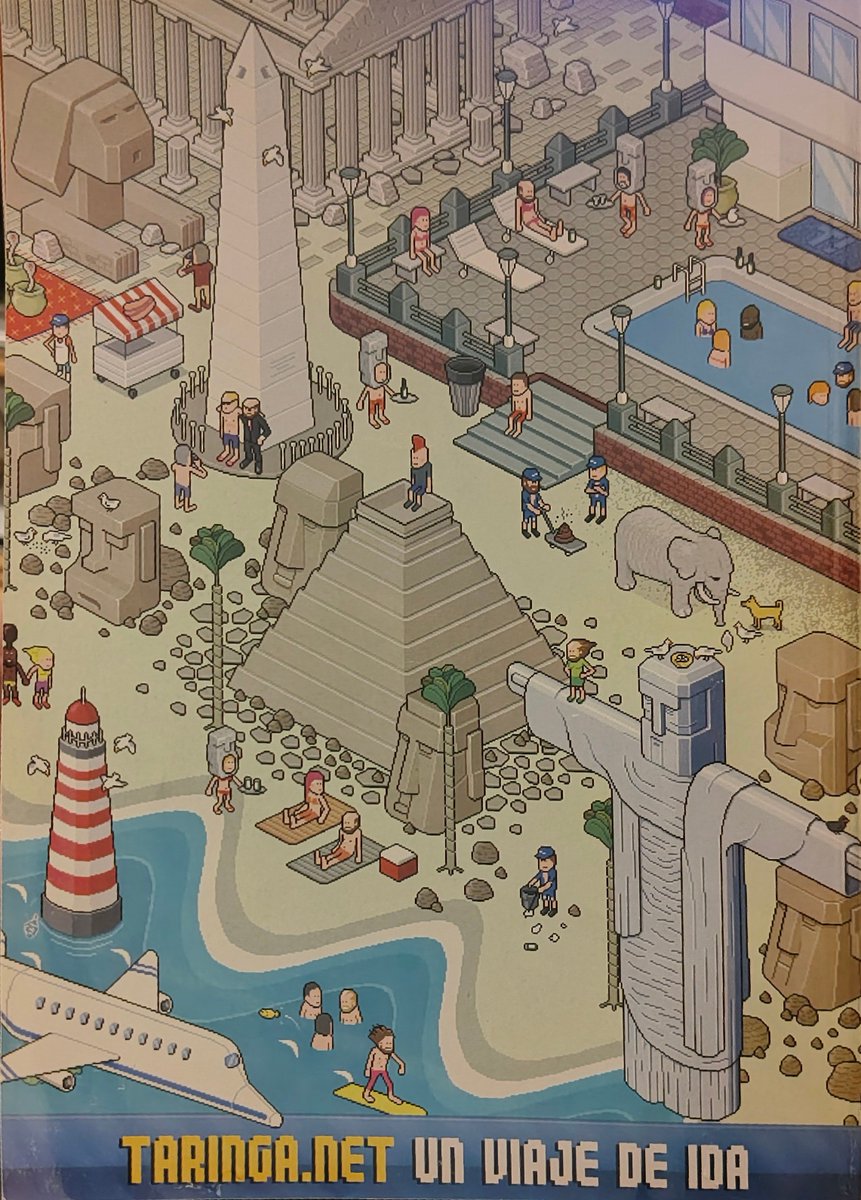
Taringa fue una de las comunidades digitales más importantes de América Latina. "https://t.co/JLMQcn7MVk, un viaje de ida", decía la publicidad de diciembre de 2009 en la contratapa de la Revista Un Caño. Dejó un montón de conceptos y lore internetero. ¿Quiénes eran taringueros?
@hernanpanessi Era impresionante el forobardo en temas como la rivalidad entre Messi y CR7, o con la política local argentina, de Taringa me quedó el recuerdo de leer temas interesantes, los post de ciencia y por supuesto la descarga de juegos que quería, iba al ciber sólo por eso.
Me cae mal la gente que jode y jode con que uno debe montar una empresa y que "la plata está ahí y toca buscarla". Señor, yo estudié una licenciatura; déjeme querer enseñar y ya.
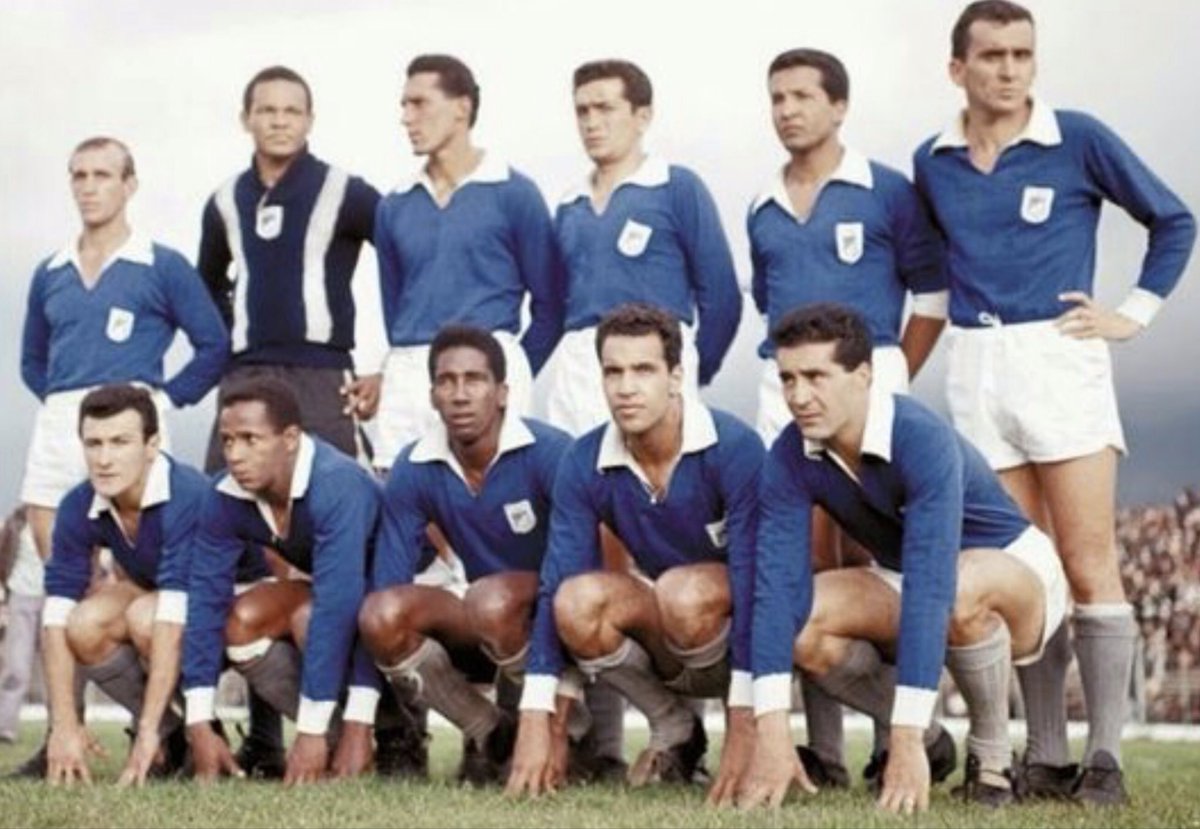
🚂 Nació entre obreros y ferrocarriles. Se hizo popular.
Conquistó América y el Mundo. Y terminó siendo el más grande de todos.
EL GLORIOSO PEÑAROL.
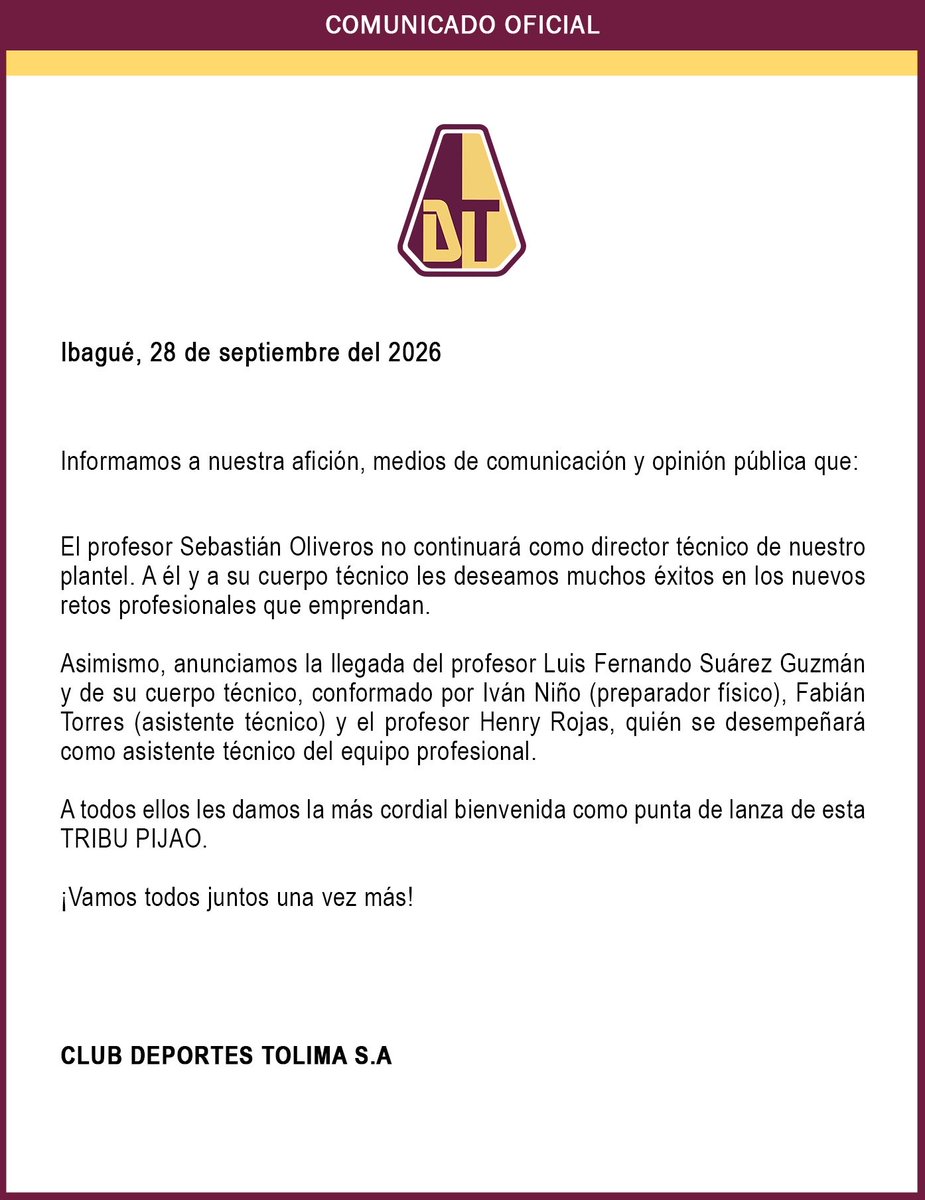
28 de setiembre de 1891, 135 años.
May 10, 1940. Germany launches its attack in the West, and within ten days it pulls off one of the most stunning moves in military history.
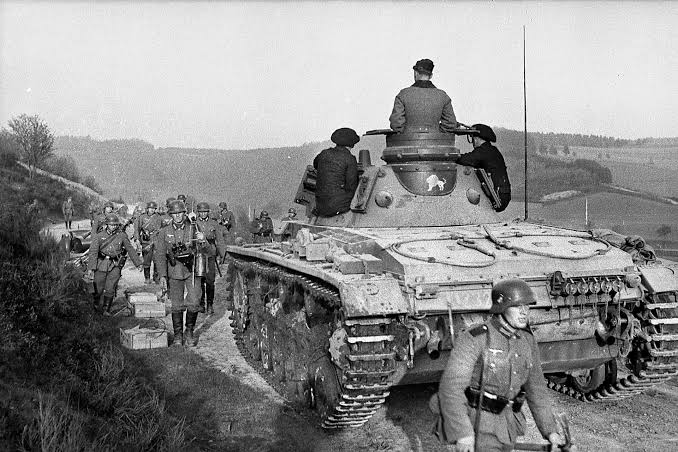
While the Allies rush north into Belgium to meet what they think is the main blow, German panzers punch through the Ardennes forest, a place the French considered too rough for tanks. They cross the Meuse at Sedan, break the French line, and race west.
On May 20, German tanks reach the English Channel at Abbeville.
The Allied armies in the north are cut in two. The British Expeditionary Force, the French First Army, and what's left of the Belgians are now trapped in a shrinking pocket with the sea at their backs.
There's only one real way out. Dunkirk.
By May 24, Guderian's panzers are across the Aa Canal, roughly 15 miles from the port. The British have almost nothing between those tanks and the beaches. One hard push and the entire BEF is gone.
Then the order comes down. Stop.
Rundstedt is worried. His armor has been driving nonstop for two weeks, a lot of his tanks are broken down, and the ground around Dunkirk is flat, wet, and full of canals. He wants to save his panzers for the fight against the rest of France. Hitler visits his headquarters and backs him. Göring promises the Luftwaffe can finish off the pocket from the air.
The German army high command thinks it's insane. Guderian is livid. His crews are close enough to see the town, and they just sit there.
For almost three days, they sit.
And the British use every hour of it.
They throw together a defensive perimeter along the canals. Rearguard units dig in. At Calais, a British brigade fights to the last and ties up an entire panzer division. At Lille, the French First Army holds out until May 31 and keeps several German divisions busy that would have otherwise been pushing on Dunkirk.
Meanwhile in London, Operation Dynamo is being thrown together at a desperate pace. Churchill privately hopes they might save 45,000 men.
The halt order is lifted on May 26. By then it's too late to simply roll in. Every mile now has to be fought for.
Over the next nine days, destroyers, ferries, minesweepers, fishing boats, and hundreds of civilian "little ships" run back and forth across the Channel under constant bombing. Most of the men are loaded off a long harbor breakwater called the East Mole. Others wade out from the beaches in chest deep water and wait in line for hours.
The Luftwaffe hits them hard, but bad weather grounds planes on some days and RAF fighters fight over the coast the whole time. Göring's promise doesn't hold.
On the first full day, about 7,700 men get out. By the end, the numbers are staggering.
When it's over on June 4, more than 338,000 Allied soldiers have been evacuated. Around 198,000 British and 140,000 French and other Allied troops.
The British left nearly all their heavy equipment behind. Tanks, trucks, artillery, all of it. But equipment can be rebuilt. Trained soldiers can't be replaced overnight.
Those men became the core of the army that would fight in North Africa, Italy, and eventually land back in Normandy four years later.
Germany had the entire British army trapped on a beach, and it decided to take a break.
Germany won the battle and let the war walk out the front door.
27 September 1943
B-17 Flying Fortresses of the 390th Bomb Group, 13th Combat Bombardment Wing, US Eighth Air Force, accompanied by P-47 escort fighter aircraft, leave contrails in the sky.
Handwritten caption on reverse: 'Single most famous aerial combat photo. B-17F Plane 'F'. 27 Sept 1943. Raid against Emden, 17th Combat mission of 390BG.'
The 390th Bomb Group flew B-17 Flying Fortresses from Framlingham, Suffolk, UK between July 1943 and the end of the war in Europe. The Group was engaged in strategic missions until the invasion of Europe when its role became more of a tactical one. This tactical role was more attuned to the needs of ground forces. For instance, the Group bombed the coast near Caen fifteen minutes before the landings in Normandy on 6 June 1944. The Group also carried out humanitarian missions, dropping food supplies for the Dutch in the final weeks of the war. The only man to fly 100 missions, Hewitt "Buck" Dunn, did so with the 390th Bomb Group. (https://t.co/xxtDm1BZYa)
Color by Jecinci
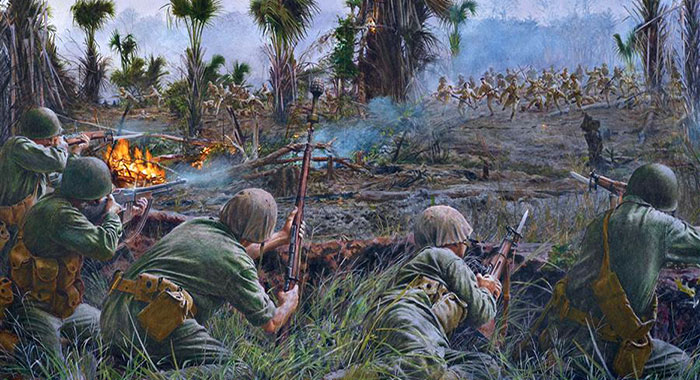
August 1942. Guadalcanal.
The Marines have been on the island for two weeks. They're sick, hungry, and living on captured Japanese rice because the Navy pulled out and took half their supplies with it. They're holding a thin perimeter around an airfield in the middle of a jungle, and every night something moves out there in the dark.
What they don't know yet is that on the night of August 18, Japanese destroyers slipped in and dropped off about 900 elite soldiers twenty miles down the coast.
Their commander is Col. Kiyonao Ichiki. His men were originally trained to storm Midway before that battle went sideways. Ichiki is aggressive, proud, and certain. His intelligence says there are maybe 2,000 Americans on the island and that they're demoralized and trying to escape. He doesn't wait for the rest of his regiment. His men carry just a week's worth of rations. He doesn't think he'll need more.
On August 19, a Marine patrol stumbles into a Japanese patrol and wipes it out. On the bodies they find officers, fresh uniforms, and maps with the Marine positions marked on them. These aren't stragglers. Something big is coming.
The Marines of the 2nd Battalion, 1st Marines, are dug in along the west bank of a stagnant, stinking tidal lagoon. The maps call it the Tenaru. It isn't. It's Alligator Creek. At its mouth, where it should meet the ocean, a narrow sandbar blocks it off. That sandbar is the only dry way across. The Marines string a single strand of barbed wire over it. It's all they have.
Now imagine you're there.
August 20, just before midnight.
You're 19 years old, lying in a hole scraped out of wet sand. You've got a bolt action Springfield and maybe a hundred rounds. It's so dark you can't see your own hand. The jungle across the lagoon is a solid black wall. Land crabs click through the brush. Mosquitoes crawl over your face and you don't dare slap them.
Then a man staggers in out of the darkness, drenched in blood.
His name is Jacob Vouza. He's a retired sergeant major of the Solomon Islands police who's been scouting for the Marines. The Japanese caught him with a small American flag. They tied him to a tree and beat him. When he wouldn't talk, they bayoneted him in the chest and throat and left him to die. He chewed through the ropes and crawled back through the jungle to tell you they're coming. He gives his report before he'll let anyone treat his wounds.
Now everyone is awake. Everyone is staring across the water.
Around 1:30 in the morning, the jungle goes silent. The insects stop.
Then flares go up over the sandbar. Green light pours down over everything, and you see them. Hundreds of men pouring out of the coconut grove across the creek, bayonets fixed, running flat out. They are screaming. The sound is unlike anything you've heard in your life.
Every gun on the line opens up at once.
Water-cooled machine guns hammer across the sandbar. Rifles crack all down the bank. A 37mm antitank gun fires canister rounds, essentially giant shotgun shells packed with steel balls, straight down the length of the sandbar. The first wave is torn apart. Men fall in heaps. The next wave climbs right over them and keeps coming.
Some of them reach the wire. Some tear through it and make it into the Marine foxholes. Now it's hand to hand in the dark. Bayonets. Knives. Entrenching tools. Rifle butts. Men strangling each other in the mud. You can't tell who is who except by the screaming.
In one machine gun position on the bank, three men are holding the line. Pvt. Johnny Rivers is on the gun. He fires until a bullet hits him in the face and kills him instantly. Pvt. Al Schmid takes over. Cpl. LeRoy Diamond is feeding the belt and is badly wounded. The Japanese keep coming at them. Then a grenade lands in the pit and explodes in Schmid's face.
Schmid is blind.
He keeps firing anyway. Diamond, bleeding, calls out where to aim. Left. Right. Lower. Schmid swings the gun wherever he's told. When they run low, Schmid pulls his pistol and waits for the next man to come over the edge of the hole. They hold that position until morning. When the sun comes up, there are around 200 dead Japanese soldiers in front of it.
Across the creek, the Japanese start firing mortars and machine guns into the Marine positions. Then, before dawn, they try again. This time they wade out into the ocean to get around the sandbar through the surf. The Marines shoot them in the water. Bodies wash back up onto the beach with the tide.
Then the sun rises.
The sandbar is carpeted in dead. Dead men tangled in the wire. Dead men floating in the lagoon. The survivors of Ichiki's force are pinned down in the coconut grove on the far bank, still shooting.
In the morning, another Marine battalion crosses the creek upstream and swings around behind them. The Japanese are trapped between the jungle, the lagoon, and the sea.
That afternoon, five light tanks roll across the sandbar and straight into the grove. They fire canister point blank into men trying to hide behind palm trees. They drive right over the living and the dead. Men throw themselves at the tanks and are crushed. The division commander, Gen. Alexander Vandegrift, would later write that the backs of the tanks looked like meat grinders.
Then the Marines move forward to clear the grove. And they learn the lesson that will shape the next three years of war in the Pacific.
A wounded Japanese soldier lying still is not out of the fight.
Men who look dead roll over with grenades. Wounded men pull pistols on the corpsmen coming to help them. A Marine bends down to check a body and is shot. After that, nobody takes chances. Only a handful of prisoners are taken.
By late afternoon on August 21, it's over.
Nearly 800 Japanese soldiers are dead. The Marines have lost 44 killed.
Ichiki is dead too. Japanese accounts say that when he saw his command destroyed, he burned his regiment's colors and killed himself. No one knows for certain. Only a small number of his men made it back through the jungle.
For days after, the bodies lie on the sandbar and in the grove, rotting in the tropical heat. The Marines have no way to bury that many men fast enough. The smell blankets the entire perimeter. Men who were there said they could never forget it.
Before that night, the Japanese Army had never been stopped cold by Americans in a land battle. Their officers believed Americans were soft and would never stand up to a bayonet charge. At Alligator Creek, a few hundred exhausted, half-starved Marines proved them wrong.
Johnny Rivers received the Navy Cross after his death. So did Diamond. So did Al Schmid, who never saw again. Hollywood made a movie about him in 1945.
Jacob Vouza survived his wounds. He was awarded the Silver Star, was later knighted, and remained a hero to the Marines for the rest of his life.
The Pittsburgh Steelers asked an Englishman to sing the American national anthem.
Bruce Dickinson did it a cappella, no autocue, having never sung it before in his life.
He held "free" for six seconds.