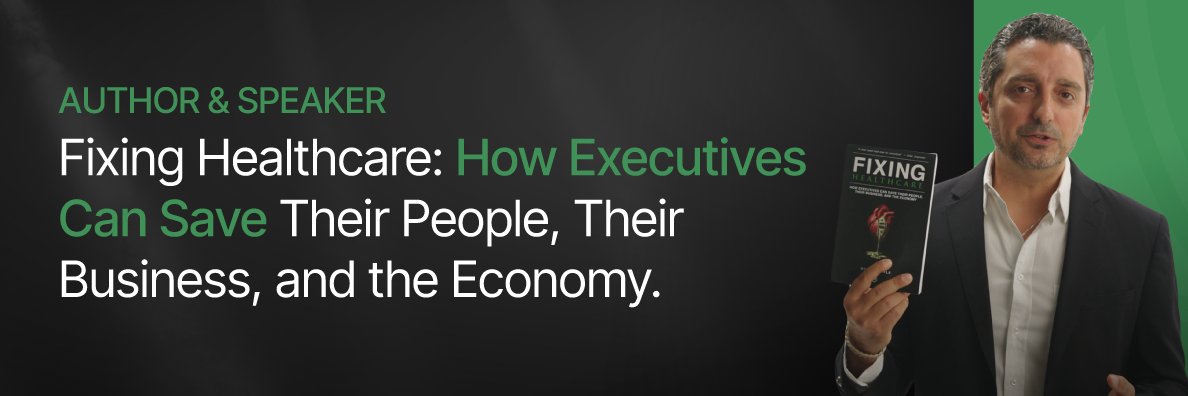
It’s already been a year since my book “Fixing Healthcare: How Executives Can Save Their People, Their Business, and the Economy” was released.
Here’s what’s changed:
- More and more businesses are recognizing that the legacy brokerage industry is designed to sell them products — not help them maximize benefits investments or help you “get the best deal”. This is because legacy brokers are paid my the same insurers you expect them to negotiate against on your behalf.
- More businesses are realizing that they need to manage benefits programs like every other part of their business: quantify your current state so that you can identify opportunities for improvement, set goals, and develop road maps to achieve them. Hold your people and vendors accountable.
However, awareness is just the first step towards implementation.
Here’s what hasn’t changed:
- Many employers are struggling with record levels of healthcare inflation, while others have little or none…it’s like they’re living in completely different universes — and the latter has a significant advantage.
- Large employers and their legacy brokers continue to face legal challenges for allegations of fiduciary breach.
- Many employers still haven’t implemented a comprehensive method for managing and maximizing the return on benefits investments.
In 2024, the average employer overpaid for healthcare by $4,000 per employee and healthcare continues to be the fastest-growing financial risk in many corporate P&Ls.
For those who don’t have the bandwidth and desire to spend years learning the technical aspects of healthcare financing and procurement, the highest leverage thing you can do to get better results is get unbiased professional advice.
This is the lever that unlocks everything else.
A lot of people close to me sacrificed quite a bit so that I could spend two years writing this book.
Too many to list, but here’s an attempt:
Vidar Jorgensen, Brian Klepper, Al Lewis 🇺🇦 , Maurice Clarke, Bunky Garrabrant, CHVP, Emma Fox, CHVA, Darren Fogarty, Justin Leader, David Contorno, Carol Hensal, Yogita Patel, Chris Pyle, Brian Pyle, Emily Ellyn, Niko J. Caparisos CSFS CHVP - Principal, Julie Griffin, NBC-HWC, FMCHC, Jessica Brooks Woods, Executive, MPM, PHR, Laurel Pickering, Ken Pyle, Kate Pyle, Mark Cuban, Judy Ngying
It’s time to take back control and lead the way.
If you’re an executive who would like to better understand this landscape so that you have the clarity, confidence, and control needed to make better decisions, send me a message and put a signed of Fixing Healthcare in the mail for you.
Cheers
Most CEOs, CFOs, and HR teams don’t have time to become experts in healthcare financing, procurement, and management.
That’s ok, but it means that they will heavily rely on external advisory firms to maximize their investment.
Every time I ask businesses what they expect their benefits broker/advisor to do, they all say “help us get the best deal”.
Fair enough.
When I ask businesses how their external broker/advisor gets paid, they usually aren’t sure.
And this presents a problem.
The legacy brokerage industry exists to serve as retail distribution for insurers.
It doesn’t exist to help you get the best deal…understanding this is the first step towards getting better results.
Selling products and executing a method that maximizes the return on your benefits investments are two completely different value propositions.
They are completely different businesses.
If you’re an executive who doesn’t have time to become an expert in healthcare financing, procurement, and management, the highest leverage thing you can do, is hire an advisory firm that specializes in this area and only gets paid by you.
In 2024, the average employer overpaid for healthcare by $4,000 per employee.
Businesses who pull the aligned advisory lever can capitalize on this opportunity to drive more value to their people and their bottom line.
PS: bringing benefits expertise in-house is a good idea, but there are only about 600 benefits professionals in the U.S. who hold the highest designations in this space (REBC and CHVP), and the chances of you finding and recruiting them are low. For businesses with under 10,000 employees, the fractional model is much more realistic.
@friedberg hospitals put the seed money to found health insurers in the 1930s to stabilize revenues and increase distribution during the Great Depression.
Health insurers are wholesalers of hospital services and legacy brokers are retailers.
In the employer market, they all benefit from rising unit prices.
See the medical loss ratio rules in the ACA.
Since employers rely on brokers to help them maximize the return on benefits investments, it’s the ultimate fox guarding the henhouse situation.
Result?
The average employer overpays for healthcare by $4,000 per employee per year.
I spent two years writing a book about the landscape so that employers better understand how to navigate and can drive more value to their bottom line and people.
Hope you are well.
A $24 million revenue opportunity gets a CEO’s full attention. A benefits contract gets handed to HR.
A $1.2 million expense reduction can produce the same earnings as that entire revenue opportunity.
At a 5% EBITDA margin, $24 million in revenue leaves $1.2 million in earnings. Reduce expenses by $1.2 million, and the full amount reaches EBITDA.
We delivered that $1.2 million reduction for a client through better health benefits management.
Owners routinely scrutinize the capital, staffing, and execution required to grow revenue. Their benefits spending deserves the same financial scrutiny.
If you would personally pursue $24 million in new business, why would you approve the next benefits renewal without understanding its effect on earnings?
Love,
Dutch
Contrary to popular belief, health insurers don't pay for healthcare...your company does.
What do I mean by "healthcare"?
* Hospitalizations
* Surgeries
* Labs
* Imaging
* Rx Drugs
So if you're the one paying for this stuff, who is managing this supply chain?
Most companies in the U.S. are unknowingly delegating this task to vendors (legacy brokers, and insurers) who make more money when underlying costs go up.
Is it any wonder the average employer wasted about $4,000 per employee on benefits in 2024?
You would never work with a CPA or Attorney who was getting paid by the other side.
Getting unbiased professional advice is the first step toward solving these problems.
Not sure if your broker works for you or the insurance industry?
Ask them for their 408 compensation disclosure, feed it to Claude, and ask Claude to see if your broker gets paid by insurers and vendors.
If legacy benefits brokers really wanted to be honest with their clients, they would say something like this to them...
"Dear client,
We know you expect us to help you get the best deal on healthcare and benefits...(you don't have internal expertise in this area, and that is why you work with us).
Although many of us want to do that, it's important for you to understand that our industry was developed to sell products for insurance companies...not to help you get the best deal.
Our job is to serve as retail distribution for health insurers...so, we get paid by the same insurance companies you are asking us to negotiate against.
In fact, since many of us still work on commission and collect bonuses from the large insurance companies, we actually make more money when your costs go up, not down.
So when you ask us to get you the best deal, what you are doing is asking us to work against our own financial interests.
And like most humans, we are not very good at that.
Many of us didn't actually know this was the role we were taking on when we entered the system...it's just how things evolved.
We understand you are facing real challenges. But it is nearly impossible for us to turn away the contingency bonuses that make up a meaningful share of our revenue.
It would also be difficult for some of us to walk away from the loans and lines of credit we get from insurance companies, or to divest the equity positions some of us hold in the very carriers you expect us to negotiate against.
We really wanted to be clear with you about how we make money and who we work for, so instead of waiting for you to ask us for our annual compensation disclosure (required by federal law), we are going to give it to you every year without being asked.
And we are going to pull these conflicts of interest out of the fine print so you actually understand our role and who we work for.
Sincerely,
Your National Legacy Broker"
------------------------------------------------------------------------------------------------
Ask your broker for a written compensation disclosure today.
@mcuban
Have you taken @mcuban’s advice and hired a Chief Benefits Officer (CBO) to help control healthcare costs at your company?
There are only about 600 benefits professionals who have advanced designations in healthcare financing and procurement in the U.S.
The benefits brokerage industry was developed to sell you insurance.
It wasn’t developed to help you get the best deal.
Brokers get paid bonuses by insurers.
They serve as retail distribution for insurers.
And this is why they make more money when your costs go up — not down.
There’s absolutely nothing wrong with selling insurance.
However, a problem arises when brokers present themselves as giving employers “independent advice”.
Even if that’s their intent, it’s not what they do.
You can’t give independent advice when you’re getting paid by the insurers employers expect you to negotiate against.
Just like a CPA who gets paid by the IRS won’t give effective tax advice.
The rest of your outside advisors know that getting paid by the other side conflicts with your interests.
Your attorney and CPA do not get paid by the other side…you would fire them if they were.
Every week we meet with employers who are suffering because of conflicted benefits advice.
And they’re realizing that the first step to driving more value to their bottom line and their people is getting unbiased professional benefits advice.
They want benefits firms that..
1. Only get paid by them
2. Providers certified expertise
3. Have a robust scope of service that makes their lives easier
4. Are contractually obligated to serve their best interests
This shift is long overdue, and it’s happening now.
"We do electrical work."
You're renovating your home and this is your electrician's entire scope written on the contract...
It doesn't list how many outlets you get, where they are, or what amperage they use.
It doesn't say when the work will be done or by whom.
Three months later, you've spent a lot of money on electrical work, but nothing in the home is working properly.
And the problem is that you can't hold your electrician accountable because their scope simply said "we do electrical work".
You would never sign that contract, and yet, when it comes to most companies' benefits programs, that's exactly what is happening in many cases.
Every week, my team meets with employers who show us their broker's contract and/or compensation disclosure, and the scope simply says "Insurance brokerage and consulting services."
What does that actually mean?
What do they actually do? By who? By when? How often? For how much?
The brokerage industry developed to sell products for insurers...not help you get the best deal on insurance.
Product salespeople don't write scopes.
Contractors do.
Demand the same from your advisor.
How much time should CFOs spend on company healthcare each year?
At a recent speaking event, I asked a group of CFOs that question.
They averaged about 6 hours per year.
Here was my challenge to them: if you invested an additional 4 hours per year, and that saved your company about $1,000 per employee in 2027, would that be a good use of your time?
For a CFO making $300K ($150/hour) with 500 employees, that ~555X return.
Sure, there might be a few things they do to drive more value to their company and their people in 4 hours, but it’s hard to think of them.
CFOs: many of you spend ~2 hours a year on your company's health plan...if you were able to save your company over $1,000 per employee each year by bumping your annual engagement up to ~8 hours a year, would that be worth it?
Let’s check the math for a 500-employee company with a CFO making $300k/year (~$150/hr):
• Additional time investment: 6 hours = $900
• Annual company savings: $500,000
That is a 555x return on your time.
Where else in your business can 6 hours of work yield a $500,000 bottom-line impact?
If you want to see exactly how we unlock these savings without cutting benefits, let’s connect.
@mcuban Medical debt is the leading cause of bankruptcy in the U.S., and most who file for it have health “insurance”.
If that’s not proof of failure, I don’t know what is.
Transparency definitely helps, but so long as US employers continue to expect legacy brokers to maximize benefits investments, value-based solutions will not be adopted by the market.
This is because legacy brokers serve as retail distribution for insurers and, therefore, make more money when the employers’ costs go up —- not down
This is exactly why my team developed the Compensation Integrity Index™️ (CII), which audits broker and consultant 408 compensation disclosures so that employers understand conflicts of interest that produce fiduciary risk.
This is akin to the service @TonyRobbins provided businesses when 408 compensation disclosures became required in the retirement industry 20 years ago.
Don't you wish CEOs knew what was in their HC benefits, brokers and consultants contracts?
I bet they can add more cash flow by paying attention to this than 90 pct of the things they want to do for their business today
I'm still amazed that VCs and PE don't use reducing benefits costs as a source of cash. It's easy
Advanced tax strategies are never recommended by CPAs who get paid by the IRS.
And advanced healthcare financing and procurement strategies are never actively recommended by legacy benefits brokers.
That’s because legacy brokers would have do more work and make less money if those strategies were adopted by their clients.
And this conflict of interest costs businesses millions each year.
At Health Compass, we are like advanced tax strategists for your company’s health plan.
Want better results? Message me.
A little piece of me dies every time an executive tells me they’ve been googling something about health plans and benefits.
They have in-house HR and/or benefits teams.
And they work with a legacy broker.
But still, no one is leading them to where they want to go.
So they rely on google…good luck with that.
Under federal law, fiduciaries (often execs) who are not experts in benefits are required to hire people who are.
But here’s the rub: the benefits industry as done a terrible job educating fiduciaries about what credentials to look for…
So here’s your cheat sheet:
- State insurance license: this is essentially a “GED” (good enough degree) for the industry. It legally allows you to advise employers on how spend millions each year, with virtually no training at all.
- CEBS: this is like a bachelors degree in benefits. It’s a solid program, but really broad in scope. It does not teach benefits professionals how to help businesses progress through the health plan maturity model (HPMM).
- REBC (Registered employee benefits consultant): thanks to the work of David C. Smith JD, REBC and others at NABIP, this is like a masters degree in health plan management, financing, and procurement. There are ~500 benefits professionals in the US with this designation. Look for them.
- CHVP (Certifed health value professional): this is PhD level training on health plan innovation. Developed by the Validation Institute, it contains 13 courses that created and taught by veteran industry professionals like Brian Klepper, Ron E. Peck, Emma Fox, CHVA, and others. There are about 100 CHVPs in the market. Note: I chair the advisory board for this designation.
If you’re an executive who has ever had to google something about benefits, it’s time to consider upgrading your advisor.
People who “dabble” in employee benefits are more likely to create risk, than manage it.
Use the criteria above as a starting point in your search.
Cheers and happy Friday.
How much is it going to cost to have this meeting?
It’s easy to disparage corporate best practices, but you can often tell when someone has never worked in that environment:
The clues include…
- no clear meeting agenda or understanding of what decisions need to be made
- no introductions
- no action items
Result?
No action…and negative ROI.
That said, I’m trying to more actively consider how much it is going to cost to have every meeting and quickly weigh the cost/benefit analysis before sending an invite.
And I certainly make mistakes too, so feel free to call me out when neglect these best practices.
I’m not a fan or work about work, but what other best practices are you using to increase ROI?