A guy named nbatman on Reddit accidentally built the most censorship-resistant website on the internet.
Hollywood tried to kill it.
Spotify tried to kill it.
Adobe tried to kill it.
Google delisted it. Reddit shadow-banned it. The Motion Picture Association flagged it as a top threat. The RIAA pressured every hosting provider it ever used.
It is still online.
Updated every single month.
By six anonymous volunteers working in their spare time.
Here is why nobody can shut it down and what it teaches every builder about the future of the internet.
THE ORIGIN
2018. One Reddit moderator. One Google Doc.
A single person decided to organize the internet's free resources into one place. No company. No funding. No team. Just a document that kept growing because people kept finding it useful.
Google killed it with a DMCA takedown in 2023.
What happened next is the part worth understanding.
THE REBUILD
The community did not petition Google.
They did not hire lawyers.
They did not start a campaign.
They rebuilt it on their own domain, mirrored it to GitHub, deployed it to IPFS, and distributed it across 12 backup domains simultaneously.
In doing so they accidentally built one of the most resilient information architectures on the internet.
No central server.
No single point of failure.
No CEO to pressure.
No hosting provider that matters.
When you remove every central point of control from a system the only way to kill it is to kill the internet itself.
Hollywood has not figured out how to do that yet.
THIS IS THE FUTURE OF INFORMATION
What nbatman built without intending to is a blueprint for how information survives in an era where platforms can disappear anything with a single policy decision.
IPFS does not work like a normal website.
A normal website lives on a server somewhere. Find the server. Pressure the host. Site goes down.
IPFS stores content across thousands of nodes simultaneously. There is no server to find. There is no host to pressure. The content exists as long as at least one node in the network holds a copy.
This is the same architecture behind every major blockchain.
It is the reason Bitcoin cannot be shut down by any single government.
Applied to information it means the same thing.
No single entity can decide what survives and what disappears.
WHAT THIS MEANS FOR BUILDERS
Every platform you build on right now has a terms of service.
Every terms of service has a clause that can remove you without notice.
X. YouTube. Substack. Medium. All of them.
The builders who understand decentralized infrastructure are not just building products.
They are building on foundations that no platform can pull out from under them.
IPFS. Nostr. Distributed storage. Peer-to-peer protocols.
These are not niche technologies for crypto enthusiasts anymore.
They are the infrastructure layer for anyone who wants to build something that lasts.
THE LESSON FROM SIX ANONYMOUS VOLUNTEERS
Six people.
No salaries.
No office.
No investors.
Maintaining something that the most powerful entertainment companies on earth cannot destroy.
The lesson is not about the content they organized.
The lesson is about what becomes possible when you remove every central point of control from a system and distribute it across a community that believes in what it is building.
That architecture is available to every builder reading this right now.
The question is whether you are building something that a single policy decision can erase or something that survives because no single decision can touch all of it at once.
nbatman did not set out to answer that question.
He just made a Google Doc in 2018.
The answer found him anyway.
Follow @cyrilXBT for the exact tools, protocols, and infrastructure decisions that matter for builders who want to build things that last.
What just happened to Litecoin:
Imagine Litecoin like digital cash that runs on its own little internet network, similar to Bitcoin, but designed to be faster and cheaper for everyday use.
Yesterday, the “software engine” that powers Litecoin had a brand new glitch (called a zeroday bug) that no one knew about until exploiters found it.
Here’s what the glitch did in plain English:
It temporarily overwhelmed the big groups of computers that normally process and secure every Litecoin transaction (think of them like the “bank tellers” of the network).
It also tricked some older computers into accepting a few fake transactions that should never have been allowed. These fake ones tried to sneak extra Litecoin out using a privacy feature called MWEB.
Because of that, the network did something it almost never does: it “rewound” the last few hours of its record book (a 13block reorganization) and threw out only those fake transactions.
The good news everyone cares about:
No real people lost any of their actual Litecoin.
All normal, honest transactions stayed safe.
The developers spotted it fast, fixed the bug completely, and the entire Litecoin network is now running normally again.
Major exchanges just paused moving money in or out for a few hours as a safety precaution …nothing was stolen.
It was NOT a “51% attack” or a big hack that drained wallets. It was more like a clever software trick that got caught and reversed before any damage was done.
Think of it as the Litecoin team finding and patching a hole in the fence before any sheep actually escaped. The network is secure again, and everything is back to business as usual. $LTC
10h ago @litecoin experienced a coordinated attack on the chain that resulted in 13 blocks reorg that took more than 3h to generate.
During this time attackers were performing double spend attacks on multiple cross-chain swapping protocols.
We are investigating the situation.
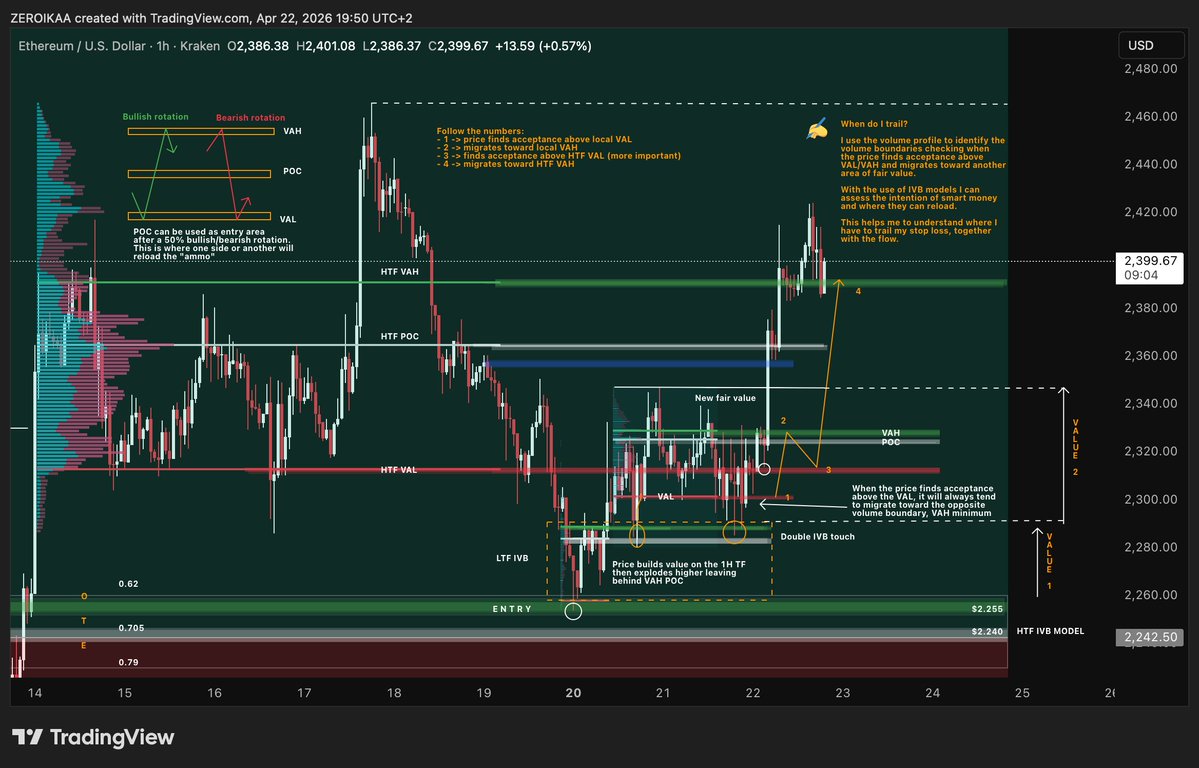
I highly recommend to study this content if you want to understand how to trail your stop loss in an accurate and dynamic manner through the use of FRVP and volume models.
This is how I do it.
What @0xfluid did here, isn't charity.
It is simply meeting the demands of aWETH holders to regain immediate liquidity, reduce exposure to liquidation risk, eliminate the need to wait for resolution on rsETH bad debt, and help Fluid to pay down its own Fluid Lite Vault looping position holding $144M.
On any normal day, Fluid Lite Vault accepts ETH deposits, swaps for wstETH or weETH, and deposits them as collateral on Aave V3 and Fluid, where it then borrows ETH against them, swaps for more collateral, borrows more ETH, etc and generates ETH yield.
Because aWETH holders on Aave cannot withdraw their collateral due to 100% utilization, and in many cases, have borrowed against their aWETH collateral (stables or ETH), Fluid created a tool to meet everyone's needs:
1⃣ Fluid buys your aWETH
2⃣ Then, sells you wstETH or weETH (2% cost)
3⃣ Your newly acquired wstETH or weETH lands in your Aave position, maintaining your current debt position on Aave (not any vampire attack)
Ultimately, you are still in an Aave position but now instead of ETH with say borrowed USDC or USDT, you have wstETH or weETH collateral with borrowed stables.
The result is you gain full control of your position again, the ability to exit if you like by having a different collateral (wstETH or weETH).
Meanwhile, Fluid further unwinds its own looping position, having withdrawn some wstETH or weETH that was sold to you, plus using the newly bought aWETH to pay back its own ETH debt on Aave.
Fluid is basically a mega-looper on Aave V3 and also now a mega ETH buyer of Aave ETH (aWETH), helping you to regain control of your liquidity by switching your collateral to something unaffected by this weekend, wstETH and weETH.
It's a win-win. Plus it does the markets some good to safely unwind more leverage out of ETH loops on Aave.
@smykjain and @0xfluid team play on another level 🐐
Fluid has the largest looped ETH vault in DeFi called Lite ETH
lite vault has wstETH collateral and ETH debt on Aave
This is basically an offer to users with the inverse position i.e ETH *collateral* on Aave to swap for Lite’s LST collateral - which has the benefit of not being at 100% utilization on Aave
These are inverse positions essentially that get cancelled out
Introducing aWETH Redemption Protocol
With ETH utilization at 100% on Aave, many lenders are currently unable to withdraw and face increasing risk if markets move.
aWETH Redemption Protocol allows ETH lenders to:
• Exit into wstETH or weETH
• Regain immediate liquidity
• Reduce exposure to liquidation risk
If you’re just lending ETH �� you can fully exit.
If you have ETH collateral and another debt — your collateral is seamlessly swapped into wstETH or weETH while your debt remains the same.
We’re working alongside @LidoFinance , @ether_fi, @0xProject, @1inch,
@KyberNetwork, and other ecosystem partners to:
• Reduce systemic risk in DeFi
• Ease utilization pressure
• Support a healthier DeFi market
Our goal is simple: protect users while reinforcing the foundations of DeFi.
Capacity is initially limited to $1B in ETH.
https://t.co/VBIAT9FZyg
How to create wealth over decades: (in my opinion)
1. Learn 1+ high-value skills + build something meaningful (business or career)
→ Focus on skills that compound: sales, finance, communication
→ Work for great companies or create value yourself
→ Stay obsessed with continuous improvement (humanly + technically)
2. Save aggressively (build your base to not get rekt)
→ Target 20–50% savings rate early on
→ First goal: 6–12 months of expenses
→ Capital = optionality (at the moment)
3. Invest consistently (to create an habit)
→ Weekly/monthly investing (DCA)
→ Automate the process
4. Build a Core ETF portfolio (60–80%)
→ Global, diversified, low-cost (MSCI World/ACWI for example)
→ This is your long-term compounding "engine"
+ Add Satellites ETF (20–40%) -> Understand seasonality/rotation
→ Tech, crypto, emerging markets, commodities, etc
→ Boost returns (% to be split into core ETF + % in cash)
+ Add individual picking (for extra boost)
5. Build a trading strategy that fits with your life
→ HTF: less screen time, more "life time" (Swing + AMT/Wyckoff/SMC/ORB-IVB)
→ MTF/LTF (Refinement of the ones mentioned above)
→ Be more active (A % to be split into core ETF, a % to be split into satellites + a % to enjoy your life as reward for your hard work)
6. Control costs + taxes
→ Low TER, efficient ETF structure
→ Avoid unnecessary trading (ask yourself: "Do I want to trade or do I want to make money?")
7. Reinvest the majority
→ Dividends + gains → back into the system
→ Compounding only works if you don't quit it
→ Small amounts scale massively over time
8. Stay consistent through cycles
→ Crashes are part of the game
→ Discipline > intelligence
→ Most wealth is built during boring years
9. Avoid common "life traps"
→ Lifestyle (don't waste money to impress other people)
→ Comparing yourself to others (everyone got different paths)
→ Changing strategy every year
→ Forgetting to remain humble (don't follow narcissistic gurus/social media arrogance)
10. Think in decades
→ Wealth = (income → savings → investments) × time × discipline
→ Time is main multiplier, everything else is secondary
→ The longer you stay in the game, the easier it gets
11. Enjoy the journey + share
→ Be happy about the process, both setabacks and wins (50 cent: -> "Sunny days wouldn't be special if it wasn't for rain, joy wouldn't feel so good if it wasn't for pain)
→ Help others doing the same when possible
→ Never forget to enjoy your life as well (take breaks, spend time with family & friends)
Update on the Resolv incident:
The Fluid team has secured short-term loans to cover 100% of the bad debt currently in the protocol. These funds were secured with commitments from @Lomashuk from @cyberfund, @weremeow, and the Fluid core team, ensuring that no user funds are at risk.
@ResolvLabs has confirmed they will cover all USR positions that were originated before the security incident, and will enable redemptions required to close those debt positions.
Additionally, multiple investors have expressed interest in purchasing $FLUID from the treasury should any additional funds be required, further strengthening the protocol’s backstop.
Fluid smart contracts are safe and operating as intended. All other markets continue to function normally, and protocol safeguards remain active. Users may see temporary rate volatility while positions are being unwound.
We will continue to provide updates as the situation progresses.
In a context of persistent war and the risk of a market collapse, the same pattern always emerges: priorities snap back to reality.
It’s no longer about returns, it’s no longer about “opportunities.”
It becomes about economic survival.
And in that moment, people stop chasing narratives and return to what actually matters: primary resources.
Energy ⚡️ + Food 🌾🍞 + Raw materials 🪨 + Water 💧+ Healthcare 💊
Everything else becomes secondary.
Not because it loses value in absolute terms, but because it loses relevance. In a system under stress, what isn’t essential gets repriced quickly.
What is essential becomes strategic.
Markets, which for years rewarded abstraction, start pricing reality again.
This isn’t new, it has happened before many times and every time, it is forgotten, until it isn’t.
So the real question is not “what will go up,” but:
“what does the system actually rely on when it’s under pressure?”
Because that’s where attention inevitably shifts and shortly after, capital follows.
Think big.
Think about all the sectors that can exist, all the subsectors that can be involved within each macro sector listed, and literally a whole world of opportunities will open up in front of you.
I could make a public video where I go into detail about my BTC bear market targets, explaining the related dynamics.
If you’re interested, smash the like button and drop your questions in the comments.