@NBrasing@GlynnErnesto And given:
-No slaves in heaven
-God freed the Hebrew slaves
-Paul said to Philemon to welcome Onesimus “like a brother”
-“Neither bond nor free”
-The protections laid out for slaves which were unprecedented at the time
Emancipation seems to be what God wanted.
@NBrasing@GlynnErnesto Like I told the other guy in subsequent replies: you are both applying a contemporary view on ancient texts whose protections for slaves and servants would have made surrounding nations furious *and* you’re leaving out the context of those protections and the New Testament.
Interesting.
They got obliterated in a theological debate so bad one blocked me, and now they’re circle-jerking each other.
@TAFKAB2 and @GlynnErnesto need some help, guys.
Pray for them.
@GlynnErnesto Where does God explicitly command people to do so?
Also, given that:
-God freed the Hebrew slaves
-Paul asked Philemon to receive Onesimus as a brother rather than a slave
-“Neither bond nor free” because Christ saved all of us
One can infer that emancipation is sought after.
@GlynnErnesto “Condemns slavery but never the practices”
Slavers and maltreatment are the practices of slavery explicitly condemned within the Bible.
Plus, again, this is a contemporary view of slavery being applied to a book which criticized it millennia ago before it was popular to do so.
@GlynnErnesto “Strongly contested by apologists trying to rehabilitate the bibles image.”
Exodus is literally about God freeing slaves.
Also, keep in mind that we are applying contemporary universal condemnation to a practice at a time which criticism was wildly unpopular.
@GlynnErnesto You didn’t ask a question, and your statement of the Bible endorsing chattel slavery (even in the face of a pair of verses you couldn’t even quote) is wildly contested with the strong condemnations of slavers and maltreatment within the Bible.
Study up.
@GlynnErnesto Three problems with your statement:
1. You cut out all of Exodus 21, which holds in it explicit protections and conditions of freedom for servants.
2. You ignored the Exodus itself, which is God emancipating slaves before it was popular.
3. You didn’t quote either verse.
@TAFKAB2
Bro got a clear answer to his question, got mad, and then blocked me so I couldn’t respond to his lies about how the discussion went.
Hateful, unable to comprehend what he reads, and can’t answer a question when pushed to do so.
He needs help.
He needs Christ.
Pray
@TAFKAB2 Quit dodging the question I’m asking when you already got a clear answer to yours several replies ago.
If God doesn’t exist, how do you justify anything being good or evil?
@TAFKAB2 You’re nitpicking wording, now.
If someone wants something to stop and they have the power to stop it, they’re going to stop it.
Quit deflecting and answer the question asked of you;
If God does not exist, how do you justify anything being good or bad?
@TAFKAB2 If you could read, my answer is the entire midsection of my tweet.
No obfuscation, here.
Now, time for you to answer a question:
If there is no God, how do you justify anything being good or evil?
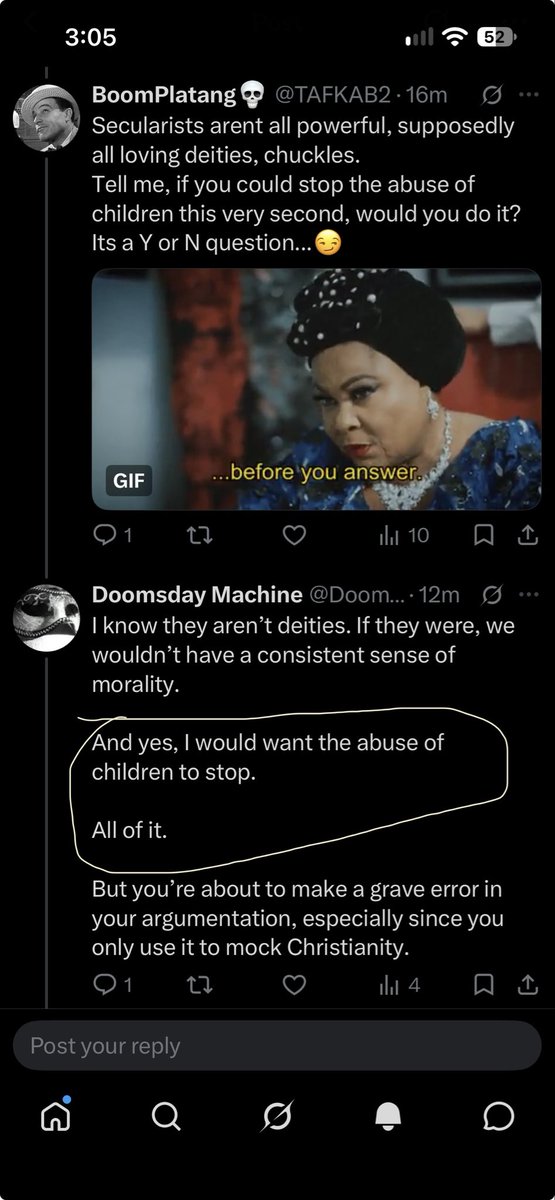
@TAFKAB2 I know they aren’t deities. If they were, we wouldn’t have a consistent sense of morality.
And yes, I would want the abuse of children to stop.
All of it.
But you’re about to make a grave error in your argumentation, especially since you only use it to mock Christianity.