@natalininhas Eu não vejo problema, mas acho que a pessoa menstruada tem que falar antes, não tem muita diferença, só sujar mais e aumenta o risco de IST, mas provável que tinha proteção então só suja mais mesmo
the nurse who learned to code at 35 is way happier than the kid who dreamed of making video games but ended up debugging payment systems for 8 hours a day
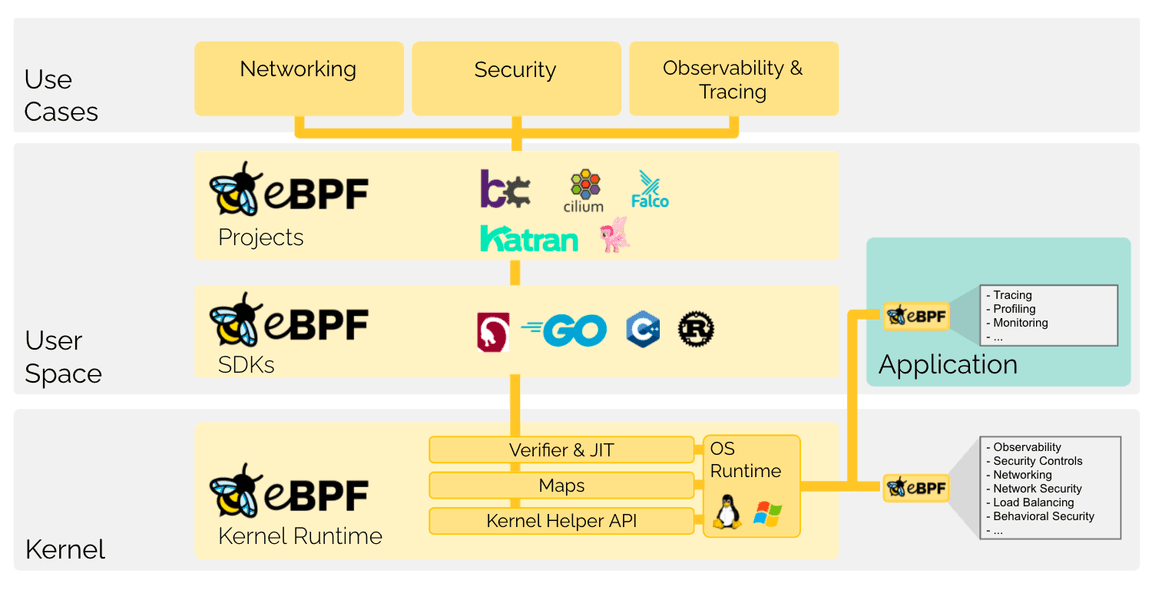
By the way, eBPF can be used in a lot of interesting and unusual ways, including stuff most devs don't even think about
Everyone knows it for networking and observability. But that's like using a supercar just to go to the grocery store
You can hook into any kernel event - syscalls, tracepoints, kprobes - without touching kernel code. Zero recompilation. Just vibe and attach
Security folks use it to build runtime threat detection that catches exploits as they happen. Not after. During
You can rewrite packets mid-flight. Like, actually change the destination IP before the kernel even blinks. That's how Cilium replaces iptables entirely - and it's blazing fast
Profiling CPU flamegraphs in prod with near-zero overhead? Yeah that's eBPF. bpftrace one-liners are genuinely magic for this
There's even people using it for canary deploys - shifting traffic at kernel level, no sidecar proxy needed. Insane
Game companies use it to detect cheat engine hooks. It's basically watching the watchers
By the way, Katran - Meta's L4 load balancer built on eBPF + XDP - is genuinely wild in terms of performance (and XDP does 26M pps per core on commodity hardware, do the math)
So, if you're doing anything serious with Linux and not looking at eBPF, you're leaving massive power on the table, really
#ebpf #networking #cilium #cloud #devops #sre #kubernetes #k8s
If you are a CS student, don’t just build CRUD apps.
Build systems like this instead:
1. Tiny search engine
- Input: a folder of text files or scraped web pages.
- You build a parser + an inverted index (word → list of documents + positions) + simple ranking (TF-IDF or frequency).
- Why it’s powerful: touches parsing, indexing, memory vs disk trade-offs, and query performance
2. Toy scheduler
- Simulate an OS scheduler with processes (arrival time + duration).
- Implement FIFO, round robin, and shortest-job-first.
- Visualize Gantt chart + calculate waiting/turnaround time.
- Why it’s powerful: shows understanding of concurrency, fairness, and performance
3. Key-value store with caching
- Think “mini Redis”: GET/SET over TCP or HTTP.
- Use an in-memory map + optional write-through to disk.
- Add LRU/LFU cache + eviction on memory limit.
- Why it’s powerful: covers serialization, networking, memory constraints, cache design.
4. Rate limiter
- Service that limits requests per user/IP/API key.
- Implement token bucket, leaky bucket, or sliding window.
- Store counters in memory or your own KV store.
- Why it’s powerful: real backend problem time windows, atomic updates, distributed correctness
5. Simple load balancer
- Reverse proxy that forwards requests to multiple servers.
- Use round-robin or least-connections.
- Add health checks + remove failed servers.
- Why it’s powerful: teaches systems thinking, networking, availability, resilience.
Just found this great tutorial on writing your own Linux system call in C.
If you’ve ever wondered how read, write, or fork actually work under the hood this is for you.
If you want to become a world-class software engineer, learn these 19 system design case studies:
1 How Stock Exchange Works:
↳ https://t.co/iFNSX9TM9O
2 How Payment System Works:
↳ https://t.co/ARiLxGR43G
3 How YouTube Works:
↳ https://t.co/kHk3g6jz6t
4 How Google Docs Works:
↳ https://t.co/W57IkAjXpT
5 How Kafka Works:
↳ https://t.co/8rOy9KgCMo
6 How Pastebin Works:
↳ https://t.co/8NSUNlYM7q
7 How WhatsApp Works:
↳ https://t.co/VScq8QwHMr
8 How Airbnb Works:
↳ https://t.co/Bi5SAjfv5S
9 How Spotify Works:
↳ https://t.co/BxrH3oHIFS
10 How Slack Works:
↳ https://t.co/eIo29uOQOJ
11 How Reddit Works:
↳ https://t.co/o6Pw2hhj3T
12 How Google Search Works:
↳ https://t.co/jwOaC4bhnv
13 How Real-Time Leaderboard Works:
↳ https://t.co/HEChNTOHWb
14 How Twitter Works:
↳ https://t.co/pF2RYmPaIG
15 How Uber Computes ETA:
↳ https://t.co/hw1hYJqQmj
16 How Amazon Lambda Works:
↳ https://t.co/lx0BjeSRZt
17 How Amazon S3 Works:
↳ https://t.co/iReWAEHwmj
18 How Do AirTags Work:
↳ https://t.co/upWcgsXwKh
19 How ChatGPT Works:
↳ https://t.co/5lCKxq2g4N
What else should make this list?
——
👋 PS - Want my System Design Playbook (for FREE)?
Join my newsletter with 200K+ software engineers right now:
→ https://t.co/ByOFTtOihX
———
💾 Save this for later & RT to help others become good at system design.
👤 Follow @systemdesignone + turn on notifications.