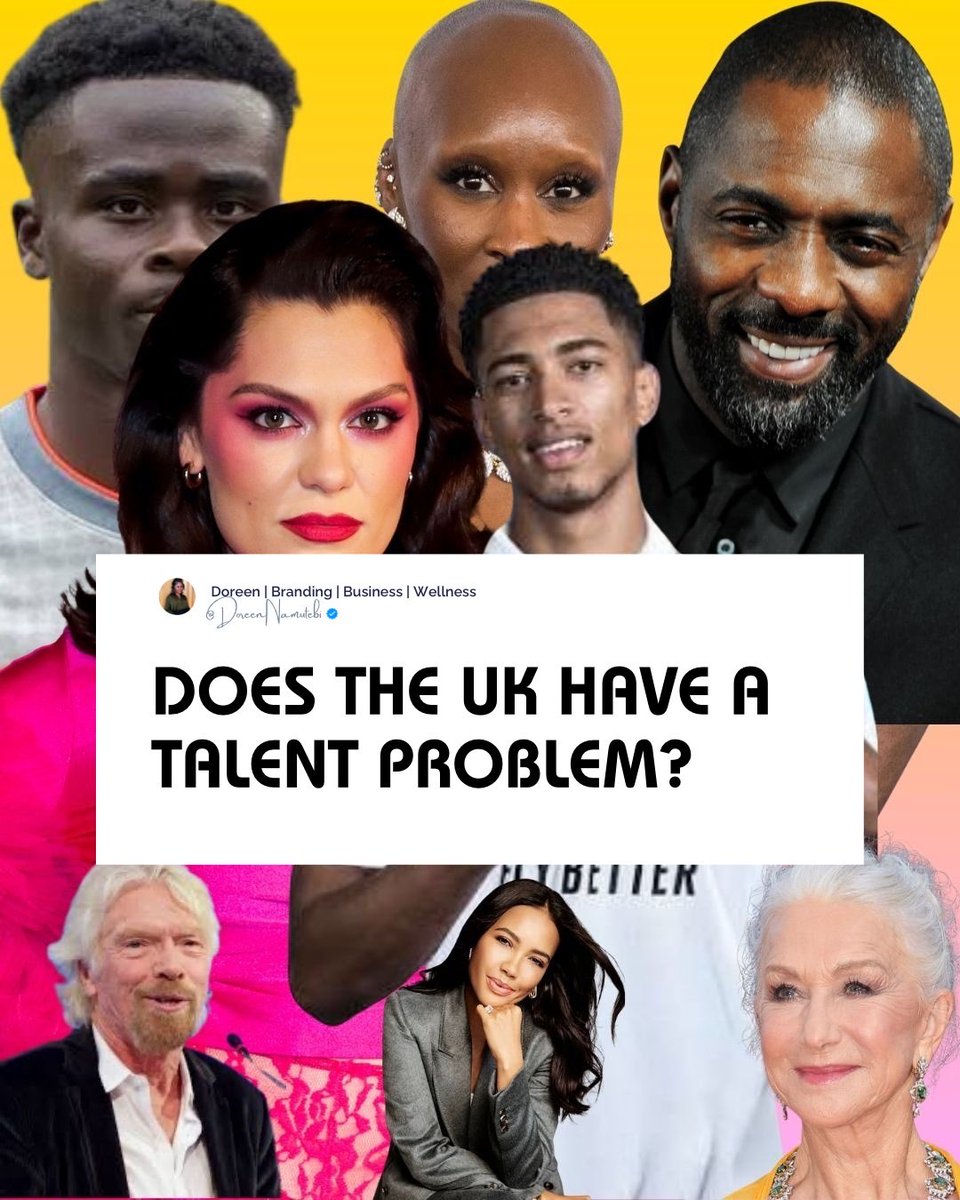
📌 DOES THE UK HAVE A TALENT PROBLEM? 🤔
Britain is brilliant at producing talent. But are we equally good at maximising it?
I’ve been thinking about this across football, entertainment and business.
Take Bukayo Saka. One of England’s outstanding footballers. But I often wonder: would he be perceived differently globally if he played for Real Madrid or Barcelona?
Then look at Jude Bellingham at Real Madrid, or Harry Kane at Bayern Munich.
Their talent didn’t suddenly appear when they left England. The talent was already there.
What changed was the ecosystem around it: coaching, systems, teammates, expectations, freedom, visibility and narrative.
And this goes beyond football.
Britain has produced extraordinary actors including Idris Elba, Cynthia Erivo, Daniel Kaluuya, Damson Idris, Helen Mirren and Emily Blunt.
Hollywood didn’t give them talent. It gave their talent a bigger stage.
The same question applies to music. Why do some incredibly talented British artists achieve enormous global success while others with comparable ability don’t?
Because talent alone isn’t enough.
Management matters, marketing matters, investment matters, position matters, networks matter, and environments matters.
And then there’s our relationship with ambition.
Tell someone you know that want to build a billion-pound company and, culturally, Britain can sometimes respond with: ‘Be realistic’.
Elsewhere in USA the response may be: ‘Okay. What’s the plan’?
Of course, that’s a generalisation. But Britain’s “don’t get too big for your boots” mentality raises an interesting question:
What happens when talented people spend too long in environments that teach them to moderate their ambition?
We see a related conversation in entrepreneurship and wealth, capital moves, founders relocate, football transfer, actors go to Hollywood. Talented people increasingly have choices about where they build.
So perhaps Britain doesn’t have a talent problem. Perhaps we have a talent-maximisation problem.
Producing talent and creating the conditions for that talent to become globally exceptional are two different things.
And there’s a lesson here for founders, leaders and professionals too:
Sometimes you don’t need more talent. You need an environment big enough for your talent.
So the question isn’t: Where is the talent?
It’s: What are we doing with the talent we already have?
That, to me, is the real conversation.
What do you think: does the UK have a talent problem or a talent-maximisation problem?
If conversations about confidence, leadership, visibility, business and sustainable growth interest you, subscribe to The EPIC Standard, our weekly newsletter from EPIC Network 👇
https://t.co/iRVJ77qdNe
📍Professor Jason Arday’s death has made me think deeply about what we mean when we talk about Black progress.
White lecturers and journalists can be accused of plagiarism and, in some cases, receive grace, institutional support or opportunities to continue their careers. Yet when a Black or ethnic minority person is accused of wrongdoing, the public scrutiny can become relentless, with their character, career and entire credibility placed under a microscope.
And this raises a broader question about whose work gets recognised, credited and valued.
British institutions have a long history of using knowledge and research from sources that don’t always receive the recognition or credit they deserve, particularly when that knowledge comes from the developing world, Africa and Asia.
In Professor Arday’s case, allegations surrounding his academic work eventually became a major public controversy. He denied plagiarism while acknowledging mistakes in his doctoral work. He resigned from Cambridge as the scrutiny intensified, and his family has since spoken about the misinformation and harassment they believe he endured.
Whatever your position on the allegations themselves, the scale and intensity of the public scrutiny surrounding a Black academic should make us stop and ask some uncomfortable questions.
Why does the standard of scrutiny sometimes feel different depending on who is being scrutinised?
Why are some people afforded room to make mistakes, learn, correct them and continue, while others can be publicly disgraced and reduced to their mistakes?
And why does the success of a Black person within a prestigious institution so often become a debate about whether they deserved to be there in the first place?
For decades, we’ve been encouraged to celebrate our ability to enter prestigious institutions such as Cambridge, Oxford, corporations, governments and other systems that historically excluded us.
And yes, representation matters, but perhaps we also need to ask a bigger question:
When are we going to build more of our own institutions?
Imagine if Professor Arday’s knowledge, research and experience had been part of a well-funded Black educational institution, one created to develop Black intellectuals, researchers, entrepreneurs and future leaders.
Imagine the universities, research centres, media organisations, investment funds, businesses and cultural institutions we could build if we stopped seeing access to existing institutions as the ultimate definition of success.
This isn’t about rejecting Oxford or Cambridge, It’s about recognising that representation inside someone else’s institution and ownership of our own institutions are two different things.
We need both, because navigating systems that weren’t historically designed with us in mind can be exhausting. And while we should absolutely continue fighting for inclusion within those systems, we should also be asking:
What are we building for ourselves?
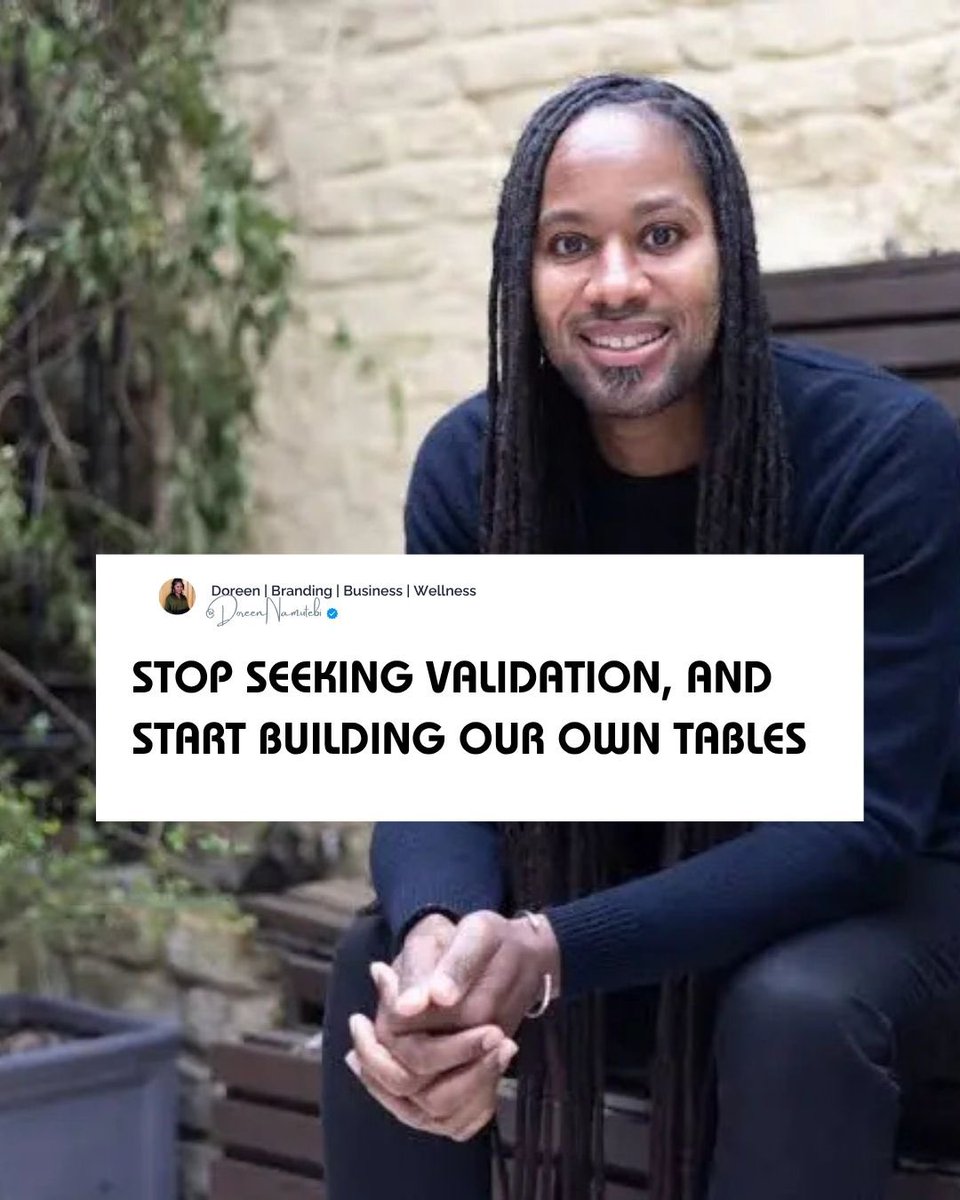
Not just getting a seat at the table, but building our own tables, such as; creating institutions, funding ideas, educating our communities, and developing our own intellectual and economic ecosystems.
Creating spaces where Black excellence doesn’t need to constantly prove that it deserves to exist.
Perhaps the lesson isn’t simply that we need more Black people inside established institutions.
Perhaps we also need more Black people building institutions.
And perhaps we need to stop viewing ownership as a consolation prize for failing to gain acceptance elsewhere.
We should want both representation and ownership.
We should be able to walk through the doors of Oxford, Cambridge and other established institutions, and also build institutions of our own that are just as respected, well-funded and influential.
That, to me, is the next conversation.
Peace and love ✌🏾
#JasonArdy, #ProfessorArdy, #CambridgeUniversity, #Racism
Rest is productivity, not the opposite of it.
Here's what 13 years of building taught me about burnout , and what actually changed 👇🏾
For years I measured my commitment by how exhausted I looked.
Early mornings, endless yeses. Pushing through because stopping felt like losing.
It cost me more than it ever built. The myth I believed: rest is something you earn after success.
The truth: rest is what creates it. I started building in seasons, not sprints. Protecting my energy like any other business asset.
The work didn't slow down, It got clearer.
If you're an ambitious founder confusing exhaustion with progress, I built EPIC Academy to teach exactly this.
Link is below 👇🏾
Ghetto Kids 🇺🇬 Uganda
Shakira 🇨🇴 Colombia
Burna Boy 🇳🇬 Nigeria
IShowSpeed 🇺🇸 United States
Madonna 🇺🇸 United States
Nicole Scherzinger 🇺🇸 United States
Robbie Williams 🇬🇧 United Kingdom
Football has once again proven to be the world’s greatest unifier.
It brings together people of every race, nationality, culture, religion, age and background in a way few other events can.
From musicians and entertainers to creators, dancers and football fans, the FIFA World Cup creates moments that transcend borders and remind us that, for 90 minutes, the world speaks one language.
That’s the true power of football. ⚽🌍❤️
#FIFA #WorldCupFinal #Football #OneGameOneWorld #WorldCup2026
2022: greatest World Cup final ever. This final was a thriller to watch and the day football became entertaining. Nothing will ever top it!
#Messi, #Mbappe, #WorldCupFinal
@Rainmaker1973 All that much money to lie to the world that cleopatra is a Caucasian woman when even modern European historians have acknowledged that cleopatra was a black woman.
He did very well given that it’s his first cup appearance / participation. Breaking a World Cup record for someone like Pele is not easy. In fact, he did a lot better than most players who have been in the World Cup longer or before. He could be the next GOAT in football if he keeps working hard and practising 🙌🏾🙌🏾🙌🏾