How does on-chain revenue work technically, and what influences the frequency of top-ups in the case of the active SAFc Registry? Can we expect it to become more regular in the near future?
Can we expect more active, publicly accessible solutions similar to SAFc to emerge this year?
@GldnCalf Oh, so you'd rather all DVs just vote exactly how you want, huh? You're attacking yet another one DV just because they don't align with your expectations. Poor Jay...
Which blockchain network will win in the long run?
The one, that provides the world's decentralized supercomputer.
Some are now more popular than others, thanks to first-mover advantage, bigger liquidity, NFT + meme culture.
But for Web3 to truly replace Web2, the network needs to scale.
And this is why I'm all in on Polkadot.
How Elastic Scaling, a Polkadot 2.0 feature, will allow to outperform the competition. 🧵(7min)
The scalability problem.
Networks need to handle a growing number of transactions. Without proper solutions, this leads to clogged systems, delayed verifications and higher costs for users (fees).
The biggest bottlenecks are:
🔹Constraints on block capacity
🔹Available bandwidth
🔹Data storage demands
🔹Underlying agreement protocols.
Polkadot 1.0
Everybody knows this story. Projects fighting for a 2 year slot on a Parachain auction. This was a high entry for small & medium projects.
Polkadot could handle up 50 Parachains (rollups) on 50 Polkadot Cores.
The block time on the Relay Chain was 12 seconds. But a Parachain could only enjoy 500ms of execution & 5MB of bandwidth during that time.
Polkadot 2.0
The three main features are:
- Asynchronous Backing
- Agile Coretime
- Elastic Scaling
Asynchronous Backing
This feature increased the throughput of Polkadot rollups by 8-12x.
- The Relay Chain block time went from 12 to 6sec, doubling the rollup throughput.
- 500ms of execution per block increased to 2sec.
- 3-5x more extrinsic per block.
Agile Coretime
This ended 2 year Parachain auctions and enabled selling Polkadot Cores in: Bulk & On-Demand.
🔹Bulk: 28 days with a possible renewal.
🔹OnDemand: Tailored & flexible - even 1block (small & medium projects, testing).
The revenue in DOT from selling Coretime is now being burned (9k DOT burned so far).
Elastic Scaling
Rollups now will be able to use multiple Polkadot Cores for one/more tasks, shorten block production time or add on-demand Cores if they have throughput problems.
🔹What's the current status on Polkadot?
Currently the Relay Chain can handle 120 Polkadot Cores.
There are 600 validators in an active set.
5 validators = 1 Polkadot Core.
What are the examples of a Polkadot rollup using currently 1 Polkadot Core?
🟥Mythos Chain (@mythicalgames ) - powering Pudgy Party, FIFA Rivals and NFL Rivals. Always top 1-4 in global NFT asset sales.
🟪Peaq (@peaq) - powering 50+ DePin projects.
If rollups will be able to use multiple Cores, this allows for building even more powerful, unstoppable Web3 apps.
Last year while testing Elastic Scaling, there was a Spammening event happening on Kusama (it mirrors Polkadot's codebase & architecture).
143k TPS was achieved using 23/100 Cores.
So already a year ago that gave a theoretical 623k TPS using full 100 Cores.
@paritytech just provided documentation for devs & founders, how to best achieve their goal with Elastic Scaling.
Projects have the need for:
🔹Compute (CPU weight).
🔹Bandwidth (Proof size).
🔹Lower latency (Block time).
They detailed 3 propositions for rollups:
🔹High throughput (TPS) & lower latency.
🔹High bandwidth.
🔹Ultra low latency.
🔸High throughput (TPS) & lower latency.
Using 3 Polkadot Cores to balance CPU, bandwidth & latency.
Gives up to 6sec of execution, 5MB/s of DA bandwidth & a 2sec block time.
This will be the most universal setup for Web3 rollups (e.g., Defi & gaming), also for CPU-intensive Web2 apps.
Mythical games is testing 3 Cores to handle massive NFT trades & in-game actions. They heavily consider going 1 big game = 1 Core (Pudgy Party, FIFA Rivals etc).
🔸High bandwidth.
Using 6 Polkadot Cores to achieve high bandwidth.
Gives up to 6sec of execution, 10MB/s of DA bandwidth & a 1sec block time.
First, what comes in my mind is the @hyperbridge. This will help optimize its bandwidth-intensive cross-chain interoperability protocol, allowing for efficient verification of Zk-proofs & seamless asset transfers across different networks.
This will also be awesome for @origin_trail, which needs bandwidth for their massive knowledge graphs for AI & enterprise solutions.
Remember, this can be also used on On-demand Cores (any time period, not fixed 28 days).
Think quick & intensive stuff: massive airdrops, NFT mints or account migrations.
🔸Ultra low latency.
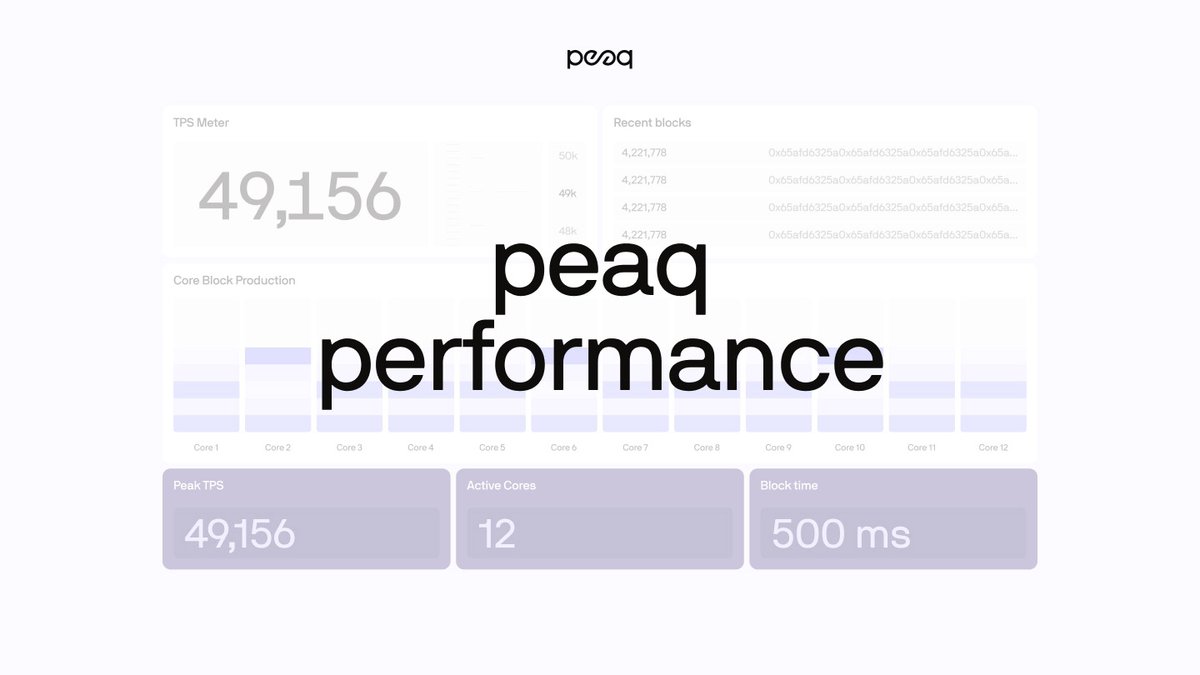
Use 12 Polkadot Cores for ultra low latency & charge the most powerful apps.
Gives ultra fast transaction confirmations with 500ms block times & up to 20MB/s of DA bandwidth.
Here is the cool part, Peaq already successfully tried it on their testnet.
They achieved 49k TPS with a 500ms block time.
This is the power of just 12 Polkadot Cores.
Only Polkadot has the tech that Peaq needs.
Handling milions of humans & robots for the future Machine Economy is not possible on other chains.
It's almost the capacity of the whole Solana, but that's a monolithic chain. If it crashes or has 60% failed txn's, that affects every project on it.
Peaq using Elastic Scaling is indepentent & secured, enjoying shared security from the Relay Chain.
Remember, Polkadot is built to scale. If 100-120 Cores get utilized, more validators are added to an active set, allowing for even more Cores.
Now show me an ecosystem, that gives 500ms block times, 49k TPS & up to 20MB/s of DA bandwidth using 12% of the network capacity.
I'm waiting.
Sticking as always with Polkadot, the tech is remarkable & now the full focus in on new apps.🙃
"We plan to be extremely conservative on using DOT from the Treasury for projects with minimal direct impact on usage of Polkadot."
Finally.✌️
https://t.co/J9YClfqKG0
@thecryptorius I disagree. We should spend on staking rewards and treasury expenses from what the protocol earns. This is the only model that will consistently drive adoption without completely devaluing the token in the meantime.
Hard cap is just the first step. Fewer $DOT printed out of thin air is a way to ease selling pressure.
For me, it's an obvious choice. This way, we have a chance to make revenue distribution more realistic and curb the still often unjustified treasury spending.
Less fairy-tale dreams, more truth.
1 million web3 users, most of whom don’t even know they’re using Polkadot’s infrastructure.
This is what true mass adoption will look like across the various industries we know from everyday life.
1 Million downloads on @FIFARivals!
We're excited to be bringing a new mobile gaming experience for the billions of football fans worldwide, with ownership at the core.
Next stop? 2 Million 💥
Read in @pgbiz 👇
https://t.co/z291OtBBtU