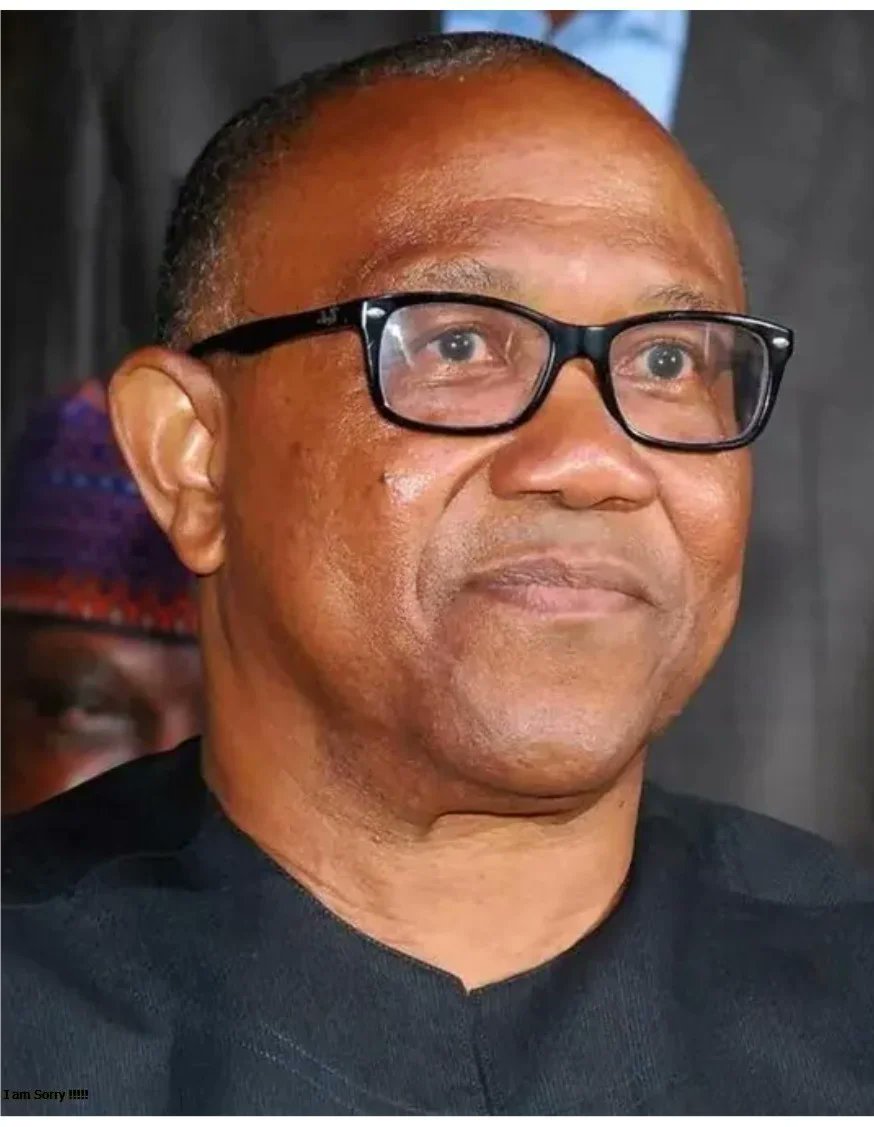
The crux of the matter is not whether Mr. Peter Obi was denied access to the players for the reasons you have advanced. The real issue is the chilling implication of the alleged statement that allowing him access could cost officials their jobs.
In a democracy, such a statement, if true, raises far more serious concerns than a mere breach of protocol. It suggests a climate of political intimidation, where public officials may feel compelled to act out of fear rather than professional judgment, and where perceived political loyalty could take precedence over fairness, institutional independence and the rule of law.
When public servants fear losing their livelihoods simply for extending ordinary courtesies to an opposition figure, the question is no longer about access to footballers. It is about the health of our democratic institutions.
That is the fundamental issue you appear to be overlooking. Democracy cannot function as it should when fear of political consequences becomes a substitute for lawful, impartial decision-making.
The real question shouldn’t be about whether Peter Obi wanted photographs with the players. Every person meeting them in this age and time would most definitely take pictures and videos, and possibly post them on their social media accounts (including me, including you). The real question is why officials would allegedly fear losing their livelihoods simply for allowing Peter Obi to congratulate fellow Nigerians. That is the core of his message and concerns. It should be everyone concerns too.
This is a complete misrepresentation of an age-old cultural practice. This is traditional communal lake fishing, where fishing is prohibited for a period and the lake is ceremonially opened for communal harvesting. It is a cultural event, not evidence of women suffering to feed lazy husbands.
This is a complete misrepresentation of an age-old cultural practice. This is traditional communal lake fishing, where fishing is prohibited for a period and the lake is ceremonially opened for communal harvesting. It is a cultural ceremonial event, not evidence of women suffering to feed lazy husbands.
I had hoped this 10 million times and strongly support this.
What worked organically in 2023 cannot simply be assumed to work again. Nigeria’s political communication environment is fragmented across geography, language, culture, demographics and media platforms. Add the speed of misinformation and coordinated narratives, and leaving communication largely to individual supporters creates gaps, contradictions and slow responses. The 2023 election already demonstrated how rapidly political misinformation could move across WhatsApp, X, Facebook and mainstream media.
Passion can create momentum. Structure sustains it.
A serious national campaign needs one strategic communications architecture: research, rapid response, fact-checking, traditional media, digital media, regional messaging, speechwriting, content production and performance analytics, all coordinated around the same facts and objectives.
2023 may have proved the power of a movement. 2027 will test whether that movement has learned how to build an institution.
We cannot keep depending on thousands of well-meaning people to independently decide what to say, when to say it and how to defend it. Coordination does not kill organic support; it gives organic support direction.
@BusuyiOrisWorks Calling a diagnosis pessimism does not cure the patient. When poverty is around 63%, acknowledging distress isn’t hatred for Nigeria; it is economic literacy. Perhaps the new development model is: if we stop discussing the fever, the thermometer will become unpatriotic.”
Fiscal prudence in government ≠ compulsory poverty in a politician’s household.
If Peter Obi says public officials should stop wasting taxpayers’ money, prove that he wastes taxpayers’ money. That would expose hypocrisy.
His wife owning an expensive item, assuming the ₦250m claim is even accurate, raises a legitimate question about optics, but it does not by itself establish corruption, hypocrisy or fiscal indiscipline.
Ask the intellectually relevant questions: Who bought it? What did it actually cost? What was the source of the money? Was public money involved?
Until then, we are not investigating governance. We are conducting opposition research inside somebody’s handbag. 😂
If a pastor preaches, “Do not steal church money,” and his wife buys an expensive handbag with her legitimate earnings, has she violated his sermon?
Of course not.
But if the handbag was bought with money stolen from the church treasury or from any other source for that matter, now you have hypocrisy and a serious moral problem.
The same distinction applies here.
Peter Obi’s political proposition has largely been about reducing government waste and the cost of governance. Therefore, demonstrate waste of public resources attributable to him and you have a powerful criticism.
But “your wife owns an expensive bag” is not yet that argument.
Unless, of course, Nigeria has quietly appointed the Handbag Price Verification Commission. 😂
@mundus01@channelstv Well done @mundus01 on your live analysis on Channels TV. Very insightful.
Could you do a similar analysis for Lagos State—examining the 2023 presidential election results in the same way you analysed the Rivers State presidential election?
The Quiet Man in a Noisy Political Arena
Now that the political momentum towards Nigeria’s 2027 general elections is beginning to build, I thought I would share some thoughts on one political figure I have watched closely since the last elections.
Something interesting is happening in Nigerian politics.
Politics here is often loud. Everyone wants the microphone. Politicians trade accusations. Spokespersons fight on television. Supporters battle on social media.
Yet in the middle of all that noise, Peter Obi seems to be doing something different.
He keeps showing up.
He is criticised almost every day. Politicians attack his record. Commentators question his statements. Spokespersons challenge his figures. Social media examines almost everything he says or does.
But Obi rarely seems interested in answering every attack.
He responds when he thinks he needs to. Then he moves on.
And perhaps that tells us something important about his political personality.
Peter Obi is not your typical Nigerian political showman.
He does not have the booming voice of the traditional rally politician. He is not the most polished speaker. Sometimes he repeats himself. Sometimes his delivery is awkward. Sometimes his statistics raise questions and need to be checked.
But strangely, these imperfections may be part of why people connect with him.
He doesn't always sound like a politician giving a speech. Sometimes he sounds like a man sitting across the table trying to make his point.
And the point hardly changes.
Education.
Healthcare.
Jobs.
Poverty.
Production.
Young people.
Government waste.
The cost of running Nigeria.
His opponents may want the conversation to move somewhere else.
Obi keeps bringing it back.
That consistency has become one of his strongest political qualities.
But there is another part of the story that deserves attention.
Hope.
For many Nigerians, especially younger people, the Obi phenomenon is not simply about Peter Obi.
It is about the possibility that Nigeria can still be different.
That government can work better.
That public money can be treated as public money.
That a young Nigerian should not have to leave the country before believing in a better future.
That competence can matter.
That character can matter.
That ordinary citizens can matter.
Whether Obi can actually deliver all of this is a different question. Nigerians have every right to demand evidence, detailed policies and realistic plans from him.
But before people can work towards change, they first have to believe that change is possible.
Obi seems to understand the political power of keeping that belief alive.
Look at how he moves around the country.
A school needs support. He visits.
A hospital needs attention. He appears.
A community suffers a tragedy. He goes there.
Students are gathered somewhere. He speaks with them.
There is a nursing school, university, market, displaced community, religious institution or small group doing something useful.
He turns up.
Of course, he is a politician. Cameras will sometimes follow him. Political calculation will naturally be part of some of these engagements.
That should not surprise anyone.
The more interesting question is what happens after the cameras leave.
Someone remembers.
A student remembers that he came.
A nurse remembers.
A teacher remembers.
A trader remembers.
A community remembers.
A family he sat with remembers.
And millions of Nigerians who watched from somewhere else may remember too.
One visit means little.
Hundreds of such encounters begin to mean something.
He is slowly building political memory.
Not only through billboards.
Not only through rallies.
Not only through television interviews.
But through human contact.
One handshake.
One conversation.
One community at a time.
There is also something hopeful about the kind of political competition this can create.
Imagine if Nigerian politicians began competing over who visited more schools.
Who supported more hospitals.
Who listened to more struggling communities.
Who presented the better education plan.
Who had the stronger ideas for jobs and production.
Who could show Nigerians exactly how public money would be spent.
Even if some of it were motivated by elections, Nigeria would still benefit from politicians competing over useful things.
That is the kind of political culture Nigerians should encourage.
And perhaps this is why the constant attacks on Obi sometimes create a problem for his opponents.
Every attack keeps the person they want to reduce at the centre of the conversation.
The pattern can become almost predictable.
Someone attacks Obi on Monday.
His supporters respond on Tuesday.
Television programmes debate it on Wednesday.
Fact-checkers examine the claims on Thursday.
By Friday, everyone is talking about Peter Obi again.
Meanwhile, Obi may already be somewhere else talking to students, visiting a community or discussing the economy.
There is a strange political irony in that.
His critics sometimes help keep him relevant.
But this does not mean criticism of Peter Obi is wrong.
Far from it.
He wants to be President of Nigeria.
His record must be examined.
His statistics must be checked.
His time as governor of Anambra State should be scrutinised.
His policies should be challenged.
His political alliances should be questioned.
His mistakes should be discussed.
His supporters should never treat criticism as an attack on their movement.
Hope must never become blind loyalty.
Nigeria has already suffered enough from politics built around personalities.
If Obi represents something different, then he should be held to an even higher standard.
But there is a difference between examining a politician and becoming obsessed with him.
Some of his opponents risk crossing that line.
The more aggressively they attack him, the easier it becomes for supporters to see a simple picture:
One relatively quiet man against a large and powerful political establishment.
That image is politically powerful.
And perhaps it connects because many ordinary Nigerians know what it feels like to stand against something much bigger than themselves.
The unemployed graduate knows.
The struggling businessman knows.
The teacher waiting for better working conditions knows.
The pensioner knows.
The young Nigerian wondering whether to leave the country knows.
The family struggling with food prices knows.
So when people see Obi absorbing political attacks and continuing his journey, some may see more than a politician.
They may see persistence.
They may see possibility.
They may even see a little of themselves.
And that is where hope becomes bigger than Peter Obi.
Perhaps Obi's greatest political advantage is not his wealth, eloquence or statistics.
It is contrast.
When politics becomes loud, he appears restrained.
When politicians display wealth, he talks about cutting waste.
When politics becomes about privilege, he talks about service.
When Nigerians are told to accept things as they are, he keeps arguing that things can be better.
And when despair becomes normal, he talks about possibility.
Whether the image always matches reality is a fair question.
It should be examined.
But politically, the image is remarkably consistent.
His simple clothing reinforces it.
His manner reinforces it.
His language reinforces it.
His constant travelling reinforces it.
His interactions with ordinary Nigerians reinforce it.
And, ironically, some attacks against him reinforce it too.
That leaves his opponents with an uncomfortable question:
How do you attack a man when too much attacking can strengthen the very image you are trying to destroy?
Mock the way he speaks and some people hear simplicity.
Mock his lifestyle and they see modesty.
Criticise his visits and people may ask why other politicians are not making similar visits.
Attack his supporters too aggressively and you may strengthen their determination.
It is a difficult political problem.
But Peter Obi has an even bigger problem of his own.
Hope is not enough.
Crowds are not votes.
Social-media followers are not polling agents.
Popularity is not political structure.
Good intentions are not government policy.
Being different does not automatically mean being capable of governing a country as difficult and diverse as Nigeria.
If Obi truly wants to become President, his greatest work may still be ahead of him.
He has to turn goodwill into organisation.
Hope into participation.
Ideas into detailed policy.
Popularity into a national coalition.
Supporters into disciplined political structures.
And enthusiasm into actual votes.
He must reach beyond X, Facebook, Instagram and TikTok.
He must reach the farmer who does not own a smartphone.
The market woman who does not follow political debates online.
The elderly voter in a remote community.
The young person who has completely lost faith in politics.
The Nigerian who does not support him today.
Because democracy ultimately comes down to individual citizens making individual choices.
One person. One vote. One community at a time.
That will be the real test.
And perhaps the bigger opportunity is not simply for Peter Obi to win an election.
It is for Nigerians to recover something many have slowly lost:
the belief that their participation matters.
That is where the hope surrounding his politics could become more important than the man himself.
A political movement should not depend entirely on one person.
People come and go.
Ideas can remain.
If the message is truly about accountability, education, production, responsible spending, healthcare, competence and better government, then those expectations should remain regardless of who eventually occupies Aso Rock.
That would be a much deeper change.
Because one of Nigeria's biggest problems is not only that government sometimes fails.
It is that Nigerians have lived with failure for so long that some failures have started to feel normal.
People provide their own electricity.
Their own water.
Their own security.
Sometimes their own roads.
Families struggle to pay for private schools because public education has failed them.
Those who can afford it travel abroad for medical treatment.
Many young Nigerians increasingly build their future around leaving Nigeria rather than building one here.
Eventually, people stop asking why things cannot work.
That is dangerous.
Because when citizens stop expecting better, poor governance becomes easier to tolerate.
Hope reverses that process.
Hope makes people ask questions again.
Why can't our schools work?
Why can't our hospitals work?
Why should government cost so much?
Why are productive young Nigerians leaving?
Why can't public officials account properly for public money?
Why can't Nigeria produce more of what it consumes?
Why should basic infrastructure remain extraordinary?
Why can't leadership look different?
And perhaps the most important question of all:
Why must Nigeria remain this way?
Once enough people start asking that question seriously, something has already changed.
That may be the deeper significance of Peter Obi's political journey.
He may win the next presidential election.
He may not.
That decision belongs to Nigerians.
But political influence is not measured only by who eventually wins an election.
Sometimes it is measured by the questions a politician forces a country to ask.
Peter Obi does not need to be a messiah.
Nigeria does not need another messiah.
No single person can rescue a country of hundreds of millions of people.
What Nigeria needs is something stronger:
millions of citizens who believe they have the right to demand better.
Better leadership.
Better schools.
Better hospitals.
Better use of public money.
Better opportunities for young people.
Better accountability.
Better politics.
And a better reason to believe in the country.
So while many political voices continue fighting over Peter Obi, he appears determined to continue moving.
Another school.
Another hospital.
Another market.
Another community.
Another conversation.
Another handshake.
Another Nigerian reminded that somebody seeking national leadership considers their story worth hearing.
His opponents will continue talking.
His supporters will continue defending him.
His record will continue being examined.
His claims will continue being fact-checked.
That is democracy.
But underneath all that noise, something quieter may be happening.
A struggle between cynicism and possibility.
Between resignation and participation.
Between those who have accepted that Nigeria cannot change and those who still believe it can.
That may be the most powerful thing Peter Obi has managed to instigate: hope.
Not hope that one man will magically fix Nigeria.
But hope that Nigeria is still fixable.
Hope that leadership can be better.
Hope that competence can matter.
Hope that ordinary Nigerians can matter.
Hope that young people can build their futures here.
Hope that elections can still mean something.
Hope that public service can actually be about service.
And hope that today's Nigeria does not have to be tomorrow's Nigeria.
While almost everyone else seems determined to tell Nigerians what they should think about Peter Obi, Peter Obi appears determined to keep meeting Nigerians and allow them to decide for themselves.
Perhaps that is the real political contest.
Not noise against noise.
Not propaganda against propaganda.
Not one politician against another.
But despair against hope.
And if that hope can grow beyond Peter Obi, survive criticism, become organised and convince ordinary Nigerians that they have the power to demand better leadership, then something important will already have happened — regardless of the final electoral outcome.
Because a country changes long before the numbers on an election scoreboard change.
It begins when its people stop accepting that failure is inevitable.
And a people who begin to believe that better is possible become much harder to convince that they deserve less.
@PeterObi@YunusaTanko@UtomiPat@AishaYesufu@IdrisZekeriJnr@Drmopaul@firstladyship
Interviewer: How did the exit of Peter Obi and Mr Kwankwaso come to you?
Dele Momodu: I told Peter Obi to work with Atiku as VP, but he told me to my face that he was more popular than Atiku. He and his supporters still claim he won the last election, that is delusional. I also told him to direct his supporters, but it seems to me that it’s his supporters that are directing him… 😂