AP C investigates the magnetic field of a 200 turn coil in the center using compass deflections. In addition a magnetic field sensor will be used to investigate the field along the x-axis #iteachphysics
Honors uses a cart launched fr a compressed spring to travel same dist before elastic & nylon cords provide an impulse. Ss analyze the Ft graphs to see if the impulses are the same. A pendulum clamp is used to ensure cord and string are same length before stretch. #iteachphysics
Honors NRG challenge lab. Ss use spring hoop @VernierST & force sensor to det k value of hoop. Each group then given diff incline angle, hoop compression & mass in cart. Ss predict max position cart reaches after launch. Ss have no access to cart until test <10% err#iteachphysics
AP investigates series, parallel, compound, and Kirchhoff using @pascoscientific circuit kit. Way better than using a circuit board with all of those wires to get in the way! Students thoroughly enjoyed themselves. #iteachPhysics.
Honors students find k value of 2 different springs. Springs are impounded. Ss are then given series spring formula and asked to predict stretch for a known mass. #iteachphysics
Honors incline challenge. Ss drag box across level track at const v w/ force sensor to get kinetic friction to det u. Track now set at unique angle w diff wt in box. Each group gets mystery mass to hang over pulley. Ss get acc of box. must determine mystery mass #iteachphysics
@RobSpencer1 No problems whatsoever. I test their predictions in front of them on a 2 m track at the front of the class. A graph of velocity versus position works like a charm. I also put spacers in the battery compartments to give more varied fan settings.
Honors records acc data w fan carts using various added masses. Challenge is each group has fan cart impounded and must predict final speed w fan at a unique angle with an added mass they didn’t use after moving a certain distance. #iteachphysics
@curtisgeldert @VernierST I tried this using force sensor instead of a smart cart. Didn’t get great results. I guess all mouse pads aren’t made equal or the smart cart is better than the force probe?
@RobSpencer1@VernierST@udefoundation All of my meter sticks are different masses whether they have holes or not. I’ve had them for a very long time. They range from 60 g to 150 g.
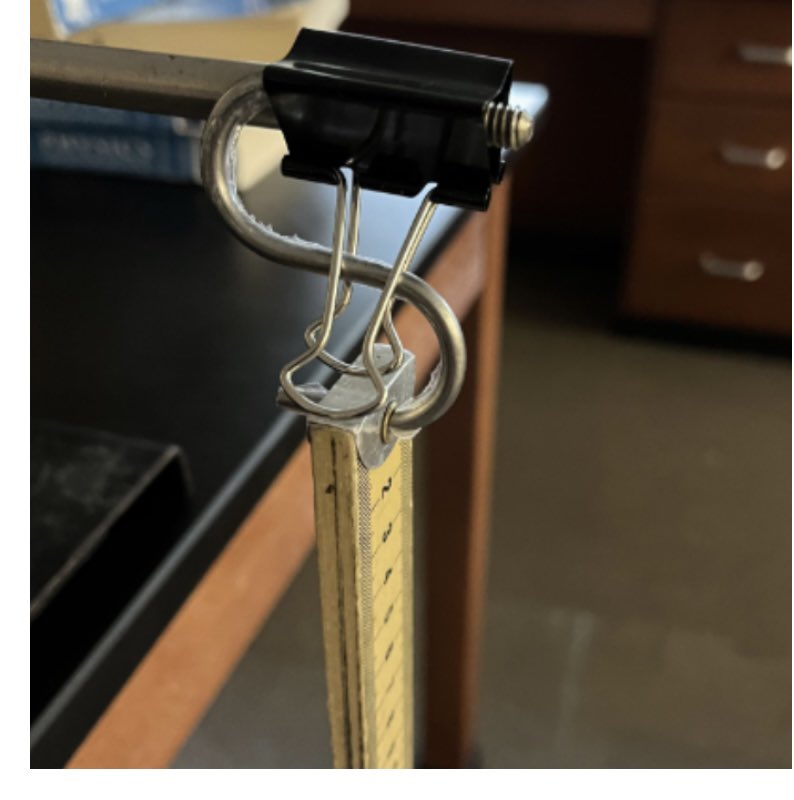
AP C uses new go direct photogate @VernierST thanks to @udefoundation to obtain T data for a phys pendulum w an attached mass that is placed at various positions. Ss are then asked to calc mass of meter stick using the best fit curve of T vs x of attached mass #iteachphysics
@BarnettDreyfuss@VernierST@udefoundation Yes. I instruct them to avoid the CM of the stick. Then impound the sticks. Ask them to get period if pt mass was at CM of stick using best fit curve. Find mass using that period.
Honors Ss get one shot to predict where to place the can for a bullseye after determining the launch speed. Tension is high and the payoff is exhilarating. The reaction of both students is priceless😁#iteachphysics
AP C uses angular momentum to predict speed of smart cart after a rod collides with it. Ss det the rot inertia of the rod and point masses. They also know the angular vel of the rod before & after the collision using rotary sensor. Results are between 5-10% error.#iteachphysics