A bit delayed, but I am extremely happy to share that this fall, I will be joining @NUSingapore as an Assistant Professor of Economics at @LKYSch. I am thankful and excited for what's to come!
📢 Tomorrow, T4G, @IGC_CtW & @IGC_Zambia are hosting the Taxing Smarter—a conference on evidence, tech & data in Zambia’s tax system. As aid becomes unpredictable, domestic revenue has never mattered more. 🇿🇲💡 #TaxForGrowth#TaxingSmarter
https://t.co/Je1E35ljIU
🚨 We’re hiring in Lusaka! Join the Zambia Evidence Lab as a Lab Economist – a pioneering partnership with Zambia’s Ministry of Finance.
Lead data-driven policy work across key sectors
📍 Lusaka | 🗓️ Apply by 15 June 2025
🔗 https://t.co/rEaXY4dVGM
#PolicyImpact@IGC_Zambia
Excited that our paper is featured in the first edition of the new @Tax4Growth webinar! We will present and discuss the paper among an interesting panel with policy makers and researchers. Join!
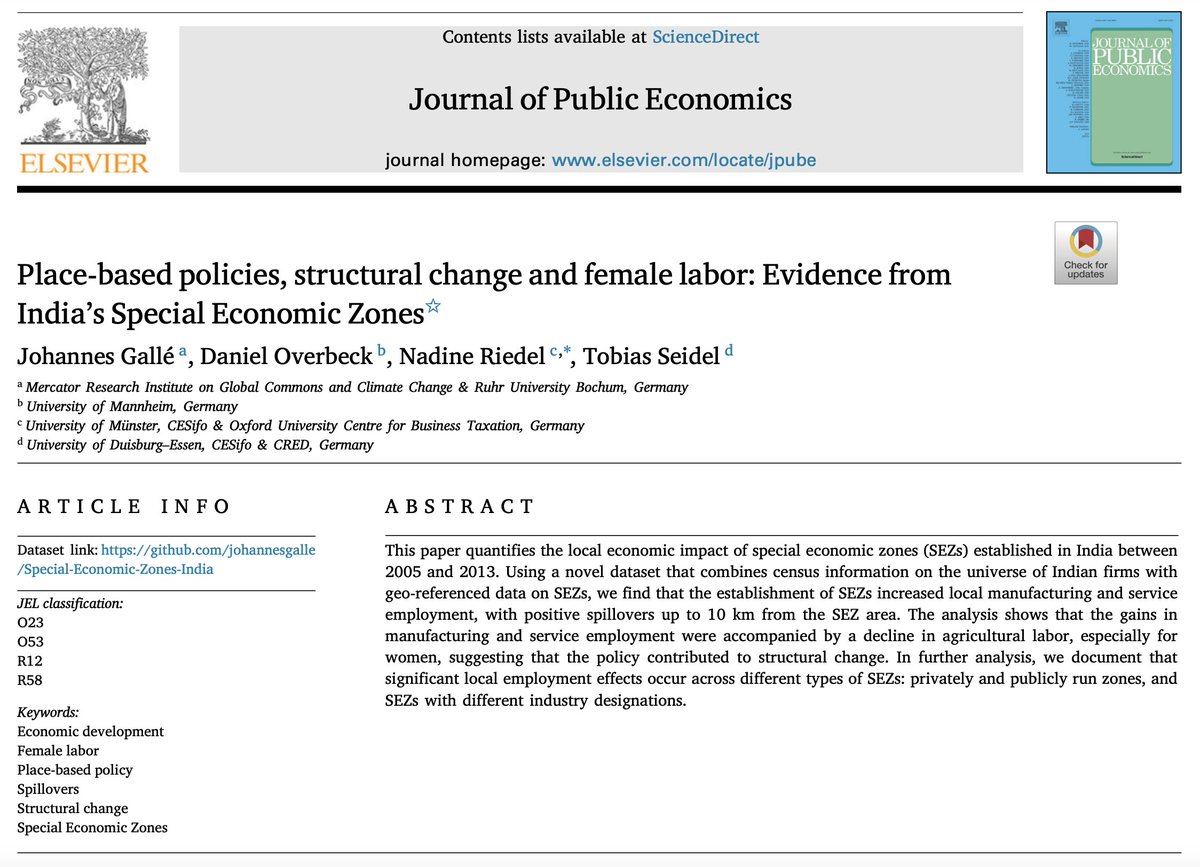
Just published!
"Place-based policies, structural change and female labor: Evidence from India’s Special Economic Zones"
By Johannes Gallé (@MCC_Berlin), Daniel Overbeck (Mannheim), Nadine Riedel (@uni_muenster), Tobias Seidel (@unidue)
The @The_IGC / @Tax4Growth just published a non-technical blog post on my #EconJobMarket paper! Check it out, as well as all the other great work supported by IGC!
Why do firms disclose greater revenue when it could result in higher taxes?
A new study from #Zambia shows that small #firms bargain with #tax collectors, possibly reporting above thresholds despite apparent disadvantages ⤵️
@DOverbeckEcon@Tax4Growth https://t.co/vWEUkcxDko
🆕 Place-based policy in India: How Special Economic Zones promoted structural change and women's employment
@cepr_org STEG research by @johannes_galle @ruhrunibochum, @DOverbeckEcon @GESSuniMannheim, @NadineRiedel2@InwireW & Tobias Seidel @unidue :
https://t.co/rcyRCWQ5wV
This paper contributes to our understanding of how small firms navigate tax systems in environments of low enforcement. It's a step toward understanding the role of informal institutions in shaping formal governance. #Taxation#Development
Informal institutions, like local networks and informal bargaining, play a crucial role in governance in lower income countries. But how do these informal institutions shape tax compliance? My job market paper explores this question. #EconJMP#EconTwitter
We also show that competing explanations like audit probability, frictions or mistakes are unlikely to explain the observed behavior. This provides new insights into how informal institutions can affect tax compliance in low-income countries with limited state capacity.
The setting me and my co-author Eliya Lungu study is Zambia, a lower-middle-income country with a growing need for revenue generation. We focus on small firms—who make up the bulk of taxpayers and find surprising patterns in the administrative data.
This paper contributes to our understanding of how small firms navigate tax systems in environments of low enforcement. It's a step toward understanding the role of informal institutions in shaping formal governance. #Taxation#Development
We also show that competing explanations like audit probability, frictions or mistakes are unlikely to explain the observed behavior. This provides new insights into how informal institutions can affect tax compliance in low-income countries with limited state capacity.