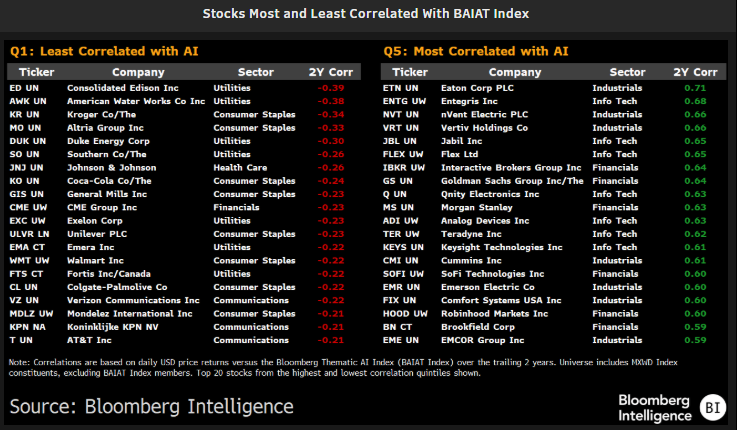
My Bloomberg Intelligence colleagues Jennie and Iza from our equity strategy team put out a note this morning on the stocks most and least correlated to AI. Here's a sample from the note with highest and least correlated quintile stocks:
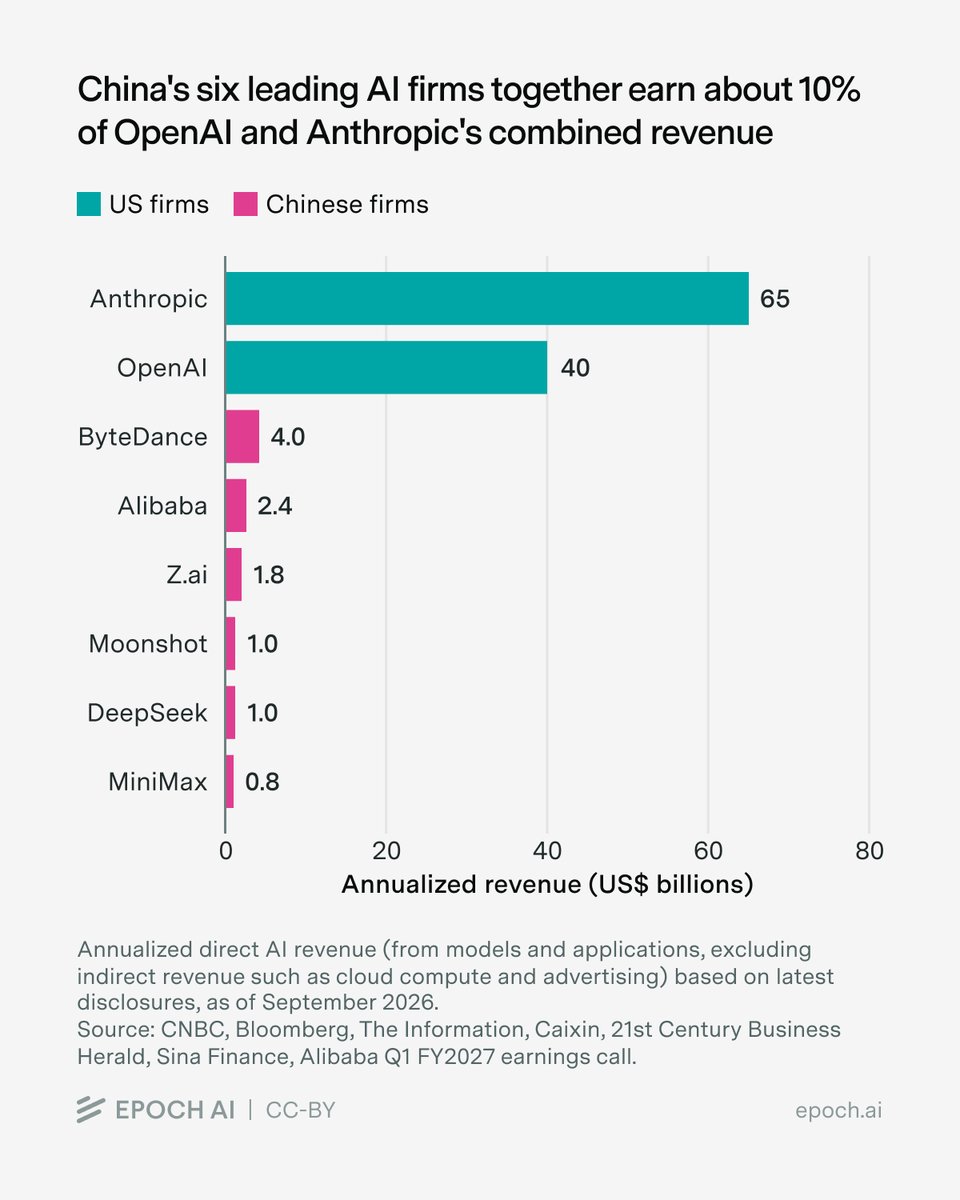
How do Chinese AI firms make money? In a new report, @cherylwoooo and @ansonwhho identify five revenue sources and analyze how much each contributes. 🧵
Spending on AI infrastructure is projected to average 3.6% of US GDP in the coming years.
That would represent a higher share of the economy than the investment in Canals (1836-41), Railroads (1870-90) and Electrification (1905-25) ... Combined.
@noncompliantAF The problem we have here is that the US is simply not capable of mounting any more big league war. At least not for more than a few days. The cupboard is bare.
Observant discerning people around the world are stunned by the realization the emperor is well and truly naked.
I get blown away every time I read this paragraph by Carl Jung:
“To love someone else is easy, but to love what you are, the thing that is yourself, is just as if you were embracing a glowing red-hot iron: it burns into you and that is very painful. Therefore, to love somebody else in the first place is always an escape which we all hope for, and we all enjoy it when we are capable of it. But in the long run, it comes back on us. You cannot stay away from yourself forever, you have to return, have to come to that experiment, to know whether you really can love. That is the question-whether you can love yourself, and that will be the test.”
I read Mircea Eliade's The Sacred and the Profane at least five times over the last two decades.
I thought it was a masterpiece the first time I read it.
But every time I reread it, I thought it was better.
That's why I decided to teach a course devoted to the book.
It launches today on Peterson Academy.
What's it about?
Attention.
What grips our attention, voluntarily and involuntarily, bears on our deepest desires.
That grip is possession by what is deepest within us.
What is deepest is by definition what is sacred.
Everything depends on what is sacred. That's what makes it sacred.
The atheist or the relativist might object: nothing is sacred to me.
But
If nothing is sacred to you, your life has no sustaining meaning.
There will come a time, if it hasn't already, where you will suffer for that lack.
And
If nothing is sacred to you, then nothing matters to you. That means that you are responsible to nothing and no one.
That means that people should avoid you by all means possible.
So what should be sacred?
That is the question....
What are China’s biggest concerns about AI?
A new article by Chen Yixin, China’s Minister of State Security, in the latest issue of China Cybersecurity Magazine offers some revealing clues.
Chen identifies six major risks:
1. Regime security. Hostile forces and people with ulterior motives can use deepfakes, AI-generated text and images, and automated online accounts to cheaply and massively produce political rumors, spread harmful information, and incite social divisions—waging “public-opinion wars” and “cognitive warfare” against China and directly threatening its political, institutional, and ideological security.
2. Critical infrastructure. AI can enable countries and organizations to rapidly discover vulnerabilities, automatically chain together attack paths, and carry out sophisticated hacking operations, dramatically lowering the technical barriers and costs of cyberattacks against China’s critical information infrastructure.
3. Data leakage. Foreign intelligence agencies can use AI-powered web crawlers, data mining, and profiling to collect sensitive information, including critical national data, trade secrets, and citizens’ personal information. Chinese users who process sensitive information through foreign AI products or export data abroad could also cause large-scale data leaks.
4. Closed technological ecosystems. Countries with advantages in AI theory, model architecture, and computing power may invoke “national security” to impose technology controls, entity lists, monopolize technical standards, and build closed-source ecosystems, restricting other countries’ access to advanced technologies and fragmenting global AI supply chains.
5. Structural challenges to social governance. AI creates new uncertainties for social governance and public order. Algorithmic “black boxes” and data poisoning can amplify existing social biases; misuse of personal information can trigger crises of public trust; automated decision-making creates difficult questions of accountability; and the rapid development of AI is increasingly outpacing existing laws, ethics, and regulatory mechanisms.
6. A fundamental transformation of warfare. AI is pushing warfare into an era of “intelligentization.” Whoever can use algorithms to achieve more precise sensing, judgment, and targeting will gain the initiative on the battlefield. AI is moving from an auxiliary role to a central one in intelligence fusion, decision support, target identification, combat operations, and cognitive warfare.
And what is the solution?
Chen’s answer is revealing: strengthen “Party control over the internet” and “Party control over data,” and “transform the advantages of Party leadership into the effectiveness of AI governance.”
In other words, from the CCP’s perspective, the central question is not simply AI versus no AI. Nor is it even fundamentally a contest between the US and China.
It is a contest between the US and the CCP over who gets to control AI, data, information, and ultimately the future of society.
And whoever wins that contest will decide the future of humanity.
https://t.co/9lXlS93A7h
This is one of the greatest lines by Tolkien. Filled with profound wisdom and reality for our everyday lives. I think about it often.
“Yet it is not our part to master all the tides of the world, but to do what is in us for the succour of those years wherein we are set, uprooting the evil in the fields that we know, so that those who live after may have clean earth to till. What weather they shall have is not ours to rule.”