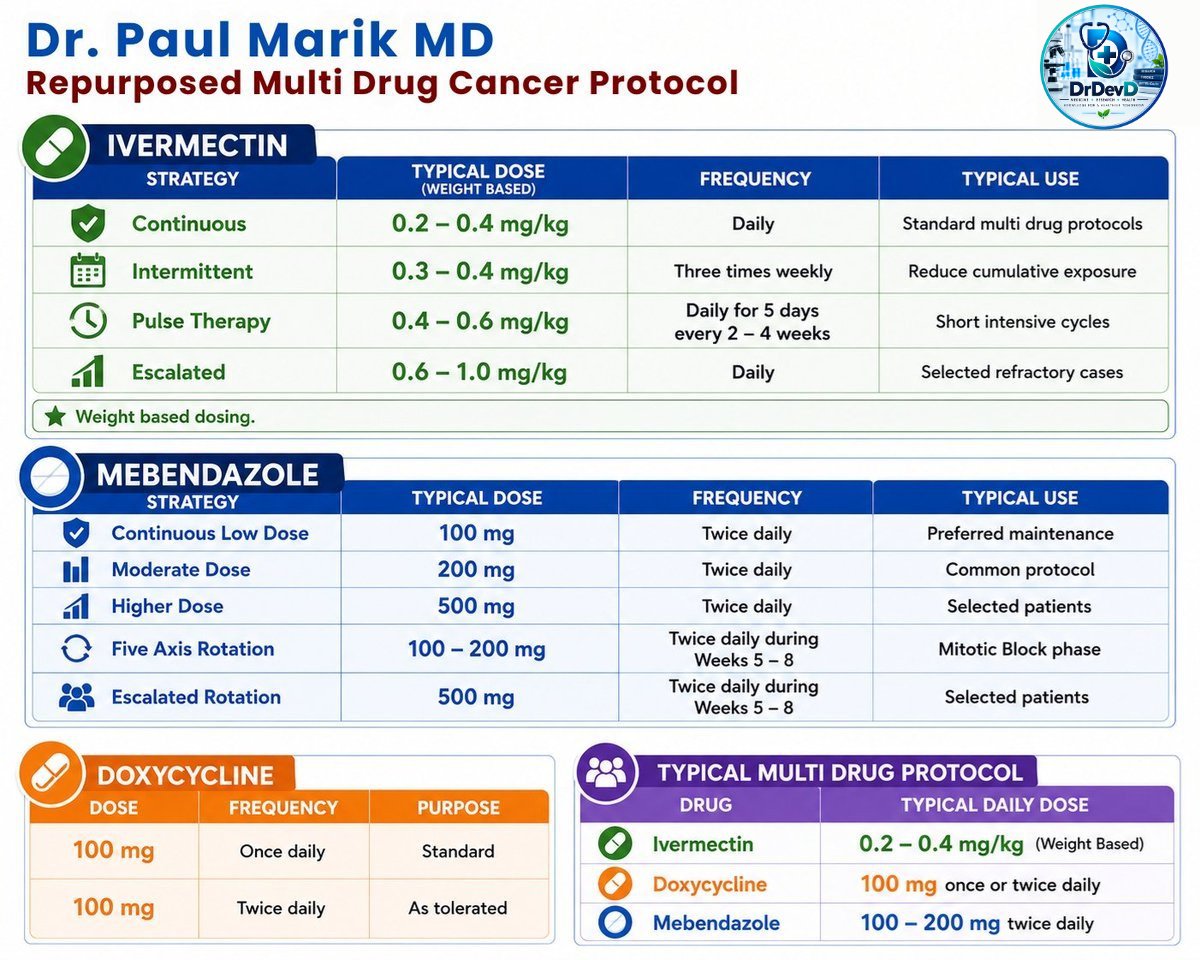
💊 A “REPURPOSED CANCER PROTOCOL” USING THREE FAMILIAR DRUGS
This chart presents a multi-drug cancer strategy attributed to Dr. Paul Marik involving ivermectin, mebendazole, and doxycycline. Rather than presenting one fixed regimen, it lists continuous, intermittent, pulse, and higher-dose approaches, including weight-based ivermectin schedules and different mebendazole dosing strategies.
The scientific idea behind drug repurposing is interesting. Ivermectin and mebendazole have demonstrated anticancer effects in laboratory and animal research through several proposed mechanisms. Mebendazole can disrupt microtubules needed for cell division, while ivermectin has been investigated for effects on multiple signaling and metabolic pathways. Doxycycline has also been studied for potential effects on mitochondrial function and cancer stem-cell biology.
However, the chart should not be interpreted as an established cancer-treatment guideline. These drugs are not approved as a three-drug cancer regimen, and the specific doses displayed have not been established as universally safe or effective for treating cancer.
That distinction becomes especially important at higher or prolonged doses. Drug interactions and adverse effects, including neurological or liver-related toxicity, can become clinically relevant, particularly when these medicines are combined with chemotherapy or other treatments.
Repurposing inexpensive existing drugs is a legitimate area of research. The crucial next step is determining through controlled human trials which cancers, if any, respond, at what doses, and whether patients actually experience better outcomes.
#Ivermectin #Mebendazole #Doxycycline #CancerResearch #DrugRepurposing #Oncology #CancerTreatment
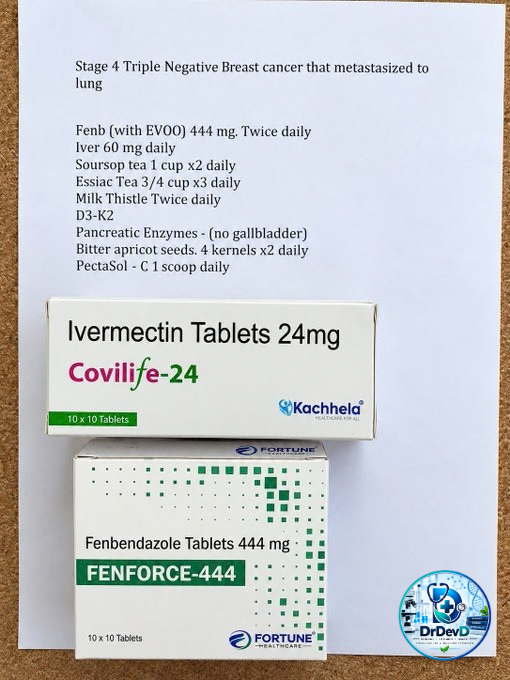
🚨 A STAGE 4 BREAST CANCER “PROTOCOL” IS CIRCULATING ONLINE. HERE’S THE IMPORTANT CONTEXT.
This image describes someone with stage 4 triple-negative breast cancer that had reportedly spread to the lung. Alongside supplements and herbal products, the list includes fenbendazole 444 mg twice daily and ivermectin 60 mg daily.
It is easy to understand why a list like this attracts attention. Both ivermectin and fenbendazole have appeared in cancer-repurposing discussions, and laboratory studies have explored potential anticancer mechanisms. Fenbendazole has shown effects involving microtubules and cancer-cell metabolism in preclinical experiments, while ivermectin has demonstrated anticancer activity through several pathways in laboratory research.
But a photographed regimen is not evidence that the combination produced remission or improved survival. We do not know from the image what conventional treatments the patient received, what the scans showed, how long each product was taken, or what adverse effects occurred.
The doses shown also should not be copied as a treatment protocol. Fenbendazole is primarily a veterinary drug, and high-dose ivermectin can cause adverse effects and drug interactions. Combining multiple supplements with cancer therapy can introduce additional risks.
Triple-negative metastatic breast cancer is a serious disease with treatment increasingly guided by factors such as tumor biomarkers and previous therapies.
Repurposed drugs deserve clinical investigation, but an individual regimen needs documented outcomes before it can tell us whether something actually worked.
#Fenbendazole #Ivermectin #BreastCancer #TripleNegativeBreastCancer #CancerResearch #DrugRepurposing #Oncology
“JUST DO A PARASITE CLEANSE” SOUNDS SIMPLE. THE REALITY IS DIFFERENT.
Videos promoting routine parasite cleanses often recommend buying veterinary ivermectin paste, measuring it using the horse-weight markings, taking activated charcoal, and interpreting unpleasant symptoms as evidence that parasites are “dying off.” Some people also report seeing worm-like material afterward and assume this confirms an infection.
There are several problems with that advice. Not everyone has intestinal parasites, and symptoms such as fatigue, abdominal discomfort, diarrhea, or unusual material in stool can have many causes. Something that looks like a worm is not necessarily a parasite. Proper stool testing or other diagnostic methods can identify many infections and help determine which treatment actually works.
Ivermectin is a legitimate human antiparasitic medicine for certain infections, but veterinary paste is formulated and labeled for animals. Horse-weight markings are not instructions for human dosing. Different parasites also require different medicines, so ivermectin will not treat every worm infection.
Activated charcoal creates another issue. It can bind medications and reduce their absorption, and it is not routinely needed alongside antiparasitic treatment. Feeling sick after taking a product should not automatically be dismissed as “parasite die-off.”
Parasites are real. Antiparasitic medicines can be extremely valuable. But diagnosis, the correct drug, and an appropriate human formulation matter more than a viral detox protocol.
#ParasiteCleanse #Ivermectin #Parasites #GutHealth #DrugSafety #HealthEducation #MedicalResearch
POTASSIUM BROMATE HAS BEEN USED IN BREAD FOR DECADES. WHY IS IT STILL CONTROVERSIAL?
Potassium bromate is a flour treatment and dough-strengthening agent that has been used in commercial baking for more than a century. Its purpose is largely technological: it can strengthen dough and help baked products achieve consistent texture and volume.
The controversy comes from toxicology research. The International Agency for Research on Cancer classifies potassium bromate as possibly carcinogenic to humans (Group 2B), based largely on sufficient evidence of carcinogenicity in experimental animals. Animal studies have reported tumors, including kidney tumors, after exposure.
Several countries prohibit its use in food, while U.S. federal regulations still permit potassium bromate in flour under specified conditions. FDA regulations state that its use should not exceed prescribed limits and should result in negligible residues in finished baked goods.
The important distinction is that evidence of cancer in animals at experimental exposures does not automatically establish that ordinary dietary exposure causes cancer in humans. At the same time, its toxicology explains why the ingredient continues to attract scrutiny.
Consumers who want to avoid it can check ingredient labels for “potassium bromate” or “bromated flour.” Claims that particular brands currently use it should be verified from current labels rather than older lists, since formulations change.
Sometimes the most useful health information really is sitting on the ingredient label.
#PotassiumBromate #FoodSafety #FoodIngredients #Nutrition #CancerResearch #HealthyEating #PublicHealth
A CANCER PATIENT SHARES HER EXPERIENCE WITH CHEMO, IVERMECTIN & FENBENDAZOLE
A woman undergoing chemotherapy documented another part of her cancer journey: self-administering veterinary ivermectin paste and fenbendazole while continuing conventional cancer treatment. She describes measuring the products using the weight markings intended for horses and says she hopes to switch to human-form capsules because they would be easier to measure.
Her video captures something often missing from discussions about repurposed drugs: the reality of patients facing cancer and searching for anything that might improve their chances. Fenbendazole and ivermectin have both attracted attention because laboratory studies have reported anticancer activity through several proposed mechanisms.
But there is an important distinction between promising laboratory research and a treatment proven to help cancer patients. Fenbendazole is primarily a veterinary drug and is not an approved human cancer therapy. Veterinary ivermectin products can also contain different concentrations and inactive ingredients from human formulations.
The “pounds” printed on horse-paste syringes represent an animal weight-based dosing guide, not the amount of medicine being consumed and not a human dosing system. Using those markings to calculate a personal cancer regimen can create serious dosing errors.
Repurposed-drug research deserves investigation, but combining experimental products with chemotherapy should involve an oncology team because interactions, toxicity, and liver effects can matter.
#Ivermectin #Fenbendazole #CancerResearch #Chemotherapy #DrugRepurposing #CancerJourney #Oncology
WATCH WHAT HAPPENS WHEN A DEWORMER MEETS PARASITIC WORMS
This demonstration puts a deworming medication directly in contact with live worms. At first, there appears to be very little change. Then their movement becomes increasingly abnormal, and eventually the worms stop moving altogether.
That basic effect is exactly why antiparasitic medicines are so useful, although different dewormers work through different mechanisms. Some drugs interfere with parasite nerve and muscle signaling, producing paralysis, while others disrupt microtubules or energy metabolism and gradually kill the parasite.
What makes the demonstration fascinating is seeing a drug’s biological target translated into a visible effect. But putting medication directly onto worms in a dish is very different from treating an infection inside a person or animal. Inside the body, absorption, metabolism, drug concentration, parasite species, and correct dosing all influence whether treatment works.
It’s also important not to assume that every substance marketed as a “dewormer” works the same way or is interchangeable between humans and animals. Veterinary formulations are designed for particular species, while human antiparasitic medicines have their own approved uses and dosing.
A simple experiment can make pharmacology surprisingly easy to visualize.
#Dewormer #Parasites #Antiparasitic #Ivermectin #Parasitology #MedicalScience #HealthResearch
🩸 SOME PATIENTS ARE REFUSING BLOOD FROM VACCINATED DONORS, AND THE CONSEQUENCES CAN BE SERIOUS
A 2026 study from Vanderbilt University Medical Center documented 15 patients whose families or care teams pursued directed blood donations because they wanted blood perceived as coming from unvaccinated donors. Two patients deteriorated while standard blood products were refused, including one who developed hemorrhagic shock. Two others had surgery delayed or canceled while waiting for directed blood.
The concern is understandable in the context of ongoing debate about COVID vaccination, but current transfusion evidence does not establish that blood from vaccinated donors is unsafe simply because of vaccination status. The Vanderbilt researchers described requests for “unvaccinated” blood as lacking scientific support and warned that delaying necessary transfusions can itself cause harm.
At the same time, America has faced a genuine blood-supply problem. In January 2026, the American Red Cross declared a severe shortage after its national blood inventory fell about 35% in one month. The organization attributed the decline primarily to widespread flu, winter weather, canceled blood drives, and hospital demand exceeding supply.
Questions about transfusion safety deserve research and transparency. But when someone is hemorrhaging or severely anemic, delaying compatible blood based solely on a donor's vaccination status can create an immediate and documented medical risk.
#BloodDonation #BloodTransfusion #VaccineSafety #COVID19 #MedicalResearch #PatientSafety #Healthcare
🧠 IVERMECTIN FOR PARKINSON’S AND ALZHEIMER’S IS GENERATING SOME EXTRAORDINARY STORIES
A physician discussing ivermectin says some of his most surprising experiences have involved people with Parkinson’s and Alzheimer’s disease. He describes Parkinson’s patients showing improved movement and an Alzheimer’s patient reportedly being taken off hospice after improving.
Other families reportedly described something deeply personal: relatives recognizing loved ones again, remembering old experiences, regaining their sense of humor, and becoming more responsive after ivermectin treatment.
These stories naturally attract attention, especially when conventional treatments have limitations. But there is an important distinction between clinical anecdotes and evidence from controlled trials. Reports from individual patients cannot determine whether ivermectin caused the improvement, whether symptoms fluctuated naturally, or whether other treatments contributed.
The claim that Alzheimer’s research involving ivermectin has been deliberately “scrubbed from Google” also requires evidence before being treated as fact. Search visibility alone cannot establish suppression.
Most importantly, doses such as 12 mg, 24 mg, 60 mg, or 72 mg mentioned in personal reports should not become a DIY neurological protocol. Ivermectin is not currently an established treatment for Parkinson’s or Alzheimer’s, and “zero risk” is not an accurate description of any medication.
The patient stories are intriguing. The missing piece is rigorous human clinical research capable of testing whether the effect is real and reproducible.
Follow the research beyond the headlines with @Dr_devdX.
#Ivermectin #Parkinsons #Alzheimers #BrainHealth #Neurology #DrugRepurposing #MedicalResearch
🧬 IS IVERMECTIN REALLY A “FERTILITY TOXIN”? THE EVIDENCE NEEDS A CLOSER LOOK
A very different ivermectin claim is circulating online: that the drug damages fertility and was deliberately promoted during COVID so that people who avoided vaccination would still experience reproductive harm.
There is experimental research showing reproductive or developmental toxicity in animals exposed to high or repeated doses of ivermectin. A 2024 rat study, for example, investigated testicular changes and effects on offspring following repeated paternal exposure. Animal findings like these deserve attention, but they cannot automatically be translated into effects at standard human therapeutic doses.
Human evidence is much less definitive. A systematic review examining ivermectin exposure during pregnancy found that available evidence was insufficient to determine its safety with confidence. Another review found an overall lack of evidence that the usual therapeutic dose causes adverse pregnancy outcomes, while still calling for additional research.
Ivermectin is not risk-free. Toxicity can occur, particularly with excessive exposure, and recent reviews document rare serious neurological reactions. But describing it as one of the most powerful fertility toxins known is not supported by established human evidence.
The further allegation that ivermectin was intentionally promoted as part of a coordinated fertility-reduction strategy is also a claim for which this evidence does not establish causation.
@Dr_devdX explores the claims behind controversial medicines and what the research actually shows.
#Ivermectin #Fertility #ReproductiveHealth #MedicalResearch #DrugSafety #HealthResearch #Science
THE UK STILL HAS A 1939 LAW RESTRICTING CANCER TREATMENT ADVERTISING
The Cancer Act 1939 is real, and part of it remains in force. Section 4 restricts advertisements that offer to treat cancer, prescribe a cancer remedy, or provide treatment advice. The wording is striking, but describing it simply as “illegal to announce a cure for cancer” leaves out important context. The provision regulates advertising and promotion of cancer treatments rather than making scientific discovery or cancer research illegal.
Another claim in this discussion compares the UK with Ghana. Cancer Research UK estimates that nearly 1 in 2 people born in the UK in 1961 will eventually be diagnosed with cancer. That is a lifetime risk, not 50,000 cancer cases occurring per 100,000 people each year.
Ghana’s 2022 age-standardized cancer incidence was about 120 cases per 100,000 people per year, while its estimated risk of developing cancer before age 75 was 12.2%. Those statistics cannot be directly compared with the UK's lifetime-risk figure because they measure different things.
Cancer remains an enormous challenge, but progress is measurable. UK cancer survival has roughly doubled since the early 1970s, even as an ageing population contributes to increasing case numbers.
More deep dives into controversial medical claims at @Dr_devdX.
#CancerAct #CancerResearch #Cancer #MedicalResearch #Healthcare #Oncology #HealthFacts
🧬 CANCER IS NOT A PARASITE, BUT THERE’S A REASON THESE DRUGS ARE BEING STUDIED
One of the more interesting ideas in cancer metabolism research is that tumor cells and certain parasites may share some metabolic features. That does not mean cancer is a parasite. Cancer develops from the body’s own abnormal cells.
Researchers have investigated whether antiparasitic drugs such as mebendazole and fenbendazole can exploit vulnerabilities in cancer cells. Laboratory studies suggest benzimidazoles can disrupt microtubules, interfere with glucose utilization and affect mitochondrial or other metabolic processes involved in cell survival.
That creates an intriguing drug-repurposing hypothesis: a medicine developed to attack biological processes in parasites might also interfere with processes that some cancer cells depend upon.
The discussion becomes even more interesting when nutritional ketosis enters the picture. Researchers continue to study how glucose availability, ketone metabolism and mitochondrial function interact with different cancers. However, neither ketosis nor antiparasitic drugs have been established as universal cancer treatments.
The mechanism may provide a scientific reason to investigate these drugs, but demonstrating a mechanism in cells is very different from proving that a medicine improves survival in cancer patients.
That is where controlled human trials become essential.
For more research on cancer metabolism and repurposed medicines, keep up with @Dr_devdX.
#CancerMetabolism #Fenbendazole #Mebendazole #CancerResearch #DrugRepurposing #MetabolicHealth #Oncology
🔬 NEARLY 200 CANCER PATIENTS REPORTED USING IVERMECTIN OR MEBENDAZOLE. HERE’S WHAT WAS REPORTED.
A physician discussing a study of nearly 200 cancer patients says participants had predominantly solid tumors, including prostate, breast and lung cancers. Importantly, these patients were not necessarily using repurposed drugs alone. Many had also received conventional treatments such as chemotherapy, radiation or surgery.
The reported numbers are attention-grabbing. About 48% reportedly showed improvement, while 36% had stable disease and 15% experienced worsening disease. Together, the first two groups were described as an “84% net clinical benefit.” Side effects were reported in roughly 25% of participants, including gastrointestinal symptoms.
But “clinical benefit” needs careful interpretation. Stable disease plus improvement is not the same as an 84% cure or remission rate. When patients are simultaneously receiving established cancer treatments, an observational study also cannot determine how much of an outcome was caused specifically by ivermectin or mebendazole.
That is exactly why these results, if confirmed in the underlying study, should be viewed as a signal worth investigating rather than proof of effectiveness. Controlled trials would need to separate treatments, objectively measure tumor responses, track survival and document adverse events.
Repurposed medicines deserve rigorous testing when early evidence looks interesting.
More emerging cancer research and repurposed-drug discussions at @Dr_devdX.
#Ivermectin #Mebendazole #CancerResearch #DrugRepurposing #Oncology #CancerTreatment #MedicalResearch
IVERMECTIN: SEPARATING ITS REMARKABLE HISTORY FROM THE BIGGER CLAIMS
Ivermectin became one of the most polarizing medicines of the COVID era. Long before COVID, however, it had a remarkable medical history. Satoshi Ōmura and William Campbell shared half of the 2015 Nobel Prize for discoveries that led to therapies against roundworm parasites, with ivermectin becoming an important medicine for diseases such as river blindness.
That history sometimes gets mixed with much bigger claims. Ivermectin has been investigated in laboratory cancer research, but saying credible studies have proven that it “cures cancer” or produces an 80% success rate across cancer patients goes beyond established clinical evidence. Promising mechanisms and early findings still need rigorous human trials.
COVID created another controversy. Critics argued ivermectin was attacked because an effective treatment would have threatened vaccine Emergency Use Authorization. FDA rules did require that there be no adequate, approved and available alternative for the specific emergency use, but that is more nuanced than saying any potentially useful treatment would automatically invalidate a vaccine EUA.
The FDA also maintains that available clinical-trial evidence did not demonstrate ivermectin to be effective against COVID-19.
Ivermectin’s genuine achievements are significant enough without turning unresolved questions into proven conclusions.
@Dr_devdX keeps following the evidence wherever repurposed-drug research leads.
#Ivermectin #CancerResearch #COVID19 #DrugRepurposing #MedicalResearch #NobelPrize #HealthResearch
🧪 THREE CANCER REMISSIONS AND ONE UNEXPECTED DRUG: FENBENDAZOLE
A published case series has brought renewed attention to fenbendazole, an inexpensive antiparasitic drug commonly used in veterinary medicine. The paper describes three people with cancer who reportedly experienced remission while taking fenbendazole alongside their cancer care.
Why are researchers even looking at a deworming drug for cancer? One proposed mechanism involves microtubules, structures cells need to successfully divide. Benzimidazole antiparasitic drugs can disrupt microtubule function in parasites, and laboratory research has explored whether similar effects could interfere with rapidly dividing cancer cells.
The concept of repurposing existing medicines is important because researchers already know considerable information about many older drugs. But fenbendazole presents an additional challenge: unlike related drugs such as mebendazole and albendazole, fenbendazole is primarily a veterinary medication and is not an established human cancer treatment.
Three cases can generate an interesting hypothesis, but they cannot establish that fenbendazole caused the remissions. Other cancer treatments, patient differences, disease course, and additional factors have to be considered. Calling these patients “cured” based solely on a case series would therefore go beyond the evidence.
The signal is interesting enough to investigate. The evidence needed now is larger, controlled human research examining effectiveness, appropriate dosing, interactions, and safety.
Discover more conversations around repurposed medicines and cancer research at @Dr_devdX.
#Fenbendazole #CancerResearch #DrugRepurposing #Oncology #CancerTreatment #Benzimidazole #MedicalResearch
🧬 NATTOKINASE JUST SHOWED SOMETHING INTERESTING AGAINST MICROCLOTS
Nattokinase is an enzyme derived from natto, a traditional Japanese food made from fermented soybeans. It has attracted attention because of its fibrinolytic activity, meaning it can interact with fibrin, an important structural component of blood clots.
In the experiment being discussed, researchers reportedly exposed microclots to nattokinase in a test tube and observed a substantial reduction over a short period. If replicated, findings like these could help researchers understand whether fibrinolytic enzymes have potential applications involving abnormal clot structures or amyloid-like deposits.
But there is one major distinction: a test-tube result is not proof that swallowing nattokinase will produce the same effect inside the human bloodstream. Digestion, absorption, metabolism, achievable concentrations, and bleeding risk all matter.
Laboratory research has also investigated whether nattokinase can degrade certain proteins, including SARS-CoV-2 spike protein under experimental conditions. Again, that does not establish that supplements remove spike protein from people.
The next important step is controlled human research measuring clinically meaningful outcomes, not simply assuming laboratory effects translate directly into patients.
Nattokinase is biologically interesting, but calling it completely safe or a proven microclot treatment goes beyond the evidence currently described.
More emerging research explained without skipping the important context at @Dr_devdX.
#Nattokinase #Microclots #BloodClots #LongCOVID #MedicalResearch #HeartHealth #Fibrin
I completely agree that people deserve informed consent and clear information about known risks . My concern is the suggestion that each adverse event listed automatically proves causation. Some signals require further investigation. Evidence of a causal association is stronger for established adverse reactions. That's the sort of evidence-based discussion I want at @Dr_devd.
That’s a huge list, and I think context matters here. A reported or listed adverse event doesn’t automatically mean the vaccine caused it, but people still deserve clear information about known risks and how those risks were evaluated. I try to keep that conversation open at @Dr_devd
🌿 WORMWOOD HAS A 2,000-YEAR HISTORY, BUT MODERN RESEARCH IS LOOKING AT SOMETHING VERY DIFFERENT
Wormwood and related Artemisia plants have a long history in traditional medicine, but artemisinin is not simply another name for wormwood. Artemisinin is a specific compound isolated from Artemisia annua, or sweet wormwood. Its derivatives became major antimalarial medicines because of their powerful activity against Plasmodium parasites.
Cancer researchers have also become interested in artemisinin and its derivatives. Laboratory studies have reported several potentially relevant effects, including triggering apoptosis, interfering with tumor blood-vessel formation, affecting iron-dependent cellular processes, and influencing pathways associated with inflammation and tumor growth.
That combination makes the research fascinating. Cancer cells often handle iron, oxidative stress, metabolism, and cell-death signaling differently from healthy cells, giving researchers potential vulnerabilities to investigate.
But there is an important line between laboratory findings and cancer treatment. Most dramatic anticancer claims surrounding wormwood come from cell or animal experiments. They do not establish that drinking wormwood tea or taking herbal preparations can selectively destroy tumors in people. Artemisinin-based medicines also have specific formulations and doses that cannot be assumed from the plant itself.
An ancient medicinal plant helped produce one of the world's most important malaria treatments. Whether its compounds can contribute meaningfully to future cancer therapies is a question for rigorous human trials.
Dig deeper into overlooked compounds and emerging research with @Dr_devdX.
#Wormwood #Artemisinin #CancerResearch #NaturalMedicine #DrugRepurposing #Oncology #MedicalResearch
🧪 HAVE YOU USED IVERMECTIN, FENBENDAZOLE OR MEBENDAZOLE?
These three antiparasitic drugs continue to generate major discussion online, particularly around drug repurposing and cancer research. Ivermectin and mebendazole have established human uses for specific parasitic infections, while fenbendazole is primarily a veterinary medication.
Researchers have also investigated these compounds in laboratory and animal models for potential effects beyond parasites. That research has fueled thousands of personal stories online, but individual experiences cannot establish whether a treatment is effective or safe for a particular disease.
SHARE YOUR EXPERIENCE
• Which medication did you use?
• What condition were you taking it for?
• How long did you use it?
• What changes or side effects did you notice?
Personal experiences can be valuable for understanding what people are trying, but they should be clearly separated from clinical evidence. Veterinary formulations should not be used as substitutes for medicines intended for humans, and treatment decisions should be discussed with a qualified clinician.
I’m collecting real experiences and following the research around repurposed medicines at @Dr_devdX.
#Ivermectin #Fenbendazole #Mebendazole #DrugRepurposing #MedicalResearch #PatientStories #HealthDiscussion
These three antiparasitic drugs continue to generate major discussion online, particularly around drug repurposing and cancer research. Ivermectin and mebendazole have established human uses for specific parasitic infections, while fenbendazole is primarily a veterinary medication.
Researchers have also investigated these compounds in laboratory and animal models for potential effects beyond parasites. That research has fueled thousands of personal stories online, but individual experiences cannot establish whether a treatment is effective or safe for a particular disease.
SHARE YOUR EXPERIENCE
• Which medication did you use?
• What condition were you taking it for?
• How long did you use it?
• What changes or side effects did you notice?
Personal experiences can be valuable for understanding what people are trying, but they should be clearly separated from clinical evidence. Veterinary formulations should not be used as substitutes for medicines intended for humans, and treatment decisions should be discussed with a qualified clinician.
I’m collecting real experiences and following the research around repurposed medicines at @Dr_devdX.
#Ivermectin #Fenbendazole #Mebendazole #DrugRepurposing #MedicalResearch #PatientStories #HealthDiscussion
🐴 THIS IS IVERMECTIN, BUT IT WAS MADE FOR A HORSE
Ivermectin has been used for decades as an antiparasitic medicine in both veterinary and human medicine. Horse ivermectin paste is typically dosed according to the animal’s body weight and is formulated specifically for veterinary use. For horses, ivermectin can be used against several internal parasites when administered according to the product label or veterinary guidance.
A FEW DETAILS THAT MATTER
• Horse paste is formulated and labeled for horses
• Human ivermectin tablets are separate pharmaceutical products
• The concentration and inactive ingredients can differ
• Weight markings on a horse syringe are not human dosing instructions
The distinction matters because seeing the same active ingredient does not make veterinary and human products interchangeable. The FDA specifically warns people not to take ivermectin products intended for animals and reports receiving cases requiring medical attention after people self-medicated with veterinary formulations. Human ivermectin tablets do exist and are approved for certain parasitic infections.
For an animal, dosing and treatment decisions should follow the product label and veterinary advice. For a person, use a human formulation prescribed when medically appropriate rather than trying to calculate a dose from horse paste.
More ivermectin facts, medical research, and drug discussions at @Dr_devdX.
#Ivermectin #HorseHealth #VeterinaryMedicine #Parasites #MedicalResearch #DrugSafety #HealthEducation